Power booking is the practice of writing a vehicle onto a finance contract with equipment it does not have — a sunroof, a navigation package, four-wheel drive — so that the book value rises and the lender advances more money than the car is worth. Lenders defend against it by decoding the vehicle identification number, and that defence is far narrower than most credit policies assume: federal law requires a passenger car’s VIN to make only six things decipherable, and optional equipment is not among them. Botminds’ Dealer Risk Monitoring treats the decode as one layer of three, scores the gap between booked and decodable equipment by dealer, and sends a person to the build sheet before anybody calls it a finding.
The product figures below come from a fictional sample lender, Coppervale Bank, and a fictional dealer; they are tagged demo where they are drawn from that sample data. The law and the regulations are linked where they appear.
What the law actually requires a vehicle identification number to reveal
6
attributes a passenger car’s VIN must make decipherable: make, line, series, body type, engine type and restraints
0
items of optional equipment a VIN is required to encode
109%
of retail book value: the vehicle price cap one 41-state settlement imposed for seven years
What is power booking, and why the lender carries the loss
In indirect lending the dealer describes the car and the lender pays for it. The amount advanced is usually expressed as a share of a published book value, and that book value depends on equipment: the same model year and trim can be worth a few hundred dollars more with a factory navigation package or a tow package. Add two or three options the car does not have, and the advance the lender is willing to make rises without the collateral behind it rising at all.
The damage is quiet and arrives late. Every payment is made on time and nothing is visibly wrong until the contract defaults and the car is sold, at which point the recovery is short by the value of equipment that was never on it. By then the dealer has been paid, the contract is one of hundreds, and the deficiency looks like ordinary credit loss rather than a mis-described asset.
Supervisors name the practice without using the trade’s word for it. The NCUA’s letter on indirect lending lists, among the red flags that may require a lender to slow down, “Poor dealer management including … dealer-created down payments through dealer incentives, inflated or fraudulent trade-in or purchase price” (Letter to Credit Unions 10-CU-15). The OCC expects the dealer contract itself to specify “collateral valuation requirements” along with documentation standards and quality control reviews (Comptroller’s Handbook, Retail Lending). Both put the obligation on the lender to know what it is lending against.
What a VIN is legally required to tell you
A vehicle identification number is not a description of a car. It is a seventeen-character scheme whose stated purpose, in the regulation that creates it, is “to simplify vehicle identification information retrieval and to increase the accuracy and efficiency of vehicle recall campaigns” (49 CFR 565.10). Recall campaigns need to know which vehicles share a part. They do not need to know which of them has heated seats, and so the scheme does not carry it.
The five sections of a VIN, what the regulation makes each one carry, and what it settles for a lender
1–3
Who built it
The manufacturer identifier, assigned by the safety regulator.
For a lenderSettles the make. Nothing about this car.
4–8
What kind of car it is
The attributes of Table I. For a passenger car: make, line, series, body type, engine type, and all restraint devices and their location.
For a lenderSettles the trim family and the engine. This is the only section that carries equipment, and it carries the equipment the model has, not the equipment this car was given.
9
The check digit
A calculated character that proves the other sixteen were transcribed correctly.
For a lenderCatches a typed-in number that was never a VIN. Worth running first.
10–11
Model year and plant
One character for the model year, one for the plant of manufacture.
For a lenderSettles the model year the contract should state, and catches a vehicle described a year newer than it is.
12–17
The serial number
The number sequentially assigned by the manufacturer in the production process.
For a lenderMakes the car unique. Says nothing about it.
The crucial section is the second. Positions four to eight must make decipherable the attributes in the regulation’s Table I, and for a passenger car that list reads in full: “Make, line, series, body type, engine type, and all restraint devices and their location.” A multipurpose passenger vehicle adds gross vehicle weight rating; a truck adds chassis, cab type and brake system. That is the entire inventory of what a VIN is obliged to tell you about a car’s specification.
What a VIN decode cannot prove
Run a VIN through the safety regulator’s own public decoder and the result makes the limit plain. One call to the vehicle product information service returns 154 named fields for a single vehicle — make, model, model year, trim, body class, engine cylinders, displacement, doors, transmission style, plant city and a long tail of safety-equipment flags — and a large share of them come back empty, because the manufacturer never encoded them (NHTSA vPIC, decoded 26 October 2026). A 2003 passenger car decoded there returns a trim of “EX-V6”, a six-cylinder engine and a 3.0-litre displacement, and an empty string for drive type.
So a decode supports exactly two kinds of statement. It can confirm or contradict a series claim: a contract that books an LX as a Limited is contradicted when positions four to eight decode to the base line, and that contradiction is strong, because the series is one of the six attributes the manufacturer is required to make decipherable. It cannot address a fitment claim at all. A sunroof, a navigation package, leather seats, a tow package and premium wheels are factory options on cars whose VINs are otherwise identical, and no decoder in the world can separate them.
This is why a dealer monitoring programme should never report “options not on the VIN” as a finding. It is a question — a well-founded one, because a car booked with $2,050 of equipment above its decodable trim is worth asking about — and the answer lives somewhere else.
The window label: itemised on a new car, absent on a used one
There is one document that prices every option on a car, and it exists only for new vehicles. The Automobile Information Disclosure Act requires that “Every manufacturer of new automobiles distributed in commerce shall, prior to the delivery of any new automobile to any dealer … securely affix to the windshield, or side window of such automobile a label” that discloses, among other things, “the retail delivered price suggested by the manufacturer for each accessory or item of optional equipment, physically attached to such automobile at the time of its delivery to such dealer” (15 U.S.C. §1232(f)(2)). That is the window sticker, and it is an itemised, priced, manufacturer-issued list of exactly what this car has.
Nothing equivalent follows the car into the used market. The sticker is a one-time obligation on the manufacturer before first delivery to the dealer; it is not required to be preserved, re-issued or transferred. A used-car buyer gets a different window form, which covers warranty status rather than equipment. Which means the evidence available to a lender depends on which half of its book a contract sits in.
Checking booked equipment on a new car and on a used car
New vehicle: Required by statute: every accessory or item of optional equipment, with the manufacturer’s suggested price, on the window label.
Used vehicle: None. No law requires any itemised equipment list to follow the vehicle.
New vehicle: Yes, in practice: manufacturers publish build data against the serial number for warranty and recall purposes.
Used vehicle: Same build data, but it describes the car as built — not what has been added, removed or damaged since.
New vehicle: Make, line, series, body type, engine type, restraints, model year, plant.
Used vehicle: Identical. The decode does not get weaker with age; it was never strong on equipment.
New vehicle: Compare the booked options with the window label. A dispute is usually a transcription error.
Used vehicle: Compare the booked options with the build data and then with the car. A dispute needs a person and a photograph.
New vehicle: Low: the price is published and the margin for invention is small.
Used vehicle: High: the book value is the only reference, and it moves with the equipment list the dealer supplies.
The three layers of evidence, and which one is proof
Put those limits together and the test for power booking has three layers, each cheaper and weaker than the next. A monitoring programme should run all three, in order, and should be honest in its reporting about which layer a given statement rests on.
Three layers of evidence on a booked option, and what each one will support
| Layer | What it costs | What it supports | What it will not support |
|---|---|---|---|
| 1. Decode the identification number | Fractions of a second, on every contract, free from the safety regulator’s public service. | A contradiction of the series, body type, engine or model year. A transcription check on the number itself. | Any statement about equipment the manufacturer was not required to encode. |
| 2. Compare with build data for that serial number | A commercial feed or the manufacturer’s own warranty data; minutes, on a sample. | A list of what left the factory on this specific car, which is where a sunroof or a navigation package can first be contradicted. | Anything fitted, removed or damaged after the car left the factory. |
| 3. Look at the car, or at a dated photograph of it | A person, an inspection, hours. | Proof. This is the only layer whose result belongs in a repurchase demand or a statement to the dealer. | Scale. Nobody inspects forty thousand contracts. |
The sampling logic is the part most often skipped. Layer one runs on everything, and its output is a ranking, not a verdict; layer two narrows the ranking to the deals where the gap is both large and repeated; layer three is spent only on those. The same discipline governs every other dealer signal a lender watches: a measurement that cannot be escalated to a document is a measurement that will lose an argument with a relationship manager.
How to test a whole book for options the car does not have
The portfolio question is not “is this car mis-booked” but “does this dealer mis-book”. One contract with an unsupported option is a clerical error. Thirty-four of them, each adding an average of $1,900 to the amount financed, at one dealer whose peers show almost none, is a business practice — and it shows up as a shift in a single, cheap number: the average advance as a share of book.
One sample dealer against dealers like it: where the advance goes above book
That fourth bar needs its caveat said out loud, because the two numbers are easy to confuse. The settlement capped the vehicle price at 109% of retail book value for certain consumers; an advance-to-book ratio measures the amount financed, which also carries negative equity, add-on products, taxes and fees. The two move together but they are not the same test, and which of them a lender sets a line against changes what crossing it means.
What the lender can do about it: the advance, not the deal
Having found a pattern, the lender’s options are narrower than they look. It cannot unwind a funded contract against a borrower who did nothing wrong, and it should not want to: the borrower’s obligation is unaffected by what the dealer wrote on the booking sheet. The levers that do exist act on the dealer and on future business.
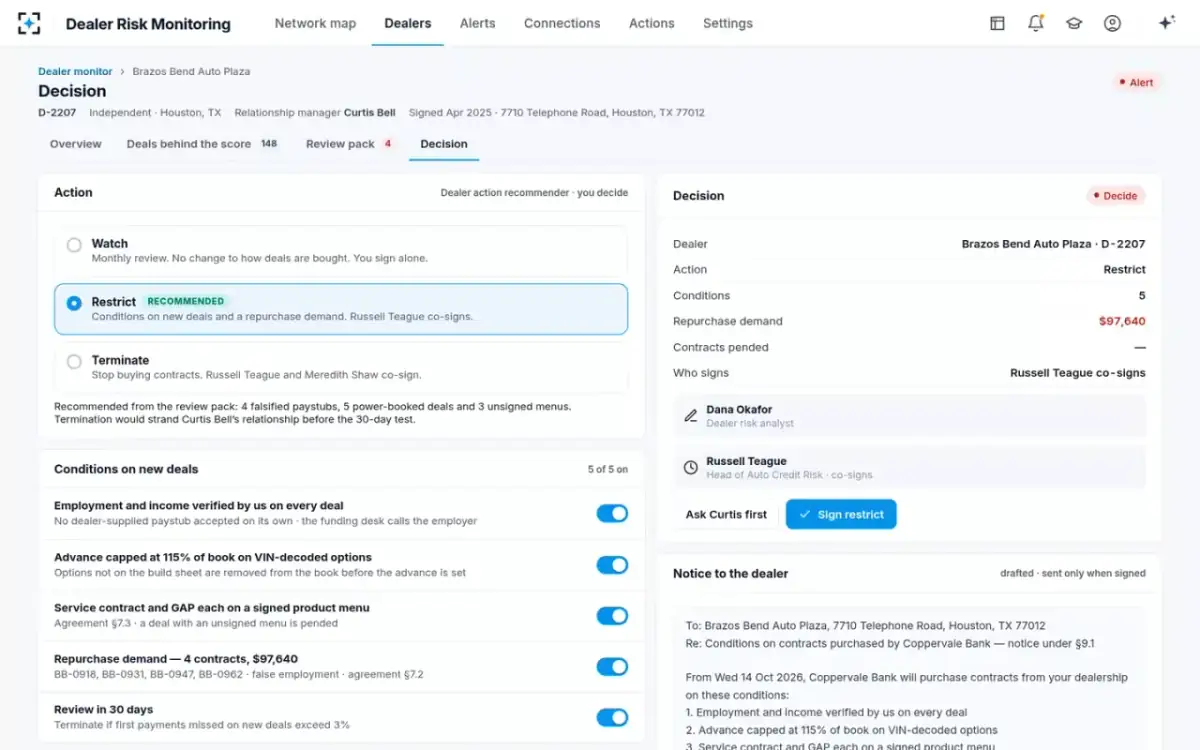
The first is the advance itself. A condition that caps the advance at a fixed share of book computed on decoded equipment only — ignoring any option the decode does not support — removes the incentive entirely for new deals, and it does so without accusing anyone. The sample lender’s restriction does exactly this, at 115% of book on decoded options, alongside employment verified by the bank on every deal and a signed product menu for each add-on.
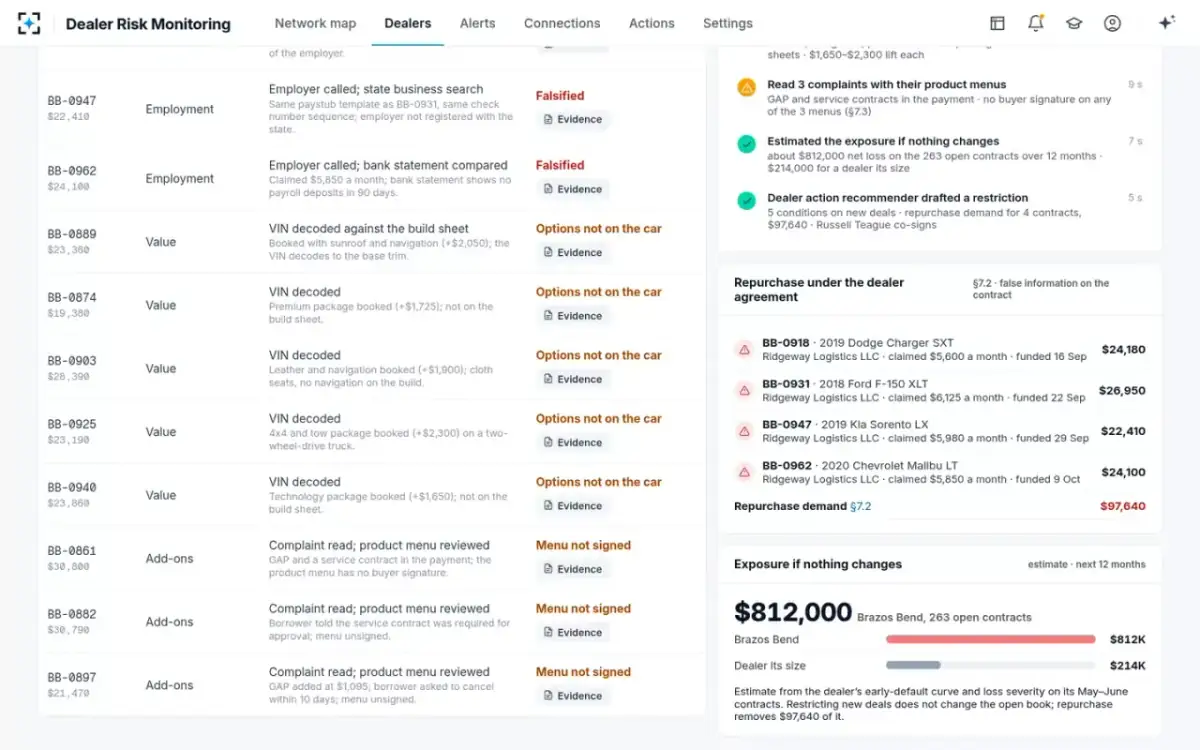
The second is the repurchase clause in the dealer agreement, which generally reaches contracts carrying false information. That is a narrower set than the mis-booked ones: it covers the deals where layer three produced a document, not the deals where layer one raised a question. In the sample dealer review, four contracts totalling $97,640 were listed as eligible for repurchase on falsified employment evidence, while the mis-booked vehicles were handled through the advance condition instead.
The advance condition a value finding supports, drafted in Dealer Risk Monitoring
What belongs in the file when the dealer pushes back
Every value finding is disputed, and the dispute is always the same shape: the dealer says the car had the equipment, the lender cannot prove otherwise, and the relationship manager — who is measured on that store’s volume — has no reason to press. The only thing that ends the argument is a file that distinguishes question from proof, contract by contract.
Four things belong in it. The contract numbers, not a rate: thirty-four deals is a statistic, BB-0889 is a conversation. The test that produced each line, named — decoded, build sheet, inspected — so that nobody has to guess how strong a given row is. The sampling rule, written before the sample was drawn, so the dealer cannot argue the deals were cherry-picked. And the separation of findings from remedies: the mis-booked vehicles support a condition on future advances, while only the contracts carrying documented false information support a repurchase demand under the dealer agreement.
A note on sequence, because it decides whether the file holds. Sample first, then verify, then characterise. A programme that decides a dealer is power booking and then goes looking for examples has produced an accusation with evidence attached; one that samples on a stated rule and reports what the sample found has produced a finding. The dealer will test which one it is, and so will anyone reading the file afterwards.
The sampled deals behind a value finding in Dealer Risk Monitoring
Options booked above the car are one of six signals a lender can watch, and on its own it is the easiest to argue with. Read it beside the others in the six signals a dealer monitoring programme scores, or see the decode, the sampled deals and the signed restriction on your own funded contracts from Dealer Risk Monitoring.
Questions people ask
What is power booking in car sales?
Booking a vehicle onto a finance contract with equipment it does not have, so that its book value — and therefore the amount a lender will advance — comes out higher than the car justifies. It is a dealer-side practice; the borrower usually never sees the equipment list the lender was given, and the loss lands on the lender at repossession, when the car is worth less than the book said.
Can you decode options from a VIN?
Only the options the manufacturer chose to encode in positions four to eight, and the law requires very few of them. For a passenger car, 49 CFR 565.15 Table I requires make, line, series, body type, engine type and restraint devices to be decipherable. Trim-level equipment that travels with the series often is decipherable as a result; standalone factory options almost never are. Treat a decode as proof of the series and nothing more.
How do lenders detect power booking?
By ranking, not by catching. The cheap test — decode every contract and measure booked equipment against decodable equipment — runs on the whole book and produces a list of dealers whose gap is large and repeated. Build data narrows that list to specific cars. Only an inspection, or a dated photograph, turns one of them into a provable finding, which is why programmes sample rather than investigate everything.
What is a Monroney sticker, and what does the law require it to show?
It is the window label on a new car, named after the senator behind the 1958 Automobile Information Disclosure Act. The statute requires the manufacturer to affix it before delivery to the dealer and to disclose the make, model and serial number, the final assembly point, the dealer and the delivery city, the manufacturer’s suggested retail price, the suggested price of each accessory or item of optional equipment attached to the car, the transportation charge, and the total — plus safety ratings where they exist. It applies to new automobiles only.
Does a mis-booked option make the contract void?
No. The borrower’s contract is not affected by what the dealer told the lender, and lenders should not try to make it the borrower’s problem. The remedies run against the dealer: the repurchase clause where there is false information on the contract, a chargeback against the dealer reserve where the agreement allows it, and conditions on future business. Which of those applies is a question for the dealer agreement, not for the booking sheet.
How large does the gap have to be before it is worth acting on?
Size matters less than repetition and concentration. A single contract $400 above its decodable trim is noise; thirty-four contracts averaging $1,900 at one dealer, where similar dealers show a handful, is a pattern worth sampling. The useful threshold is therefore two-part: a per-deal gap that exceeds normal transcription error, and a dealer-level rate that exceeds the peer group by enough that chance is an unconvincing explanation.