Indirect auto lending is the arrangement in which a car dealer takes the credit application, submits it to several lenders, and the winning lender buys the resulting contract — so the bank funds a loan to a borrower it has never spoken to, originated by a business it does not employ. It is how most car finance in the United States is written: “more than eighty percent of auto loans are obtained ‘indirectly’ through dealers”, a working paper by Grunewald, Lanning, Low and Salz notes. Botminds’ Dealer Risk Monitoring exists because the consequences of that arrangement land on five different desks inside the lender, each of which sees one true signal about a dealer and none of which sees the dealer.
The people below are characters in a fictional sample lender, Coppervale Bank, with 412 dealers; their figures are tagged demo or estimated. The rules and research are linked where they appear.
The five desks that each hold one signal about the same dealer
Today
Pends a deal for a missing paystub, chases the stipulation, funds it or does not — one deal at a time, under a cycle-time target.
With agents
Still funds deal by deal, and sees the dealer’s pend rate and waiver rate beside the queue.
Still theirs: The funding decision on every individual contract.
Today
Works each failed income check as its own case, and never sees the dealer behind them.
With agents
Sees employers, phone numbers and references that repeat across deals and across dealers.
Still theirs: Whether a case is referred, and to whom.
Today
Knows which contracts missed a first payment, grouped by month observed and by collector.
With agents
The same contracts, grouped by the dealer and the month that funded them.
Still theirs: Every contact with the borrower.
Today
Reads complaints one at a time, answers each within the deadline, reports themes quarterly.
With agents
Complaint themes attached to the dealer that sold the deal, within days.
Still theirs: The response to the borrower, and the regulator’s file.
Today
Visits 38 stores, is measured on volume, and hears about a problem once the decision is made.
With agents
Is told when one of their dealers raises an alert, and arrives with the sampled deals.
Still theirs: The relationship, and the conversation with the dealer.
Indirect auto lending, defined
Indirect auto lending is point-of-sale lending through a merchant. The NCUA describes it plainly: “The most typical form is an arrangement where a credit union contracts with a merchant to originate loans at the point of sale, such as an auto dealer” (Letter to Credit Unions 10-CU-15). The OCC’s handbook splits it in two: either “dealers or brokers may originate loans to borrowers, and banks then purchase the loans”, or “dealers or brokers forward loan applications to banks that then originate the loans” (Comptroller’s Handbook, Retail Lending).
In both forms the dealer is doing work the bank would otherwise do itself: meeting the customer, collecting the application, describing the collateral, presenting the price and the term, and selling the add-on products that ride on the contract. The bank supplies money, a credit decision and a long memory. The OCC’s glossary defines a dealer as a “third-party retailer” that “generate[s] loan applications to facilitate sales of their products” — which is the heart of it. The dealer’s business is selling cars; lending is how cars get sold.
Direct and indirect auto lending: what actually changes for the lender
Three things change, and only one of them is obvious. The obvious one is contact: the bank never meets the borrower, so everything it knows about them arrived on a form filled in by someone with a commercial interest in the answer. The second is incentive: the dealer is paid on the deal, not on its performance, so the alignment that a loan officer’s employment provides is simply absent. The third, and the one that shapes the organisation, is that the dealer is a counterparty the bank does business with hundreds of times — which makes it a thing that can be measured, and therefore a thing the bank is expected to measure.
What does not change is responsibility. “Regardless of the loan origination source,” the OCC states, “the obligation to comply with all applicable laws and regulations and manage associated risks (e.g., consumer protection, fair lending, and OFAC) remains with the bank.” The NCUA says the same thing as a prohibition.
Regardless of the type of indirect lending relationship established, no credit union should delegate loan approval authority to a third party. Every credit union has the responsibility to perform its own due diligence, establish effective controls and monitoring systems to mitigate the risks to the credit union’s earnings and net worth.
NCUA, Letter to Credit Unions 10-CU-15, Indirect Lending and Appropriate Due Diligence
The same letter closes with a warning that is unusual in its tone for a supervisory document: “NCUA has seen seemingly healthy credit unions fail in a matter of months due to indirect lending programs that spun out of control.” Months, not years — because indirect volume can scale faster than any direct channel, and because the signals that would show it going wrong sit on separate desks.
The five desks, and the one signal each one sees
Walk a problem dealer through a lender and you pass five people, each of whom is right about their own piece and none of whom is looking at the store.
The funding desk sees stipulations. It knows that a disproportionate share of one dealer’s deals arrive missing a paystub or a proof of residence, because it is the desk that pends them — and it also knows how many of those pends were waived to get the deal funded before the dealer sent it elsewhere. That second number is the one nobody reports, and it describes the lender’s own control as much as the dealer’s behaviour.
The fraud team sees failed verifications. Each one arrives as a case about a borrower: this paystub does not match this employer, this employer’s number rings to voicemail. Worked one at a time, as fraud cases are, the pattern that would make them a dealer finding — the same employer on seventeen applications, the same phone line at two different stores — only exists when the cases are joined by dealer.
Collections and servicing see early failure, and see it grouped the wrong way for this purpose: by the month the delinquency was observed, by collector, by bucket. The information needed to judge a dealer — which contracts, funded in which month, from which store — is present in the same records and is not how the report is cut.
Compliance sees complaints, usually the richest single source about a dealer’s sales floor, and handles each on a response deadline. Complaint themes get reported quarterly and in aggregate; the sentence in a complaint that names the salesperson who said the service contract was required is read once and filed.
The relationship manager sees the dealer, and is usually measured on volume from it. They are the only person in the building who knows the store, the general manager and the finance office, and they are structurally the last to hear that something is wrong.
Who owns the dealer relationship at a bank?
This is the awkward question, and most banks answer it twice. Commercially the relationship manager owns the dealer: they recruit it, visit it, negotiate its compensation and defend its volume. For credit purposes, frequently nobody does. The dealer is not a borrower, so it has no credit file, no rating and no annual review; it is a counterparty to an agreement filed with legal. Volume targets have an owner and dealer quality does not.
The interagency guidance on third-party relationships treats that gap as a staffing question with a named answer: “To support effective monitoring, a banking organization dedicates sufficient staffing with the necessary expertise, authority, and accountability to perform a range of ongoing monitoring activities” (SR 23-4 attachment). Authority and accountability, not just effort. In practice that means a named person for whom dealer quality is the job — in the sample lender, a dealer risk analyst who does not carry volume targets and does not report to the people who do.
It also means the relationship manager is told early rather than last. A dealer conversation that begins with a decision already made costs the bank the relationship; one that begins with twelve sampled contracts and a 30-day test is a commercial discussion the relationship manager can have.
What the rules require: no delegated approval, segregated duties, incentives that do not reward volume
Three structural requirements shape how this work can be organised, and all three are in the same supervisory letter.
First, approval stays with the lender. No part of the credit decision may be delegated to the dealer, which is why a dealer monitoring programme never automates an action against a dealer either: the symmetry matters, and a system that can restrict a dealer without a person is the same category of mistake as a dealer that can approve a loan without the bank.
Second, duties are segregated: “one person should not be responsible for loan approval, reporting, reconciliations, and collection. If staffing levels do not allow for proper segregation of duties, other compensating internal controls may be necessary.” Third, incentives are examined — “Incentive programs tying loan officer bonuses to indirect loan volume” sits in the published list of red flags, next to “Inadequate analysis of overall indirect loan portfolio performance”.
The letter also names the control that most often goes missing: “Internal audit functions that include testing loans from each vendor through direct member communication.” Calling a sample of borrowers from each dealer, and asking them what they were told, is the only test in the whole programme that reaches the sales floor.
Dealer reserve: the money sitting between the lender and the dealer
Understanding who owns the dealer requires understanding how the dealer is paid, and the mechanics cut both ways. The OCC defines the buy rate as “the interest rate a bank charges for loans purchased through third-party dealers”, and a dealer reserve as “Bank-controlled, dealer-specific deposit accounts” that accumulate the difference between the contract rate and that buy rate, released “according to the terms of the dealer agreement”.
Two consequences follow. The first is a conduct exposure: “lenders suggest loan prices but allow dealers to increase them; dealers often do so and are compensated with a share of the resulting profit through incentive contracts”, the NBER authors write (NBER 28136, not peer reviewed). Discretion exercised unevenly across borrowers is a fair lending question for the lender, not only for the dealer; a 2013 bureau bulletin on that subject was disapproved by Congress in 2018 (CFPB), but the Equal Credit Opportunity Act did not go anywhere, and a lender that cannot see dealer-level pricing cannot answer the question either way.
The second is a lever. Because the reserve is a bank-controlled account, the dealer agreement typically allows non-performing contracts to be charged back against it. The NCUA puts this among the minimum contents of the written contract, alongside “Dealer compensation; Credit criteria; Documentation standards … Dispute resolution; and Exit clauses.” It is the quietest remedy in the programme and the one most lenders have never exercised, because exercising it requires knowing which contracts, from which dealer, failed how fast — which is the measurement counting defaults by the month a contract funded is for.
Compensation design is now also an enforcement topic. The 41-state settlement announced in September 2026 rested in part on allegations that a lender’s “dealer compensation methodology and lack of reasonable dealer oversight resulted in dealers aggressively selling” add-on products to buyers who did not know they had bought them (Arizona Attorney General). How the dealer is paid and how the dealer is watched turn out to be the same subject.
What changes when the join happens every night
Nothing about the five desks’ work has to change for the join to exist. Each desk keeps its decision; what changes is that the by-product of each decision is attributed to a dealer on the day it happens, so that the question “what is going on at this store” has an answer that is not a week of spreadsheet work.
Where the days go between a dealer’s practice changing and a signed action
By the quarterly dealer review · 145 days
- Waiting for defaults · 52%
- Joining five desks by hand · 14%
- Waiting for the meeting · 21%
- Sampling and verifying · 7%
- Drafting and signing · 6%
With the signals joined nightly · 32 days
- Waiting for defaults · 87%
- Joining · 2%
- Sampling and verifying · 3%
- Drafting and signing · 8%
The same five signals, before and after they are attributed to the dealer
Five desks, five reports: A cycle-time metric for the desk.
Five desks, one dated view: A rate per dealer, with the waivers and their approvers shown beside it.
Five desks, five reports: A queue of individual cases.
Five desks, one dated view: A rate per dealer, plus the employers and phone numbers that repeat across stores.
Five desks, five reports: Delinquency by month observed and by collector.
Five desks, one dated view: Contracts by the month they funded and the dealer that wrote them.
Five desks, five reports: Counted quarterly, themed in aggregate.
Five desks, one dated view: Attached to the dealer within days, grouped by what the borrower says happened at the sale.
Five desks, five reports: A commercial report the relationship manager owns.
Five desks, one dated view: The same numbers, read next to the four signals above.
Five desks, five reports: A committee, quarterly, from a summary.
Five desks, one dated view: A named analyst, within ten business days, from sampled contracts. Unchanged: a person signs.
The escalation path, and who signs what
The point of naming an owner is to make escalation ordinary rather than exceptional. The interagency guidance expects ongoing monitoring to “escalate significant issues or concerns … or other indicators of increased risk” and to “respond to such significant issues or concerns when identified”; what that looks like in a dealer programme is a published path with signatures attached to each step.
From alert to notice at the sample lender: who may do what
Agent
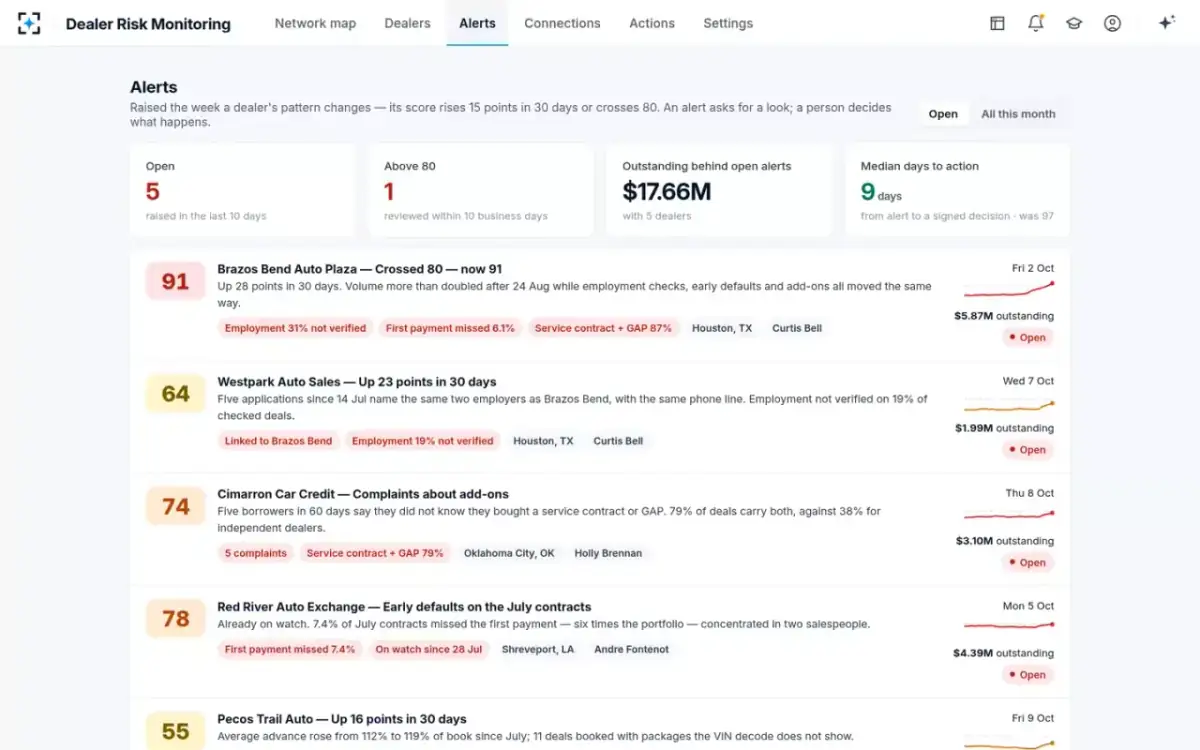
Nightly scoringAttributes every funded contract to its dealer, scores the dealer against its own history and its peers, and raises an alert when the pattern changes.
Never: Never acts on a score — an alert asks a person to look
A person decides
Dealer risk analystOpens the alert within ten business days, reads the sampled contracts and the documents behind them, and signs a watch if one is warranted.
A person decides
Dealer relationship managerIs notified at the alert, not at the decision, and supplies what the data cannot: who runs the store, what changed there, whether the finance office turned over.
A person decides
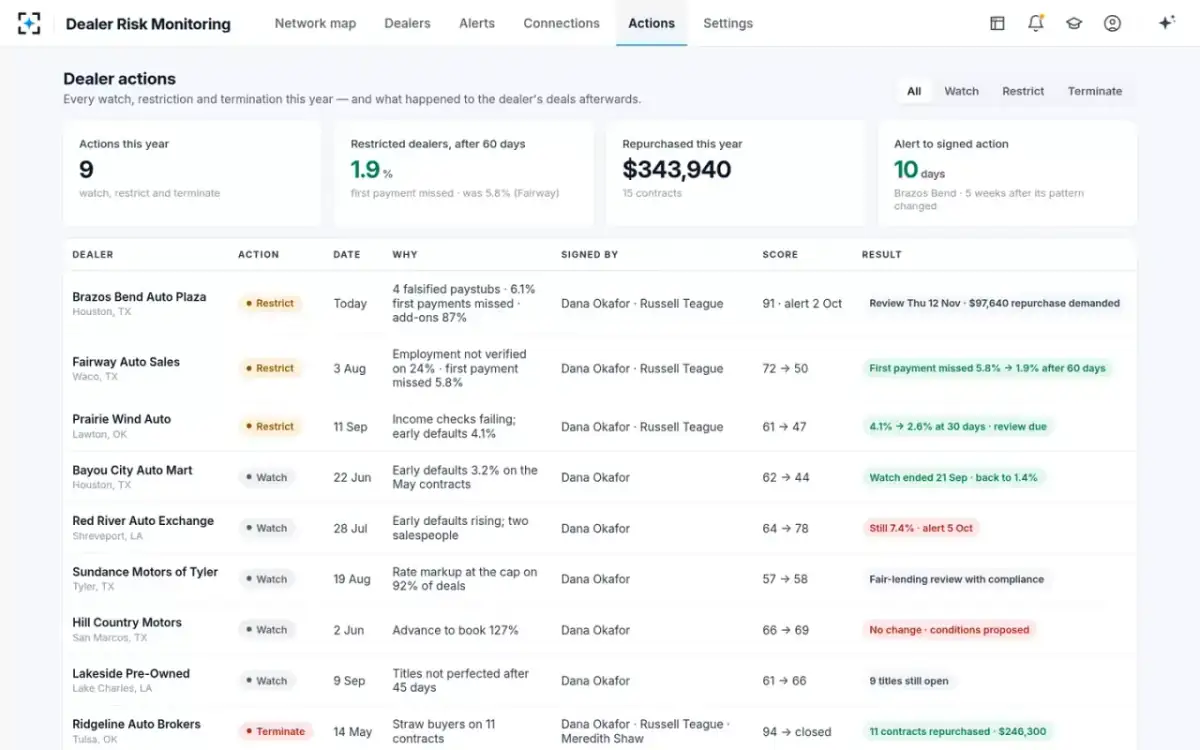
Head of Auto Credit RiskCo-signs a restriction and its conditions, and sets the review date on which the restriction is tested.
A person decides
Head of Auto FinanceCo-signs a termination, the heaviest action, which ends both the dealer’s new business and the lender’s view of its book.
Agent
After the decisionTracks what happened to the dealer’s deals after every action, so the thresholds can be judged on outcomes rather than on instinct.
Never: Never closes or reopens an action
What the relationship manager is told, and when, in Dealer Risk Monitoring
Every action, its signatures and what followed, in Dealer Risk Monitoring
Indirect lending is organised the way it is for good reasons, and the five desks are not a design flaw. What is a flaw is that the one view which would let any of them see a dealer is the one view nobody is responsible for producing. For what that view contains and what each signal can prove, read the six signals a dealer monitoring programme scores; to see the joined view on your own funded contracts, start from Dealer Risk Monitoring.
Questions people ask
Who is the lender in indirect auto lending?
The bank, credit union or finance company that funds the contract — not the dealer, even though the dealer’s name is on the paperwork the borrower signs. Depending on the structure, the dealer either originates the contract and immediately assigns it to the lender, or forwards the application for the lender to originate. Either way, the borrower’s payments go to the lender and the lender carries the credit risk for the life of the loan.
Can a dealer approve a loan?
No. Supervisory guidance is explicit that approval authority must not be delegated to a third party, and the dealer’s role is to submit, not to decide. What a dealer can legitimately do is originate a contract within criteria the lender has set in advance and the lender then buys — which looks like dealer approval from the showroom floor and is not, because the lender can decline to purchase. If a lender finds itself buying whatever arrives, it has delegated approval in practice whatever the agreement says.
What does an indirect lending manager do?
Runs the programme rather than the loans: sets and reviews the underwriting standards the dealers submit against, selects and removes dealers, negotiates compensation, watches concentration against the balance sheet, and reports performance by dealer to the board. The NCUA’s planning expectations give the job description — goals, portfolio limits, staffing sufficient to operate and monitor the programme, periodic risk-reward analysis, and an exit strategy for when a programme’s risk profile moves unexpectedly.
What is dealer reserve?
A bank-controlled, dealer-specific account that holds the dealer’s share of the finance income on contracts it has sold to the lender — in the OCC’s words, the difference between the rate on the installment contract and the buy rate at which the lender purchased it, released according to the dealer agreement. Because the lender controls it, the agreement usually permits non-performing contracts to be charged back against it, which makes the reserve both the dealer’s compensation and the lender’s first recovery lever.
What are the risks of indirect lending?
Supervisors list five: credit, liquidity, transaction, compliance and reputation risk, all amplified by the speed at which indirect volume can grow. The specific failure mode named in the guidance is a programme that is improperly planned or loosely managed and grows faster than the controls around it — the NCUA notes it has seen healthy credit unions fail within months for exactly that reason. The practical risks a lender meets daily are a handful of dealers producing most of the fraud, the early defaults and the complaints.
Does joining the signals require a new team?
A named owner, yes; a new department, no. The five desks keep their decisions and their queues. What has to exist is one accountable person for dealer quality who does not carry volume targets, and a view that attributes each desk’s by-product to a dealer on the day it happens. Segregation of duties is preserved precisely because the join is a reading exercise: nothing in it approves, collects or reconciles anything.