Auto loan fraud, seen from the lender’s side, is rarely one spectacular file. It is an ordinary application that clears every check, funded alongside sixteen others that also cleared, where the only thing wrong is that all seventeen share a detail no honest group of strangers would share — a cash down figure to the dollar, an employer’s phone line, a job title spelled the same way. Single-deal verification cannot see that, because it is built to ask whether this file is internally consistent. Botminds’ Dealer Risk Monitoring reads a dealer’s last ninety days together, shows the details that repeat far more often than at dealers like it, and hands a person the contracts — it never calls a pattern fraud. This guide sets out which details matter, how often a repeat is genuinely unusual, and what turns a pattern into a finding a lender can act on.
The worked example below is a fictional sample lender, Coppervale Bank, and two fictional Houston dealers; the people, employers and phone numbers are characters in sample data and every product number is tagged demo or estimated. The enforcement material and the research are linked where they appear.
What auto loan fraud looks like from the lender’s side
Most published writing about auto loan fraud is written for the car buyer: fake listings, title washing, yo-yo financing. An indirect lender meets a different animal. It never sees the car, never meets the buyer and never watches the conversation at the desk; it receives a structured application and a contract and has to decide whether to buy it. Everything it can be deceived about is therefore a field on a form — income, employment, residence, down payment, the vehicle’s equipment, and occasionally the identity of the person who is supposed to be paying.
Three broad shapes cover almost all of it. The first is a misstated fact on an otherwise genuine deal: the buyer exists, wants the car and intends to pay, but the income on the application is not the income they have. The second is a deal built to be funded rather than paid — the vehicle moves, the money is drawn and the first payment never arrives. The third is identity: the person on the contract is not the person who took the car, whether because a relative’s name and credit were used, or because the applicant was assembled from parts.
The lender’s problem is that all three arrive looking the same. There is no field marked suspicious, and the dealer is not a disinterested witness — it is paid on the deal. That is why the published supervisory list of warning signs for indirect lending is about dealer behaviour rather than borrower behaviour, naming things such as “dealer-created down payments through dealer incentives” and “Insufficient loan documentation” (NCUA, Letter to Credit Unions 10-CU-15).
How do lenders detect auto loan fraud when each application looks fine?
By changing the unit of analysis. A verification step asks whether a document is real and whether a stated figure is supported; that is a question about one file, and a well-made false file answers it. A pattern question asks whether this file resembles other files more than chance allows, and no amount of care inside a single application can hide the answer, because the evidence is not in the file — it is in the relationship between files.
That distinction is doing more work than it appears. Income falsification, the most common form, is a per-file deception that leaves a per-dealer trace: a store that inflates incomes does it with the templates and the arithmetic it has to hand, so the inflated figures cluster. The Federal Trade Commission’s complaint against a group of Arizona and New Mexico dealerships — the agency called it its “first action alleging income falsification by auto dealers” — describes the mechanics of exactly that production line.
The complaint also alleges that Tate’s Auto representatives often prevented consumers from reviewing the income and down payment information on the forms, such as by rushing consumers through the process of reviewing and signing the financing applications, having consumers fill out the forms over the phone, and failing to give them the income and down payment portion of the application before they signed.
Federal Trade Commission, complaint against Tate’s Auto Center, 1 August 2018
Read that as an operational description rather than as an allegation and it tells a lender where to look. If the buyer never saw the income figure, the figure was produced by someone at the store, and whoever produces numbers repeatedly produces them the same way. The repetition is not incidental to the method; it is the method.
Why a single-deal check cannot see a ring
Consider the verification a funding desk actually performs. It confirms that the paystub’s arithmetic is internally consistent, that the employer exists, that the phone number answers, that the stated income supports the payment. Each of those tests passes or fails on one file. Now suppose seventeen files each name a real-sounding employer, each produce a number that answers, and each state an income that clears payment-to-income by a comfortable margin. Every file passes. The desk has done its job and the lender has funded a ring.
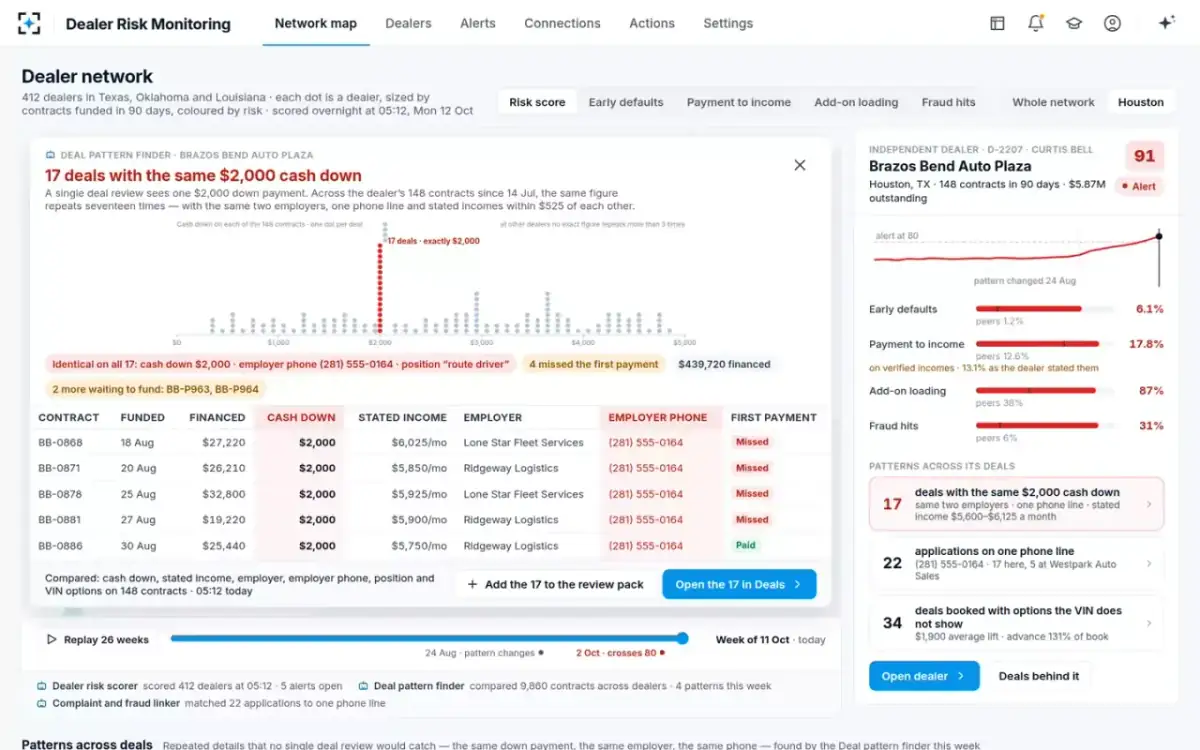
What was visible, and unexamined, is that the comfortable margin was comfortable in the same way seventeen times. Genuine borrowers at one store in one quarter do not earn amounts within $525 of each other. They do not put down exactly $2,000 to the dollar on cars priced from $17,400 to $31,900. They do not all describe themselves as a route driver. Each of those facts is unremarkable alone and jointly they are close to impossible, which is the whole argument for reading a dealer’s deals together rather than one at a time.
There is a second reason the single-deal view fails, and it is structural rather than statistical. A fraud case is opened, worked and closed by a fraud team; a dealer is managed by a relationship manager; the contracts sit in the loan system. Nobody’s queue is the dealer, so nobody is looking at the only level at which the pattern exists — the five desks that each see one signal is the organisational half of this problem.
The details that repeat, and what each one suggests
Not every repeated field is interesting. Two contracts from the same store naming the same large regional employer is a town with a large regional employer. The details worth watching are the ones a borrower would not plausibly share with a stranger, and the ones a fabricator finds convenient to reuse.
Repeated details on applications from one dealer: what each suggests, and what would prove it
| The detail that repeats | The innocent explanation | What it would suggest | What would settle it |
|---|---|---|---|
| A cash down figure to the dollar | A dealer advertising a fixed down-payment offer, or a rebate structure that lands on a round number. | A down payment created by the store rather than paid by the buyer — the supervisory list calls these “dealer-created down payments”. | The deposit itself: a receipt, a card settlement or a bank statement showing the money leaving the buyer. |
| An employer’s phone number | A staffing agency, or a group of companies sharing a switchboard. | A controlled number: whoever answers it will confirm whatever the application says. | A number the lender found for itself — a public register, a directory, the employer’s own published contact — and a person reached on it. |
| An employer name on deals from two stores | A genuine employer whose staff buy cars locally. | A referral channel that moves between dealers, which is how a group survives one store being cut off. | A state business search, and the address: a registered entity with no premises is the strongest single indicator here. |
| Stated incomes inside a narrow band | A single occupation with standard pay at one employer. | Figures produced to clear a payment-to-income limit, rather than copied from a payslip. | Payment to income recomputed on verified income, dealer by dealer, against the dealer’s peers. |
| The same job title, spelled the same way | A common occupation in a local industry. | One author. Spelling and spacing survive copying in a way that numbers do not. | Nothing on its own. It is a ranking signal that tells a reviewer which files to pull first. |
| A reference, address or bank account shared across files | Family members buying together; shared housing. | A single party behind several contracts — the shape of a straw purchase or of an assembled identity. | The contracts themselves, read side by side, and the servicing record of who actually pays. |
Across dealers: how fraud rings use car dealers
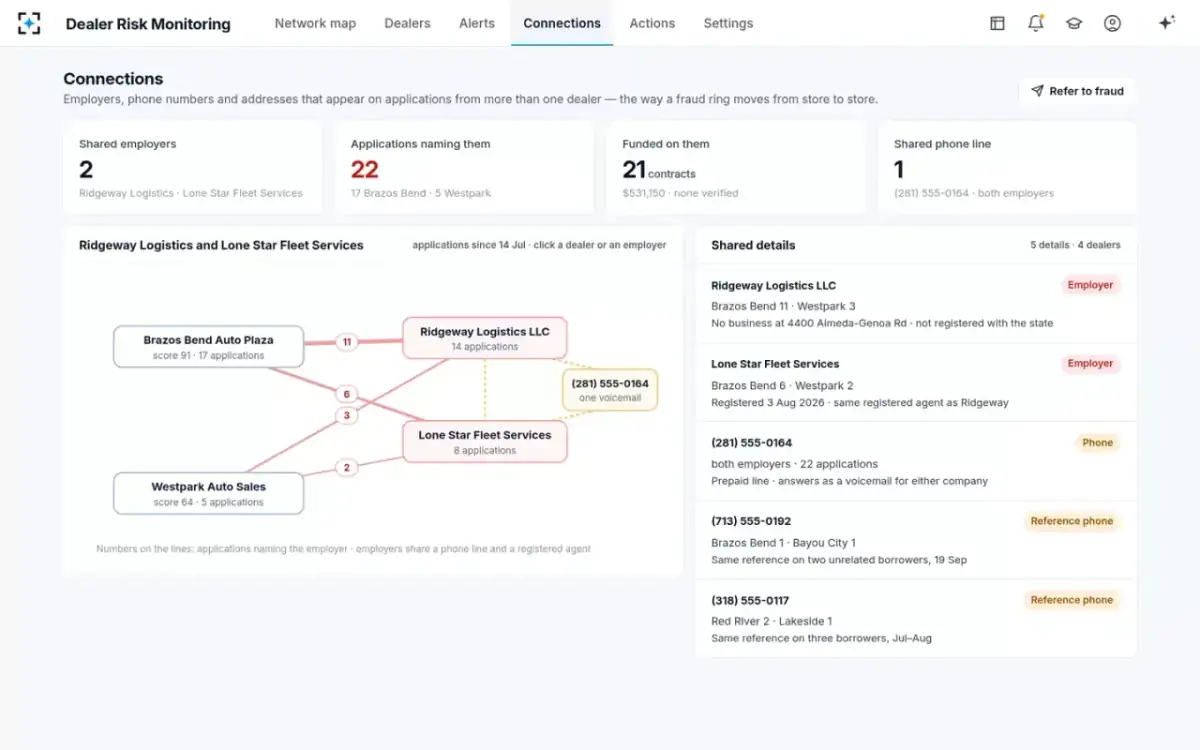
The most valuable version of this signal is the one no single lender department owns, because it crosses stores. A group that has found a cooperative or careless finance office does not stop when that store is restricted; it takes the same employers and the same documents to the next store on the ring road. From the lender’s side that movement is visible — the same phone number is on applications from two dealers — and from each dealer’s side it is not.
One phone line, two dealers: the same details on applications from both stores
Brazos Bend Auto PlazaHouston · independent · 148 contracts
The detail they share
Westpark Auto SalesHouston · independent · 61 contracts
17applications
Employer phone line (281) 555-0164
Answers as a voicemail for either company. The two employers list the same number.
5applications
11applications
Employer: Ridgeway Logistics
No business at 4400 Almeda-Genoa Rd; not registered with the state.
3applications
6applications
Employer: Lone Star Fleet Services
Registered on 3 August, with the same registered agent as the first.
2applications
17applications
Cash down of exactly $2,000
To the dollar, on contracts from $17,400 to $31,900.
4applications
14applications
Stated position “route driver”
Same wording, same spelling, across both stores.
4applications
17applications
Stated incomes within $525 of each other
A band narrow enough to clear payment-to-income by a margin, and no narrower.
5applications
Twenty-two applications on one phone line is the number that changes the conversation, because it is not a number either dealer could have produced. It also changes what the lender does next: a restriction on the first store does nothing about the second, and a fraud case on one borrower does nothing about either. The action that fits the finding is a condition applied to both stores — employment verified by the bank, on a number the bank found — plus a pend on anything still waiting to fund that names either employer.
The details shared across two dealers, in Dealer Risk Monitoring
The arithmetic: when is a repeat unusual?
A programme that reports every repetition reports noise, so the threshold has to be defensible. The practical test has three parts, and none of them requires a model.
The first is the base rate at comparable dealers. Exactly $2,000 down appears on roughly 3% of contracts across the sample lender’s independent dealers of similar size — a popular round number, as expected. At the dealer in question it appears on 11.5%, and the right comparison is not with the portfolio but with dealers serving the same kind of buyer, for the reasons set out in measuring a dealer against its peers rather than against an average.
The second is concentration in time. Seventeen matching contracts spread over three years is a dealer with a long-running promotion. Seventeen inside ninety days, all after a single week in August, is a change in practice with a date on it — and the date is what makes the conversation with the dealer specific rather than accusatory.
The third is co-occurrence. One repeated field is weak. The same seventeen contracts carrying four repeated fields — the down payment, the employer, the phone line and the income band — is the thing that cannot be explained by a promotion, because a promotion does not choose the buyers’ employers.
How often each detail repeats at one sample dealer, against dealers like it
A pattern is not a finding — what turns it into one
This is the governing rule of the whole discipline, and it is worth being blunt about why. A repeated detail is a reason to look. It is not evidence that anybody did anything, it names no wrongdoer, and a lender that treats it as proof will eventually be wrong in public about a dealer that was running a promotion or an employer that genuinely has four hundred route drivers.
What converts a pattern into a finding is a document or a contact, obtained independently of the dealer. In the sample lender’s review, four contracts crossed that line: the employer was called on a number the bank found for itself and a state business search was run, and the employer was not registered; a bank statement showed no payroll deposits in ninety days against a claimed $5,850 a month. Eighteen more could not be verified either way, and the honest report says so rather than rounding them up.
From a repeated detail to a signed decision: five reading steps and two signatures
Agent
Deal pattern finderReads the dealer’s last ninety days together and reports details that repeat far more often than at dealers like it — cash down, stated income band, employer, employer phone, references, position.
Never: Never calls a pattern fraud, and never reports a conclusion about a borrower
Agent
Complaint and fraud linkerTies the same employers, phone numbers and addresses to applications from other dealers, so a group moving between stores is visible as one thing.
Never: Never names a borrower outside a dealer review
Agent
Review pack builderSamples contracts behind the pattern on a rule written before the sample is drawn, and verifies each at source — the employer at an independently found number, the state register, the bank statement.
Never: Never treats a sampled deal as proven without a document on file
A person decides
Fraud managerReads the sampled contracts and the documents behind them, decides which are proven and which are merely unverified, and refers what belongs outside the bank.
Agent
Dealer action recommenderDrafts the least action that would stop the pattern, with the repurchase demand limited to the contracts a document proves and the pend list for deals still waiting to fund.
Never: Never restricts, terminates, pends or sends a notice
A person decides
Dealer risk analyst, then Head of Auto Credit RiskSign the action, with the meaning of each signature recorded; a restriction needs both before any notice leaves the bank.
What happens when a lender finds fraud on a funded contract
Less than most people expect, and the limits are worth knowing before the meeting. The contract with the borrower stands; a lender cannot unwind a funded retail instalment contract because the dealer wrote a false number on the application, and it should not want to try. The remedies run against the dealer, and they are contractual rather than statutory.
The usual one is the repurchase clause, which generally reaches contracts carrying false information. It is narrower than the pattern: in the sample review, four contracts totalling $97,640 were listed as eligible for repurchase under the dealer agreement, while the other thirteen in the group were not, because they were unverified rather than disproved. The second is the dealer reserve, a lender-controlled account that the agreement usually permits non-performing contracts to be charged back against. The third is prospective — conditions on new business, a pend on deals still waiting to fund, or removal. What each lever actually reaches, and what it costs is the arithmetic a committee asks for.
There are also obligations that run the other way. A lender that learns a consumer’s identity was used without their knowledge has duties under consumer credit law about what it reports and what it collects, and those are triggered by what the lender knows rather than by what it has decided to do about the dealer. Supervisors have been direct about the cost of monitoring failures in this channel: examining add-on products sold through third parties, the Consumer Financial Protection Bureau recorded that “the companies had failed to conduct comprehensive compliance monitoring of the service providers” (Supervisory Highlights, Issue 35).
Every contract behind a repeated detail, in Dealer Risk Monitoring
Where this crosses into an accusation about a borrower
A dealer monitoring programme looks at borrowers’ data and is not about borrowers, and keeping that line visible is a design problem as much as a policy one. Three rules hold it in the sample lender, and they are worth copying.
Borrowers are named only inside a dealer review pack, which has a reader list and an audit trail; nothing with a borrower’s name in it is on the dealer screens the relationship manager sees. The language of every report distinguishes repeated, unverified and proven, and only the third ever appears beside a person. And a repeated detail is never, in any report, called fraud — the finder names what repeats and how often, and stops.
The reason is not only fairness. A borrower on a fabricated application is as often the person deceived as the person deceiving, especially where identity is involved: the Federal Reserve describes a synthetic identity as one “created by using a combination of real information (such as a legitimate Social Security number) with fictional information”, built up over time until the fraudster can “‘bust out’ by purchasing high-value goods and services on credit and disappearing”, leaving the consumer whose number was used “the time-consuming process of correcting their credit reports” (Federal Reserve System, 9 July 2019). The name on that contract is a second victim, and a programme that treats a pattern as an accusation will say so to them.
Supervisors expect the control to be tested rather than asserted. The NCUA lists among the internal controls that prevent fraud “Quality control processes to ensure the credit union receives perfected liens, proof of insurance, and other necessary documentation, in addition to verifying the completeness, accuracy and validity of loan deals”, and the OCC asks that “control systems, internal audit, and credit risk review include indirect lending activities as part of normal oversight scope and reviews” (Comptroller’s Handbook, Retail Lending). Reading a dealer’s deals together is one of those controls; what the finding is allowed to say is the other half of it. To see the repeated details, the sampled contracts and the signed decision on your own funded book, start from Dealer Risk Monitoring.
Questions people ask
What is a straw purchase auto loan?
A contract written in one person’s name for a car that someone else takes, usually because the real buyer could not be approved. The name on the application is real, the credit is real and the first payment often is too; what is false is who will be driving and paying. From the lender’s side it shows as a cluster — shared addresses, shared references, a servicing record where payments arrive from a party who is not the borrower — rather than as anything visible on the application itself.
What is synthetic identity fraud in auto lending?
An application in the name of a person assembled from real and invented parts — commonly a genuine Social Security number attached to a made-up name and date of birth. The Federal Reserve’s description of the method explains why it defeats ordinary checks: the identity is cultivated until it has a credit history, then used to buy high-value goods on credit before the fraudster disappears. Auto lending is attractive to it because the goods are valuable, portable and immediately resaleable.
Can a lender tell which dealer a fraud came from?
Only if it attributes verification outcomes to the dealer at the time, which many lenders do not. A fraud case records the borrower, the contract and the finding; unless the originating dealer is carried through to the case and the cases are counted per dealer, the channel is invisible. Attribution costs nothing at the point of funding and cannot be reconstructed cheaply afterwards, which is why it is the first thing to fix.
What is income falsification on a car loan?
Stating a monthly income on the credit application that the applicant does not have, so the deal clears the lender’s payment-to-income limit. It can originate with the buyer, but the enforcement record includes dealers doing it to their own customers: the FTC charged a group of dealerships with inflating income and down payment figures on financing documents, in what it described as its first such action, and alleged that buyers were frequently prevented from seeing those fields before signing.
How many repeats are enough to act on?
Acting means looking, and for that the bar is deliberately low: a rate several times the peer rate, concentrated in time, on more than one field. Acting against a dealer is a different bar entirely, and it is not a count — it is a sampled set of contracts with a document behind each finding. In the sample lender’s case the pattern covered seventeen contracts and the restriction rested on four, because four were all that could be proven.
Does the dealer always know?
No, and a programme that assumes otherwise will be unfair and will also miss things. The same pattern is consistent with a finance manager producing the numbers, with a single salesperson funnelling deals, with a third party feeding applications to several stores, and with a store that is being used precisely because its checks are weak. That is why the first action is usually a condition rather than a termination: a thirty-day test with the bank verifying employment tells the lender which of those it is.