Dealer oversight is a lender’s own supervision of the dealers that originate its loans: choosing them, writing down what they may submit, measuring what they actually submit, and removing them when the measurement says so. It is the half of indirect lending that produces no revenue and the half an examiner opens first, because the published supervisory material is unusually specific about the artefacts it expects to see — reports produced per dealer, not a portfolio summary. Botminds’ Dealer Risk Monitoring scores every dealer each night, keeps the sampled deals and the signed decisions behind each score, and can therefore answer those requests on the day they arrive. This guide walks the request list line by line, names the five elements of a due diligence programme, and sets out what each one has to be able to show.
The screens and figures from the product below describe a fictional sample lender, Coppervale Bank, with 412 dealers and 41,280 open contracts; its people, dealers and employers are characters, and its numbers are tagged demo or estimated. The supervisory documents are linked where they appear.
How much of a retail lending examination turns on the dealer channel
38
numbered items in the sample request letter the examiner sends before the work begins
2
of them ask for the management reports produced per third-party originator — items 20 and 21
5
elements a sound indirect lending due diligence programme has, as a supervisor lists them
What dealer oversight means to a supervisor
To a relationship manager, dealer oversight sounds like a visit and a signed agreement. To a supervisor it is a control function with outputs, and the outputs are reports. The OCC’s examination procedures put the test in a single line: examiners are to “determine whether brokers, correspondents, fintechs, and other third-party loan originators are the subject of prudent due diligence and oversight”, assessing first whether “an established framework exists for oversight of indirect lending activities and dealers” (Comptroller’s Handbook, Retail Lending).
A framework, in that sentence, is not a policy document. The same procedure lists seven further things the examiner assesses, each of them demonstrable rather than assertable: that “criteria exist for entering into, continuing, and exiting relationships with intermediaries and originators”; that purchased loans “reflect standards and practices consistent with those applied by the bank in its direct lending activities”; that compensation “is structured to avoid providing incentives to originate loans with predatory or abusive characteristics”; that “each new third party is subject to defined due diligence before establishing a relationship”; and that “control systems, internal audit, and credit risk review include indirect lending activities as part of normal oversight scope and reviews”.
Read that list as a shopping list and the shape of the problem appears. Six of the seven can be satisfied by a document. One — consistency between what the credit policy says and what the dealers actually submitted — can only be satisfied by measurement, and measurement per dealer is the thing most programmes cannot produce without a week of notice.
The two request-letter lines that decide it
Examinations begin with a request letter, and the OCC publishes a sample of its own. It runs to 38 numbered items covering strategy, policy, originations, administration, collections, control functions and allowance; the covering text asks the bank to flag anything that “is not readily available or requires significant effort on your part to prepare”. Two of the 38 are about the dealer channel, and in an indirect programme they carry the whole subject.
The request-letter items a dealer programme answers, line by line
- Item 20 — reports per third party
“If dealers, brokers, or other third-party originators are used, copies of the management reports used to monitor the quality of applicants and credit performance of loans sourced from each third party used.” The operative words are “each third party”: a portfolio report, however good, is not responsive.
- Item 21 — reports per add-on product
“If debt suspension, debt cancellation, or other add-on products are offered, please provide management reports used to monitor product performance. Include information for product penetration, claims rates (approved and denied), reserve method and balances, and profitability.”
- Item 13 — the process flow, with third-party steps marked
A flow chart of screening, underwriting and verification that “should clearly note functions and identities of activities performed by third parties”. The honest version of this diagram is where most lenders discover how much the dealer does.
- Item 17 — exceptions and overrides, with what followed
Reports used to monitor policy exceptions and overrides, including “any analyses of subsequent performance by type of exception”. For an indirect book that means stipulations waived to fund, and how those contracts then performed.
- Item 18 — applicant quality and trends
Applications submitted, approved, booked and denied for the most recent year-end and year to date, with credit grades, loan-to-value ratios, scores and debt-to-income distributions. Cut by dealer, it is the earliest view of a changing submission mix.
- Item 31 — first payment defaults, monthly
“Copies of management reports detailing the number and dollar amounts of first payment defaults. If available, include monthly reports for the last 12 months.” Monthly, not quarterly — the cadence the request assumes is already faster than most dealer reviews run.
Two things about that list are worth saying plainly. The first is that none of it asks for a score. The examiner wants the reports management actually uses, which means a monitoring programme nobody reads is worse evidence than a spreadsheet somebody argues about. The second is the tense: “the management reports used to monitor” is present and continuous. A pack assembled in the fortnight before an examination answers the letter and fails the question behind it.
What is in a dealer due diligence file: the five elements
The most complete published description of what that file holds comes from the credit union regulator, and it is short enough to quote whole. “The elements of a sound due diligence program include: A planning process which assesses the risk of the vendor relationships both initially and ongoing; Comprehensive written policies addressing all facets of the indirect lending program including underwriting and monitoring; A review process to assess the vendor’s financial and operational risks; A process to periodically assess the legal agreements and needs for each program; and A risk management process to control the risk associated with the vendor relationship” (Letter to Credit Unions 10-CU-15).
Those five are easy to nod at and hard to evidence, because four of them are processes and a process leaves no trace unless it produces a dated artefact. The table below is our reading of what each element has to put on the table.
The five elements of a due diligence programme, and what proves each one happened
| Element | What the supervisor describes | The dated artefact that proves it |
|---|---|---|
| Planning | Risk of the relationship assessed “both initially and ongoing” — with goals, portfolio limits in terms of net worth, staffing sufficient to operate and monitor, periodic risk-reward analysis, and an exit strategy. | A board paper with the limits in it, and the minutes of the periodic review that tested them. The exit strategy is the line most often missing. |
| Written policies | Policies “addressing all facets of the indirect lending program including underwriting and monitoring”, with indirect standards consistent with direct standards and reviewed at least annually. | The policy with a version history, plus the exception report: the supervisor expects exceptions to be “infrequent”, approved by named staff and reported to the board. |
| Financial and operational review | The vendor’s business plan, related parties, financial condition from statements and business credit reports, how cash moves between the parties, and references from other indirect lending partners. | A completed review per dealer with a date on it, and the next review date. For 400 dealers this is the element that fails on volume rather than on intent. |
| Periodic assessment of the agreements | A process to “periodically assess the legal agreements and needs for each program”, with the contract reviewed by counsel independent of the vendor. | The agreement register with the date each was last read, and the counsel opinion. A clause nobody has re-read since it was drafted is not an assessed agreement. |
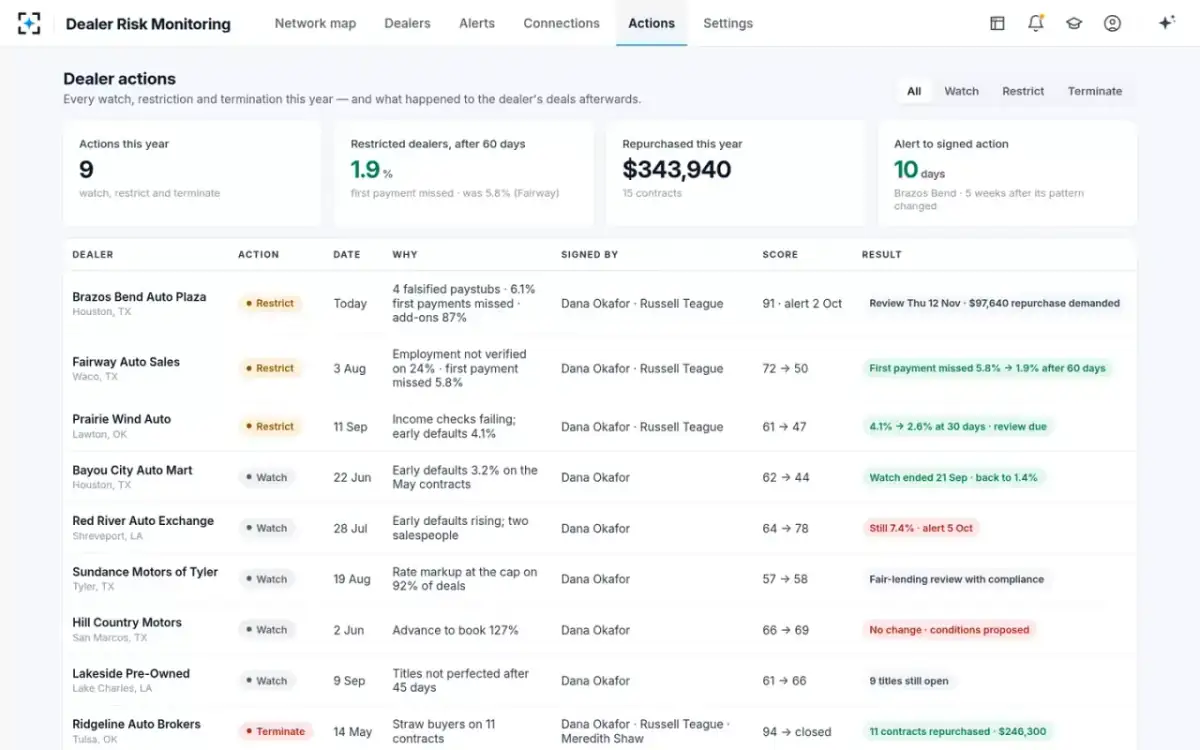
| Risk management | A process “to control the risk associated with the vendor relationship” — in practice the static pool report per dealer, tested against contract terms and previous results. | The report itself, per dealer, with the actions it produced: who was watched, who was restricted, who was removed, and what happened next. |
What should a dealer agreement contain?
Six headings, at minimum: dealer compensation, credit criteria, documentation standards, dealer reserves, dispute resolution and exit clauses. The part of that passage least often read is the sentence after it, which says who has to read the contract: counsel “with the specialization necessary to provide a written opinion on indirect lending contracts”, who “should be completely independent of the vendor, be hired directly by the credit union either internally or externally, and represent only the credit union’s interests” (10-CU-15). An agreement drafted by the dealer group’s counsel and signed unamended is not an assessed agreement.
The OCC adds a selection test on the way in — “each new third party is subject to defined due diligence before establishing a relationship” — and a reporting one that most lenders under-use. An indirect agreement that specifies reporting requirements entitles the lender to data it rarely asks for: what the dealer told the buyer about the add-on products, the signed product menu, the build sheet. The collateral half belongs in the same clause, which is why the guide, edition and condition grade the advance is measured against should be named in the contract rather than settled in a spreadsheet.
And the practical test of an agreement is not whether it contains the six headings. It is whether the clauses have been exercised. A repurchase clause that has never produced a demand, a reserve chargeback right that has never been used and an exit clause nobody has read since signing are all, for supervisory purposes, untested controls. The lender finds out what they mean in the week it needs them, which is the worst possible week to find out.
The red flags an examiner is looking for
Supervisors do not usually publish their own warning list. In this subject one did, and it has not been withdrawn. The NCUA names seven “key red flags” that “may require a credit union to slow down indirect lending”, and adds that an examiner seeing one “may contact your credit union or conduct on-site supervision to assess the indirect lending vendor due diligence program and red flags — even if a regular exam is not scheduled”. The grid below sets each flag beside the measurement in a lender’s own data that would show it.
Each published red flag, and the measurement that would surface it
1
A high concentration of indirect loans to total loans or net worth without adequate controls in place
Where it showsIndirect balances against total loans and against capital, trended monthly — and the same ratio per dealer, since concentration in one store is invisible in the total.
2
Incentive programs tying loan officer bonuses to indirect loan volume
Where it showsNot in the loan data at all. This one is read out of the compensation plan, and it is the reason dealer quality needs an owner who carries no volume target.
3
Inadequate analysis of overall indirect loan portfolio performance
Where it showsWhether a report exists per dealer at all — the examiner is testing the analysis, not the portfolio.
4
High instances of first payment default, payment deferment, and account re-aging
Where it showsFirst payments missed, deferments granted and accounts re-aged, each counted against the month the contract funded and against dealers of the same kind and size.
5
Frequent refinancing of past due interest, repairs, and add-on expenses (GAP Insurance)
Where it showsRefinances where the amount financed exceeds the prior payoff, split by what the excess paid for, per dealer.
6
Insufficient loan documentation
Where it showsStipulations raised at funding, stipulations waived to fund, and files closed with a document still outstanding — the lender’s own control, measured per dealer.
7
Poor dealer management including reliance on the dealer to obtain credit reports; accepting loan payments from dealers; dealer-created down payments through dealer incentives, inflated or fraudulent trade-in or purchase price; or continuous overdrafts in dealer reserve accounts
Where it showsWho pulled the credit report, who remitted the payment, cash down repeating to the dollar across deals, price and advance against book, and the reserve balance by day.
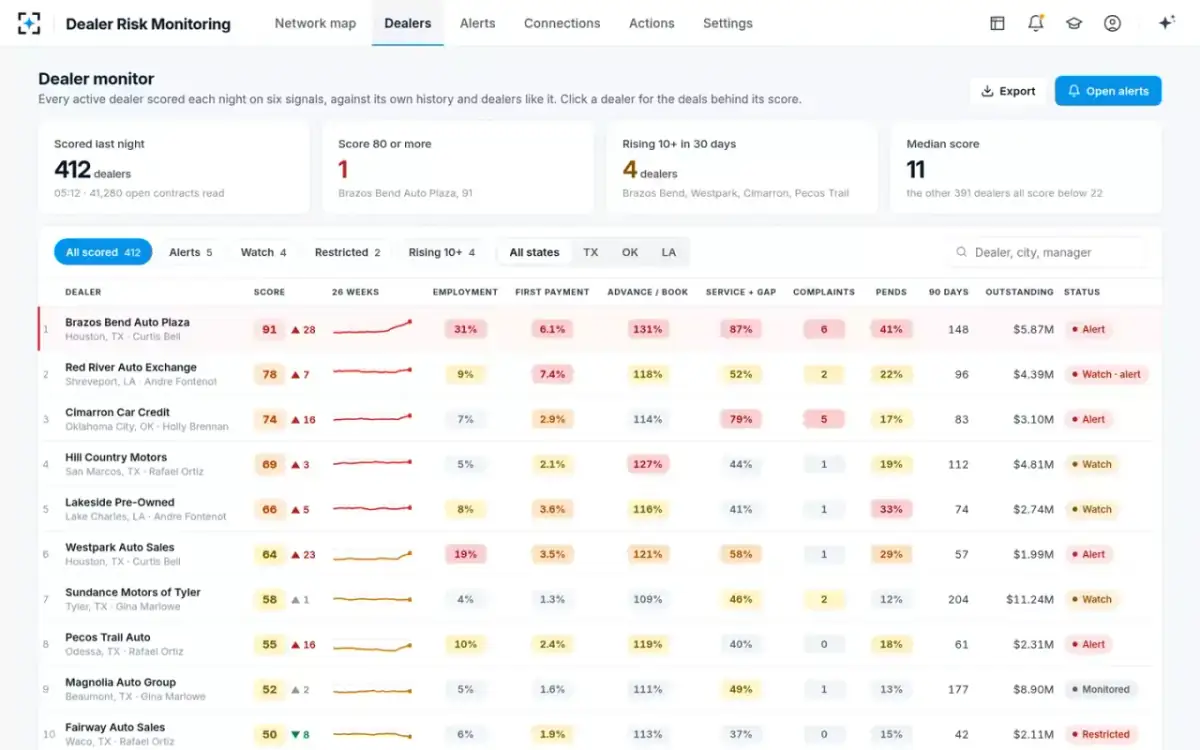
Five of the seven are things a nightly dealer score already computes, which is the useful observation for anyone building a programme: the warning list and the signal list are nearly the same list. The other two are structural. Incentive design is read from the compensation plan, and the adequacy of the analysis is judged by whether the analysis exists per dealer — the six signals a lender can score dealers on are the answer to that one.
What reports should a lender keep on its dealers?
Working backwards from the request letter and the red-flag list gives a short, specific inventory. Per dealer, dated, retained: a static pool report carrying “delinquency rates, default rates, current and cumulative losses, prepayments, and rates of return”; applicant quality and submission mix; exceptions raised and waived, with what the waived contracts did afterwards; add-on penetration, claims and reserve balances; complaints by theme; the financial and operational review with its next date; and the action record.
The last of those is the one lenders most often lack and examiners most often want. An oversight programme is judged on its decisions, not on its measurements, and the decisions are only legible if each one carries its date, its evidence, its signatures and its aftermath. A score that rose and fell with nothing recorded in between tells a reader nothing about whether the lender was watching.
The action record a dealer oversight file is built on, in Dealer Risk Monitoring
Dealer selection, and when a lender should terminate a dealer
Entry and exit are a single control, and the supervisory language treats them that way: “Credit union officials should establish clear policies governing the selection of vendors, as well as conditions requiring removal of vendors from the indirect lending program.” Conditions requiring removal — written in advance, not decided in the moment. The OCC’s version is the examination point that criteria must exist “for entering into, continuing, and exiting relationships”.
Writing those conditions down is harder than it sounds, because the honest ones are rarely a single threshold. A score crossing a line is a reason to look, never a reason to terminate; the conditions that actually belong in a policy are things like a documented falsification that the dealer declines to repurchase, a second restriction inside twelve months, a refusal to supply records the agreement entitles the lender to, or a pattern that continues after a restriction with conditions has been tested for thirty days.
The interagency guidance adds the practical half, which is that termination is a project rather than a decision. It asks a banking organisation to consider “options for an effective transition of services”, and “relevant capabilities, resources, and the time frame required to transition the activity … while still managing legal, regulatory, customer, and other impacts that might arise” (SR 23-4 attachment). For a dealer that means the open contracts stay, the servicing relationship stays, and the exposure that matters is the book already funded, which termination does not touch at all.
How often should dealer agreements be reviewed, and how often scored?
The agreements have a published cadence of sorts — “a process to periodically assess the legal agreements and needs for each program” — and the underwriting standards a firmer one: reviewed “at least annually or more often if risk levels increase or if negative trends begin to surface”. The useful discipline is to tie the agreement review to an event rather than only to a date, because the moment a lender wants to enforce a clause is the moment it discovers whether the clause works.
Scoring cadence is a different question, and the guidance deliberately declines to fix it: “Ongoing monitoring may be conducted on a periodic or continuous basis, and more comprehensive or frequent monitoring is appropriate when a third-party relationship supports higher-risk activities, including critical activities.” The test is risk, not calendar. A channel that originates most of a bank’s consumer loans, from counterparties paid per transaction, with no delegated approval and a published list of fraud warning signs, is not a low-risk relationship by anyone’s reading.
What the request letter asks for, against what a quarterly dealer review produces
A quarterly dealer review: A loss and delinquency ranking produced for the meeting, covering dealers above a volume floor.
A dealer oversight programme: A dated report per dealer, retained, including the dealers nobody discussed — the examiner samples, and samples the quiet ones.
A quarterly dealer review: Penetration reported for the product line, owned by the insurance or finance-and-insurance team.
A dealer oversight programme: Penetration, price and claims attached to the dealer that sold them, beside that dealer’s other five signals.
A quarterly dealer review: Pend and waiver counts as a funding-desk cycle-time metric, not retained by dealer.
A dealer oversight programme: Waivers per dealer with the approver, and the subsequent performance of the contracts that were waived.
A quarterly dealer review: Quarterly, by the month the delinquency was observed.
A dealer oversight programme: Monthly, by the month the contract funded, against dealers of the same kind and volume band.
A quarterly dealer review: A summary paper; the contracts live in the loan system and are fetched if challenged.
A dealer oversight programme: The sampled contracts, the document that proved each finding, and the sampling rule written before the sample was drawn.
A quarterly dealer review: Days of assembly, and a gap for any dealer removed before the period began.
A dealer oversight programme: The reports already exist, because they are the ones the programme runs on.
Periodic or continuous: who tests this, and how often
Oversight that is only performed by the team that owns the relationship is not oversight, and both supervisors say so in their own idiom. The OCC expects “control systems, internal audit, and credit risk review” to include indirect lending in normal scope. The NCUA names the specific test it wants to see, and it is the only one in the whole programme that reaches past the paperwork: “Internal audit functions that include testing loans from each vendor through direct member communication.” Calling a sample of borrowers from each dealer and asking what they were told at the sale is the control that finds packed add-ons, because the only two parties who know what was said are the finance office and the buyer.
The interagency guidance sets out what continuous monitoring is for: it “enables a banking organization to: (1) confirm the quality and sustainability of a third party’s controls and ability to meet contractual obligations; (2) escalate significant issues or concerns, such as material or repeat audit findings, deterioration in financial condition … compliance lapses, or other indicators of increased risk; and (3) respond to such significant issues or concerns when identified.” Among the factors it lists is one that belongs to a dealer programme word for word: “The volume, nature, and trends of customer inquiries and complaints, the adequacy of the third party’s responses … and any resulting remediation.”
It also makes staffing part of the expectation rather than an implementation detail: “To support effective monitoring, a banking organization dedicates sufficient staffing with the necessary expertise, authority, and accountability to perform a range of ongoing monitoring activities.” Authority and accountability — which in an indirect programme means a named owner of dealer quality who does not carry volume targets, as the five desks that each see one signal sets out.
Every active dealer, scored and retained, in Dealer Risk Monitoring
One last reason to take the paperwork seriously. For at least one lender, dealer monitoring stopped being a supervisory expectation in September 2026 and became an injunctive term with a commencement date: a 41-state settlement “which will be effective as of November 2, 2026” requires it among the processes that must be put in place against add-on packing (Arizona Attorney General, 17 September 2026). The question an examiner asks and the question a court order asks have converged, and both are answered by the same artefacts. To see the reports, the sampled deals and the signed actions on your own funded contracts, start from Dealer Risk Monitoring.
Questions people ask
What is indirect lending due diligence in banking?
The work a lender does to satisfy itself about a dealer before it buys contracts from it, and to keep satisfying itself afterwards. Initially it is a financial and operational review: the dealer’s business plan, its related parties, its financial condition from statements and business credit reports, how cash moves between the parties, and references from other lenders it originates for. Afterwards it is measurement — performance reported per dealer rather than per portfolio — plus a periodic re-read of the agreement.
What do examiners look for in indirect lending?
Whether a framework exists, whether the criteria for entering, continuing and exiting relationships are written down, whether purchased loans match the standards the bank applies to its own direct lending, whether compensation avoids rewarding predatory origination, and whether internal audit and credit risk review cover the channel. Then they ask for the reports: per third party, per add-on product, plus exceptions with subsequent performance and monthly first payment defaults.
Who inside the lender should own dealer oversight?
Someone with no volume target. The interagency guidance asks for staffing with “expertise, authority, and accountability”, and in a dealer programme the accountability half fails if the owner also carries the channel’s growth. Commercially the relationship manager keeps the dealer; for credit purposes a named analyst or team owns dealer quality, reports outside the sales line, and is the person who opens an alert.
Does a monitoring system satisfy the expectation on its own?
No, and claiming so is a mistake worth avoiding out loud. A system can produce the reports, retain the evidence and date the decisions. It cannot write the credit policy, negotiate the dealer agreement, call a sample of borrowers, or decide to remove a dealer — and three of those four are explicit expectations. The reasonable claim is narrower: the measurement and the record stop being the bottleneck.
What happens if a lender cannot produce reports per dealer?
Nothing dramatic in the first instance; the request letter invites the bank to say when information “is not readily available or requires significant effort”. The consequence is what follows. The examiner has been told, in writing, that the lender does not routinely monitor the channel it buys most of its loans through, and the red-flag list already names “inadequate analysis of overall indirect loan portfolio performance” as a reason to look harder.
How long should dealer oversight records be kept?
Longer than the relationship, because the questions arrive afterwards. The request letter asks for the last 12 months of first payment default reports and 18 months of control-function review schedules, which sets a floor rather than a policy; a repurchase dispute or a consumer claim can reach contracts written years earlier. The practical rule is to retain the score history, the sampled deals, the documents that proved a finding and the signed actions for as long as any contract that dealer originated remains on the book.