Dealer monitoring software scores the dealers an indirect auto lender buys contracts from, using data the lender already holds, and shows the contracts behind every number. Choosing one is therefore less a question about the software than about what you can hand it: six dated feeds, two documents and a population of dealers whose outcome is already known. Botminds’ Dealer Risk Monitoring is the worked example here — 412 dealers and 41,280 open contracts scored overnight on the sample data — but the intake list below is the same whoever builds it, and so is the test that tells you whether the score means anything.
The product figures are from a fictional sample lender, Coppervale Bank, and are tagged demo; its people and dealers are characters. Supervisory material is linked where it appears.
What dealer monitoring software has to do
Five things, and the order matters because each depends on the one before it. It has to attribute every funded contract to the dealer that originated it, and keep doing so when a dealer changes name or is acquired. It has to compute a comparable measure per dealer, which means cohorts by funding month rather than a portfolio ratio. It has to compare each dealer with dealers like it rather than with an average. It has to explain any score as its components and open the contracts behind each. And it has to record what a person decided, when, on what evidence, and what happened afterwards.
Anything that does the first four and not the fifth is a reporting tool. The decision record is what an examiner asks for, what makes a threshold testable, and what stops a programme from being an opinion that moves with whoever is running it — the reports a supervisor asks for first are almost entirely artefacts of that fifth capability.
A sixth is worth asking about, because it is where most products are weakest: whether the thresholds are settings or constants. A score is a credit policy expressed as arithmetic, and a credit policy that cannot be changed by the credit team, versioned, with the change recorded, is not the lender’s policy.
What data do you need to monitor dealers: the six feeds
Every signal worth scoring is a by-product of work the lender already does, which is the good news; the bad news is that the by-products sit in six systems with six owners and six refresh cycles. The intake list below is the honest version — what has to arrive, from where, and how often.
The intake list: six feeds, and what each one has to carry
- 1. The loan system — funded contracts, nightly
One row per funded contract with the originating dealer, the funding date, the amount financed, cash down, term, rate, the vehicle and its identification number, and the book value used at approval. This is the spine; nothing else joins without it.
- 2. The funding desk — pends and stipulations
Every stipulation raised, cleared or waived, with the date and the approver. The waiver field is the one most often missing and the one that makes the signal honest, because it measures the lender as well as the dealer.
- 3. The fraud and verification team — employment and income checks
The outcome per contract, recorded as a rung rather than a tick: stated, documented, corroborated, contacted. A single “verified” flag loses the distinction the whole signal rests on.
- 4. Servicing — the first six payments on every contract
Payment-level history, not a delinquency bucket, so first payment default and early payment default can be counted against the month the contract funded rather than the month a collector noticed.
- 5. The complaints system — every channel
Complaints with their free text and their date, including those arriving through a regulator’s portal, joined to the contract and therefore to the dealer. The sentence naming what a salesperson said is the point of this feed.
- 6. Vehicle decode and book values — per deal
The decoded identification number, the options booked on the contract, and the guide value with its edition and condition grade. Store the value used at the time: a book recomputed a year later will not reproduce the decision.
Feed by feed: the fields that are usually missing, and what breaks without them
| Feed | The field that is usually missing | What cannot be computed without it |
|---|---|---|
| Funded contracts | The originating dealer on historical contracts, after a dealer was renamed, merged or re-keyed. | Any history. A dealer whose key changed looks like two dealers, each below the minimum volume to score. |
| Pends and stipulations | Who waived the pend, and which stipulation it was. | The waiver rate — the one signal that points at the lender’s own control rather than at the dealer. |
| Verification outcomes | The route: whose number was called, and whether a register was searched. | The difference between unverified and disproved, which decides whether a repurchase demand is collectable. |
| Servicing payments | Payment-level dates. Many extracts carry only a current delinquency bucket. | Early payment default by funding vintage. A bucket tells you the state today, never when the cohort failed. |
| Complaints | The contract or account number on the complaint, and its free text. | Attribution to a dealer at all, and any grouping by what the borrower says happened at the sale. |
| Decode and book values | The book value as used at approval, with its edition and condition grade. | A reproducible advance-to-book ratio. Recomputing against a later book changes the number and the argument. |
The two documents nobody remembers to bring
The feeds get all the attention and the documents decide what the numbers mean. The first is the credit policy, because every threshold in a dealer score is a policy number in disguise: the advance-to-book tolerance, the payment-to-income limit, what counts as a verified income, which exceptions are permitted and who may approve them. Loading a score with default thresholds and reconciling them later produces a programme whose alerts nobody believes.
The second is the dealer agreement — ideally the executed versions, because they differ by dealer and by vintage. It names the repurchase clause and its window, whether the reserve may be charged back, the reporting the lender is entitled to demand, the conditions for removal and the notice period. Without it the programme can rank dealers and cannot recommend anything, because every recommended action is an action under a contract.
Supervisors treat both as programme documents rather than as paperwork. The NCUA expects “Comprehensive written policies addressing all facets of the indirect lending program including underwriting and monitoring”, and a planning process that will “Determine the level of lending and collection staff sufficient to operate and monitor the program” (Letter to Credit Unions 10-CU-15). Monitoring, in both sentences, is part of the programme and not an add-on to it.
Keys: how a contract is tied to a dealer, and where that breaks
The dealer key is the least glamorous and most load-bearing part of an implementation. Everything in a dealer score is a group-by on it, and it breaks in predictable ways.
Dealers are created more than once in a loan system, usually by a different team at a different time, so the same store has two identifiers and each carries half its contracts. Dealer groups own several rooftops that the lender sometimes treats as one counterparty and sometimes as many, and which answer is right depends on what is being measured — a shared finance office is one unit for a pattern question and several for a performance question. Stores are sold, change name and keep the old key, so a score blends two owners’ behaviour. And terminated dealers are deactivated in a way that detaches their history, which is precisely the history the back-test needs.
The remedy is a dealer register the lender owns rather than one inherited from the loan system: one row per store with its aliases, its parent group, its licence and address, the dates it was active, and every identifier that has ever pointed at it. It costs a few days and it is the difference between a score with twenty-six weeks of history and a score that starts today.
The back-test: scoring the dealers you already terminated
This is the part of an evaluation most buyers skip and the only part that answers the question they actually have. Take the dealers the lender has already acted on — watched, restricted, terminated — and score them on data as it stood before the action. Then ask three things: how high did they rank, how early would the alert have fired, and how many dealers that were never a problem would have ranked alongside them.
The third question is the one that matters commercially. A score that finds every past problem by alerting on half the network has told you nothing you can staff. The usable output of a back-test is a pair of numbers per threshold — how many known-bad dealers it catches and how many alerts a week it creates — and the threshold is chosen where the second is something a team can work.
The method has supervisory backing as the right way to compare dealers at all. A lender’s “indirect lending policy should establish the information which is contained on the static loan pool data report”, the NCUA writes, and lenders “should regularly test for compliance with the contract terms by comparing delinquency, loan losses, and rates of return to previous results and budget levels”, with those statistics “compiled for each vendor and the overall program”. Against previous results — which is a back-test by another name, and the reason counting defaults by the month a contract funded is the measurement the whole exercise depends on.
How do you set signal weights, and who may change them?
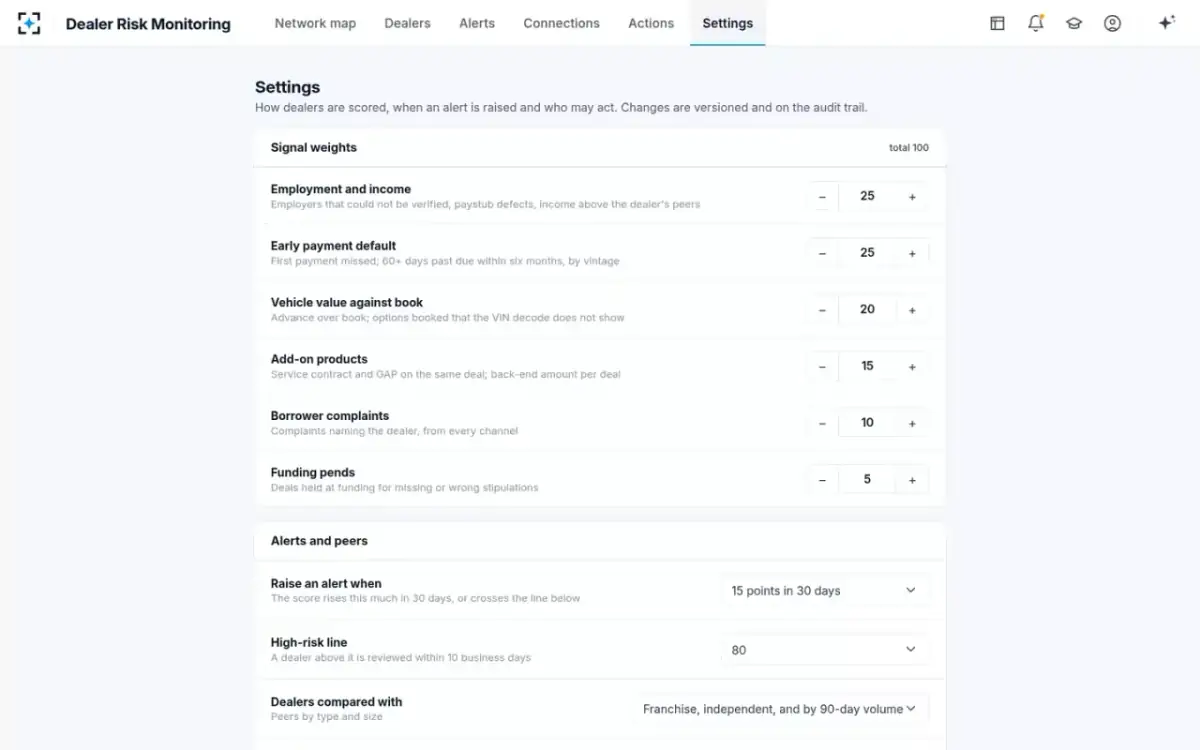
Start from what each signal can prove rather than from how predictive it looks, because a weight is a statement about evidence as much as about risk. In the sample lender’s settings the six weights total 100: employment and income 25, early payment default 25, vehicle value against book 20, add-on products 15, borrower complaints 10 and funding pends 5. Two reasons for that shape are worth borrowing.
The two heaviest are the two that can end in a document — an employer reached on an independently found number, or a contract that failed from the first payment. The lightest is the pend rate, not because it is uninformative but because it is partly a measure of the lender, and a signal that implicates your own funding desk should not be able to carry a dealer over an alert line on its own.
Who may change a weight matters as much as its value. In the sample lender every threshold is a setting with permitted values — the alert at 10, 15 or 20 points in 30 days; the high-risk line at 75, 80 or 85; the minimum volume at 5, 10 or 20 contracts in 90 days; the advance-to-book tolerance at 110%, 115% or 120% — changed by the credit team, versioned, with the change on the audit trail. The OCC expects the shape of this to be in policy anyway, listing among the contents of a sound credit policy “concentration limits (e.g., product, geography, brokers, dealers, and score bands)” (Comptroller’s Handbook, Retail Lending).
The weights and thresholds as settings, in Dealer Risk Monitoring
Can you monitor dealers in a spreadsheet?
To the first alert, yes — and it is a reasonable way to find out whether the signals say anything about your own network before buying anything. Pull three months of funded contracts with the dealer, the advance, the add-ons and the verification outcome, join the first payment status, and rank by the two or three measures you trust. A week of work will surface the worst dealer in most networks.
Past the alert it stops. Four things break, and none of them is about size. The join has to be rebuilt every time it is run, so nobody runs it weekly. There is no record of what was decided last time, so thresholds can never be judged against outcomes. The contracts behind a number are a filter somebody applied rather than a link anyone else can open, which loses the argument with a relationship manager. And a spreadsheet cannot be the artefact an examiner is told the lender uses to monitor each third party, because it is not produced on a cadence and not retained per dealer.
A spreadsheet dealer report, against a monitoring programme
A quarterly spreadsheet: About a week of work, and it does find the worst dealer.
A monitoring programme: The same answer, on the first night, with twenty-six weeks of history behind it.
A quarterly spreadsheet: The join is rebuilt by hand each time, so it runs when someone has time.
A monitoring programme: Nightly, on a schedule, with the date the pattern changed carried on the alert.
A quarterly spreadsheet: A filter the author applied, reproducible only by the author.
A monitoring programme: A link anyone in the review can open, with the test that produced each finding named.
A quarterly spreadsheet: In an inbox, if anywhere.
A monitoring programme: An action record: date, evidence, signatures, and what the dealer’s deals did afterwards.
A quarterly spreadsheet: Impossible. There is no retained population to test them against.
A monitoring programme: A back-test against dealers already acted on, re-run whenever a weight changes.
A quarterly spreadsheet: A reconstruction, and a gap wherever a dealer left before the period began.
A monitoring programme: The artefact the programme already runs on, per dealer, retained.
What should a dealer monitoring pilot cover?
A pilot should be narrow in dealers and complete in signals, which is the opposite of how most are scoped. Take one region or one dealer type, take every contract those dealers wrote for twelve months, and compute all six signals rather than the two that are easiest to load. A pilot on all 400 dealers with two signals proves that the vendor can read a file; a pilot on 40 dealers with six signals proves whether the score ranks your network.
Four acceptance criteria are worth fixing in advance. The dealers the lender has already acted on rank in the top decile on data as it stood before the action. The alert date precedes the lender’s own historical decision date by a stated margin. The alert volume at the chosen threshold is something the team can actually review inside its service level. And every number in the output opens the contracts behind it, including the ones a relationship manager will dispute.
Interagency guidance sets out what ongoing monitoring of a third party normally includes, and it is a reasonable scope statement for a pilot too: “(1) review of reports regarding the third party’s performance and the effectiveness of its controls; (2) periodic visits and meetings with third-party representatives to discuss performance and operational issues; and (3) regular testing of the banking organization’s controls that manage risks from its third-party relationships” (SR 23-4 attachment). Only the first of the three is software; a pilot that forgets the other two will produce a score nobody acts on.
Who has to be in the room, what they bring, and what changes for them
Today
Owns the indirect lending programme, its limits and its board reporting, and sets thresholds from judgement and a quarterly loss report.
With agents
Brings the credit policy to the intake, then sees the alert volume each threshold would produce before it goes live.
Still theirs: The decision to run the programme at all, and its reporting line.
Today
Reviews dealers from loss and delinquency reports, and will work every alert once this is live.
With agents
Brings the review process and the pack contents, and opens each alert with the sampled contracts already assembled.
Still theirs: The first signature on every action, and the judgement behind it.
Today
Owns the contracts, the dealer identifiers and the history, and answers ad hoc extract requests.
With agents
Brings one nightly extract and the dealer register with its aliases and active dates, and stops rebuilding joins by hand.
Still theirs: The system of record. Nothing is written back to it.
Today
Owns pends, stipulations and waivers, measured on a cycle-time target that erodes them.
With agents
Brings the waiver data and the approver field, and sees the desk’s own waiver rate beside each dealer’s pend rate.
Still theirs: The funding decision on every individual contract.
Today
Owns complaints and the testing that reaches the sales floor; themes are reported quarterly, in aggregate.
With agents
Brings the complaints feed with its free text and sets the retention, then sees themes attached to a dealer within days.
Still theirs: The response to the borrower, and the independent re-check of every finding.
Today
Holds the executed dealer agreements, usually by vintage, and is asked about a clause when something has gone wrong.
With agents
Brings the repurchase clause, reserve terms, reporting entitlement and removal conditions into the intake, before they are needed.
Still theirs: What the lender may demand of a dealer, and in what words.
How long does it take to implement dealer monitoring?
Ninety days is a realistic figure for a first score a credit team will argue with, and the shape of it is more useful than the total. The long poles are never the computation; they are the dealer register, the payment-level servicing extract and the agreement review.
The first ninety days, and where the time actually goes
- Contracts extract agreedwk 1
- Dealer register built, aliases resolvedwk 2–3
- Pends, verifications, complaintswk 4–5
- Payment-level servicing historywk 6–7
- Credit policy thresholds mappedwk 6–7
- Dealer agreements read by vintagewk 8–9
- Back-test on dealers already acted onwk 8–10
- Thresholds set, first live alerts workedwk 11–13
Two things shorten it and one lengthens it. It is shorter where the lender already has a dealer register and a payment-level warehouse, and shorter where the credit policy states its thresholds numerically rather than by convention. It is longer wherever the agreements are not in one place, because the agreement review cannot be parallelised and is the input to every recommended action.
What the first score looks like once the joins exist, in Dealer Risk Monitoring
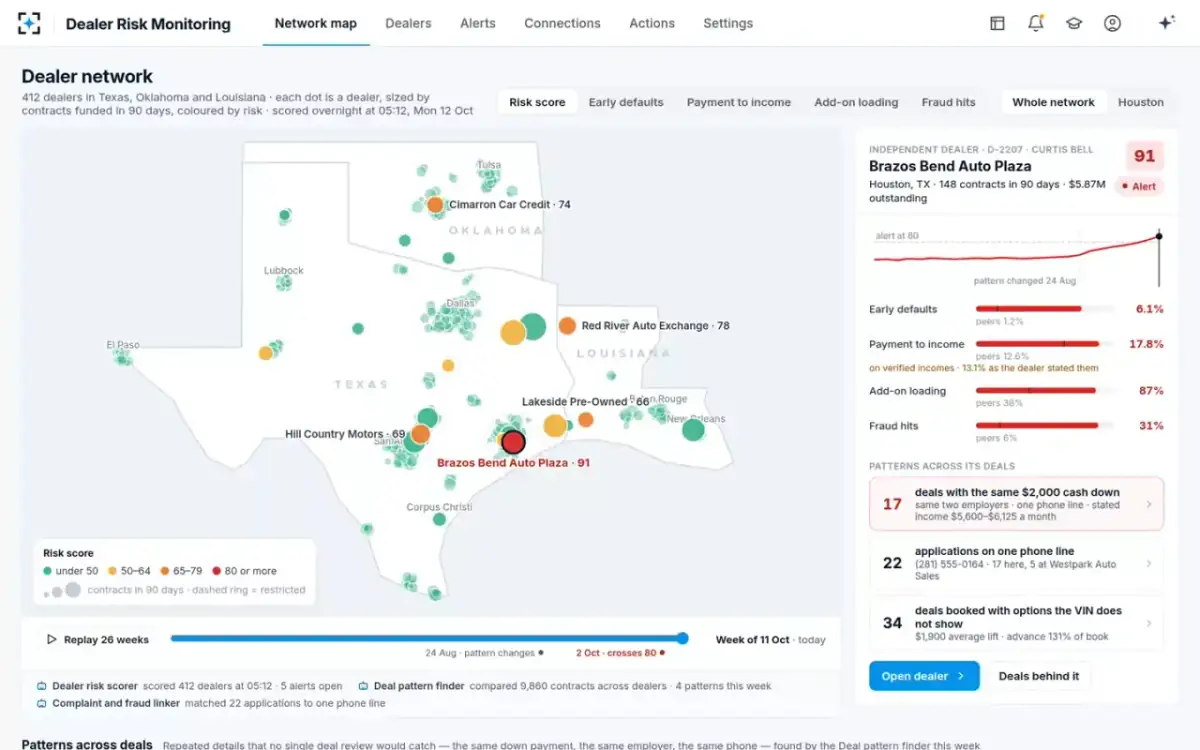
One last reason to get the intake right rather than fast. Dealer monitoring has moved from a supervisory expectation to, for at least one lender, an injunctive term of a 41-state settlement announced in September 2026 (Arizona Attorney General). A programme assembled to satisfy an obligation tends to produce reports; one assembled on six feeds, two documents and a back-test produces decisions, and the decisions are what the obligation is actually about. To see the six signals, the sampled deals and the signed actions on your own funded contracts, start from Dealer Risk Monitoring.
Questions people ask
How do you build a dealer scorecard?
Pick signals that are available on the day a contract funds, attribute each to the dealer, compare each dealer with dealers of the same kind and volume band, weight the signals by what they can prove rather than by what correlates best, and make every component open the contracts behind it. Then test the weights against dealers you have already acted on. A scorecard that has never been back-tested is a set of opinions with arithmetic around them.
What if the lender has no history of terminated dealers?
Use the nearest available population and say what you did. Dealers that were exited for commercial reasons, dealers whose contracts carried a disproportionate share of charge-offs, or dealers that attracted complaints are all weaker labels than a documented termination, and all are better than none. Where no label exists at all, set the threshold on alert volume alone — what the team can review in a week — and revisit it after six months of recorded decisions.
How many dealers do you need before monitoring is worth it?
Enough that a peer group means something, which in practice is a few dozen rather than a few hundred. The binding constraint is not the dealer count but the contract count per dealer: a store writing fewer than ten contracts a quarter produces percentages that swing on single cases, which is why a minimum volume to score is one of the first settings to fix. Below that floor a dealer is reviewed by a person, not ranked by a number.
Does this replace dealer visits?
No, and a supplier claiming it does is overselling. Interagency guidance lists visits and meetings with the third party alongside report review and control testing as normal monitoring activity, and the control that reaches furthest into a dealership — asking a sample of borrowers what they were told at the sale — happens on a telephone, not in a report. What changes is that the visit is informed: the relationship manager arrives with twelve contracts rather than with an impression.
Who should own the programme inside the lender?
Someone accountable for dealer quality who carries no volume target, with the relationship manager keeping the commercial relationship. Supervisory guidance asks for staffing with the expertise, authority and accountability to perform ongoing monitoring; in an indirect programme the accountability half fails if the same person is measured on the channel’s growth. One named analyst and a defined escalation path is enough to start.
What should a buyer ask to see in a demonstration?
The settings screen, the action record and one dealer’s contracts — in that order, and before the map. The settings screen shows whether the credit policy is yours or the supplier’s. The action record shows whether decisions, signatures and outcomes are retained. And one dealer’s contract list shows whether every number opens, which is the capability that decides whether the first disputed finding survives the conversation with a relationship manager.