Dealer risk monitoring is the practice of scoring every dealer an indirect auto lender buys contracts from, on signals the lender already holds, often enough that a dealer writing inflated, packed or falsified deals is found while it is still writing them rather than in next year’s loss review. Botminds’ Dealer Risk Monitoring scores every active dealer each night on six signals — employment and income, early payment default, value against book, add-on products, borrower complaints and funding pends — against that dealer’s own history and against dealers like it, and drills from the score to the contracts that produced it. This guide sets out what each signal measures, what each one cannot prove, how often scoring has to happen, and who decides what when a score moves.
The screens and figures below come from a fictional sample lender as it runs through the solution: Coppervale Bank, 412 dealers, 41,280 open contracts. The people, dealers and employers are characters, and every number from the product is tagged demo (seen on that sample data), target (a design goal) or estimated (our arithmetic). The research figures come from regulators, courts and published research, linked where they appear.
Why the dealer, not the borrower, is the unit of risk
80%+
of US auto loans are written indirectly, through a dealer
$211bn
of new auto loans appeared on credit reports in one quarter, 2026Q2
$694m
settled in September 2026 by one lender whose remedy includes dealer monitoring
What is dealer risk monitoring?
Dealer risk monitoring is ongoing measurement of the people who originate your loans but do not work for you. In indirect lending the dealer takes the application, prices the vehicle, sells the add-on products and submits the contract; the lender funds it and carries it for five or six years. “Dealer loan intermediation is of outsize importance for American consumers,” the NBER paper by Grunewald, Lanning, Low and Salz observes, “as they hold more than $1 trillion in auto debt, and more than eighty percent of auto loans are obtained ‘indirectly’ through dealers” (NBER 28136, a working paper that has not been peer reviewed).
That arrangement does not move the risk. The OCC’s Retail Lending booklet is blunt about where it stays: “Regardless of the loan origination source, the obligation to comply with all applicable laws and regulations and manage associated risks … remains with the bank” (Comptroller’s Handbook, Retail Lending). The NCUA goes further and forbids the shortcut most often taken: “no credit union should delegate loan approval authority to a third party. Every credit union has the responsibility to perform its own due diligence, establish effective controls and monitoring systems” (Letter to Credit Unions 10-CU-15).
So the lender must form its own view of each dealer, and it can only do that from what it can see: the contracts that dealer submits, what happens to them, and what borrowers say afterwards. Dealer risk monitoring is the method for turning those into a comparable number per dealer, with the deals behind it always one click away.
The six signals, and what each one measures
Six signals cover the ways a dealer’s book goes wrong, and each is already on a desk somewhere in the lender. What makes them a monitoring programme rather than six reports is that they are attributed to the dealer, dated, and compared with the dealer’s peers. Each one also has a limit, and a programme that forgets the limits produces accusations instead of findings.
The six signals Dealer Risk Monitoring scores, and the limit of each
| Signal | What it measures | What it cannot tell you |
|---|---|---|
| Employment and income | The share of funded contracts where the stated employer or income could not be verified, and payment to income computed on verified figures rather than stated ones. | Whether the dealer knew. A falsified paystub proves the document is false, not who typed it. |
| Early payment default | First and early payment defaults counted by the month the contract was funded, against dealers of the same kind and size. | Anything at all until the first payment has come due. It is the slowest signal on this list. |
| Value against book | Advance as a share of book value, and options booked on the contract that the vehicle’s own identification number does not support. | Whether an option was fitted. Only a build sheet or a window label settles that. |
| Add-on products | Service contract and guaranteed asset protection penetration and price, against peers selling to similar buyers. | Whether the buyer agreed. Penetration is a reason to read the signed menus, never a finding on its own. |
| Borrower complaints | Complaints per hundred contracts over sixty days, grouped by theme rather than counted. | Anything about a dealer whose buyers do not complain. Silence is not evidence of health. |
| Funding pends | The share of submitted deals pended for stipulations, and how many of those pends were waived to fund. | Whether the waiver was wrong. It points at the lender’s own control as often as at the dealer. |
Two of the six deserve a separate look, because each is widely misunderstood. The value signal is usually described as “checking the options against the VIN”, which overstates what a vehicle identification number can settle: federal law requires only make, line, series, body type, engine type and restraint devices to be decipherable from it, which is why a VIN decode disproves a trim claim and never disproves a sunroof. And early payment default, the signal credit teams trust most, is the one that cannot speak until the first payment is due.
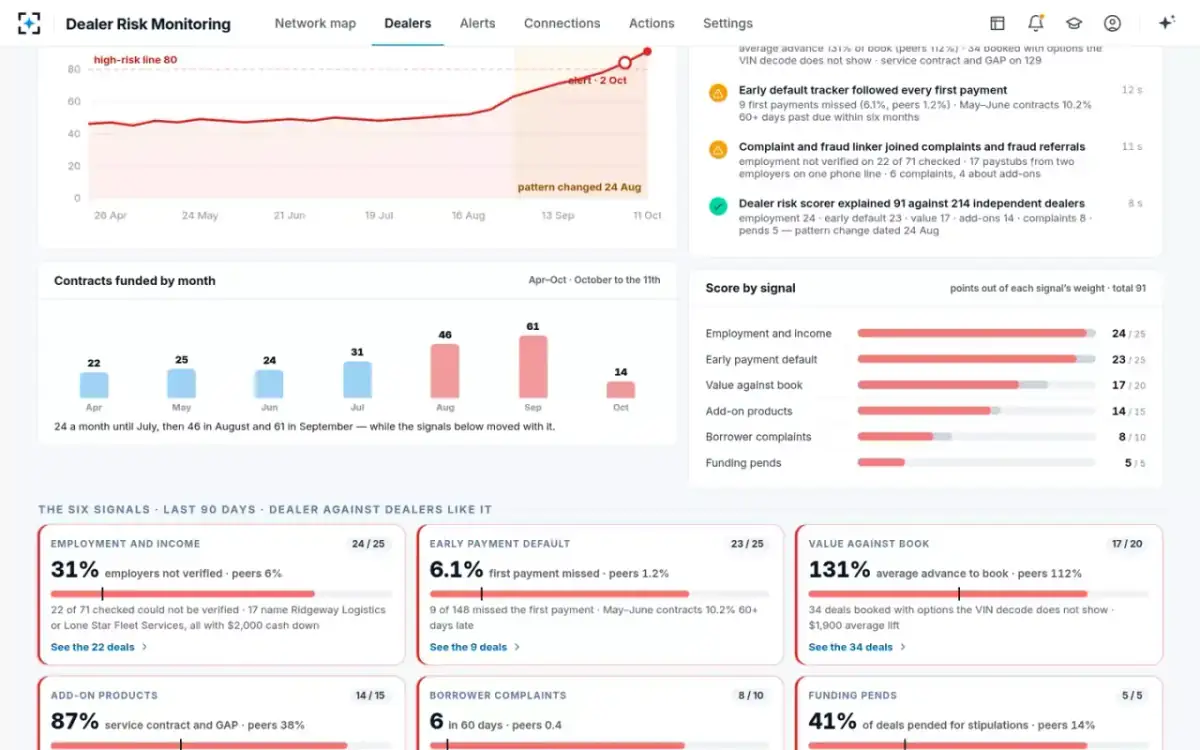
One dealer’s score in Dealer Risk Monitoring, broken into its six signals
Why the quarterly dealer review finds it too late
Most lenders already review dealers. The review is quarterly, it is built from a loss and delinquency report, and by the time a dealer appears on it the arithmetic has already worked against the lender twice. First, early payment defaults take sixty to a hundred and eighty days after funding to show. Second, the quarterly calendar adds up to another ninety. A dealer whose pattern changed in late August is therefore a candidate for a conversation some time in the following spring — and in the sample lender’s case that dealer went from twenty-four contracts a month to sixty-one while the clock ran.
From a dealer’s pattern change to a signed action: two ways of running the same work
- Waiting for early defaults to show75d
- Joining by hand20d
- Waiting for the next review30d
- Sample, draft, sign20d
- Waiting for early defaults28d waiting + 4d of work
The honest reading of that figure is that twenty-eight of the second lane’s thirty-two days are still waiting, because no amount of computation makes a first payment fall due sooner. What continuous scoring removes is the twenty days of joining five desks’ data by hand and the thirty days of waiting for a meeting — and, crucially, it lets the other five signals, all of which are available on the day a contract funds, raise the alert before the default signal arrives at all.
Peers, not averages: who a dealer is compared with
A dealer score against a portfolio average is close to useless, because dealer type predicts performance before any behaviour does. Federal Reserve economists comparing buy-here-pay-here lending with traditional auto lending found that “BHPH loans have delinquency and default rates that are respectively 2.65 and 1.88 times higher than those of loans from traditional auto lenders”, and that roughly 78% of buy-here-pay-here volume goes to subprime borrowers against 27% for traditional lenders (FEDS Notes, 8 May 2026). Score those two populations together and every independent used-car dealer looks like a problem and every franchise store looks clean.
So the peer group is a decision the lender has to make and write down. In the sample lender it is a setting with two parts: dealer kind — franchise or independent — and ninety-day volume band, so a store writing thirty contracts a quarter is measured against stores writing thirty, not against one writing three hundred. A minimum volume to score at all (ten contracts in ninety days in the sample settings) keeps small samples from producing dramatic percentages.
Seasonality belongs in the same decision. Model-year changeover, tax-refund season and quarter-end push both volume and mix around for every dealer at once; a score computed against the same period’s peers absorbs that, while a score computed against the dealer’s own trailing year does not. Dealer Risk Monitoring does both, and shows them separately — the dealer against its own history, and the dealer against dealers like it — because the two answer different questions.
What supervisors expect: indirect lending due diligence
Nothing in this method is novel to a supervisor. The NCUA’s letter on indirect lending sets out the elements of a due diligence programme — a planning process, written policies covering underwriting and monitoring, a review of the vendor’s financial and operational risks, periodic assessment of the legal agreements, and a risk management process — and names the measurement: “The most effective method of evaluating the performance of a vendor is through an analysis of the vendor’s static loan pool data”, reported per dealer with “delinquency rates, default rates, current and cumulative losses, prepayments, and rates of return” (10-CU-15).
The same letter publishes the warning signs examiners look for, and five of the six signals above appear in it: “High instances of first payment default, payment deferment, and account re-aging”; “Frequent refinancing of past due interest, repairs, and add-on expenses (GAP Insurance)”; “Insufficient loan documentation”; and “Poor dealer management including … dealer-created down payments through dealer incentives, inflated or fraudulent trade-in or purchase price; or continuous overdrafts in dealer reserve accounts.” The OCC’s handbook adds the instruction to examiners: “Examiners should closely scrutinize any channels or sources having an elevated level of negative customer outcomes such as higher levels of delinquency, losses, negative amortization, or consumer complaints” (Retail Lending).
And in September 2026 the expectation stopped being advisory for at least one lender. Announcing a $694 million settlement joined by 41 states, the Arizona Attorney General described allegations that the lender’s “dealer compensation methodology and lack of reasonable dealer oversight resulted in dealers aggressively selling” service contracts and guaranteed asset protection to buyers who did not know they were buying them. The remedy is specific: a mandated process against packing that includes “enhanced pre-purchase disclosures, a post-purchase process … and dealer monitoring”, plus a seven-year cap on vehicle prices at 109% of retail book value (Arizona Attorney General, 17 September 2026). Dealer monitoring is now, for that lender, an obligation with a date on it.
How often should a lender score its dealers?
The interagency guidance on third-party relationships gives the rule without giving a number: “Ongoing monitoring may be conducted on a periodic or continuous basis, and more comprehensive or frequent monitoring is appropriate when a third-party relationship supports higher-risk activities” (SR 23-4 attachment). The question for an auto lender is therefore not what the rule says but what the signals allow.
Four of the six signals change daily — every funded contract carries its value, its add-ons, its pends and its verification result on the day it funds. Complaints arrive continuously. Only early payment default moves on a monthly cycle, because payments are monthly. A quarterly scoring cadence therefore throws away four signals’ worth of timeliness to accommodate the slowest one. Nightly scoring costs nothing extra once the joins exist, and it changes what an alert means: instead of “this dealer’s numbers were bad last quarter”, the alert carries a date — the week the pattern changed — and that date is what makes the conversation with the dealer specific.
The threshold matters as much as the cadence. The sample lender raises an alert on a fifteen-point rise within thirty days, or on any score crossing eighty, and reviews anything above the high-risk line within ten business days. Set the rise too small and relationship managers drown; set it too large and the alert arrives at the same time as the loss. Both numbers are settings, versioned, with the change on the audit trail.
From alert to signed action: who decides what
A score is an instruction to look, never an instruction to act. That separation is the whole governance design: agents read, join, score, sample and draft; people verify and sign. The chain below is the one the sample lender runs, with each step’s hard limit written beside it.
Alert to signed action in Dealer Risk Monitoring: five reading steps, two signing steps
Agent
Deal signal readerReads every funded contract each night — advance to book against the decoded options, add-on products, stipulation pends, employment checks — and attributes each to its dealer.
Never: Never changes a contract or a funding decision
Agent
Early default trackerFollows the first six payments on every contract and computes first-payment and early default by dealer and by month funded.
Never: Never contacts a borrower
Agent
Dealer risk scorerScores each dealer against its own history and its peers, explains the score as points by signal, and raises an alert when the pattern changes.
Never: Never acts on a score alone — an alert asks for a look
Agent
Review pack builderSamples deals behind each signal and verifies them at source: the employer at an independently found number, the state register, the build sheet, the signed product menu.
Never: Never treats a sampled deal as proven without a document on file
Agent
Dealer action recommenderDrafts the least action that would stop the pattern — watch, restrict with conditions, or terminate — with the repurchase demand and the dealer notice.
Never: Never restricts, terminates or sends a notice
A person decides
Dealer risk analystReads the sampled deals and the documents behind them, and signs a watch with the meaning of the signature recorded.
A person decides
Head of Auto Credit RiskCo-signs a restriction before any notice leaves the bank; a termination needs the Head of Auto Finance as well.
The reason to draft the smallest effective action, rather than the strongest available one, is that termination is a blunt instrument with its own costs: it strands the relationship manager, it ends the lender’s visibility into the dealer’s book, and it does nothing about contracts already funded. A restriction with conditions — the bank verifies employment on every deal, the advance is capped, each add-on needs a signed menu, and the file is reviewed in thirty days — keeps the dealer measurable while the pattern is tested.
What a dealer risk report has to be able to show
The test of a monitoring programme is not the score; it is what the programme can put in front of a relationship manager who disagrees, a committee that has to sign, and an examiner who asks later. Six things have to survive that, and each is a question worth asking of any report, including ours.
Six things a dealer risk report has to survive
- The contracts behind every number
A percentage nobody can open is an opinion. Each signal must list the specific contracts that produced it, by number, so the conversation is about deals.
- The peer group, named on the page
Against which dealers, over which period, with what minimum volume. A comparison whose population is unstated cannot be challenged, and so cannot be defended either.
- The date the pattern changed
Not the date the alert fired. The dealer will ask when this started, and an answer in weeks is the difference between a specific discussion and an accusation.
- Exposure on the open book, separately
Restricting new business does not touch contracts already funded. A report that mixes the two overstates what the decision achieves.
- What was waived, and by whom
Pends waived to fund a deal are the lender’s own control failing. A dealer report that never implicates the lender is not being honest about the data.
- What happened after the last action
Every watch, restriction and termination, who signed it, and how the dealer’s deals performed afterwards — the only evidence that the thresholds are set right.
The dealer network in Dealer Risk Monitoring, scored overnight
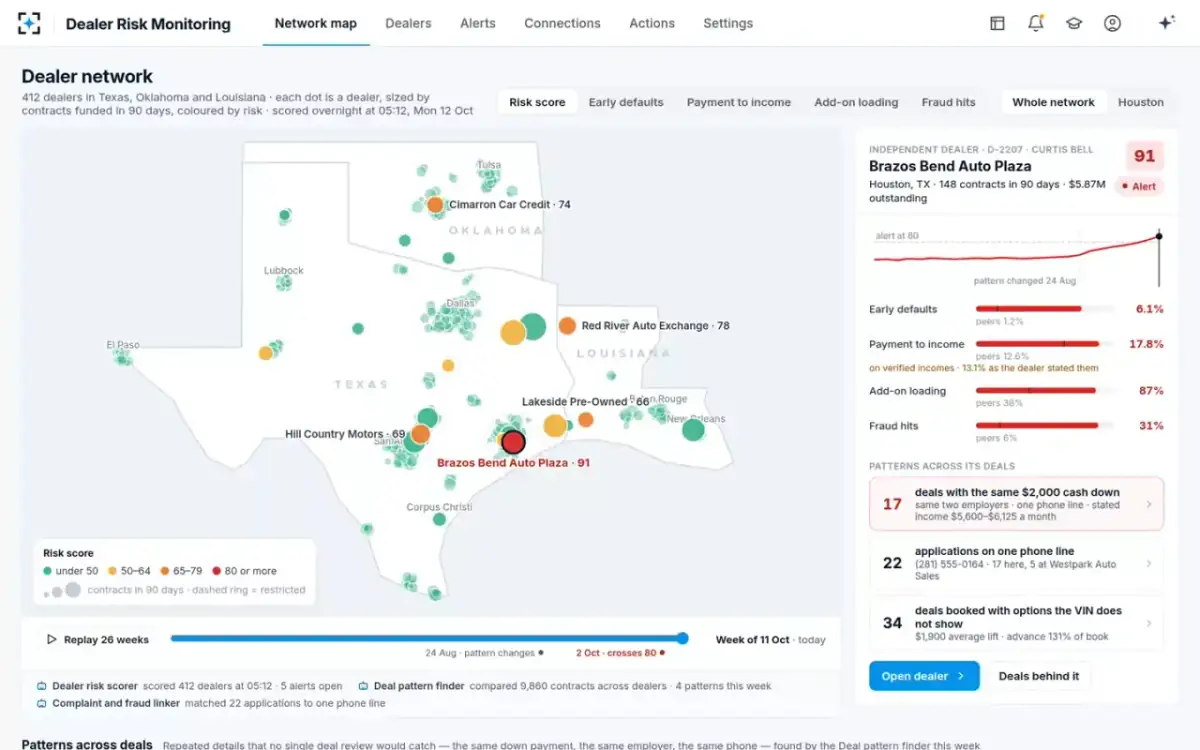
412 dealers scored at 05:12 · 5 alerts open
One last point about ownership. The signals in a lender are held by five different desks — funding, fraud, collections, compliance and the relationship manager — and the reason the quarterly review exists at all is that joining them by hand is a week’s work. Who is accountable for a dealer, and why the rules that make indirect lending safe also make that join harder, is the organisational half of this problem. To see the scoring, the sampled deals and the signed actions on your own funded contracts, start from Dealer Risk Monitoring.
Questions people ask
What is a dealer scorecard?
A dealer scorecard is a per-dealer summary of the signals a lender tracks, usually with a composite number and a comparison against peers. The useful ones are not the ones with the cleverest weighting; they are the ones where each component opens the contracts behind it. The NCUA’s expectation is more specific than “a scorecard”: a static loan pool report per dealer showing delinquency, default, current and cumulative losses, prepayments and rate of return.
How do banks monitor car dealers?
Through the contracts, because that is all they have. A bank sees what the dealer submits, what the funding desk pends, what verification finds, what the borrower pays, what the borrower complains about and what the vehicle was worth. Monitoring is the practice of attributing all of that to the dealer, dating it, and comparing it with dealers of the same kind and size. Dealer visits and financial statements matter too, but they are periodic and self-reported; the contract data is neither.
What signals show a dealer is a problem?
Signals that move together are worth more than any single one. In the sample lender’s case four moved at once after 24 August: employment unverified on 31% of checked deals against a peer rate of 6%, first payments missed on 6.1% against 1.2%, advance at 131% of book against 112%, and both add-on products on 87% of deals against 38%. Any one of those has an innocent explanation. Four at once, while monthly volume went from 24 contracts to 61, is a pattern to verify.
Who decides to restrict a dealer?
A person, with a name and a recorded reason. In the sample lender the dealer risk analyst signs a watch alone; a restriction needs the Head of Auto Credit Risk to co-sign; a termination needs the Head of Auto Finance as well, and the notice to the dealer is sent only when every signature is in. Who may do what is a setting; that no agent may do any of it is not.
Is a high score evidence of fraud?
No, and treating it as such is the fastest way to lose a defensible programme. A score is a ranking of where to look. Only a sampled deal with a document on file — an employer reached at a number the lender found itself, a build sheet, an unsigned product menu — counts as proven, and only proven deals belong in a repurchase demand or in any statement to the dealer.
How often should dealer agreements be reviewed?
The NCUA expects a process to “periodically assess the legal agreements and needs for each program”, and specifies what the agreement must cover: dealer compensation, credit criteria, documentation standards, dealer reserves, dispute resolution and exit clauses. In practice the trigger matters more than the interval: an agreement that has not been re-read since the last time the lender wanted to enforce a repurchase clause is overdue, whatever the calendar says.