Employment verification on an auto loan is the step where a lender decides whether the income typed into a credit application is a fact or a claim. In indirect lending it is also the step most often performed on evidence the dealer supplied, which is the reason it fails: a paystub, an employer name and a phone number all arrive in the same envelope as the deal, and checking them against each other proves only that whoever assembled them was consistent. Botminds’ Dealer Risk Monitoring follows that one fact from the application to the signed decision, records which rung of the verification ladder each contract reached, and reports the result per dealer so a store whose income claims cannot be confirmed is visible while it is still writing business.
The worked figures below come from a fictional sample lender, Coppervale Bank, and a fictional dealer; the people, employers and contract numbers are characters in sample data, and every product number is tagged demo or estimated. Rules and enforcement material are linked where they appear.
The fact we are following, and where it starts
The fact is a number: stated monthly income, written on the credit application at the dealership. Almost everything downstream depends on it. It sets payment to income, which is usually the binding affordability test on a car loan; it moves the applicant between credit tiers and therefore the rate; it decides the maximum advance; and it is the figure a court or a regulator will ask about if the contract ends badly.
It also starts life in the worst possible place for a lender — a form filled in at a desk where the person helping is paid when the deal funds. The supervisory language about this is unambiguous. “Sufficient due diligence should support credit information before it is used,” the OCC writes, listing what careful banks verify directly: “current employer, primary income (amount, frequency, and type), supplemental sources of income (source, amount, and likely recurrence), and the value of any collateral taken to secure the loan.” The sentence that follows is the one worth pinning above a funding desk: “Banks relying on customer assertions rather than direct verifications face greater uncertainty, assume an inherently higher quantity of credit risk, and should have enhanced risk management practices to compensate” (Comptroller’s Handbook, Retail Lending).
The life of one stated income, from the application to the signed decision
- Income stated on the applicationstated
- Paystub or bank statement attacheddocumented
- Employer name and a phone number givenasserted
- Deal pended for a stipulationpend
- Employer reached on a number the lender foundcontact
- Register searchedproved
- Which rung the contract reached, stored with itrecorded
- Counted per dealer against its peersscored
- Sampled, re-verified, and signedsigned
What counts as proof of income for an auto loan, and what a paystub is not
A paystub is a document about an employer, produced by whoever has the template. It is excellent evidence that someone with a printer believes a person earns a figure, and weak evidence that the person does. The three failure modes a funding desk meets are an entirely fabricated stub, a genuine stub with the figures edited, and a genuine stub from a genuine employer for a job that ended two months ago.
So experienced verifiers read a stub for internal tells rather than for its headline number: arithmetic that does not reconcile across year-to-date, deductions, net and gross; a tax withholding that does not match the stated filing status; a pay date that is not a working day; a check number sequence that repeats across unrelated applications; a template identical to one seen on a different contract. In the sample lender’s review, two of those tells appeared on the same file — the same paystub template as another contract and the same check number sequence — which is how the reviewer knew to go further rather than to decline.
The enforcement record is blunt about where the editing sometimes happens. Charging a group of dealerships, the Federal Trade Commission alleged that “in many cases Tate’s Auto falsely inflated the numbers, making it appear that consumers had higher monthly incomes than they really did”, and that the dealerships “often inflated the amount of a consumer’s down payment as well” (FTC, August 2018). A document supplied by the party that may have written it is not independent evidence, however well it is examined.
Can a lender call your employer, and which number?
Yes — a verification of employment is an ordinary part of consumer lending, and the call confirms employment and sometimes income, usually through a payroll or human resources contact. What matters far more than whether the call happens is how the number was obtained.
A number supplied on the application is part of the claim being tested. If the employer is invented, the number rings to a confederate or a voicemail greeting that names the company; if the employer is real but the job is not, the number may route to someone with no reason to check. A number the lender found for itself — from a public register, the employer’s own published contact details, a directory the lender maintains — tests something the application cannot control.
That is why a single repeated phone line across many applications is such a strong signal, and why the same employer phone number appearing on applications from two different dealers is worth more than any individual call. A controlled number answers every time, and answers correctly every time, which is exactly what makes a run of successful verifications on one line unremarkable until somebody counts them.
Public registers: what a state business search can and cannot settle
The cheapest independent check available is a state business register, and in most states it is free. Texas, where the sample lender’s dealers sit, publishes a taxable entity search alongside its franchise tax, which “is a privilege tax imposed on each taxable entity formed or organized in Texas or doing business in Texas” (Texas Comptroller of Public Accounts). A business operating in the state is expected to be on it.
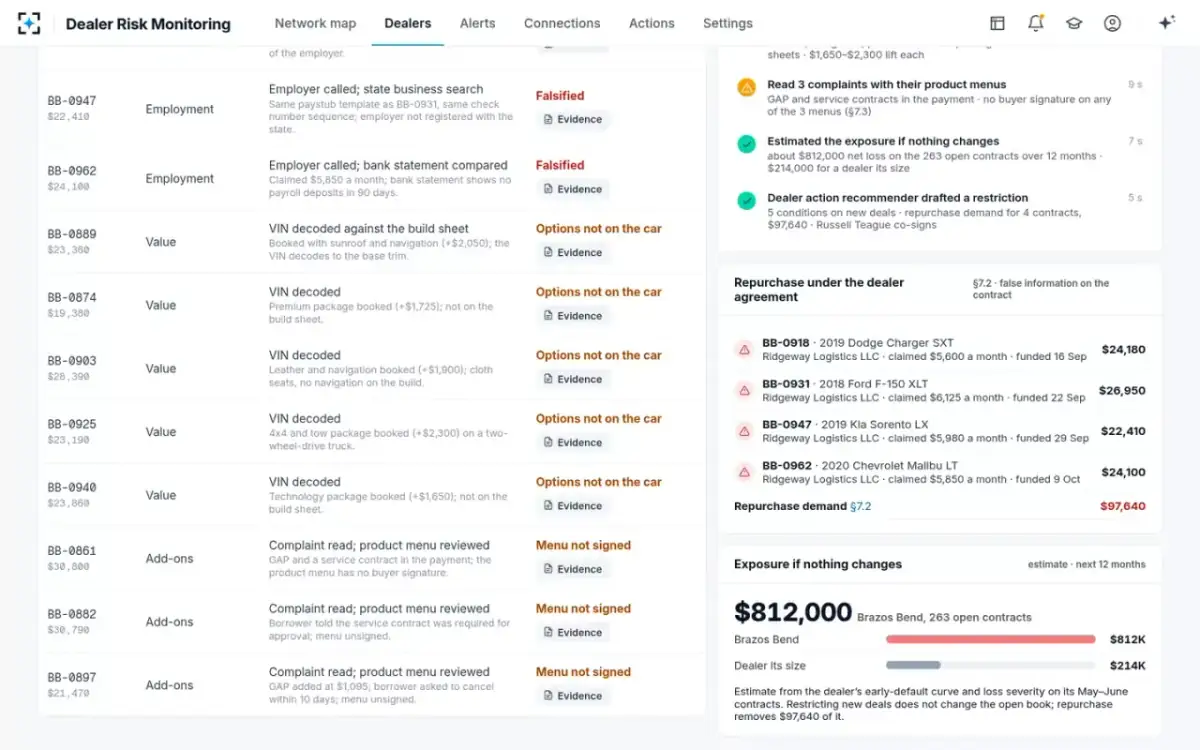
What the register settles is narrow and useful: whether an entity of that name exists, when it was registered, its registered agent and its registered address, and whether its registration is current or forfeited. In the sample review that was enough to turn two files: one named employer had no business at the address on the application and was not registered at all; the second had been registered three weeks before the first of these contracts funded, with the same registered agent as a third company.
What it cannot settle is employment. A registered company is not a company with employees, a current registration is not a current payroll, and a small employer may legitimately sit below a state’s reporting thresholds. A register result therefore belongs in one of two sentences in a file — “no such entity is registered”, which is strong, or “an entity of that name is registered, with this agent and this date”, which is context. Neither of them proves that a person works there.
Stipulations and pends on an auto loan: the control that is waived
A stipulation is a condition the lender attaches to an approval: supply this paystub, this proof of residence, this proof of insurance, and the deal will fund. A pend is the state the deal sits in until the stipulation is cleared. Together they are the mechanism by which a lender gets evidence out of a dealership at all — and they are also where the lender’s own discipline fails, because a pend is friction in a process measured on speed, and the dealer can send the deal to a competitor while the lender waits.
So pends get waived. Waiving one is sometimes right; waiving a quarter of them at one dealer, by one approver, for one kind of stipulation, is a control that has stopped working. Supervisors expect waivers to be visible: exceptions “should be infrequent”, the NCUA writes of indirect lending policy, and “All exceptions should be approved by credit union personnel responsible for administering the indirect lending program and reported to the board of directors for their review” (Letter to Credit Unions 10-CU-15).
The useful discipline is to measure pends and waivers per dealer and to report them as a dealer signal, while acknowledging what they describe. A high pend rate says the dealer submits incomplete deals. A high waiver rate says the lender funds them anyway. The first is a dealer finding; the second is a finding about the lender, and a monitoring programme that never produces one of those is not reading its own data honestly.
The verification ladder, rung by rung
Verification is not binary, and recording it as a tick loses the only information that matters later. Each contract reached a particular rung, and the rung is what a reviewer, an auditor or a committee needs to know.
The verification ladder: what each rung settles, and what it leaves open
| Rung | What is done | What it settles | What it leaves open |
|---|---|---|---|
| 1. Stated | The income is taken from the application as written. | Nothing. It records what was claimed and by whom. | Everything. This is the rung most disputed files turn out to have reached. |
| 2. Documented | A paystub, a bank statement or a tax document is on file. | That a document exists and reconciles internally. | Who produced it. The document arrived with the deal. |
| 3. Corroborated | The document is compared with something else on file — the bank statement against the stated payroll deposits, the employer against a register. | Whether two independent records agree. A claimed $5,850 a month with no payroll deposits in ninety days fails here. | Whether the employer exists as an employer of this person. |
| 4. Contacted | A person is reached at the employer, on a number the lender found for itself, and confirms the employment. | Employment, and often income. This is the first rung that produces proof. | Nothing much — but it costs minutes per file and cannot run on every deal at scale. |
| 5. Re-verified | The contact is repeated independently during a dealer review, by someone other than the original verifier. | That the first verification was done, and done correctly. | Only applies to a sample. It is a test of the control, not of the book. |
Two design notes follow from the ladder. The rung should be stored on the contract rather than in a verifier’s queue, because the dealer question is asked months later. And the rung should be recorded even when the answer is unwelcome: a contract where the employer could not be reached is not the same as one where the employer denied the employment, and a programme that collapses both into “not verified” throws away the distinction that decides whether a repurchase demand is arguable.
Measuring the verification rate by dealer
A verification failure rate means nothing in isolation and a great deal against a peer group. Thin-file buyers work for small employers, are paid in ways that are harder to confirm and change jobs more often; a dealer serving them will show more unverifiable income with nothing wrong at all. The comparison that carries weight is against dealers of the same kind, size and market.
Employment and income that could not be verified, by dealer
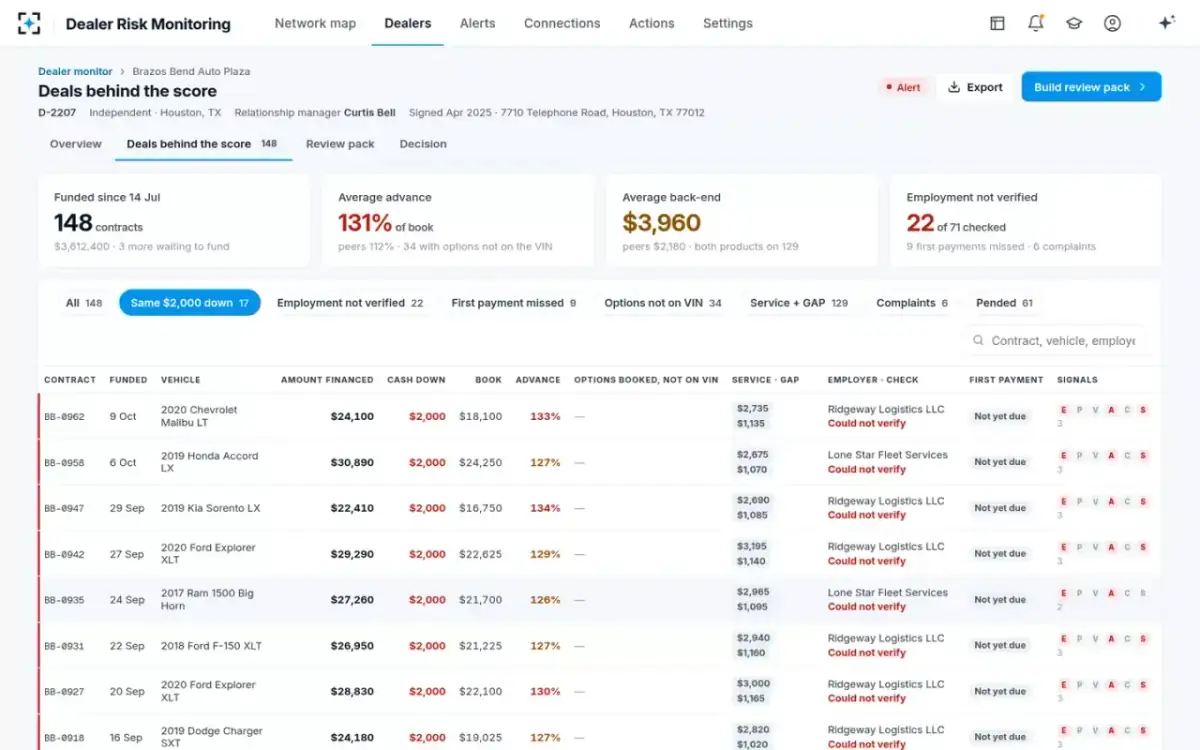
Two further cuts turn that rate into something a credit officer can use. The first is payment to income recomputed on verified figures: at the sample dealer it runs 17.8% against 13.1% computed on the incomes as the dealer stated them, with a peer median of 12.6% — so the stated figures were not merely optimistic, they were optimistic by roughly the amount needed to clear the test. The second is the funding pend rate, 41% of submitted deals against a peer rate of 14%, which says the incompleteness was visible at submission.
Read together with the other five signals, that is what moves a dealer up a ranking. The six signals a lender can score dealers on includes this one at the heaviest weight in the sample lender’s settings, precisely because it is the only one that is both available on the day of funding and capable of producing a document.
Every contract and its verification result, in Dealer Risk Monitoring
What happens if income cannot be verified
Before funding, the honest answer is that the deal does not fund, or it funds on a different basis — a lower advance, a shorter term, a co-signer, or an approval priced for the uncertainty the OCC describes. The failure mode is the third option nobody writes down: the stipulation is waived because the deal is at risk of going elsewhere.
After funding, the lender’s options narrow to the dealer agreement. A contract where the employer actively denies the employment, or where a register shows no such business, is usually false information within the meaning of a repurchase clause; a contract where the employer simply could not be reached usually is not. The sample review holds both: four contracts totalling $97,640 were listed as eligible for repurchase under section 7.2, and another eighteen were recorded as unverified and excluded from the demand. Separating them is not caution, it is what makes the demand collectable — what each lever actually reaches depends entirely on that distinction.
The borrower’s position is unchanged by any of it. Their obligation stands, they are not told their income is disbelieved on the strength of a pattern, and nothing in the dealer file names them outside the review pack. Where a verification failure points at identity rather than at a dealer, the lender’s duties to that consumer are triggered by what it has learned, not by what it decides to do about the store.
What the dealer supplies, against what the lender finds for itself
Supplied with the deal: Typed on the application, sometimes without the buyer seeing the field.
Obtained independently: Confirmed by a person at the employer, or corroborated against payroll deposits on a bank statement.
Supplied with the deal: A name, an address and a phone number on the form.
Obtained independently: A state register search: existence, registration date, registered agent and address.
Supplied with the deal: A number that will answer and will confirm.
Obtained independently: A number the lender found and keeps in its own directory of employers.
Supplied with the deal: A paystub produced by whoever has the template.
Obtained independently: A bank statement the buyer retrieves, or a tax record — neither routed through the dealership.
Supplied with the deal: That the file is internally consistent.
Obtained independently: That the fact is true. Only the right-hand column belongs in a statement to the dealer.
Supplied with the deal: Nothing. It arrives with the deal.
Obtained independently: Minutes per file, which is why it runs on a sample and on everything at a restricted dealer.
What goes in the file, and what an auditor re-checks
The file is the only part of this that survives. A verification nobody recorded did not happen, and a finding whose evidence cannot be produced will not hold against a relationship manager, let alone against a dealer’s counsel.
What a verification has to leave behind to count as proven
- The rung reached, on the contract
Stated, documented, corroborated, contacted or re-verified — stored with the contract, not in a work queue that closes.
- The number dialled, and where it came from
The register entry, the directory, or the employer’s published page. A verification against the number on the application records that fact too, so a later reader knows what it is worth.
- Who was reached, and when
A name or a role, a date and a time. “Employer confirmed” with no person behind it is a note, not evidence.
- The document, and the tells read on it
The stub or statement itself, plus what the verifier checked: the arithmetic, the check number sequence, the template. The tells are what made a reviewer go further.
- The register result, verbatim
Entity name, registration date, agent and status as the register returned them — not a summary. Registers change, and a dated capture is the only reproducible version.
- The sampling rule, written before the sample was drawn
Which contracts were eligible and how they were chosen. Without it, every finding is open to the argument that the lender went looking for the answer it wanted.
- The distinction, in the words used
Unverified and disproved are different outcomes with different consequences. A file that uses one word for both cannot support a repurchase demand on the half that deserves one.
Who re-checks it matters as much as what is in it. Interagency guidance on third-party relationships asks a lender to dedicate “sufficient staffing with the necessary expertise, authority, and accountability” to ongoing monitoring (SR 23-4 attachment), and in practice the re-check belongs to someone other than the original verifier — internal audit, credit risk review, or a dealer risk analyst sampling during a review. In the sample lender, twelve contracts were sampled across the signals and each was taken back to source independently; four came back proven and the rest did not, which is the normal and healthy ratio.
The sampled contracts and the evidence behind each, in Dealer Risk Monitoring
One fact, followed end to end, is a short way of auditing a whole dealer programme: wherever the stated income stops being tested, that is where the programme ends. To see the verification result on every contract, the sampled deals and the signed decision on your own funded book, start from Dealer Risk Monitoring.
Questions people ask
What is a verification of employment?
A confirmation, obtained from the employer rather than from the applicant, that a person works there and often what they are paid. It can be a phone call to a payroll or human resources contact, a written form returned by the employer, or a record drawn from a payroll data service. For an indirect auto lender the defining question is not the method but the route: a confirmation obtained through a contact the dealership supplied tests the dealership’s consistency, not the borrower’s income.
How do lenders spot a fake pay stub?
By reading it as a document rather than for its number. The common tells are arithmetic that does not reconcile between gross, deductions, net and year-to-date; withholding that does not match the stated filing status; a pay date falling on a weekend or holiday; rounded figures where a real payroll would produce odd cents; a template or check number sequence seen on another application. None of those is proof — they are reasons to go to the employer or to the bank statement, which is where proof lives.
What is a funding pend?
A deal that has been approved subject to conditions and is held until they are met — the missing paystub, proof of residence, proof of insurance, a signed document. It is the lender’s main lever for getting evidence out of a dealership, and the one most eroded by speed: every day a deal sits pended is a day the dealer can place it with another lender, which is why waiver rates need to be measured and reported per dealer alongside the pend rate.
Can a lender verify income without calling the employer?
Often, yes. Bank statements showing recurring payroll deposits that match the stated amount and frequency are strong corroboration and come from outside the dealership; tax records and payroll data services serve the same purpose. The weakness of all of them is coverage — cash income, irregular hours and recently started jobs produce genuine applicants whose income cannot be confirmed this way, which is exactly why the result has to be recorded as a rung rather than as a pass or fail.
Does a failed verification mean the borrower lied?
No, and the distinction is the most important one in this subject. Unverified means the lender could not confirm the fact; disproved means an independent source contradicted it. Most unverified files are small employers, changed jobs or an unanswered phone. Only the disproved ones support a statement to a dealer or a repurchase demand, and a programme that blurs the two will make claims it cannot stand behind.
How many deals should a lender verify?
Enough that the rate per dealer is meaningful, and all of them at a dealer under restriction. A fixed percentage applied evenly wastes effort on dealers that never fail; the useful design is a floor everywhere, a higher rate for dealers above an alert line, and complete coverage as a condition of continuing to buy from a dealer being tested. In the sample lender, 71 of one dealer’s 148 contracts had been checked by the time the review opened, which is why its rate carries a denominator wherever it is shown.