The auto loan to value ratio is the amount financed divided by the vehicle’s value, and on a car loan it routinely exceeds 100% — the Consumer Financial Protection Bureau’s own pilot data puts the average at 119.3% when negative equity from an old loan is rolled into the new one, against 88.9% where the trade-in had positive equity. That means the useful question is never whether a ratio is above the collateral, but what put it there and whether one dealer puts it there more often than its peers. Botminds’ Dealer Risk Monitoring computes the ratio on every funded contract, splits it into the terms that produced it, and ranks dealers against dealers of the same kind and size so a policy line can be set on evidence rather than on habit.
Figures from the product below describe a fictional sample lender, Coppervale Bank, and are tagged demo or estimated. Published research and settlement terms are linked where they appear.
What published data says about loan to value on US auto loans
119.3%
average LTV where negative equity was rolled into the new loan, 2018–2022
88.9%
average LTV where the trade-in carried positive equity
2×
more likely to be assigned to repossession within two years, when negative equity was financed
What is loan to value on an auto loan?
Loan to value compares what the lender put out against what it could recover if the borrower stopped paying. On a mortgage both halves are relatively settled; on a car loan neither is. The numerator is the amount financed, which includes a great deal that is not the car. The denominator is a book value drawn from a published guide, which exists in several flavours and moves monthly.
Two consequences follow, and they shape everything else on this page. First, an auto LTV above 100% is normal rather than alarming: more than half of the accounts in the CFPB’s pilot had no trade-in at all and still averaged 101.6%. Second, nobody computes it the same way. Comparing its own pilot data with an industry credit-reporting dataset, the Bureau found the differences it saw “were more an indication of differences in calculations or definitions than inconsistency in the auto finance data pilot dataset” (CFPB, June 2024). A credit policy that states a limit without stating the formula has not stated a limit.
How do you calculate auto loan to value, term by term?
Write the numerator out and the argument about where the line belongs usually resolves itself, because the terms are owned by different people and only some of them say anything about the dealer. Four of the five below are added at the dealership.
The five terms of the amount financed, and who prices each
Vehicle price
agreed price − cash down − positive trade-in equity
What the car sold for, net of money the buyer actually put in. This is the term the September 2026 settlement capped, at 109% of retail book value.
The dealer
Negative equity rolled in
+ prior loan balance − trade-in allowance
The unpaid balance on the old car, financed again. Present on 11.6% of loans in the CFPB pilot, averaging $5,073 new and $3,284 used.
The borrower’s last loan
Add-on products
+ service contract + guaranteed asset protection + other
Charged as a lump sum at origination and financed over the term. Penetration and price are both dealer decisions.
The dealer
Taxes, title and fees
+ sales tax + registration + documentation fee
Largely fixed by the state, except the documentation fee. Small per deal, not small across a book.
The state, and the dealer
The denominator
÷ book value at the chosen guide, edition and condition
Clean trade, clean retail, wholesale or rough — the choice changes the ratio by more than most policy debates do.
The lender
The ratio worked through on one sample contract, line by line
| Step | Calculation | Result |
|---|---|---|
| 1. Vehicle price agreed | The price on the contract before anything is added or taken off | $21,400 |
| 2. Less cash down and positive trade equity | − $2,000 cash down, no trade-in equity | $19,400 |
| 3. Plus negative equity rolled in | + $2,180 unpaid on the previous loan, above the trade allowance | $21,580 |
| 4. Plus add-on products | + $2,820 service contract + $1,020 guaranteed asset protection | $25,420 |
| 5. Less the rebate applied, plus tax, title and fees | − $2,900 rebate + $1,660 tax, title, registration and documentation fee | $24,180 |
| 6. Book value, decoded equipment only | The guide value the policy names, computed on equipment the identification number supports | $19,025 |
| 7. Advance to book | $24,180 ÷ $19,025 | 127% |
The reason to keep the terms separate is that they fail differently. Negative equity is the borrower’s history arriving with them, and a dealer that serves a working-class market will show more of it with no misconduct whatever. Add-on loading is a dealer behaviour. Vehicle price against book is a dealer behaviour too — and a car booked with equipment it does not have inflates the denominator rather than the numerator, which makes a mis-booked deal look better on this ratio, not worse.
Where the amount financed goes on one sample contract
Contract BB-0918 · $24,180 financed
- Vehicle, net of cash down and rebate · 68%
- Negative equity rolled in · 9%
- Service contract and GAP · 16%
- Tax, title and fees · 7%
A deal at the peer median
- Vehicle, net of cash down and rebate · 81%
- Negative equity rolled in · 5%
- Service contract and GAP · 6%
- Tax, title and fees · 8%
The book value you compare with, and why advance over book is the same question
Lenders in indirect auto lending usually say “advance over book” rather than loan to value, and they mean the same ratio with the denominator pinned to a specific guide value. Which value is a real decision. A clean-trade number and a clean-retail number for the same car can differ by several thousand dollars, so a 115% limit against one is a materially different policy from 115% against the other. Condition grading adds a second lever: a book value taken at clean condition on a car that is not clean is an optimistic denominator nobody has tested.
Three practical rules follow, and they cost nothing to adopt. Pin the guide, the edition date and the condition grade in the policy, not in a spreadsheet. Record the denominator that was used on each contract, because a book value recomputed a year later will not reproduce the decision. And compute the equipment adjustment from decodable equipment only, so that a dealer cannot raise its own denominator by describing the car generously.
The OCC expects this to be contractual rather than conventional: dealer agreements, it says, should “clearly specify credit criteria, loan documentation standards, collateral valuation requirements, reporting requirements, quality control reviews, and other methods that allow the bank to assess compliance” (Comptroller’s Handbook, Retail Lending). Collateral valuation requirements means: write down which book, and make the dealer sign it.
Does negative equity raise LTV? What rolling a loan forward does
Yes, and by more than most other single factor. The CFPB’s finding is worth reading as three numbers rather than one: 119.3% average LTV where negative equity was financed, 101.6% where there was no trade-in, 88.9% where the trade-in had positive equity. The gap between the first and the third is thirty points of collateral cover, and it arrives before the dealer has sold a single add-on.
It also predicts outcomes. Consumers who financed negative equity “were more than twice as likely to have their account assigned to repossession within two years compared to consumers who had a positive trade-in balance applied”, and almost one and a half times as likely as consumers with no trade-in (CFPB, 2024). The same accounts carried an average amount financed of $32,316 against $28,244 and $26,767, an average term of 73 months against 68 and 67, and an average credit score of 704 against 752 and 732. Negative equity does not travel alone.
For a dealer monitoring programme the operational point is that negative equity must be measured and then set aside. A dealer whose buyers arrive underwater is not misbehaving; a dealer whose contracts are above the line after the negative equity term is removed is doing something the peer group is not.
What LTV do lenders allow once add-ons are in the amount financed?
Add-on products sit in the numerator in full, on day one. “Dealers and finance companies often charge consumers all payments for add-on products as a lump sum at origination,” the CFPB’s auto finance supervisory report explains, and “generally include the lump sum cost of add-on products as part of the vehicle financing agreement” (Supervisory Highlights, Issue 35). A service contract and a guaranteed asset protection product together can add several thousand dollars to a deal, none of it recoverable from the car.
That makes add-on penetration a loan-to-value question as much as a conduct question. The sample lender’s problem dealer put both products on 87% of its deals where similar dealers manage 38%; the same report describes examiners finding servicers that had suspended title checks “for certain originating dealers and then financing GAP products that were void due to loss events recorded on the vehicles’ title histories” — products that “delivered no benefit to consumers but increased the amounts financed and the monthly payments”. A ratio built from such a deal is inflated by coverage that could never pay out.
So a limit expressed as a single number hides a choice: does the limit apply to the whole amount financed, or to the vehicle alone? Most policies mean the whole amount and most conversations mean the vehicle. Say which, and report both.
Where regulators and settlements have put the line
There is no federal maximum LTV for an auto loan. What exists is one recent, specific number arrived at through enforcement. Announcing the $694 million, 41-state settlement with a large subprime auto lender in September 2026, the Arizona Attorney General set out injunctive terms including that “For seven years, CAC must institute a price cap for vehicle prices at 109% of retail book value for certain consumers”, alongside processes “to prevent dealers from raising car prices due to credit worthiness or above advertised prices” (Arizona Attorney General, 17 September 2026).
Read it carefully before adopting it. The cap is on the vehicle price, not the amount financed; it is against retail book value; it applies to certain consumers; and it is a settlement term for one company, not a rule of general application. It is nonetheless the most concrete figure any US authority has attached to this question, and it says something a lender can use: a sale price materially above retail book, concentrated at particular dealers, is the thing authorities decided to stop.
The supervisory expectations around it are older and vaguer but point the same way. The NCUA’s red flags for indirect lending include “inflated or fraudulent trade-in or purchase price” and “Frequent refinancing of past due interest, repairs, and add-on expenses” (10-CU-15), and the OCC asks examiners to look hard at channels with elevated delinquency, losses, negative amortization or complaints.
Portfolio LTV hides the dealer effect
A portfolio average answers a question nobody asked. Used car values moved sharply through 2021 and 2022 and deficiency balances rose with them — the CFPB’s repossession analysis found deficiency balances rising significantly in 2022 as car prices declined (CFPB, Repossession in Auto Finance, January 2025). A book-wide LTV drifting upward in such a period tells the lender about the market. It says nothing about which of its four hundred dealers are responsible for the tail.
Average advance to book by dealer, one sample lender’s Houston independents
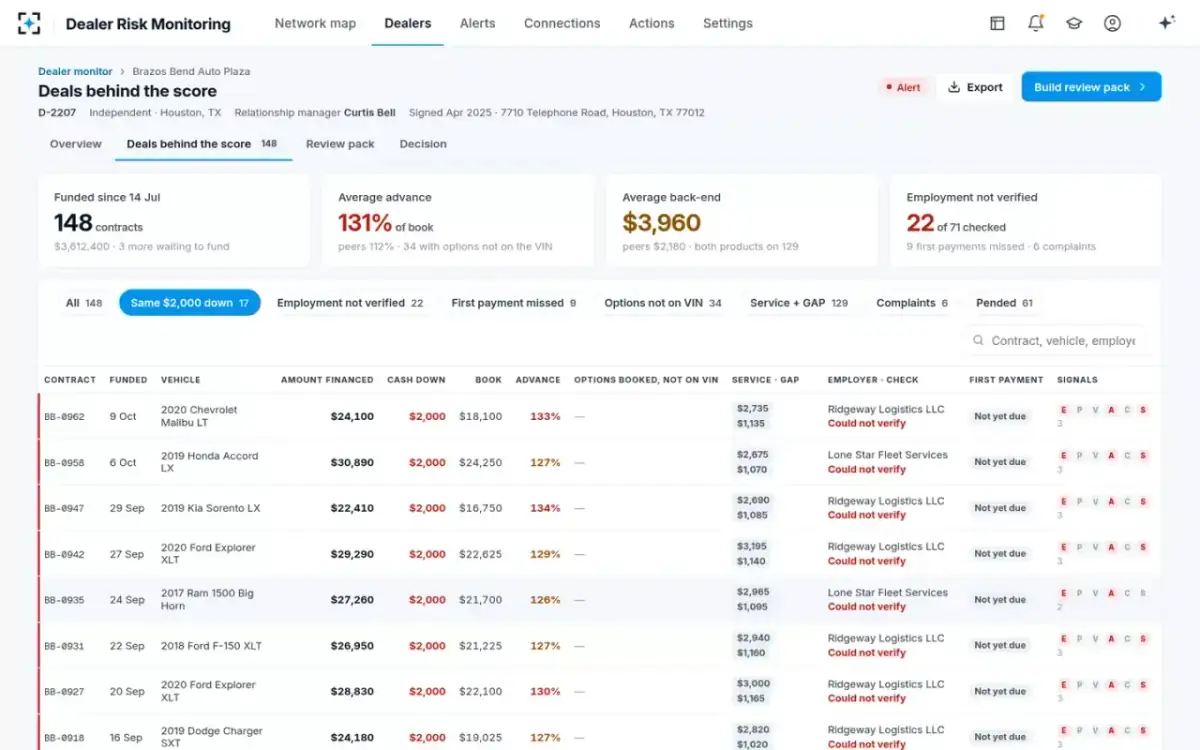
The arithmetic of why is simple enough to be worth stating. One dealer writing 148 contracts inside a book of 41,280 moves the portfolio average by less than a tenth of a point even when its own ratio is twenty points high. Dealer-level measurement is not a refinement of portfolio measurement; it is the only level at which this signal exists at all.
Every contract behind a dealer’s ratio in Dealer Risk Monitoring
Setting the tolerance, and what happens when a deal crosses it
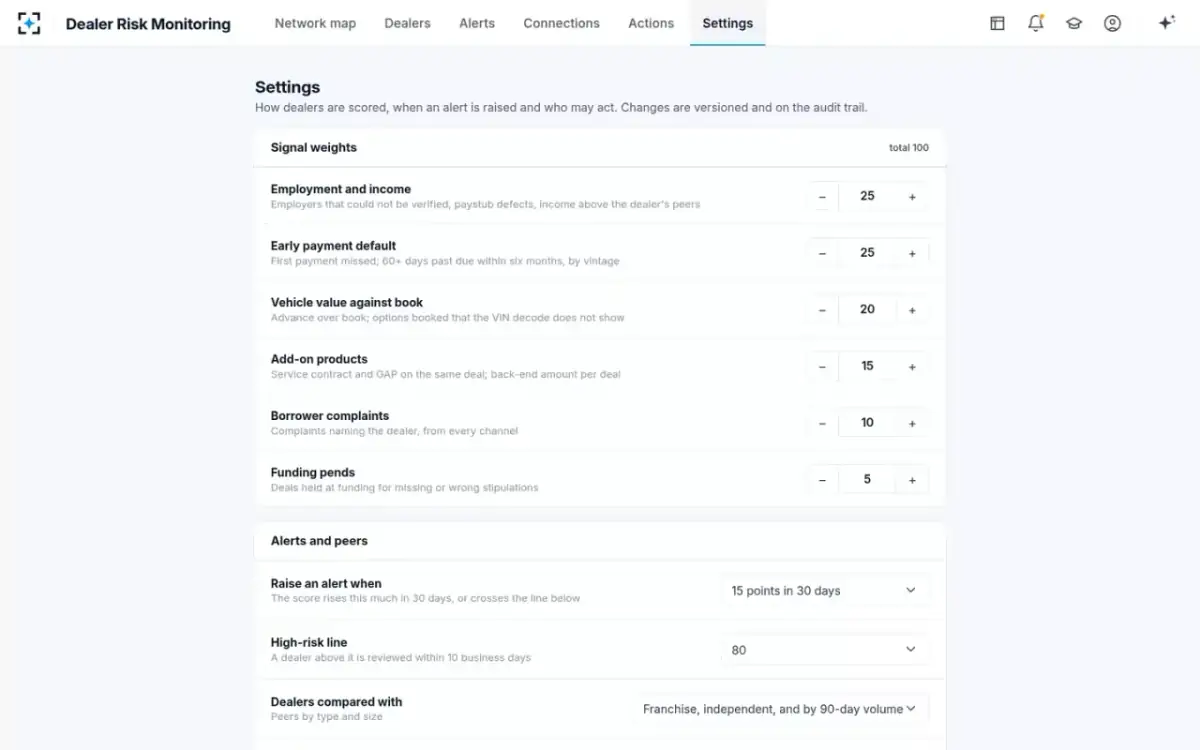
A tolerance is a policy choice with two parts — the number, and what crossing it does. In the sample lender the number is 115% of book, computed on decoded equipment only, and it is a setting with three permitted values rather than a constant buried in code; the change is versioned and sits on the audit trail. What crossing it does depends on when: at funding it raises a pend for the desk, and across a dealer’s book it feeds one of the six signals that make up the score.
Three design points are worth borrowing. Make the tolerance a condition the lender can impose on a single dealer, not only a book-wide rule — the sample lender’s restriction caps the advance for one dealer while leaving everyone else alone. Record every waiver with its approver, because pends waived to fund are the lender’s own control failing rather than the dealer’s. And review the line against outcomes at least annually: a tolerance that has never produced a declined deal is not a tolerance, and one that produces hundreds is a pricing decision in disguise.
The advance-to-book tolerance as a setting in Dealer Risk Monitoring
Advance over book is one of six signals a dealer monitoring programme watches, and like the others it is a reason to look rather than a verdict. Read it beside the full set of six and what each can prove, or see the ratio, the contracts behind it and the conditions it supports on your own funded book with Dealer Risk Monitoring.
Questions people ask
What is a good LTV for a car loan?
There is no standard figure, and comparing to a mortgage will mislead you: car loans routinely finance more than the car is worth. In the CFPB’s pilot data the average ran 88.9% with a positive-equity trade-in, 101.6% with no trade-in and 119.3% with negative equity rolled in. What makes a ratio good or bad is what is in it and whether the dealer that wrote it is an outlier against similar dealers.
What is the maximum LTV on an auto loan?
No federal rule sets one; lenders set their own in credit policy, as a percentage of a stated book value, often with exceptions for stronger credit. The only recent authoritative number is a settlement term: a seven-year cap on vehicle prices at 109% of retail book value imposed on one subprime lender in the 41-state settlement announced in September 2026. That is a price cap on the car, not a cap on the amount financed.
How do you calculate auto loan to value?
Divide the amount financed by the vehicle’s book value. The amount financed is the agreed price less cash down and positive trade-in equity, plus any negative equity rolled in from a prior loan, plus add-on products, plus tax, title and fees. The denominator is whichever book value, edition and condition grade the credit policy names. State both halves: most disagreements about LTV are disagreements about the formula, not the car.
Does a high LTV mean the dealer did something wrong?
No. Negative equity rolled forward raises LTV substantially and is the borrower’s history, not the dealer’s conduct. The dealer-level questions are narrower: is the vehicle price high against book, are add-on products loaded onto most deals, and are both true at this dealer and not at dealers serving the same kind of buyer? Those are the parts a dealer controls.
What book value do lenders use?
It varies, which is why it has to be written down. Published guides offer trade and retail values at several condition grades, updated monthly, and the spread between them on the same car is often thousands of dollars. Record on each contract the guide, the edition date, the value type and the condition assumed, so that the decision can be reproduced later; a ratio recomputed against this month’s book is a different number from the one the lender approved.
How does LTV relate to a deficiency balance?
Directly. A contract that starts above the car’s value stays above it longer, and if the car is repossessed and sold the shortfall is the borrower’s deficiency. The CFPB found deficiency balances rising significantly in 2022 as used car prices fell, and that consumers who financed negative equity were more than twice as likely to be assigned to repossession within two years. A dealer whose deals systematically start further underwater therefore produces more deficiency balances even when every borrower behaves identically.