What makes a loan CRA eligible is decided by two different routes. A retail loan (a home mortgage, small business, small farm or, in some cases, consumer loan) counts in the lending test according to where it is and who borrowed: a low- or moderate-income borrower or tract, or a business with $1 million or less in revenue. Acommunity development loan counts only if its primary purpose is one of four things the regulation lists (affordable housing, services for low- and moderate-income people, small business economic development, or revitalizing a qualifying area), if it was not already reported as a retail loan, and if it benefits the bank's assessment area or a broader area that includes it. The first route is mostly data. The second is a judgment about a document: a regulatory agreement, a prospectus, a credit memo. That judgment is the work Botminds' CRA Compliance was built for. Its Qualification agent reads the file, proposes whether the loan qualifies, quotes the deciding passage beside the rule, and leaves the decision to two people.
What decides a community development loan
4purposes
that count: affordable housing, community services, economic development, revitalize or stabilize
50%+
of the dollars or beneficiaries tied to those purposes, or a stated, structured and likely intent
19hours
the OCC’s burden estimate for one request to confirm that an activity qualifies
What makes a loan CRA eligible? Two routes, two kinds of evidence
The rule in force for most banks is the 1995 regulation (for national banks, the OCC's 1995/2021 text, reproduced in appendix G to 12 CFR part 25), read with the 2016 Interagency Questions and Answers. It defines a community development loan in three conditions: it must have "as its primary purpose community development"; except at wholesale and limited purpose banks, it has not been reported or collected as a home mortgage, small business, small farm or consumer loan, "unless the loan is for a multifamily dwelling"; and it benefits the assessment area "or a broader statewide or regional area" that includes it.
Everything else a bank lends is judged as retail lending, and there the evidence is the loan record itself: the property address for a mortgage, the main business facility or the place the proceeds will be applied for a small business loan, and the borrower's income or revenue the bank relied on. A CRA officer asking "does this count?" is usually asking about the second route, because a retail loan always counts somewhere in the analysis; the question is only whether it lands in a low- or moderate-income cell.
The two routes to CRA credit for a loan
| Retail loan | Community development loan | |
|---|---|---|
| Which loans | Home mortgage, small business, small farm; consumer if a substantial majority of the business or at the bank’s option | Any loan whose primary purpose is community development, including multifamily loans also reported as mortgages |
| What decides credit | Location of the loan, borrower income or business revenue | Purpose, who benefits, where, and whether it is already counted elsewhere |
| Where the evidence is | The loan record: address, income or revenue relied on, amount | The file: regulatory agreement, rent roll, prospectus, business plan, government plan, credit memo |
| Who checks it | Data review, then examiner sampling of the reported fields | A reviewer’s judgment, then examiners verify that each activity qualifies |
What loans count for CRA credit? It depends on the size of the bank
The size category sets which loans are looked at and whether they can be counted twice. A large bank, over $1.649 billion at both prior year-ends in 2026, is evaluated on home mortgage, small business, small farm and community development lending, and must report its small business, small farm and community development loan data each year. A small bank is evaluated on its loan-to-deposit ratio, the share of lending in its assessment area, the distribution of loans by borrower income and business size, the geographic distribution, and how it handled written complaints; its community development loans can be considered as "other lending-related activities".
The middle tier has a choice the others do not. The Q&A says that an intermediate small bank that does not report HMDA or small business data may, "at the institution's option", have home mortgage, small business, small farm and consumer loans considered as community development loans if they meet the definition, choosing loan by loan. A small bank that is not intermediate may not (Q&A § __.12(h)-2), and neither may an intermediate small bank that opts into the large-bank tests (§ __.12(h)-3). For the same loan in the same town, the answer to "does it count as community development?" can therefore differ by bank size.
What is a community development loan? The four purposes, with their limits
A community development loan finances one of the four purposes in 12 CFR 25.12(g). The Q&A lists typical cases (§ __.12(h)-1): construction and permanent financing of multifamily rental housing serving low- and moderate-income people; loans to nonprofits serving mainly low- and moderate-income housing needs; community facilities in or serving low- and moderate-income areas; loans to community development financial institutions, community development corporations and low-income credit unions that lend for community development; brownfield redevelopment that revitalizes the surrounding community; and SBA 504 loans above $1 million.
The limits are as instructive as the list. A secured credit card program aimed at low- and moderate-income customers does not qualify, because it has no community development purpose (§ __.12(h)-4). And a loan does not stabilize a low- or moderate-income tract just by being in one: "a loan for upper-income housing in a low- or moderate-income area is not considered to have a community development purpose simply because of the indirect benefit" of construction jobs or tax base, while "a loan for a pharmacy that employs and serves residents of the area promotes community development" (§ __.12(h)-5). The difference between those two loans is not in the loan system. It is in what the file says about who is served.
How is primary purpose decided for CRA?
By one of two tests in Q&A § __.12(h)-8. The first is arithmetic: "if a majority of the dollars or beneficiaries of the activity are identifiable to one or more of the enumerated community development purposes", the whole loan qualifies. The second applies when the identifiable share is below half: the loan can still qualify in full if its "express, bona fide intent", stated for example "in a prospectus, loan proposal, or community action plan", is community development, the deal is specifically structured to achieve it, and it "accomplishes, or is reasonably certain to accomplish" it.
Mixed-income housing has a third path. Where fewer than half the units are affordable and the intent test is not met, the bank may elect to count only the affordable share, pro rata by units; the arithmetic is worked in the CRA affordable housing definition guide. The same Q&A closes by putting the burden on the bank: an institution that wants an activity considered must be ready to show examiners why it qualifies. That makes the whole exercise a matter of documents.
Primary purpose is not a field in the loan system. It is a fact about a document, and the examiner will ask to see the document.
Can a loan count as both retail and community development?
Only a multifamily loan, as a rule. The regulation excludes from the community development loan definition any loan the bank has reported or collected as a home mortgage, small business, small farm or consumer loan, with the single exception of a loan "for a multifamily dwelling". So an affordable apartment loan that a large bank reports under HMDA can also be claimed as a community development loan; a small business loan in a low-income tract that is already in the small business data cannot be claimed again as economic development. Separately, an activity counted under the lending or service test "may not be considered under the investment test" (12 CFR 25.23(b)).
Double counting has a second form across institutions. An affiliate's loan can be counted only if no other institution claims it, and a participant in a lending consortium may not claim more than its share. A reviewer therefore checks three things before saying yes: the bank's own retail data, the other tests, and the claims of affiliates and partners.
Does a loan outside the assessment area count for CRA?
Sometimes. A community development loan must benefit the assessment area "or a broader statewide or regional area" that includes it. The Q&A says the assessment area need not receive an "immediate or direct benefit" if the purpose of the organization or activity includes serving people or places inside it (§ __.12(h)-6). A retail bank can also receive consideration for activities that benefit somewhere in the broader area but not its own assessment area, "as long as the institution has been responsive to community development needs and opportunities in its assessment area(s)." A "regional area" can be intrastate or multistate, such as "the tri-county area" (§ __.12(h)-7).
The geography question is therefore two questions: where is the property or the borrower, and what does the organization's mission or the fund's prospectus say it serves? The first is a geocoding step, explained in the LMI census tract lookup guide. The second is a reading step.
What documents prove CRA eligibility?
The documents that show who benefits, in what share and for how long. Which ones depends on the purpose. The list below is what a reviewer, or an examiner, looks for under each purpose in the Q&A; the right column of a well-kept CRA file is the page reference for each.
Documents that prove a community development loan, purpose by purpose
- Affordable housing
The recorded regulatory agreement or land use restriction: units restricted, income limit, rent limit and term. A rent roll or income certification where occupants can be verified.
- Mixed-income housing
The government set-aside or agreement that fixes the affordable units, so the pro rata share is countable.
- Community services
The nonprofit’s mission and client eligibility, or proof the service is targeted: a school where most pupils get free or reduced-price meals, Medicaid eligibility, HUD program income limits.
- Economic development
Revenue of $1 million or less or SBA size eligibility, and the purpose test: jobs for low- and moderate-income people or in targeted areas, or an SBDC, SBIC, CDFI or similar intermediary.
- Revitalize or stabilize
A government revitalization plan or designation the project is consistent with, or evidence of its actual effect on the area.
- Geography and double counting
The geocoded address and tract income level; the retail data showing the loan was not already reported, unless it is multifamily.
Inside the CRA Compliance Qualification agent: the decision is read, not typed
In most banks the decision is still typed. An analyst finds the loan file in document imaging, reads until the deciding paragraph turns up, places the address in a tract, applies the rule and types "qualifies" into a tracker. The tracker keeps the answer and loses the reason. When an examiner asks why a loan was claimed, someone opens the file again.
CRA Compliance turns the sequence around. Four agents do the reading, placing, proposing and challenging; two people decide. Take a fictional sample bank, Corvane National Bank, and one candidate from its 2026 docket: a $4.2 million construction-to-permanent loan to Brookfield Commons LP for 84 apartments in the Dayton-Kettering assessment area.
One loan through the CRA Compliance agents, and the two people who decide
Agent
Document readerOpens the loan file in document imaging, finds the recorded regulatory agreement and quotes Section 3: 62 of 84 units restricted to households at or below 60% of area median income for 30 years.
Never: Never guesses an illegible page: it marks it and asks for a new scan. It quotes, never paraphrases.
Agent
Geography agentGeocodes the property to census tract 0806.00, moderate income, inside the Dayton-Kettering assessment area.
Never: Never assigns an area to a tract with no income level: it holds the item for a person.
Agent
Qualification agentMatches the passage to 12 CFR 25.12(g)(1) and (h): affordable housing, lending test; 62 of 84 is 73.8%, a majority, so the full $4,200,000; also in HMDA data as multifamily, which the rule allows. Confidence 0.96.
Never: Never signs. Below 0.85 confidence its answer is always Needs you.
Agent
Second-read agentTries to prove the yes wrong: is the restriction recorded or only promised, is the share a majority, is the loan claimed in another area or test? Here it agrees.
Never: Never overrides a person: it can only send an item to one.
A person decides
CRA data analystReads the passage beside the rule and accepts, edits or rejects with a reason code. Accepted at 9:12 AM, reason A1.
A person decides
CRA officerSigns one qualification at a time. The signature records the passage, the rule and the agent versions. Signed at 10:41 AM.
The point of the design is that each step leaves its evidence where the next reader needs it. The analyst does not see "Qualifies: yes"; she sees the sentence from page 3 of the agreement that makes it so, highlighted, next to the paragraph of 12 CFR 25.12 and the Q&A answer it satisfies. The CRA officer signs the same view.
The deciding passage, beside the rule it satisfies
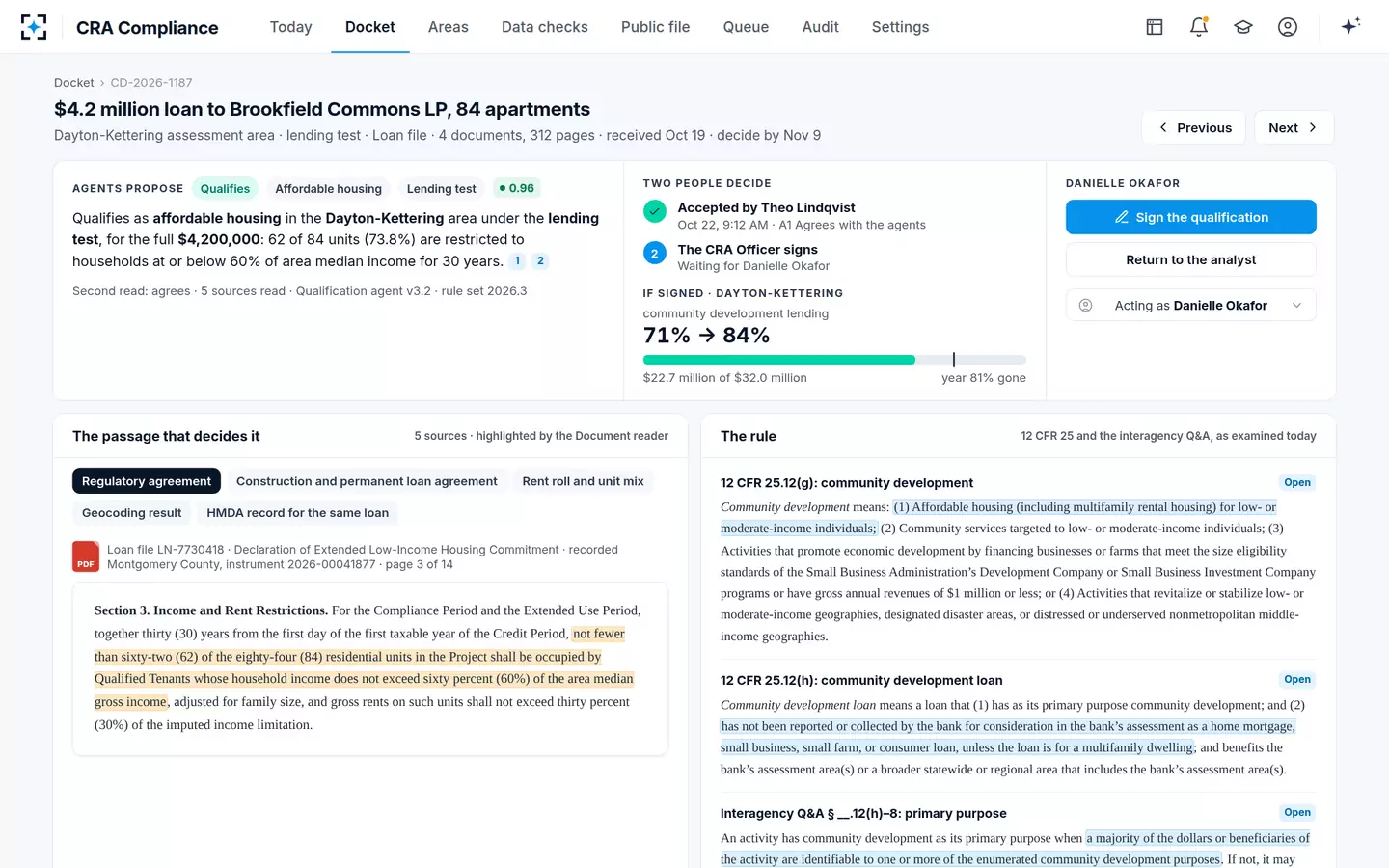
The rule panel highlights the multifamily exception in 25.12(h): the loan is also in the HMDA data, and the rule lets it count as a community development loan too.
Every step is listed with its source, so a reviewer can retrace it in seconds: four documents and 312 pages opened, the tract, the 73.8% majority test, the double-count check, and the second read. Anyone can ask the agents a question about the activity, such as whether the 30-year restriction is recorded or only promised.
How the agents reached it, and the agent that argues against it
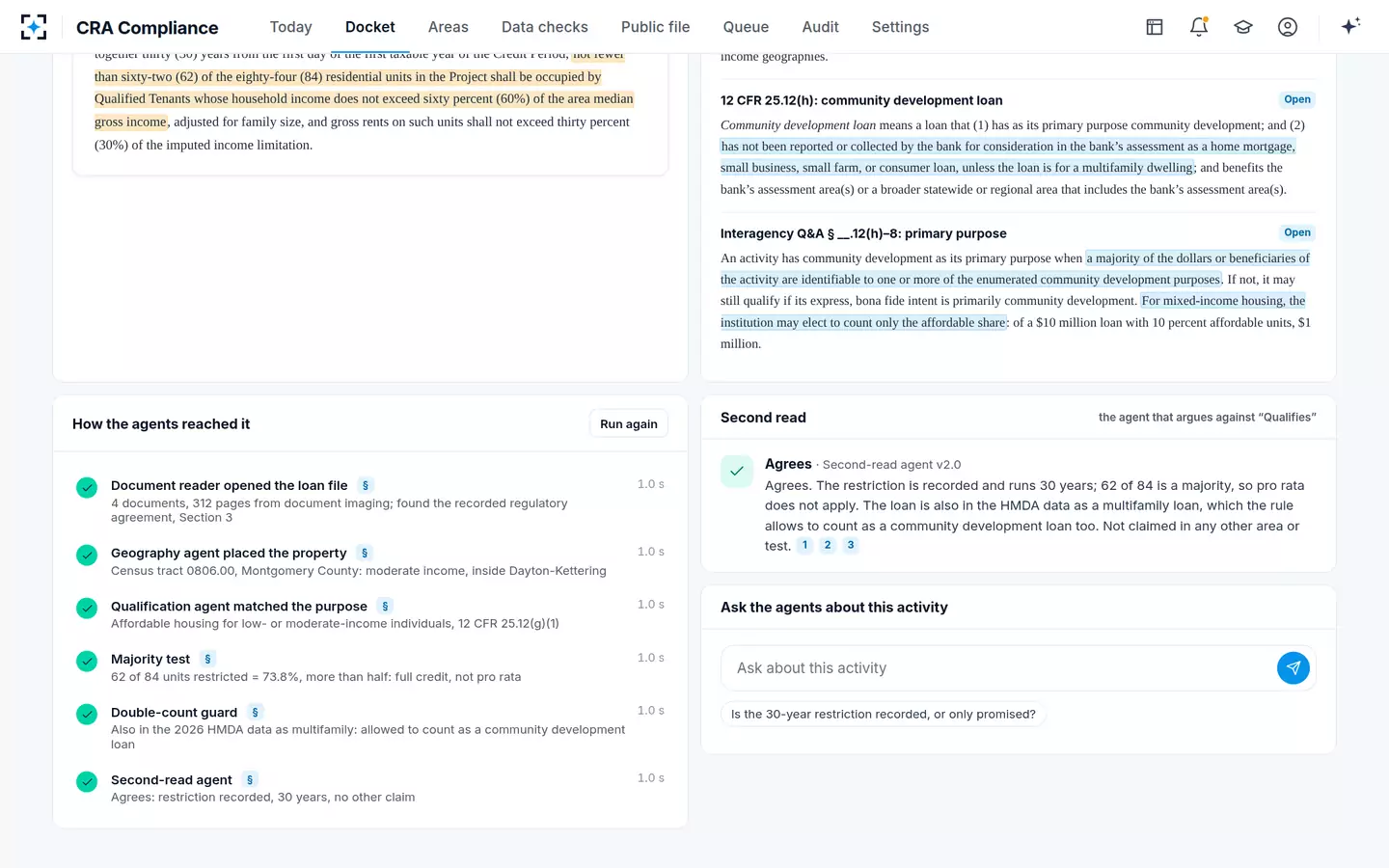
When the evidence is thin, the second read says so
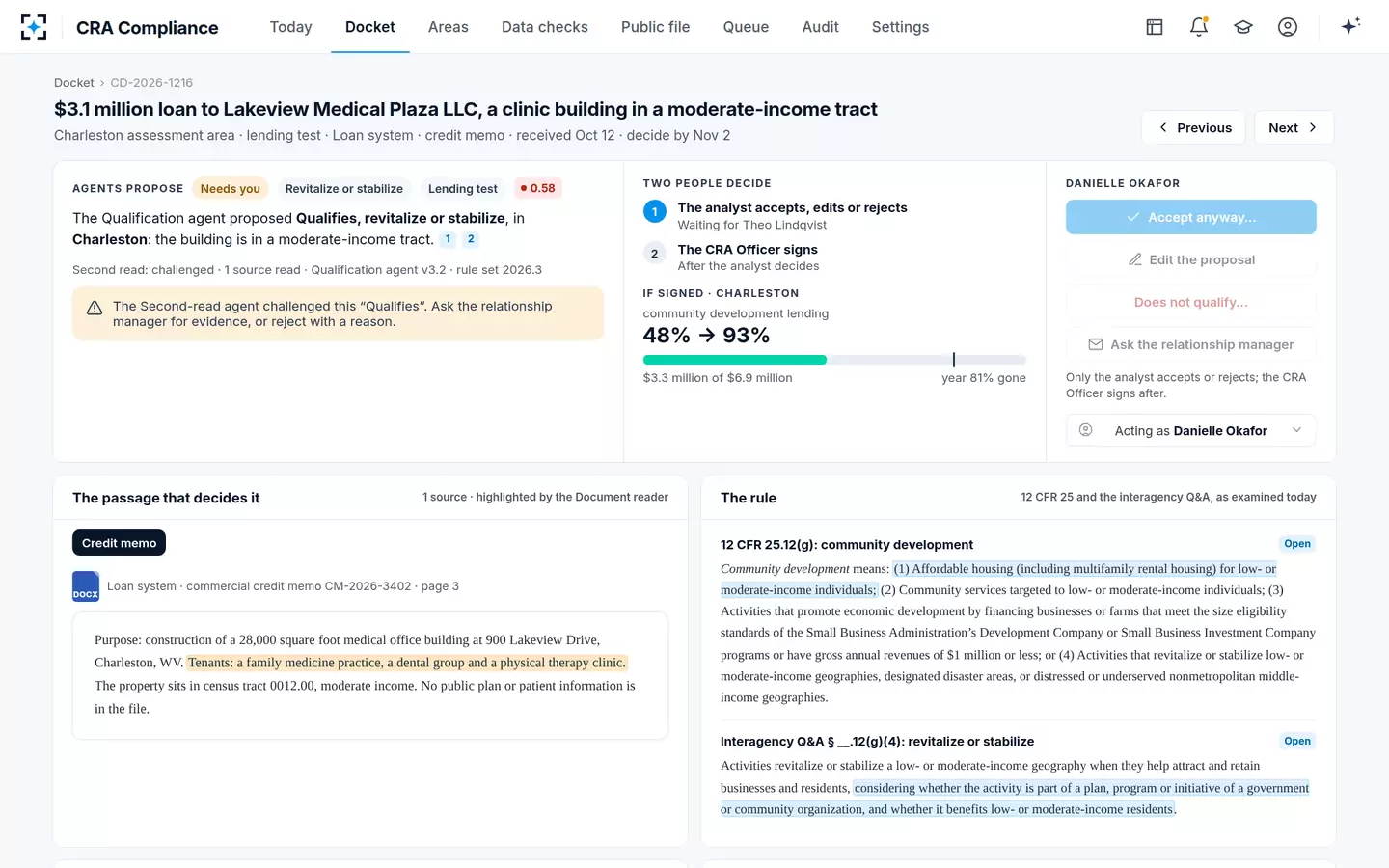
The harder cases are the ones where the purpose is plausible and the file is silent. On the same docket, the Qualification agent proposed that a $3.1 million loan to Lakeview Medical Plaza LLC, a clinic building in a moderate-income tract in Charleston, qualifies as revitalizing or stabilizing that tract. The Second-read agent challenged it at confidence 0.58 and sent it to a person, because the only document, the credit memo, says nothing about who the clinic serves.
Lakeview Medical Plaza: a plausible purpose, an empty file
What the proposal assumed: Moderate-income census tract 0012.00, so the loan helps stabilize the area.
What the file shows, and what would settle it: Location alone is not enough: Q&A § __.12(h)-5 says not every loan in a low- or moderate-income tract stabilizes it.
What the proposal assumed: A health clinic, so local residents benefit.
What the file shows, and what would settle it: Three private practices as tenants; no patient information. Evidence of Medicaid patients or a public health partnership would show targeting.
What the proposal assumed: Assumed consistent with local revitalization.
What the file shows, and what would settle it: “No public plan” in the file. A city or county plan covering the site would create the presumption in Q&A § __.12(g)(4)(i)-1.
What the proposal assumed: Qualifies, revitalize or stabilize, lending test.
What the file shows, and what would settle it: Ask the relationship manager for evidence, or reject with a reason. Confidence 0.58, below the 0.85 floor.
A challenged proposal goes to a person, with the reason
When the guidance runs out, the regulator can be asked. The OCC already runs a qualifying activity confirmation process as a matter of policy (OCC CRA page), and the OCC–FDIC proposal of August 2026 would give both agencies one, answered within 90 days (91 FR 52114). At roughly 19 hours of preparation a request on the OCC's own estimate, it is a tool for genuinely new structures, not for the clinic loan that simply needs its evidence. How examiners weigh what a bank finally claims is the subject of CRA ratings best to worst.
Questions people ask
Does a multifamily loan count for CRA?
Yes, in two ways. It counts as a home mortgage loan in the lending test if it is reported or collected as one, and it can also count as a community development loan if its primary purpose is affordable housing for low- and moderate-income people. It is the only retail loan type the regulation lets a bank count both ways.
What loans are eligible for CRA credit at a small bank?
All of its home mortgage, small business, small farm and, where relevant, consumer lending, judged by distribution and the share inside its assessment area. Community development loans may be considered as lending-related activity, but a small bank's retail loans cannot be relabelled as community development loans, multifamily loans excepted. Only an intermediate small bank may choose to count individual retail loans that way.
Does a loan in a low-income census tract automatically qualify?
No. A retail loan located there counts in the geographic distribution, but a community development loan needs a primary purpose. The Q&A gives the example of upper-income housing in a low-income area, which does not qualify just because it brings construction jobs.
Can a commercial real estate loan be a CRA community development loan?
Yes, if the property serves a community development purpose the file can show: a facility serving mainly low- and moderate-income people, a business that employs and serves residents of a low- or moderate-income area, or a project consistent with a government revitalization plan. A building in the right tract with no such evidence is the case examiners most often question.
Who decides whether a loan qualifies for CRA?
The bank decides what to claim and must be prepared to show why; examiners verify each claimed activity during the CRA evaluation. A confirmation request to the OCC is optional and best kept for novel activities.
Is a loan to a community development financial institution CRA eligible?
Usually. The Q&A lists loans to CDFIs, community development corporations, community loan funds and low-income credit unions "that primarily lend or facilitate lending to promote community development" among its examples of community development loans.