The CRA proposed rule 2026 is a notice of proposed rulemaking that the Office of the Comptroller of the Currency and the FDIC published on 12 August 2026 (91 FR 52114). It would raise the asset thresholds that decide how a bank is examined (under $1 billion small, $1 billion to $10 billion intermediate, over $10 billion large), narrow what counts as a grant or a service, add a formal process for confirming that an activity qualifies, and let banks keep their public file on a website. Comments closed on 13 October 2026. It is a proposal: banks are still examined under the 1995 rules, and the Federal Reserve has not joined it. For a CRA team the hard part is not reading the proposal but qualifying hundreds of loans, investments and volunteer hours a year against the rules in force while the rules are argued over. Botminds' CRA Compliance exists for that work: agents read each activity's source documents and propose whether it counts, citing the rule version they applied, and the CRA Officer signs.
What the 2026 CRA proposal would do to the OCC's and FDIC's banks
79.8%
of the banks the two agencies supervise for CRA would be small banks, up from 57.0% today
86banks
would be large: 2.4% of banks, holding 85.4% of industry assets
106,171hours
a year less paperwork burden, by the FDIC’s own estimate (55.3%)
Oct 13
the day comments closed; no final rule and no effective date yet
What is the CRA proposed rule 2026?
It is a set of targeted amendments to the OCC's and FDIC's existing CRA regulations, not a new framework. The agencies say so directly: "as a general matter, the proposal leaves much of the current framework unchanged." Large banks would still face lending, investment and service tests; smaller banks would still face a tailored lending test, with a community development test for the middle tier; wholesale, limited purpose and strategic plan options all survive. Assessment areas stay tied to branches and deposit-taking ATMs, because, in the agencies' words, "the CRA statute focuses on the geographic area(s) surrounding a bank's physical facilities."
The agencies give four aims: more weight on lending, community development grants that actually reach communities, less burden "particularly for community banks", and clearer rules on what earns consideration. Each aim maps to a small number of drafting changes, and most of them codify guidance or practice that already exists. That is the first thing a CRA officer should take from the document: if the proposal is finalized much as written, the daily work of qualifying an activity from its file barely moves. The thresholds, the grant rules and the service definition are where the changes are.
Was the 2023 CRA rule rescinded?
No. The interagency rule issued on 24 October 2023 never applied, but it has not been formally rescinded either. A federal district court in Texas preliminarily enjoined it on 29 March 2024, days before its first provisions would have taken effect, and the agencies have applied the earlier rules ever since. In July 2025 all three agencies proposed to rescind the 2023 rule and restore the 1995 framework (90 FR 34086). That proposal drew about 47 comments. The OCC and FDIC then "decided not to finalize the rescission proposal but to issue this new proposal instead". They dropped their appeal, which the Fifth Circuit dismissed on 9 July 2026, and are asking the district court to enter a final judgment against them.
From the 2023 rule to the 2026 proposal: three years, no change in force
- To injunction5 mo
- Enjoined; appeal, then stayed15.5 mo
- Rescission proposed, then a new proposal and comments15 mo
The status on each agency's own site, checked on the day this was written, is consistent. The OCC "continues to assess banks' CRA performance under the 1995/2021 regulatory framework" (OCC); the FDIC "continues to assess banks' CRA performance under the 1995 regulatory framework" (FDIC); and the Federal Reserve says the 2023 rule "is currently subject to legal action and the Board continues to apply the 1995 CRA regulations" (Federal Reserve). One practical trap follows: in today's electronic Code of Federal Regulations, the main text of 12 CFR part 25 is the enjoined 2023 rule. The rule in force is reproduced in appendix G to part 25 (and in appendix G to parts 228 and 345 for the Fed and FDIC). A citation, a procedure or a software rule set that quotes the main text is quoting a rule no bank is examined under.
Which CRA rules and thresholds apply to your bank today?
The 1995 rules, with the 2016 Interagency Questions and Answers as guidance, and the thresholds the agencies adjust each January for inflation. From 7 January to 31 December 2026, a small bank is one with assets under $1.649 billion at either of the two prior year-ends, and an intermediate small bank is a small bank with at least $412 million at both (91 FR 509). A bank above $1.649 billion at both year-ends is examined as a large bank and must collect and report small business, small farm and community development loan data by 1 March.
The two-year test produces results people get wrong. The FDIC's examination manual works four cases (FDIC manual XI-1). A bank with $415 million at the end of 2025 and $355 million a year earlier is still small, because it did not reach $412 million at both dates. A bank with $1.725 billion and $1.535 billion is still intermediate small, because it was under $1.649 billion at one of them. Only a bank over the line at both year-ends moves up, and a new large bank cannot be examined under the large-bank procedures until it has collected a full year of data.
The CRA thresholds in force in 2026, and the 2026 proposal
| Category | In force, 7 Jan – 31 Dec 2026 | Proposed by the OCC and FDIC | How each is examined |
|---|---|---|---|
| Small bank | Under $1.649 billion at either prior year-end; not intermediate small | Under $1 billion | Small bank lending test only |
| Intermediate small / intermediate | $412 million or more at both prior year-ends, under $1.649 billion at either | $1 billion to $10 billion | Lending test plus a community development test |
| Large bank | $1.649 billion or more at both prior year-ends | Over $10 billion at both prior year-ends | Lending, investment and service tests; data reporting by 1 March |
| Annual adjustment | Small and intermediate small thresholds move with CPI-W each January | Small threshold keeps the CPI-W adjustment; the $10 billion line would not adjust | — |
What are the proposed CRA asset thresholds, and who moves?
Under $1 billion, small; $1 billion to $10 billion, intermediate; over $10 billion, large. The agencies justify the jump with history. In 1995 the small-bank line was $250 million, small banks were about 80.4% of banks and large banks held about 86.2% of industry assets. Today small banks that are not intermediate small are 57.0% of the banks the two agencies supervise (2,040 banks) and hold 2.0% of assets. Between December 2005 and January 2026 the CRA small-bank threshold rose 64.8%, to $412 million; the SBA's size standard for banks rose from $150 million to $850 million over the same period.
How the OCC's and FDIC's CRA banks would be examined
Today (3,577 banks)
- Small · 57%
- Intermediate small · 29.6%
- Large (our arithmetic) · 13.4%
Proposed
- Small · 79.8%
- Intermediate · 17.8%
- Large · 2.4%
Two groups feel it most. Banks between $412 million and $1 billion would stop being examined on community development at all; the agencies note that crossing into intermediate small status today "typically results in these banks adjusting their CRA programs". And roughly 390 banks between the current large-bank line and $10 billion (our arithmetic: about 477 large today, 86 under the proposal) would move from three tests and annual data reporting to the intermediate tests, which carry no CRA data reporting. The agencies themselves ask whether $30 billion, the line they use for community bank supervision, would be a better ceiling.
Is the Federal Reserve part of the 2026 CRA proposal?
No. The notice is issued by the OCC and the FDIC only, and it says: "Any decisions about the Board's next steps with respect to the rescission proposal rest exclusively with its Governors." State member banks therefore stay on Regulation BB as it stands, the 1995 framework in appendix G to 12 CFR part 228, and the Fed's 2025 rescission proposal page still says the Board continues to apply the 1995 regulations. For a holding company with a national bank and a state member bank, that could mean two CRA rulebooks after a final OCC–FDIC rule, with different thresholds and different grant rules for affiliates in the same market.
The proposal changes how many banks face which test. It barely changes what makes a single loan, investment or volunteer hour count.
What changes for intermediate banks, and for everyone else?
Beyond the thresholds, five changes would reach most CRA programs. Retail lending would be judged on a bank'smajor product lines only, for banks of every size. Retail banking services would be narrowed to credit services and the distribution of branches, excluding deposit services. A large bank's community developmentgrant would count only if the recipient spends no more than 15% on indirect costs; the agencies cite a real grant where about 25% went on internal expenses and say it would no longer qualify. Large banks would also report each grant's recipient, address and amount, which the agencies expect to publish. And thepublic file could live on the bank's website, with no paper copy required.
The intermediate tier gets the most relief: no CRA data reporting, a tailored community development test in place of three separate tests, and no move to large-bank status until $10 billion. The proposal also says which loans can count as community development loans when they fall outside a bank's major product lines, which matters for the double-counting rules explained in what makes a loan CRA eligible.
What the 2026 proposal would change, row by row
The 1995 rules, in force: Primary purpose of community development, related to the provision of financial services, not already counted as a retail service.
The OCC–FDIC proposal: A volunteer service by an employee representing the bank, related to financial services "or the employee’s area of expertise at the bank".
The 1995 rules, in force: Qualified investments, with no cap on what the recipient spends to administer them.
The OCC–FDIC proposal: Count only if used directly for a community development program in the bank’s community; a 15% indirect-cost cap for large banks.
The 1995 rules, in force: Defined by benefit to low- and moderate-income people; no written rent standard.
The OCC–FDIC proposal: Subsidized and unsubsidized housing named; rent affordable at 30% of income for a moderate-income renter.
The 1995 rules, in force: The OCC runs a confirmation form as policy; otherwise the answer comes at the exam.
The OCC–FDIC proposal: An optional confirmation request at both agencies, answered within 90 days unless more time is needed.
The 1995 rules, in force: The OCC alone credits an activity that was eligible when the bank conducted it.
The OCC–FDIC proposal: Both agencies would, for activities in the evaluation period or still on the balance sheet.
The 1995 rules, in force: Kept at the main office and branches, copies on request.
The OCC–FDIC proposal: May be kept on the bank’s website; no paper copy required.
The service and housing rows deserve a closer look before anyone redesigns a program around them. The service definition would mostly write down what examiners already credit: the 2016 Q&A already lists human resources, information technology and legal work by bank staff among qualifying technical assistance. Where reviewers still split on volunteer hours is set out in CRA community development services examples. The housing row would give unsubsidized, "naturally occurring" affordable housing a written rent test for the first time; the arithmetic is worked in the CRA affordable housing definition guide.
What happens to CRA strategic plans?
They stay, and both the proposal and a separate OCC proposal try to make them usable. The agencies call the current plan provisions, by public feedback, "inaccessible, complex, and burdensome, particularly for community banks". The proposal would set a 90-day submission window, state why a plan can be denied, let a denied plan be resubmitted without restarting, and evaluate a bank automatically under the ordinary tests if it misses its "satisfactory" goals. In December 2025 the OCC separately proposed a simplified strategic plan process for community banks, which the OCC defines as banks with up to $30 billion in assets (90 FR 59744).
In CRA Compliance, a rule set is a version recorded with every signature
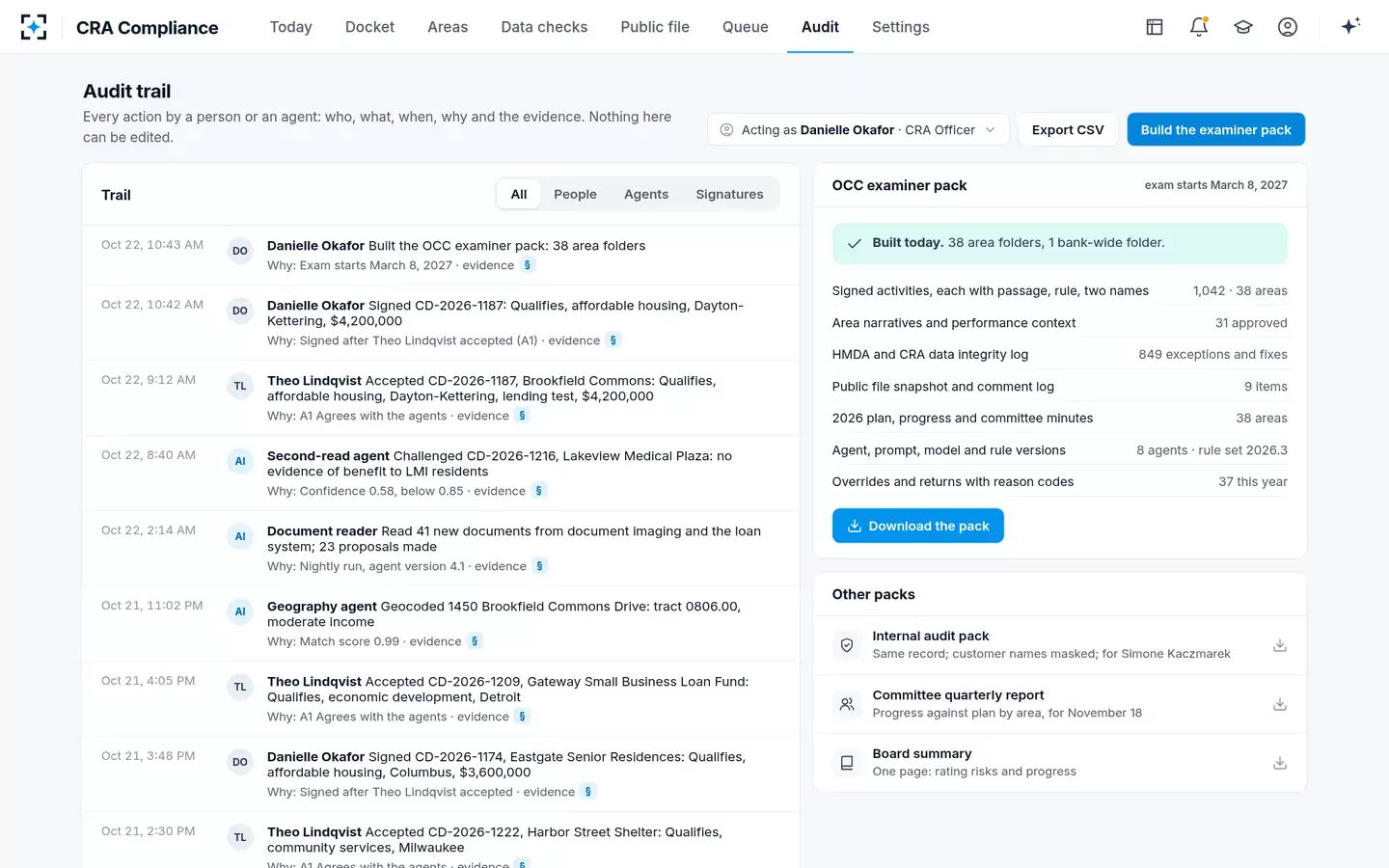
The pack lists 'Agent, prompt, model and rule versions: 8 agents · rule set 2026.3'. An examiner can see which rulebook every qualification was decided under.
When would the CRA proposal take effect?
No date has been proposed. The notice contains no effective date and asks whether the final rules should include "transition provisions providing for deferred applicability dates" for the confirmation process, strategic plans, the new data requirements and the public notice. Under the Riegle Community Development Act the agencies must also weigh, in setting an effective date for new reporting duties, "any administrative burdens that the proposed rule would place on depository institutions" against its benefits. Until a final rule is published, nothing in the proposal binds an examiner.
The practical calendar is therefore the current one. A bank under $1.649 billion that will cross the line at the end of 2026 should plan to collect data as a large bank in 2027 under today's rules, whatever the proposal says. A bank whose CRA program was built around the enjoined 2023 rule should check that its procedures, training and software cite the 1995 text, not the 2023 text that sits in the main body of the eCFR.
What should a CRA officer do before a final rule?
Keep qualifying under the rules in force, and record which rules each decision used, so that nothing has to be redone if the definitions change. The proposal itself helps: both agencies would keep crediting an activity that was eligible when the bank conducted it, so a decision made correctly under today's rules should survive tomorrow's.
Six things to do while the 2026 CRA proposal is pending
- Cite the rule in force
Appendix G to 12 CFR part 25, 228 or 345, plus the 2016 Q&A. Not the main text of the eCFR, which is the enjoined 2023 rule.
- Check your size at both year-ends
$412 million and $1.649 billion in 2026. A bank crossing at the end of 2026 changes procedures in 2027.
- Version every qualification
Record the rule set and guidance each activity was decided under, so a later change does not reopen it.
- Inventory your grants
If you are, or may become, a large bank, ask recipients now what share of each grant went to indirect costs.
- Map affiliates by regulator
A state member bank stays under Regulation BB as it stands; an OCC or FDIC affiliate may not.
- Keep your strategic plan options open
If a plan suits your business, the OCC’s simplified process and the proposal both make one easier to get.
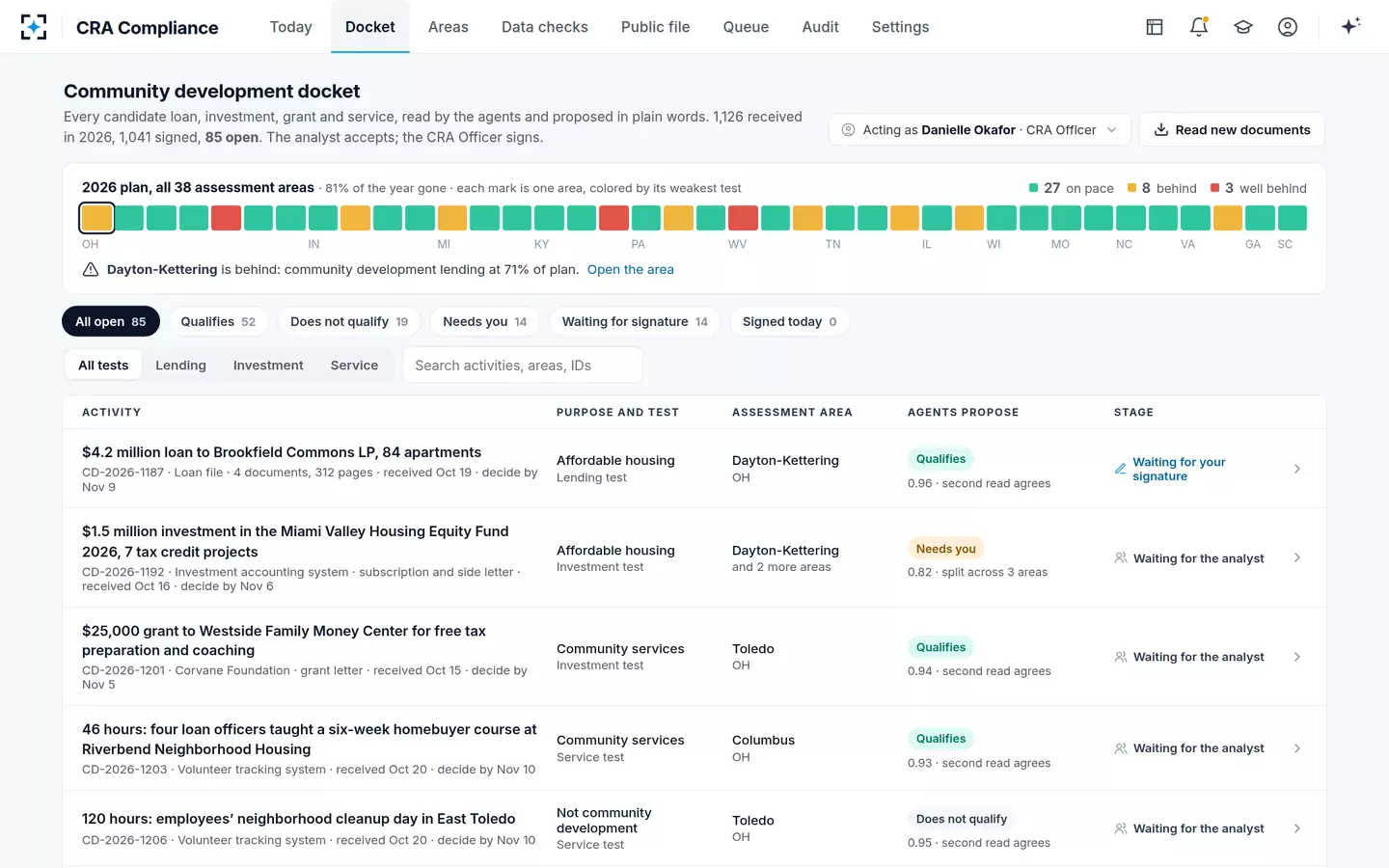
The work that decides a CRA rating does not wait for the rulemaking: each loan, investment, grant and service hour still has to be qualified from its documents, placed in an assessment area and counted once. On the CRA Compliance page, that is the job the agents do first, with the deciding passage beside the rule they applied.
The docket in CRA Compliance: the same activities, whichever rule wins
Questions people ask
Is the 2023 CRA final rule in effect?
No. It was preliminarily enjoined on 29 March 2024, days before its first provisions applied, and the OCC, FDIC and Federal Reserve all say they examine banks under the 1995 framework. The OCC and FDIC have since dropped their appeal and are seeking a final judgment against them.
What are the CRA asset size thresholds for 2026?
A small bank has assets under $1.649 billion at either of the two prior year-ends; an intermediate small bank has at least $412 million at both and under $1.649 billion at either. The thresholds apply from 7 January to 31 December 2026 and are adjusted each year for inflation.
Who would be a large bank under the CRA proposal?
A bank with more than $10 billion in assets at both prior year-ends. On 2024–2025 data that is about 86 of the 3,577 banks the OCC and FDIC supervise for CRA, holding 85.4% of industry assets.
When did comments close on the 2026 CRA proposal?
On 13 October 2026, two months after publication in the Federal Register on 12 August. The agencies must consider the comments before issuing any final rule, and they asked specifically whether parts of it should apply later than others.
Does the 2026 CRA proposal change assessment areas?
Largely not. Assessment areas would stay tied to the main office, branches and deposit-taking ATMs, with the surrounding tracts where a bank lends. The agencies say the statute focuses on the areas around a bank's physical facilities, even though customers are increasingly spread out.
Will CRA performance evaluations already done be reopened?
Nothing in the proposal reopens a completed evaluation. It would also codify, for both agencies, the principle that an activity eligible when the bank conducted it keeps its consideration, which the OCC already applies under its current rule.