CRA consulting fees are set by quotation, engagement by engagement, and no regulator or research body publishes them, so the useful comparison is not between quotes but between ways of doing one unit of work: qualifying a community development activity for the Community Reinvestment Act. A loan, investment, grant or service hour has to be found, read, placed in a tract and an assessment area, tested against the rule and recorded with its evidence. Price that at the FDIC's own estimate of what compliance staff cost, $93.97 an hour fully loaded, and a 45-minute read by hand is about $70 an activity; a bank with 1,400 candidates a year spends roughly 1,050 hours, about $99,000, before anyone signs (our arithmetic on estimates explained below). That unit is what a consultant, an extra analyst or software should be measured against. Botminds' CRA Compliance attacks the largest part of it, the finding and reading, by giving it to agents that quote the deciding passage, and leaves the decision and the signature with the bank.
The numbers that price CRA work
$93.97/hour
the FDIC’s fully loaded cost of compliance staff time in its 2026 CRA proposal
45min
estimated reading time to qualify one community development candidate by hand
19hours
the OCC’s estimate of the work in one request to confirm that an activity qualifies
60%+
of community banks’ compliance spending is personnel, in every size group studied
How much does CRA consulting cost?
There is no public price list. Fees depend on scope (a mock evaluation, a data integrity review, a performance context study, a strategic plan, training or outsourced qualification work), on the bank's size category and on the number of assessment areas, and they are quoted as a project fee or as hours at a rate. What can be priced independently is the work itself. The FDIC's 2026 proposal gives a public, defensible rate for compliance staff time, and the CRA rule and Q&A define the steps each activity needs. Put the two together and any quote can be converted into a cost per activity, or per assessment area, and compared with doing the same work in-house.
The rate is worth understanding before using it. To estimate the cost of CRA paperwork, the FDIC took "the 75th percentile hourly wages reported by the Bureau of Labor Statistics" for compliance officer and clerical occupations in banking and multiplied them by about 1.58 for non-wage compensation, giving $93.97 an hour (91 FR 52114). For reference, the national median for all compliance officers was $38.81 an hour, or $80,730 a year, in 2025 (O*NET), before benefits. A bank should use its own loaded rate where it has one; the FDIC's is a neutral default.
How long does it take to qualify one CRA activity?
By hand, for a community development loan or investment with a few documents, three-quarters of an hour is a reasonable working estimate, and most of it is not judgment. The estimate below comes from CRA Compliance's fictional sample bank, Corvane National Bank, a 640-branch bank with about 1,400 candidates a year. It is an estimate for that sample, not a measured result, and the after column is deliberately conservative.
Where the minutes go on one CRA candidate, by hand and with CRA Compliance agents
By hand: 45 minutes
- Finding the file, 12 min · 26.7%
- Reading for the passage, 15 min · 33.3%
- Tract and area, 6 min · 13.3%
- Applying the rule, 8 min · 17.8%
- Typing, 4 min · 8.9%
With agents: 5 minutes
- Find, 0.5 min · 10%
- Read the quote, 2 min · 40%
- Place, 0.5 min · 10%
- Decide, 1.5 min · 30%
- Record, 0.5 min · 10%
Finding and reading take 27 of the 45 minutes by hand: locating the loan file, agreement or prospectus in document imaging and reading until the deciding clause appears. Applying the rule, the part that needs a trained reviewer, takes eight. That split is why hiring more analysts scales cost almost one for one, and why outsourcing the same reading moves the cost rather than removing it.
What does CRA compliance cost a bank?
It depends heavily on size, and research gives the shape. The Federal Reserve Bank of St. Louis found that in 2014, banks with under $100 million in assets spent an average of $163,800 on compliance across all regulations, 8.7% of noninterest expense, against 2.9% for banks of $1 billion to $10 billion, and that staff time was the biggest cost for banks of every size, above 60 percent of compliance spending (St. Louis Fed, 2016; the study's figures by bank size are inthe cost of AML compliance by bank size). For CRA specifically, the FDIC estimates 191,953 hours a year of paperwork across the 2,689 banks it supervises for CRA, about 71 hours a bank on average (our arithmetic), which counts recordkeeping, reporting and disclosure but not the analysis behind them.
The annual cost of qualifying CRA activities, term by term
Reading
Candidates × minutes to find and read ÷ 60 × rate
1,400 × 27 ÷ 60 × $93.97 ≈ $59,200 a year on the sample bank’s estimates
Analyst time
Deciding and recording
Candidates × minutes to apply and record ÷ 60 × rate
1,400 × 18 ÷ 60 × $93.97 ≈ $39,500
Analyst time
Second review and sign-off
Share reviewed × minutes × rate
A second person on each claim: the CRA officer’s signature, an auditor’s sample
CRA officer, audit
Over-claims removed at the exam
Activities disallowed × their weight in the rating
Not an hourly cost: an area that falls short of its plan, or a test rating that drops
What does a CRA consultant do?
The work a bank does not do every day, or wants done by someone independent. Mock evaluations, data integrity reviews before a submission or an exam, performance context research, strategic plan drafting and the 30-day public comment process, assessment area reviews after branch changes, and training. The FDIC's compliance management chapter allows a compliance officer to use "third-party service providers or consultants" to help run the program or audit it, but leaves the board and management answerable for the result, as if the work had been done in-house (FDIC manual II-3).
Outsourced qualification, where a consultant reads the bank's files and decides what counts, is the engagement to price most carefully. The bank still has to be able to show examiners why each activity counts, and a consultant's workpapers become the bank's evidence. Ask to see what a qualified activity looks like in the deliverable: the passage, the page, the rule, and who decided.
Three ways to qualify CRA activities, compared on the same unit
| Outsourced to a consultant | More analysts in-house | Agents read, staff decide | |
|---|---|---|---|
| Cost of one activity | The quote divided by activities covered; the reading is billed | About $70 at 45 minutes and the FDIC rate | About $8 of analyst time at 5 minutes, plus the software |
| Who decides | The consultant proposes; the bank must still decide and defend | The bank | The bank: an analyst accepts, a different person signs |
| Evidence kept | Workpapers, in the consultant’s format | Whatever the tracker holds | The passage, page, rule version and both names on every activity |
| When problems surface | At the end of the engagement | When someone totals the tracker | On each signature: every area’s plan recomputed |
| Where it is strongest | Independence, mock exams, strategy, training | Judgment and local knowledge | Volume, consistency and the evidence kept with each decision |
Is it cheaper to outsource CRA?
For specialist, occasional work, often; for the daily reading of hundreds of activities, rarely, because the reading is billed by the hour wherever it is done. The arithmetic is simple. At 45 minutes and $93.97 an hour, 1,400 candidates cost about $98,700 a year in-house. A consultant doing the same reading needs similar minutes per activity, at a billing rate that also covers the firm's margin. What changes the unit cost is removing the finding and reading from human time, not moving it to someone else's.
Cost of qualifying one CRA candidate, at the FDIC's hourly rate
Most of the cost of a CRA qualification is finding the page. Whoever does it, a bank pays for the minutes.
What drives CRA compliance cost?
Five things, roughly in order. The number of community development candidates, which grows with the bank and with the plan. The number of document types (loan files, regulatory agreements, prospectuses, grant letters, volunteer logs) and how scattered they are. The number of assessment areas, because each needs its own plan, narrative and allocation. The size category, because large banks collect and report data and face three tests. And the cost of errors: activities removed at the exam, data resubmitted, an area that falls short. The last one does not appear on any invoice, which is why a cheap engagement that leaves weak evidence can be the expensive choice.
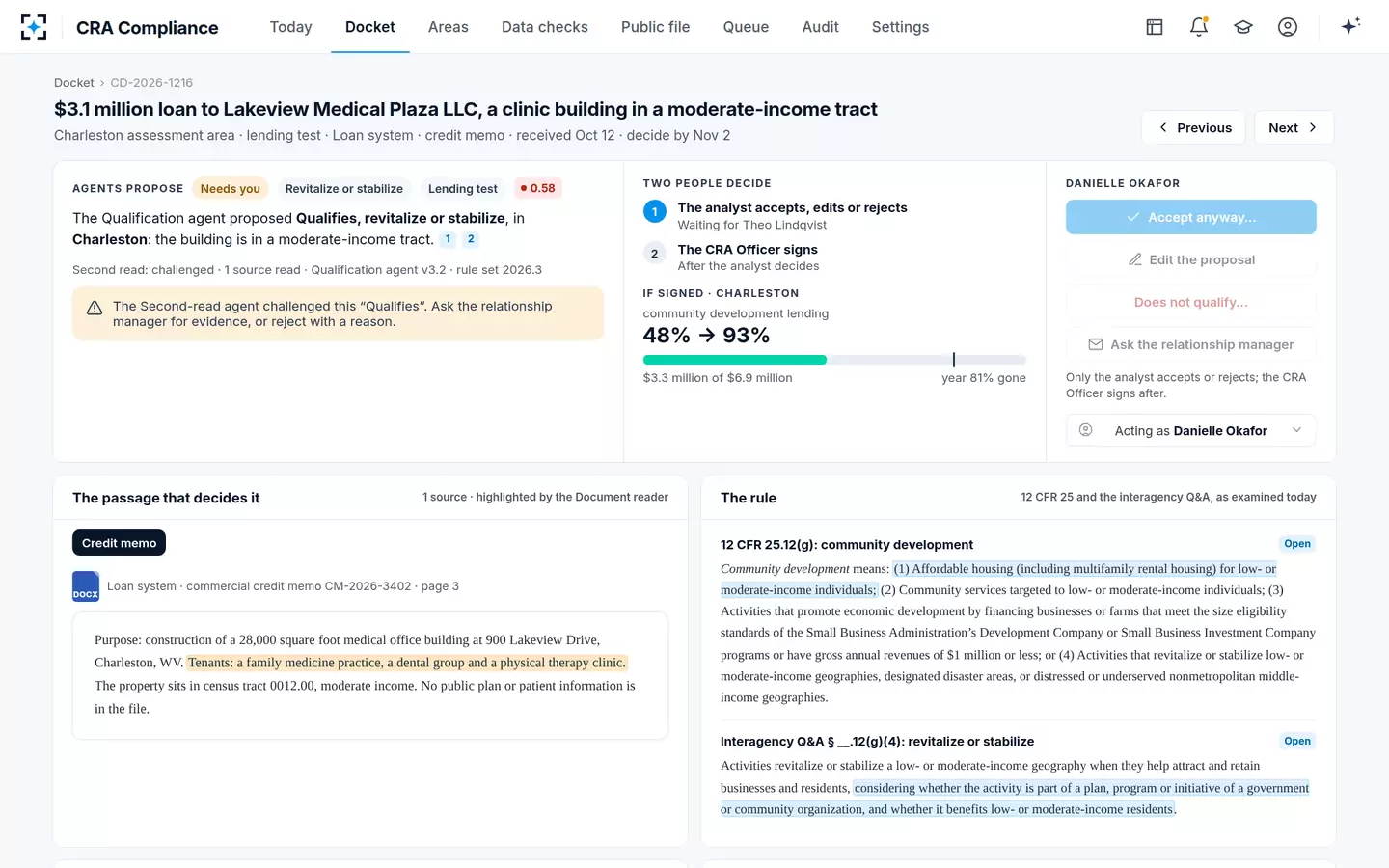
The cost of an over-claim is easiest to see on a single file. In the sample bank, a $3.1 million clinic loan in a moderate-income tract would have taken one assessment area from 48% to 93% of its lending plan. The credit memo showed three private practices and no evidence of who the clinic serves, so the second read challenged it. Claimed without that evidence, it is the kind of activity an examiner removes, after the year is over.
In CRA Compliance, the claim that would have moved a plan most is the one challenged
Will the 2026 CRA proposal reduce costs?
For many banks, yes, if it is finalized as proposed. The FDIC estimates its banks' annual paperwork burden would fall by 106,171 hours, 55.3%, "or $10 million per year", about $3,700 a bank on average (our arithmetic). The savings are concentrated in banks that change category: those between $412 million and $1 billion would no longer face a community development test, and those between today's large-bank line and $10 billion would stop reporting CRA data. For a bank that stays large, the proposal adds work, such as collecting each grant recipient's indirect costs. What the proposal would and would not change is set out in CRA proposed rule 2026.
It would not remove the core unit of cost. Community development activities would still need a primary purpose shown from documents, and a strategic plan would still be a project: the agencies estimate 275 hours to prepare one under the proposal.
What to ask a CRA consultant, or any alternative
The same questions, whichever way the work is done, so that quotes and software can be compared on one basis.
Questions that turn a CRA consulting quote into a cost per activity
- How many activities, areas and documents does the fee cover?
Divide the fee by activities; ask what happens above the estimate.
- What does one qualified activity look like in the deliverable?
The passage, the page, the rule and version, and who decided. Without them, the bank redoes the work at the exam.
- Who decides, and who signs?
The bank must; ask how the engagement keeps the decision with named people at the bank.
- Which rules are applied?
The 1995 rules in appendix G and the 2016 Q&A, not the enjoined 2023 text in the main eCFR.
- How are data checked?
Against loan documents, not only against the system the data came from.
- What is left behind?
A procedure, a trained team and a record the bank can keep using, or a report.
- What is independent?
Mock exams and audits need independence; daily qualification needs consistency. Price them separately.
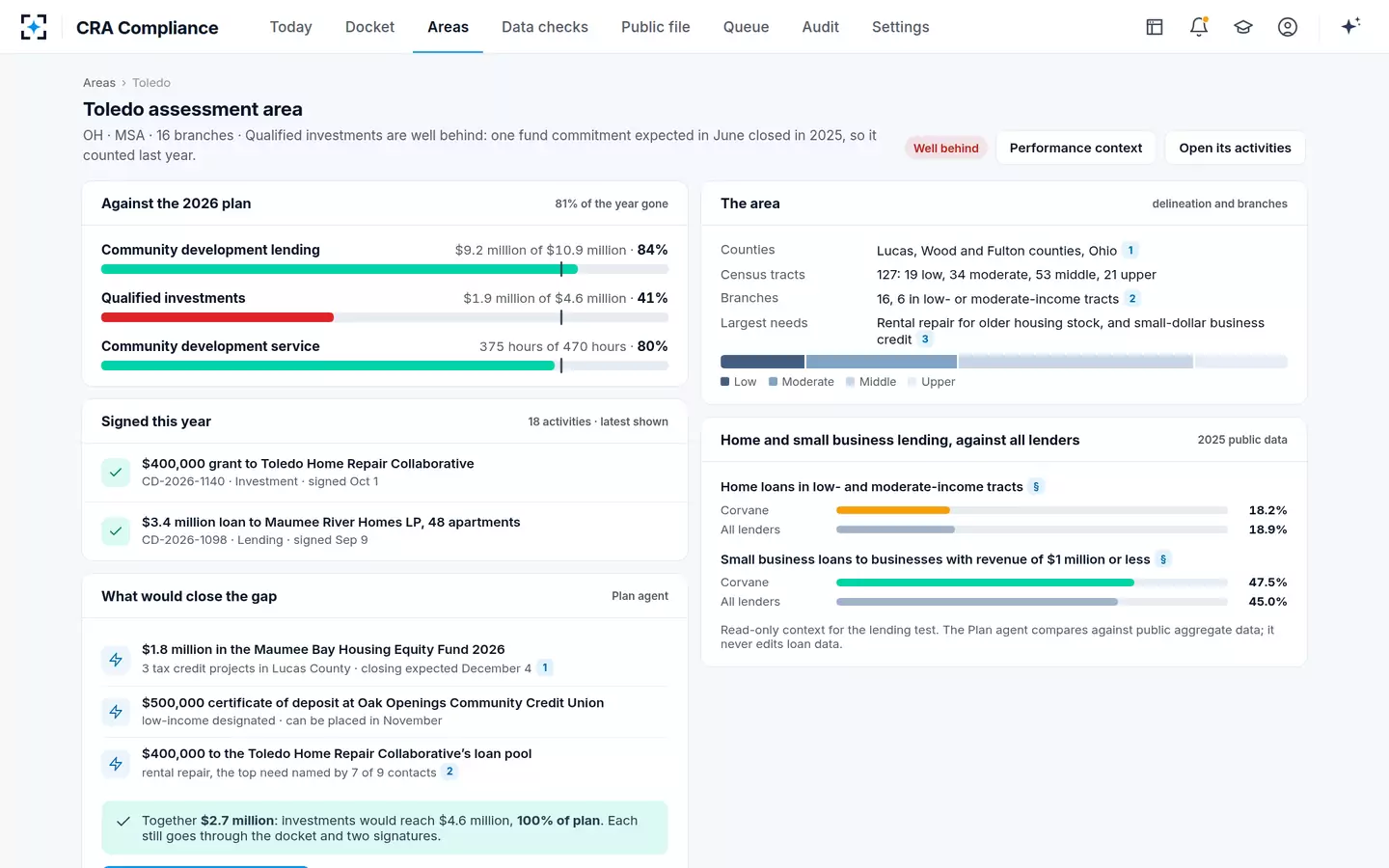
The plan side has a cost too: finding the deals that close an area's gap, early enough to source them. In the sample bank, the Plan agent lists pipeline items that would bring Toledo's qualified investments from 41% to 100% of plan; each still goes through the docket and two signatures. What a bank needs to bring for any of this to work is listed in CRA management software for banks, and the agents and their limits are on the CRA Compliance page.
What would close an assessment area's gap, found in time to act
Questions people ask
How many hours does CRA data collection take?
The FDIC estimates 191,953 hours a year of CRA paperwork across its 2,689 CRA banks, about 71 hours a bank on average, most of it at large banks that collect and report data. Its proposal would cut that by 55.3%.
What does a CRA performance evaluation cost a bank?
No agency publishes a figure. The cost is staff time to answer requests, explain activities and gather evidence, which falls sharply when every activity already carries its documents and the decision behind it.
Should a small bank hire a CRA consultant?
Often for training, a mock evaluation or a strategic plan. A small bank below the intermediate threshold, $412 million in 2026, is examined on its lending and has no community development test, so routine qualification work is light.
Is CRA software cheaper than a consultant?
It depends on what each replaces. Software that only stores typed answers does not remove the reading; software that reads the documents removes most of it. Compare both on the cost per qualified activity, including review time.
What is a CRA mock exam?
An independent review that tests a bank's CRA performance and records the way examiners would, usually before an evaluation. It is most useful when it samples activities and data against their source documents.
Can CRA compliance staff be shared between banks?
The FDIC's examination manual allows a compliance officer to be shared by several banks. Each bank remains responsible for its own CRA record and public file.