CRA management software for banks does four jobs: it collects, geocodes, checks and reports the loan data the Community Reinvestment Act requires; it records community development loans, investments, grants and service hours and tracks them against plan by assessment area; it keeps the public file; and it assembles what examiners ask for. None of that is better than its inputs. Before choosing, a bank should inventory what it will bring on day one: loan data and the documents behind it, assessment area definitions, geocodes, investment and grant records, volunteer logs, branch records and public comments, and the plan. Most CRA software reads fields; the costly CRA questions are answered in documents, which is why examiners keep finding data that a system accepted and a loan file contradicts. Botminds' CRA Compliance is built for the document side: agents read each candidate's files, propose whether it qualifies with the deciding passage beside the rule, check the reportable data against its documents, and leave every decision to two named people.
Where CRA data goes wrong, and when it is due
53violations
of Regulation BB small business and farm data rules at Fed-supervised banks in 2024, second only to HMDA
3fields
examiners cite most: loan amount, census tract and revenue indicator
Mar 1
large banks report the prior year’s CRA data
Apr 1
the public file must be current as of this date each year
What is CRA management software?
A label covering four kinds of product, often sold together. A buyer should know which of the four a demonstration is showing, because each depends on a different input and fails in a different way.
Four kinds of CRA management software, and what each one runs on
| Kind | What it does | Runs on | What it cannot see |
|---|---|---|---|
| Data collection and reporting | Geocodes loans, applies the small business and farm rules, formats the 1 March submission, runs edits | Core and loan origination system fields, a geocoder | Whether the field matches the note, the credit memo or the business address |
| Analytics | Compares the bank’s lending by tract and borrower with demographics and other lenders’ public data | Reported data and public aggregate files | Anything the bank did not report correctly |
| Activity tracking | Logs community development loans, investments, grants and hours against plan by area and test | What staff type in | Why an activity counts: the passage that proves it |
| Document reading and qualification | Reads loan files, agreements, prospectuses, grant letters and logs; proposes qualification with the passage and rule | The documents, plus the fields above | Facts never written down, such as a phone conversation |
What data does CRA software need on day one?
Ten inputs, each tied to a provision of the rule. Some live in systems; several live only in document images or spreadsheets. The inventory below is the one to complete before any demonstration, with the system of record and an owner for each.
The ten inputs CRA management software needs, and the rule each serves
- Loan data from the core and origination systems
For each small business and small farm loan: loan number, amount at origination, location and revenue indicator (12 CFR 25.42(a)); home mortgage data for HMDA reporters.
- The loan file documents
Notes, credit memos and tax returns that support the amount, the business location and the revenue, and the agreements that prove community development purpose.
- Assessment area definitions
The tracts in each area, kept current after branch changes and new metropolitan boundaries (25.41); large banks report the list by 1 March.
- Geocoding
Address to census tract and income level for the year of each activity, using the right address for each loan type (25.12(k), (o)).
- Investment and grant records
Subscriptions, prospectuses, side letters and grant letters for every qualified investment, with the area each benefits.
- Volunteer logs
Who, when, hours, organization, purpose and capacity for every community development service hour (25.12(i)).
- Branch and service records
Branches, addresses, tracts, openings and closings, hours and services, for the service test and the public file (25.24, 25.43).
- Public comments and responses
Every written comment about CRA performance, for the current and two prior years, with the bank’s reply (25.43(a)(1)).
- The plan
Lending, investment and service goals by area and test, approved by the committee; a strategic plan’s measurable goals if the bank has one (25.27).
- Community and market context
Community contact notes, needs assessments and public data for the performance context examiners consider (25.21(b)).
What defect does each CRA input usually carry?
Each input arrives with a characteristic error, and examiners have described most of them. Federal Reserve examiners reviewing 2024 Regulation BB violations traced incorrect loan amounts to "bank software pulling information from the wrong core system data fields and inadvertent manual input failures", wrong tracts to owners' home addresses and "bank software improperly geocoded addresses", and wrong revenue indicators to staff who did not "compare collected data against supporting loan documentation during second reviews" (Consumer Compliance Outlook, 2025).
Day-one CRA inputs, where they live, and what usually goes wrong
| Input | Usually lives in | Typical defect | How to catch it |
|---|---|---|---|
| Small business loan amount | Core or loan system field | The wrong field mapped, or a keying error | Compare with the signed note |
| Business location | Borrower address field | Owner’s home address instead of the business | Geocode the main facility or where proceeds are used |
| Revenue indicator | Loan system or manual entry | Code 1 or 2 wrong, or "NA" missing when revenue was not collected | Compare with the revenue the bank relied on in the credit memo |
| Census tract | Geocoder output | Tract code from the previous decennial census; a software geocoding error | Re-geocode in current boundaries; periodic checks of the software |
| Community development purpose | Analyst tracker | An answer without the evidence that supports it | Keep the deciding passage and page with the answer |
| Investment area allocation | Investment accounting | A regional fund claimed in full in one area | Read the prospectus or side letter for where the money goes |
| Service hours | Volunteer system export | Personal-time hours, or work with no financial expertise | Capture capacity and activity at the time of the service |
| Public file items | Shared drive | Comments not filed; branch closings not added | Check the file against 25.43 on a schedule, not only before 1 April |
Examiners will find these defects whatever software the bank buys. The FDIC tells its examiners that for banks that collect or report CRA data, examiners must validate its accuracy, checking "loan type, loan amount, location, and income/revenue" (FDIC manual XI-11), and its large-bank procedures tell examiners to test "a sample of loan files to verify the accuracy of data collected and/or reported" (FDIC manual XI-4). A product that checks the data only against itself passes the first two rows of that table every time.
How do banks track CRA activity today?
Mostly in a tracker: a spreadsheet or a database where an analyst types each activity, its purpose, its area and its test after reading the documents. The tracker keeps the answer and drops the reason. It also totals progress when someone runs it, often at quarter end, so an area that is behind is noticed when there is too little of the year left to source a deal.
Two ways CRA software can know an activity counts
A tracker of typed fields: “Qualifies, affordable housing, Dayton-Kettering, lending test”, typed by the analyst.
Software that reads the documents: The same answer, with the clause from the recorded agreement and the rule paragraph it satisfies.
A tracker of typed fields: Someone reopens the loan file and finds the page again.
Software that reads the documents: The page is already attached to the decision, with who accepted and who signed.
A tracker of typed fields: Totalled when the report is run, often at quarter end.
Software that reads the documents: Recomputed on every signature, for every area and test.
A tracker of typed fields: Depends on the analyst remembering the retail data.
Software that reads the documents: Checked against the HMDA and small business data before the proposal is made.
A tracker of typed fields: Finding and reading is the analyst’s work for every candidate.
Software that reads the documents: Agents find and read; people decide on what they found.
What is CRA geocoding?
Assigning each loan or activity to a census tract, and through it to an income level and an assessment area. It sounds mechanical and is where many cited errors start: the wrong address (an owner's home for a business loan), a tract code from the previous decennial census, or a geocoder that matched an address badly. CRA software either geocodes itself or calls a geocoding service; either way, ask how it chooses the address for each loan type, which census tract boundaries and income levels it uses for which year, and what it does with an address it cannot place. The details are in the LMI census tract lookup guide.
Does CRA software maintain the public file?
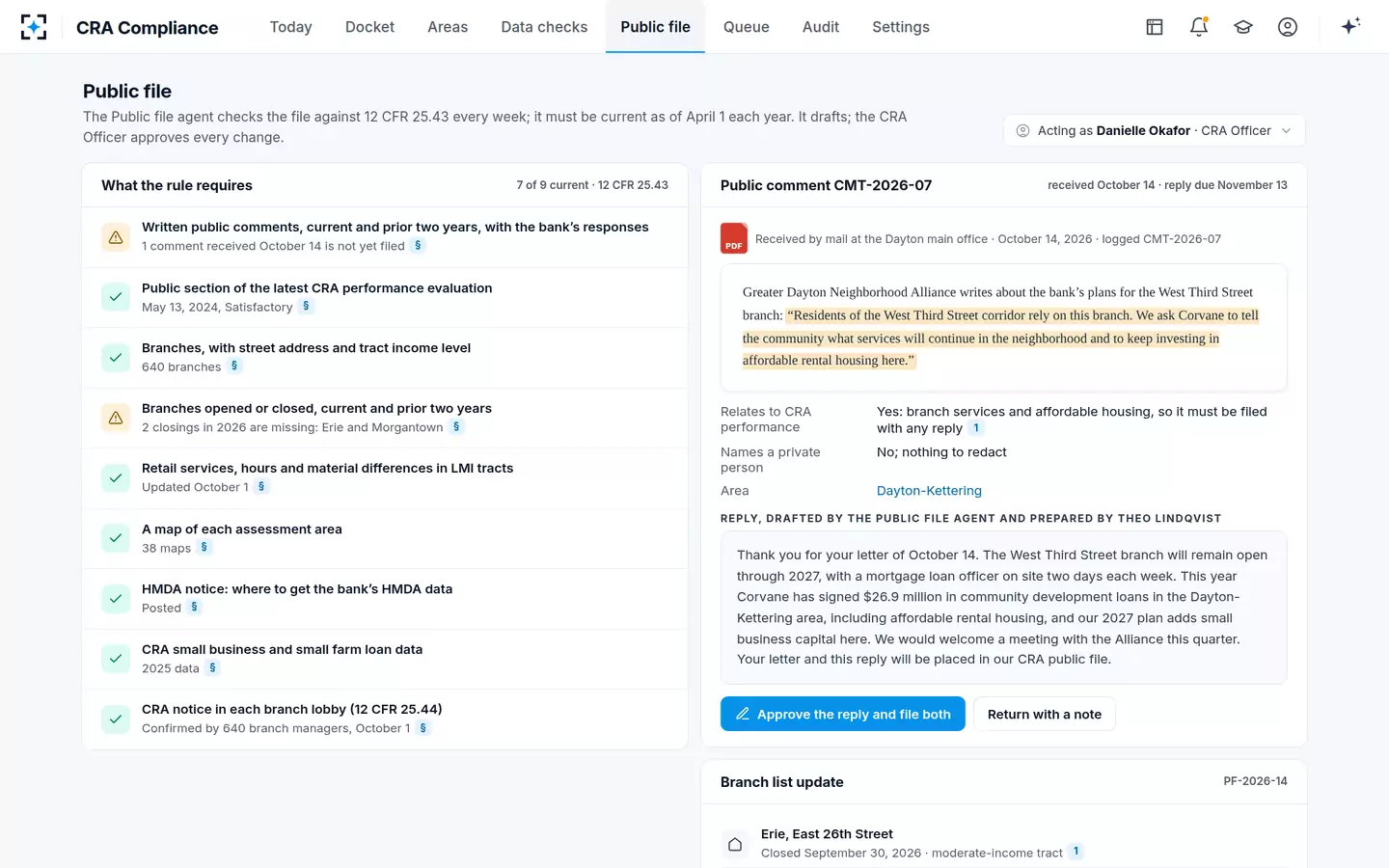
Some does, and it is worth checking how. The rule in force lists what the file must hold (12 CFR 25.43, in the 1995 text reproduced in appendix G, not the enjoined 2023 text above it): public comments on CRA performance for three years with responses; the latest public evaluation within 30 business days; branches with addresses and tracts; openings and closings for three years; services and hours; assessment area maps; and, by bank type, the CRA disclosure statement, quarterly loan-to-deposit ratios, a strategic plan or an improvement statement. It must be current as of 1 April. A product that stores documents is not the same as one that checks the file against that list and flags what is missing.
A CRA public file checked item by item in CRA Compliance
Can CRA software read loan documents?
Most cannot; it reads fields. That is enough for retail lending analysis once the fields are right, and not enough for community development, where the interagency Q&A puts the burden on the bank to show examiners why each activity qualifies. The deciding facts (how many units are restricted and for how long, where a fund invests, whether a volunteer used financial expertise) are in agreements, prospectuses and logs. Software that cannot open those documents leaves the reading to people and stores what they typed.
Software that can read them should prove it on your documents, not its own. Ask for the deciding passage and the page on a sample of your closed activities, including scanned agreements and multi-area funds, and check what it does with an illegible page. In CRA Compliance the Document reader never guesses an illegible page: it marks it and asks for a new scan, and it quotes rather than paraphrases. What an examiner needs from any machine-prepared qualification is set out in CRA compliance AI.
Ask a CRA software vendor one question first: when an examiner asks why this activity counts, what does the system show?
How do you choose CRA software?
By testing it on your own closed year against what your examiners found, and by asking questions whose answers can be shown on screen. The checklist below is the one to bring to a demonstration. It is as useful for judging a consultant's process as a product.
Nine questions to ask any CRA management software, on your own data
- Which inputs does it read: fields, documents or both?
Ask to see a qualification and the evidence behind it.
- Which rule set does it apply, and is the version recorded?
The 1995 rules in appendix G and the 2016 Q&A today; a final OCC–FDIC rule may change definitions.
- How does it choose the address and year for geocoding?
Business location for small business loans; tract and income level as of the activity date.
- Does it check reportable data against the documents?
Amount against the note, revenue against the credit memo, tract against the geocoded business address.
- How does it prevent double counting?
Against retail data, across tests, across areas and across affiliates.
- Who decides, and is it separated?
Named people, reason codes, and a different person to approve than to prepare.
- What happens when it is unsure?
A threshold below which it hands the item to a person, and a record of overrides.
- How does it track plan progress?
By area and test, updated when a decision is made, not when a report is run.
- What does it hand the examiner?
Per-area folders with each activity’s evidence and signatures, not a spreadsheet export.
Be clear about what CRA software does not replace. It does not file HMDA data, which is submitted through the HMDA Platform, and it does not decide what counts; the bank does, and examiners verify. CRA Compliance works with the systems a CRA program already runs on: the loan system, the HMDA and CRA data system, investment accounting, document imaging, the volunteer tracking system and a geocoding service. It reads from them and proposes; people decide, and the bank's regulatory reporting team files.
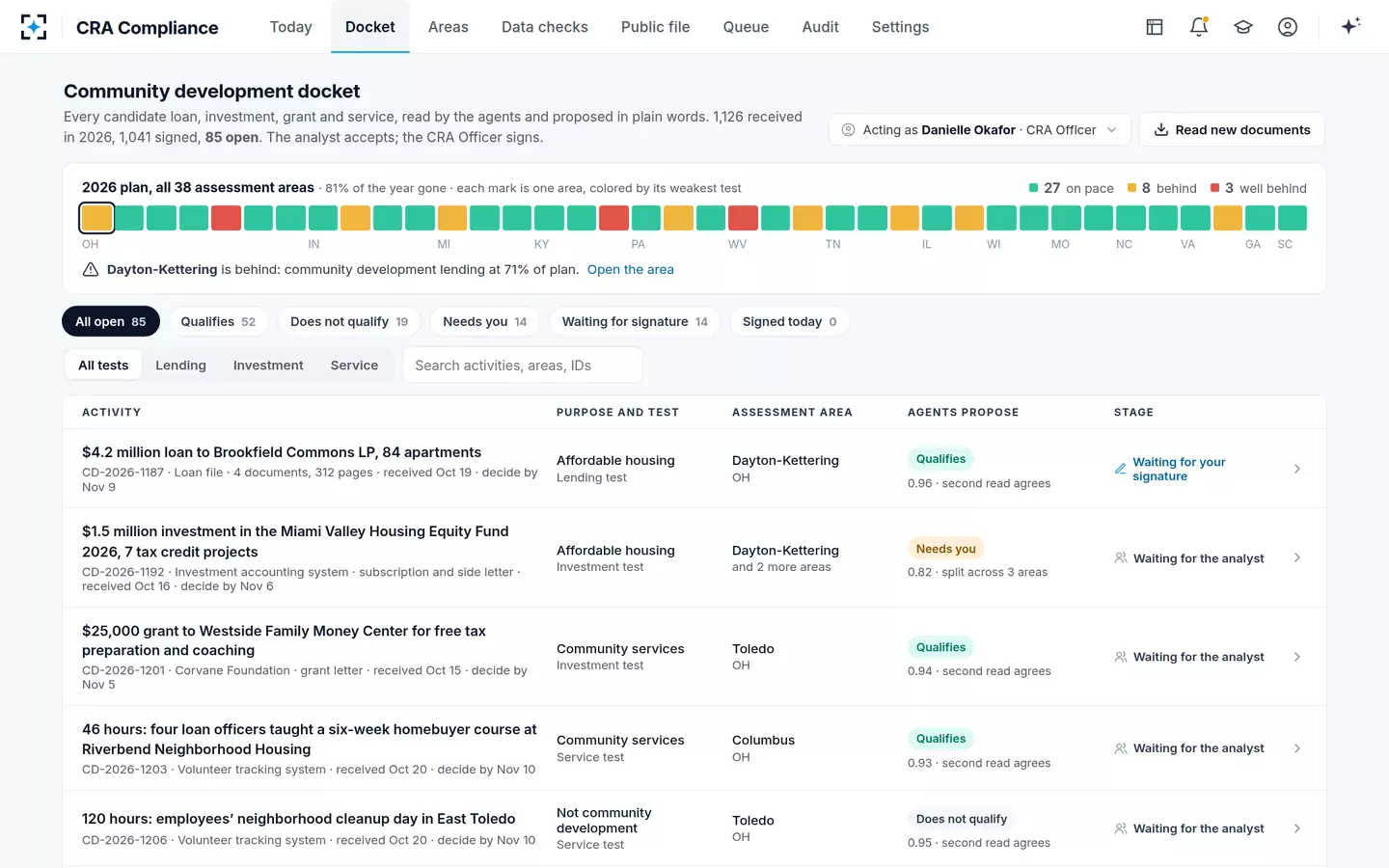
Every candidate in CRA Compliance, one plain sentence each
How long does CRA software take to implement?
As long as the inputs take to be ready, which is why the inventory comes first. No regulator publishes implementation benchmarks, and vendor timelines depend on two things a bank controls: read access to its systems and document store, and a written set of its own CRA procedures for the software to apply. A sensible sequence puts a test on a closed year before anything goes live.
A go-live sequence for CRA management software that a bank controls
A person decides
Inventory the ten inputsName the system of record and an owner for each; note which exist only as documents.
A person decides
Write the rule set downYour procedures on the 1995 rules and the Q&A: pro rata elections, broader-area claims, service tests, confidence thresholds.
Agent
Connect read-onlyLoan system, data system, investment accounting, document imaging, volunteer system, geocoder: read access only.
Agent
Replay a closed yearRun last year’s activities and data with your decisions held back, and compare.
Never: Never changes the records it reads.
A person decides
Read the differencesEvery disagreement with your past decisions is either a software error or a past error. Both are worth knowing before the exam.
A person decides
Go live by areaStart where the plan is furthest behind; keep two signatures on every qualification.
Questions people ask
What is the difference between CRA software and HMDA software?
HMDA software compiles and edits the mortgage loan/application register filed with the FFIEC. CRA software covers small business, small farm and community development data, assessment areas, the public file and activity tracking. Large banks need both, and both depend on correct geocoding.
Do small banks need CRA software?
Not for data reporting: banks under the large-bank threshold, $1.649 billion in 2026, report no CRA data unless they choose the large-bank tests. An intermediate small bank still has to qualify and document its community development activities, which is where most of its CRA effort goes.
Does CRA software need to change for the 2026 proposal?
Only if a final rule changes what it applies. The OCC–FDIC proposal would change thresholds, the grant and service definitions and data for large banks' grants. Software with a versioned rule set can add a new version; software with hard-coded rules needs a release.
Can CRA software produce the performance context?
It can draft it from census data, market and community contact data, but examiners weigh what the bank says against their own research and community contacts. In CRA Compliance each drafted sentence carries its source and a person approves the text.
What is a CRA data integrity review?
A check of reported CRA data against loan files before submission or an exam, ideally by someone other than the preparer. Federal Reserve examiners recommend a second review that "compares collected data with supporting loan documentation" and documenting every error found.
What does CRA software cost?
Vendors rarely publish prices. A fair comparison prices the work the software takes over in your own hours, including the reading time per activity; that method is set out in CRA consulting fees vs the cost of qualifying one activity.