CRA community development services examples, in the regulators' own list, include serving on the board or loan committee of a community development organization, teaching financial education to low- and moderate-income people, homebuyer and credit counseling, foreclosure prevention, technical assistance on financial matters to small businesses and nonprofits, and lending staff with human resources, IT or legal expertise to such groups (Interagency Q&A § __.12(i)-3). A service counts when it meets three conditions in 12 CFR 25.12(i): a primary purpose of community development, a relation to "the provision of financial services", and, at a large bank, not already credited as a retail banking service. The Q&A adds a fourth in practice: the employee must act "as a representative of the institution". Neighborhood cleanups and personal-time volunteering do not count. Services are where CRA reviewers disagree most, because each of those conditions has a grey edge. That is why Botminds' CRA Compliance has a Second-read agent that checks financial expertise and personal time on every service it is asked to approve, and sends the uncertain ones to a person.
Twelve kinds of service hour, scored against the rule
| Activity | Purpose test | Financial services test | Usually |
|---|---|---|---|
| Loan officers teach a homebuyer course for a nonprofit housing counselor | Affordable housing, low- and moderate-income clients | Homebuyer counseling is listed | Counts |
| Teller teaches a money-skills class at a school where most pupils get free or reduced-price meals | Targeted: the school meal test is in the Q&A | Financial education is listed | Counts |
| Same class at a school where few pupils qualify | Not targeted, unless another test shows it | Listed | Does not count |
| Credit analyst sits on the loan committee of a community loan fund | Fund lends for community development | Loan committee service is listed | Counts |
| Staff prepare returns at a free tax clinic for low-income families | Community services targeted to low- and moderate-income people | Tax preparation draws on financial skills | Counts |
| IT manager rebuilds the loan-intake system of a community development financial institution | The CDFI’s mission | Employees’ IT expertise is listed | Counts, often missed |
| Employees spend a day on a neighborhood cleanup | May help the area | No financial expertise used | Does not count |
| Branch staff build a house for an affordable housing nonprofit | Affordable housing | Construction labor is not a financial service | Does not count |
| Director volunteers at a counseling program on her own time | Community development | Financial | Does not count: not representing the bank |
| Officer is treasurer of a homeless shelter, a role she held before joining | Community services | Treasurer’s work is financial | Splits: was she acting for the bank? |
| Manager sits on a hospital foundation board in a mixed-income county | Serves the whole community | Board service | Splits: is the purpose community development? |
| Branch hosts account-opening events in a low-income tract | Benefits low- and moderate-income people | A retail banking service | Splits: by bank size |
What counts as a CRA community development service?
A service whose primary purpose is community development, that is "related to the provision of financial services", and that has not already been counted as a retail banking service (12 CFR 25.12(i)). The Q&A defines the middle condition broadly: providing financial services "often involves informing community members about how to get or use credit or otherwise providing credit services or information to the community", and service on the board of an organization that "promotes credit availability or finances affordable housing" qualifies. It draws the line with one example: "activities that do not take advantage of the employees' financial expertise, such as neighborhood cleanups, do not involve the provision of financial services" (§ __.12(i)-1).
The purpose condition is the same one that governs loans and investments: affordable housing, community services targeted to low- and moderate-income people, small business economic development, or revitalizing a qualifying area. A financial literacy class is a service with a financial skill; whether it has a community development purpose depends on who is in the room. The Q&A lists ways to show targeting, such as a school "at which the majority of students qualify for free or reduced-price meals", clients eligible for Medicaid, or recipients of government programs with income limits "equivalent to, or stricter than" the CRA's (§ __.12(g)(2)-1).
Do employee volunteer hours count for CRA?
Yes, when the employee volunteers on the bank's behalf and the work meets the three conditions. The Q&A is explicit about the opposite case. If a director, "on her own time and not as a representative of the institution, volunteers one evening a week at a local community development corporation's financial counseling program, the institution may not consider this activity a community development service" (§ __.12(i)-2). It is the clearest rule in this area, and still the one most often misapplied, because volunteer tracking systems record hours, not capacity.
Hours are not the only measure, either. In a large bank's service test, examiners look at "the extent to which the financial institution provides community development services as well as the innovativeness and responsiveness", using quantitative factors such as low- and moderate-income participants, organizations served, sessions sponsored or "financial institution staff hours devoted" (§ __.24(e)-2). The wages of the employee doing the work are not a qualified investment; "donated labor" is considered as a service (§ __.12(t)-7).
Where do two reviewers score the same service hours apart?
On four questions, and the same four every year. Reviewers rarely disagree about a cleanup or a board seat at a community loan fund. They disagree where the guidance gives a principle and the log gives too little to apply it: whether an organization's clients are mainly low- and moderate-income, whether a professional skill counts as financial, whether the employee was acting for the bank, and whether the activity is really a retail service.
Where CRA service hours are settled by the rule, and where reviewers split
Settled: Clear when the organization’s mission or the program’s eligibility targets low- and moderate-income people.
Left to judgment: Splits when the organization serves everyone, such as a hospital foundation or a chamber of commerce.
Settled: Clear for board seats, loan committees, budgeting, counseling and teaching money skills; clearly not for cleanups and building days.
Left to judgment: Splits on non-financial professional skills used for a community group: the Q&A counts HR, IT and legal expertise, many procedures do not mention it.
Settled: Clear when the bank assigned or approved the work and it was logged at the time.
Left to judgment: Splits when a long-standing personal role, such as a treasurer’s seat, appears in the log after the fact.
Settled: Clear at a large bank: anything counted as a retail banking service is excluded.
Left to judgment: Splits at an intermediate small bank, where retail services that benefit low- and moderate-income people can count as community development services.
The expertise row is the one most banks get wrong in the bank's disfavor. The Q&A's list of technical assistance already includes "providing services reflecting a financial institution's employees' areas of expertise at the institution, such as human resources, information technology, and legal services." The OCC–FDIC proposal of August 2026 would put the point into the rule itself, extending the definition to services that draw on the employee's own expertise at the bank and describing a community development service as "a volunteer service performed by a bank employee representing the bank" (91 FR 52114). The status of that proposal is set out in CRA proposed rule 2026.
The retail row depends on the bank's size. For a large bank, a service already counted under retail banking services cannot also be a community development service. For an intermediate small bank, the Q&A says examiners "will consider retail banking services as community development services if they provide benefit to low- or moderate-income individuals", naming low-cost deposit accounts, electronic benefit transfer accounts, individual development accounts, free or low-cost check cashing and "reasonably priced international remittance services" (§ __.26(c)(3)-1). The same branch event can be in or out depending on which test the bank is under.
Most disagreement about service hours is not about the rule. It is about a fact the volunteer log never recorded: who the clients were, or whose time it was.
Does board service count for CRA?
Yes, when the organization has a community development purpose. Service on the board of an organization that promotes credit availability or finances affordable housing is named in the Q&A as related to financial services, and "serving on the board of directors" heads its list of technical assistance to community development organizations, along with loan review committees, underwriting standards, loan processing, marketing, staff training, bookkeeping and fundraising. The Q&A also gives board service as an example of quality: an employee's "unique expertise and service on the board of a community organization" can show innovativeness and responsiveness when the engagement "significantly improves the products, services or operations" of the organization.
The board of a general-purpose charity is the hard case. A hospital foundation in a mixed-income county, an arts council or a chamber of commerce serves everyone; the seat counts only if the bank can show a community development purpose, for example a program of the organization that is targeted to low- and moderate-income people, or a distressed or underserved nonmetropolitan area whose essential needs it meets.
Does teaching financial literacy count for CRA?
Yes, when it is aimed at low- and moderate-income people. The Q&A lists school savings programs and "developing or teaching financial education or literacy curricula for low- or moderate-income individuals", as well as "credit counseling, home-buyer and home maintenance counseling, financial planning or other financial services education". The targeting is what needs evidence: the school meal share, the partner organization's client eligibility, or the location of the session in a low- or moderate-income tract and its audience.
How do you measure whether two CRA reviewers agree?
Have two reviewers score the same sample of service logs independently, then count. Percent agreement is the simple measure: the share of entries where both said the same thing. Cohen's kappa corrects it for agreement that would happen by chance, and the difference can be large. In a worked example in the peer-reviewed literature, 94% agreement corresponds to a kappa of 0.85 (McHugh, Biochemia Medica, 2012).
Two ways to measure agreement between CRA reviewers
Percent agreement
Entries scored alike ÷ entries scored
Easy to read; overstates agreement when most entries are easy ones
Count from the two score sheets
Chance agreement
Σ (row total × column total ÷ n) ÷ n
How often the two would agree if each scored at random with their own yes and no rates
From the 2 × 2 table
Cohen’s kappa
(observed − chance) ÷ (1 − chance)
Agreement beyond chance; McHugh calls .60–.79 moderate and .80–.90 strong
McHugh 2012, table 3
Where they split
Disagreements by condition
Purpose, expertise, capacity or test: the rows to rewrite in the procedure, or always send to a person
The measurement matters more than the number. A sample drawn from the easy entries will show high agreement and teach nothing. The calibration that pays is a sample weighted toward the four contested conditions, scored blind, with every disagreement read against the Q&A and turned into a sentence in the bank's procedure. Where the procedure cannot settle a condition, the honest answer is to send every such entry to a person.
How do you document CRA volunteer hours?
At the time of the service, with the facts that decide the four conditions. A log that records only a name, a date and a number of hours forces a reviewer to reconstruct the purpose and the capacity months later, which is when disagreements are born.
What a CRA service log entry needs to settle at the time
- Who, when, how long
Employee, role at the bank, date, hours; for recurring roles, each session or meeting.
- Acting for the bank
Assigned or approved by the bank, or a standing appointment the bank made; not a role held privately.
- What was done, in financial terms
Budget review, loan committee, credit counseling, curriculum taught, IT or legal work: the expertise used.
- The organization and its purpose
Mission, and the evidence of targeting: client eligibility rules, school meal share, Medicaid or program income limits.
- Where it benefits
The assessment area, or the broader statewide or regional area that includes it.
- Corroboration
A letter, agenda, sign-in sheet or minutes from the organization, so an examiner can verify the hours.
How do examiners verify CRA service hours?
From what the bank and third parties provide. Under the Q&A, "examiners will consider any relevant information provided by the institution and from third parties that documents the extent, innovativeness, and responsiveness of community development services", and the FDIC's intermediate small bank procedures tell examiners to "review community development loans, qualified investments, and community development services to verify that they qualify as community development" (FDIC manual XI-3). Hours that cannot be tied to an organization, a purpose and a capacity are the ones that come out.
How CRA Compliance handles community development services
The solution treats a service hour the way it treats a loan: the Document reader turns each volunteer log entry and the organization's letter into one plain sentence, the Qualification agent proposes an answer with the Q&A passage it relies on, and the Second-read agent argues against it. The second read runs on every proposed yes and on a 20% sample of everything else, and its checklist for services is the four conditions above. Anything below the 0.85 confidence threshold is proposed as "Needs you". Take a fictional sample bank, Corvane National Bank: on its 2026 docket, 46 hours of a six-week homebuyer course taught by four loan officers are proposed as qualifying, and 120 hours of an employee cleanup day in East Toledo as not.
Service hours on the CRA Compliance docket
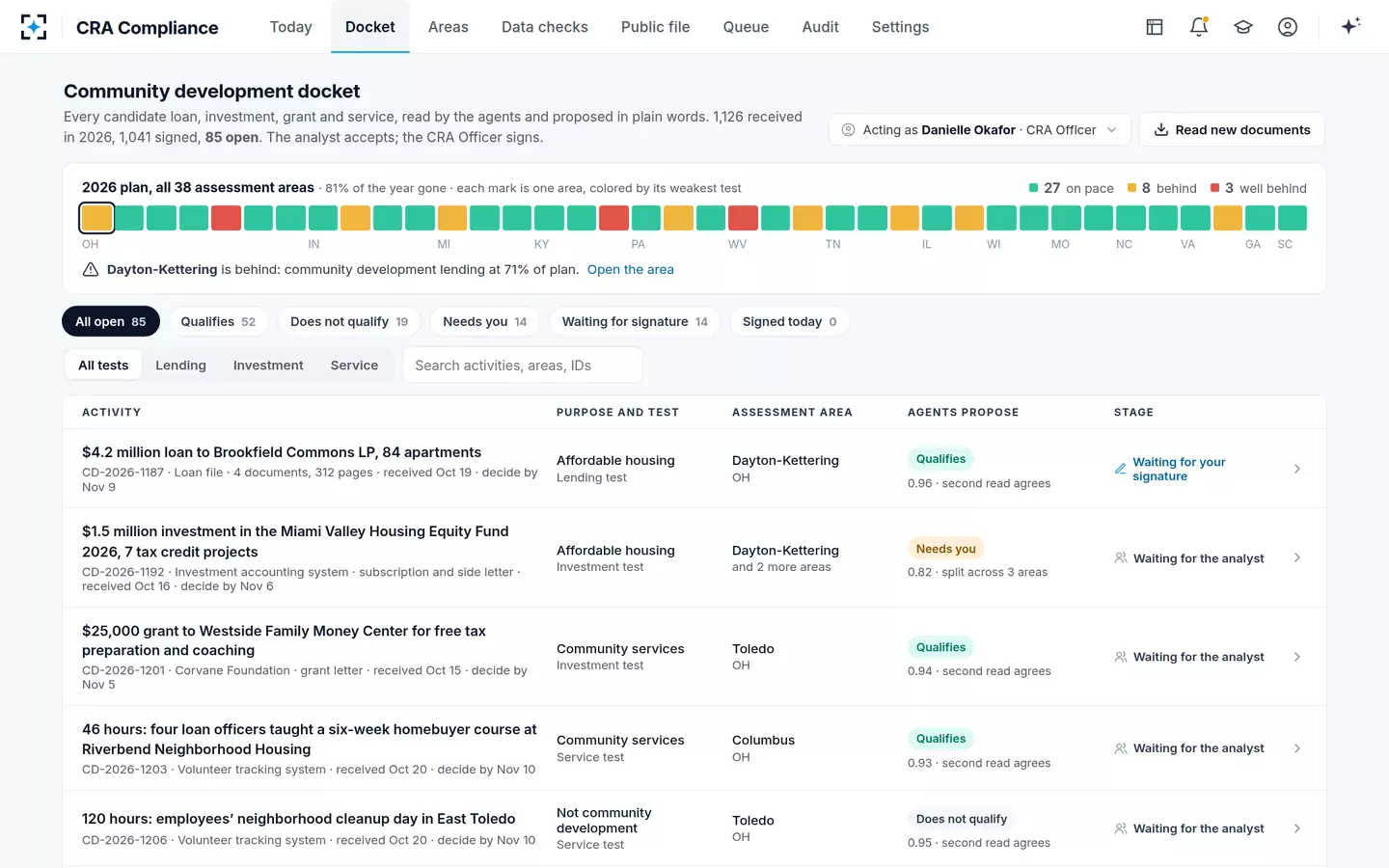
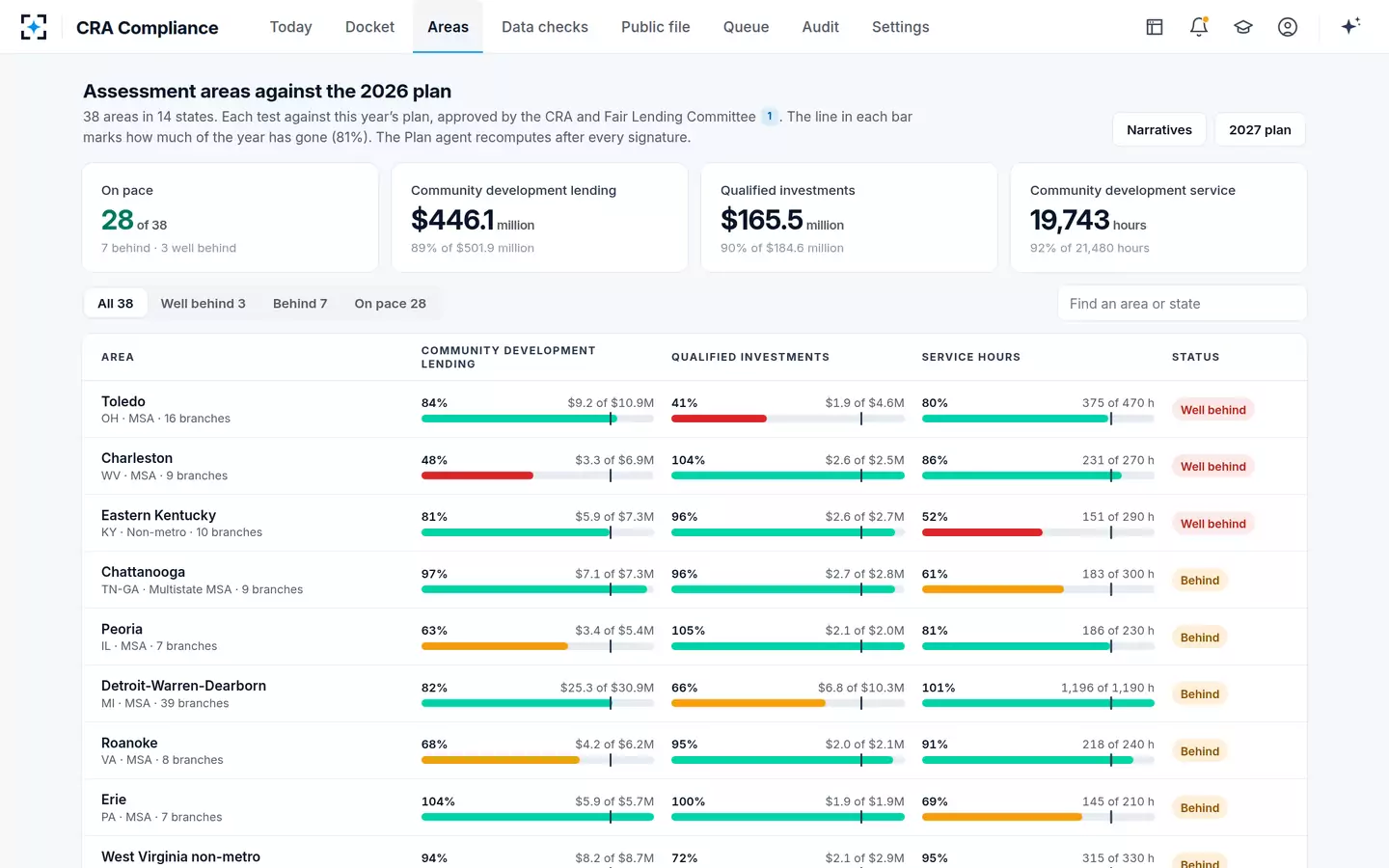
Service hours also have a plan. On the sample bank's areas view, community development service stands at 19,743 of 21,480 planned hours with 81% of the year gone, and the weakest areas are visible at once.
Community development service hours against plan, sample assessment areas
All 38 assessment areas, lending, investment and service hours against plan
Service hours rarely decide a rating on their own; at a large bank the service test, which also covers branches and retail delivery, generally carries a quarter of the weight. How the tests combine into the four ratings is in CRA ratings best to worst.
Questions people ask
Does volunteering at a food bank count for CRA?
Serving meals does not, because it uses no financial expertise. Serving on the food bank's board or finance committee, or helping it with budgeting or grant applications, can count if its clients are mainly low- and moderate-income people and the employee acts for the bank.
Does Habitat for Humanity volunteering count for CRA?
Building houses does not: construction labor, like a neighborhood cleanup, is not a financial service. Homebuyer education for the affiliate's families, board service or help with its mortgage processing can count as community development services.
Do CRA community development services have to be in the assessment area?
They must benefit the assessment area, or a wider statewide or regional area that takes it in. A statewide nonprofit whose mission includes the bank's area qualifies even if a particular session took place elsewhere in the state.
Do small banks get CRA credit for community development services?
A small bank that is not intermediate is judged on lending; services may support an Outstanding rating if its lending is at least Satisfactory. An intermediate small bank's community development test counts the extent of its community development services, including qualifying retail services.
Are employee wages for volunteer time a qualified investment?
No. The Q&A says the wages or other compensation of an employee or director who helps a community development organization are not a qualified investment; the donated labor is considered as a community development service if it meets the definition.
How many service hours does a bank need for CRA?
The regulation sets no number. Examiners weigh the extent of services against the bank's capacity and the area's needs and opportunities, along with innovativeness and responsiveness, so a bank sets its own goals in its plan.