The CRA affordable housing definition is one line of the regulation: community development includes "affordable housing (including multifamily rental housing) for low- or moderate-income individuals" (12 CFR 25.12(g)(1)). What turns that line into a dollar figure is the guidance. Housing qualifies when low- and moderate-income people, meaning incomes under 80% of the area median, "benefit, or are likely to benefit" from it. A loan or investment gets full credit when a majority of its units or dollars serve them, or when its stated, structured intent is affordable housing; for mixed-income housing below that line, the bank may elect pro rata credit for the affordable share, by units. The calculation is short; the hard part is the reading. The share, the income limit and the term all sit in a recorded agreement, a set-aside or a rent roll, and an analyst has to find the clause before doing the arithmetic. That reading is the job Botminds' CRA Compliance gives to its agents, which quote the clause beside the rule for a person to sign.
CRA credit for a housing loan, as the interagency Q&A computes it
Affordable share
Affordable units ÷ total units
Units set aside or restricted for low- and moderate-income households, from the recorded agreement or set-aside
Read from the document
Majority test
Share > 50% → full loan amount
A majority of dollars or beneficiaries; or an express, bona fide, structured intent, documented
Q&A § __.12(h)-8
Pro rata credit
Loan × affordable share
Mixed-income housing below the majority, at the bank’s election: $10m × 10% = $1m in the Q&A’s own example
Q&A § __.12(h)-8
Reported amount
Only the pro rata dollars
A bank that reports CRA data and elects pro rata consideration reports only that portion
Q&A § __.42(b)(2)-3
What counts as affordable housing for CRA?
Housing that low- or moderate-income people benefit from, or are likely to. The Q&A rejects a purely formulaic test: affordable housing "does hinge on whether low- or moderate-income individuals benefit, or are likely to benefit, from the housing", and it would be "inappropriate to give consideration to a project that exclusively or predominately houses families that are not low- or moderate-income simply because the rents or housing prices are set according to a particular formula" (§ __.12(g)(1)-1). Where occupants are not yet known or their incomes cannot be verified, examiners look at median rents of the project and the area, home values, the low- and moderate-income population nearby and the track record of the sponsor, or at an intent the sponsor has written down, in a prospectus, for example, or in the loan proposal.
The category is broader than apartment loans. Loans and investments for affordable housing rehabilitation and construction, loans to nonprofits that serve mainly low- and moderate-income housing needs, investments in projects eligible for low-income housing tax credits, and state and municipal bonds that "specifically support affordable housing" all appear in the Q&A's examples. A single-family mortgage made directly to a low- or moderate-income buyer is the exception: it is generally judged in the lending test as a retail loan, not as community development. Which other loans can count twice is covered in what makes a loan CRA eligible.
How is area median income used in CRA?
As the yardstick for both people and places. The regulation defines area median income as the median family income of the metropolitan area or metropolitan division, or the statewide nonmetropolitan median outside a metropolitan area (12 CFR 25.12(b)). Low income is under 50% of it; moderate income is "at least 50 percent and less than 80 percent"; middle income runs from 80% to under 120% (25.12(m)). The same cut-offs classify census tracts, using the tract's median family income against the area's.
Two details trip reviewers. The first is the boundary: in the CRA definition a household at exactly 80% of the median is middle income. Housing programs often write their limits as "at or below" a percentage, and some adjust for household size, so a reviewer should check that the restriction in the agreement sits inside the CRA's own line or record why the program's limit is treated as equivalent. The second is the median itself: the CRA uses family median income for the metropolitan area, while a housing program may use its own published limits. The figures differ, and the file should say which one the restriction uses.
What share of units must be affordable for CRA?
More than half, for full credit by arithmetic. The Q&A's first approach to primary purpose looks for a majority of the activity's dollars or beneficiaries tied to a community development purpose. Below a majority, there are two ways to credit housing. The whole loan still counts if its stated, genuine aim is affordable housing, it is built to achieve that aim and it achieves it or is reasonably certain to (the test is quoted in what makes a loan CRA eligible). Otherwise, for mixed-income housing, the bank may elect to count only the affordable share.
On a $10 million loan, credit jumps at the majority line
The cliff explains a pattern examiners see in files: unit counts that sit just above half, and arguments about which units count. Units held for a manager, units restricted for a shorter term than the loan, or units whose restriction is promised in a term sheet but not recorded are the usual disputes. The reviewer's defence is the recorded document and its page.
What is pro rata CRA credit?
Credit for the affordable part of a mixed-income project, measured by units. The Q&A's example is the standard one: "if an institution makes a $10 million loan to finance a mixed-income housing development in which 10 percent of the units will be set aside as affordable housing for low- and moderate-income individuals, the institution may elect to treat $1 million of such loan as a community development loan." It applies to "a development that has a mixed-income housing component or an affordable housing set-aside required by Federal, state, or local government".
Three features matter in practice. It is an election by the bank, not an automatic result. It is measured in units, not square feet or rents. And a large bank that reports community development loan data must report only the pro rata dollars, "based on the percentage of units that are affordable" (§ __.42(b)(2)-3). The OCC–FDIC proposal of August 2026 would keep the method, stating that for subsidized housing with a mixed-income component "the pro rata dollar amount of the total activity would be based on the percentage of units set aside for affordable housing" (91 FR 52114).
The calculation fits on one line. The input to it, the number of restricted units and for how long, lives on one page of a recorded agreement.
Two loans worked to the same steps in CRA Compliance
Take two loans from the 2026 docket of a fictional sample bank, Corvane National Bank, as they run through CRA Compliance. Both are multifamily, both are in the lending test, and both are also in the bank's HMDA data, which the multifamily exception allows. They differ in one number.
The CRA affordable housing calculation, worked on two sample loans
Brookfield: $4,200,000 construction-to-permanent
Northgate: $9,800,000
Brookfield: 84 units; 62 restricted
Northgate: 120 units; 18 restricted
Brookfield: At or below 60% of area median income, 30 years, recorded
Northgate: City housing agreement, 15 years from certificate of occupancy
Brookfield: 62 ÷ 84 = 73.8%
Northgate: 18 ÷ 120 = 15.0%
Brookfield: Majority of beneficiaries: met
Northgate: Majority: not met. Express, bona fide intent: none found
Brookfield: Full loan: $4,200,000
Northgate: Pro rata, at the bank’s election: $9,800,000 × 15% = $1,470,000
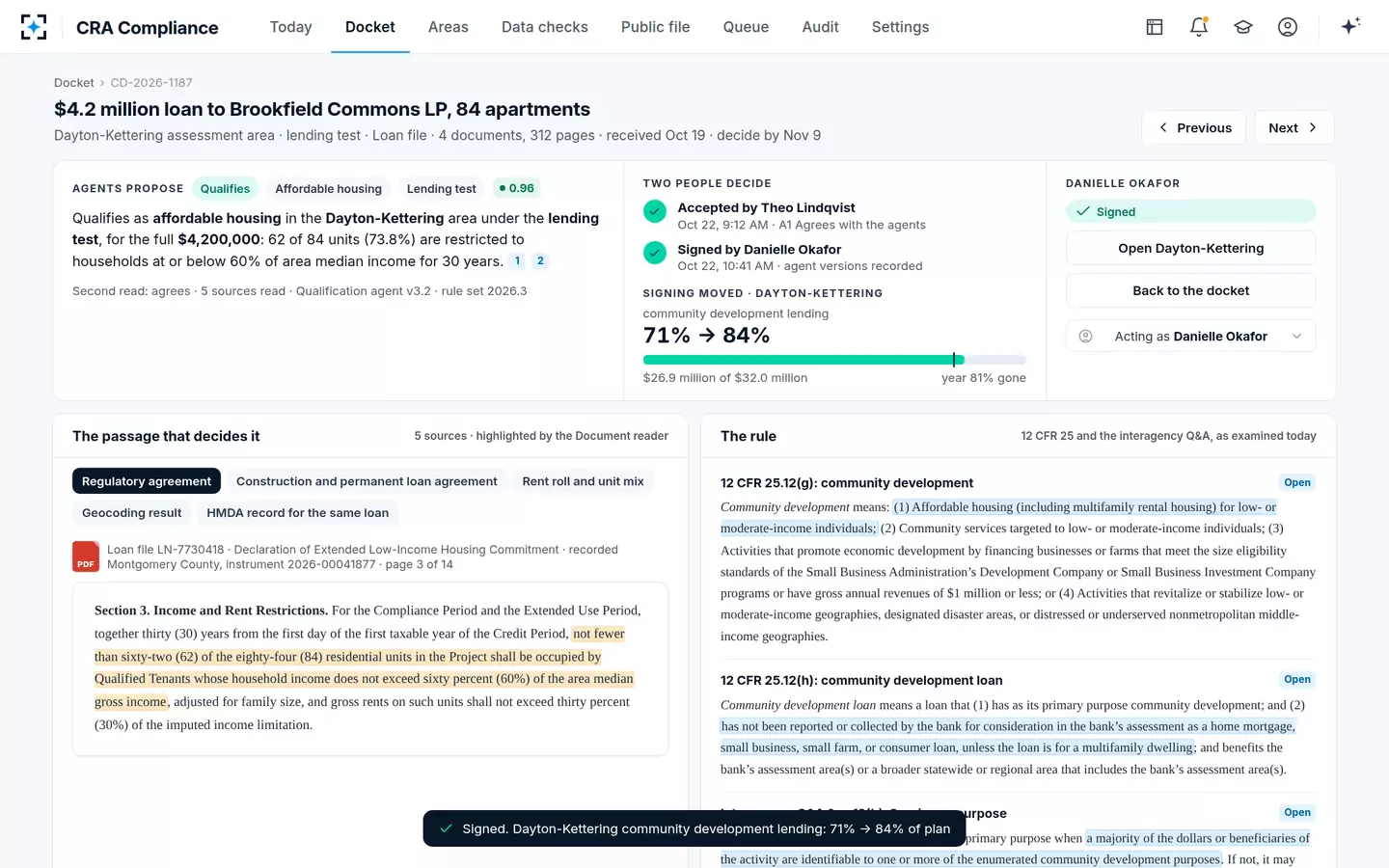
Brookfield's agreement restricts 62 of 84 units, a 73.8% majority, so the whole $4.2 million counts and the area's lending moves from 71% to 84% of plan when the CRA officer signs. Northgate's city agreement reserves 18 of 120 units. That is 15%, below half, and the file contains no prospectus or plan stating an express community development intent, so the agents propose the pro rata share: $1,470,000.
Mixed-income housing in CRA Compliance: agents propose the share, people elect it
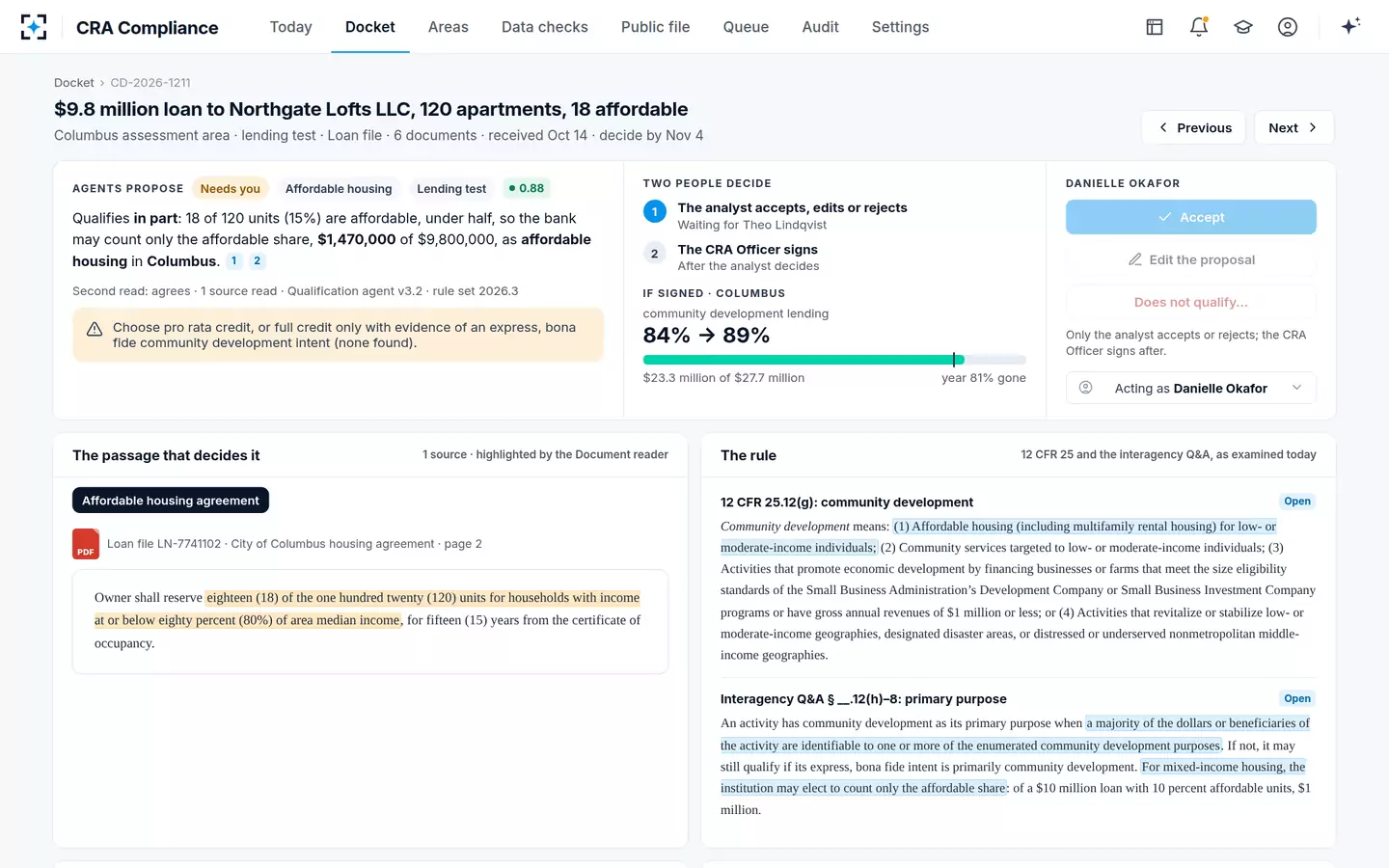
The highlighted rule text reads: 'For mixed-income housing, the institution may elect to count only the affordable share.'
Can a market-rate loan get partial CRA credit?
Only through an affordable component the file can prove. A loan on a market-rate building with no restriction, no set-aside and no stated intent has no affordable share to prorate. Where the rents are simply low, the current guidance lets examiners infer likely benefit from rents and demographics, but it gives no number; the Q&A only says what examiners "may look at". This "naturally occurring" affordable housing is where reviewers disagree most.
The August 2026 OCC–FDIC proposal would write the missing number down. It would treat a unit as affordable when the rent is affordable to a moderate-income renter "assuming that 30 percent of the renter's income is spent on rent", and asks whether partnerships with nonprofits should be exempt from "the requirement that median rents not exceed 30 percent of 80 percent of the area median income". On an illustrative area median of $90,000, that is $72,000 × 30% = $21,600 a year, or $1,800 a month. In high-cost areas the proposal would use 120% of the median instead; the OCC has generally treated as high-cost any county where more than 40% of households spend over 30% of income on housing. None of this is in force; it is the direction of travel.
Unsubsidized affordable housing: from inference to a written rent test
Rules in force today: Qualifies when the program or set-aside means low- and moderate-income people benefit.
OCC–FDIC proposal, August 2026: Named as a category; qualifies if the program or set-aside has a stated purpose of affordable housing for them.
Rules in force today: Pro rata by units, at the bank’s election.
OCC–FDIC proposal, August 2026: Pro rata by units set aside, for subsidized housing with a mixed-income component.
Rules in force today: No written standard; examiners weigh rents, home values and local demographics.
OCC–FDIC proposal, August 2026: Qualifies if median rents do not exceed 30% of 80% of area median income and benefit is likely.
Rules in force today: Middle-income housing may be considered in high-cost areas under the Q&A.
OCC–FDIC proposal, August 2026: Rent test at 30% of 120% of area median income in high-cost areas.
Does an affordable set-aside count for CRA?
Yes. A set-aside required by a federal, state or local government is exactly the case the pro rata rule was written for, and a set-aside that makes up a majority of units earns full credit on the majority test. What the reviewer needs is the instrument that imposes it: an inclusionary zoning agreement, a city housing agreement, a tax credit extended-use commitment or a recorded deed restriction, with the number of units, the income limit and the term.
The term deserves attention. Neither the regulation nor the Q&A sets a minimum period of affordability, but responsiveness affects the weight examiners give an activity, and a 15-year restriction on a 30-year loan is a fact an examiner will notice. The agents in CRA Compliance flag the term without changing the credit, as they did for Northgate.
What documents prove affordability for CRA?
The ones that fix who may live there, at what income and for how long, plus the ones that show the units exist. A reviewer's list:
The affordable housing file, document by document
- The recorded restriction
Regulatory agreement, land use restriction or extended-use commitment: units restricted, income limit, rent limit, term, and recording details.
- The government set-aside
For mixed-income projects: the agreement or ordinance that fixes the affordable units, so the pro rata share is countable.
- The unit mix and rent roll
Total units, the restricted units by income tier, and current rents, to check the count and, for unsubsidized housing, the rents.
- Income evidence where it exists
Tenant income certifications or program eligibility files; otherwise the area data examiners use to judge likely benefit.
- The stated intent, if claiming full credit below a majority
A prospectus, loan proposal or community action plan, and the structure that delivers it.
- The geography and the double-count check
The geocoded address, the assessment area, and the retail data showing whether the loan is already reported as a mortgage.
Volunteer work on housing has its own rules: a loan officer teaching a homebuyer course counts as a service, a weekend of painting does not. That line is drawn in CRA community development services examples.
Signed, and the assessment area's plan moves
Questions people ask
Is affordable housing for CRA the same as housing affordable at 30% of income?
Not under the rules in force. The test is whether low- and moderate-income people benefit or are likely to; rent affordability is evidence, not the definition. The OCC–FDIC proposal would add a 30%-of-income rent standard for unsubsidized housing, but it is not final.
What income counts as low or moderate for CRA?
Low income is under 50% of the area median family income; moderate is at least 50% and under 80%. The median is the metropolitan area's or division's, or the statewide nonmetropolitan median outside metropolitan areas.
How is mixed-income housing credited for CRA?
If a majority of units are affordable, the whole loan counts. If fewer are, the bank may elect to count the affordable share by units, so 18 of 120 affordable units on a $9.8 million loan gives $1,470,000.
Do low-income housing tax credit projects count for CRA?
Generally yes. The Q&A lists "projects eligible for low-income housing tax credits" among its examples of qualified investments, and loans financing such projects can be community development loans when their primary purpose is affordable housing.
Does middle-income housing ever count for CRA?
In limited cases. Housing for middle-income people can count where it directly helps revitalize a distressed nonmetropolitan middle-income area or a designated disaster area, and examiners may take high housing costs into account. The 2026 proposal would write the high-cost case into the rule.
Can the same affordable housing loan be claimed by two banks?
Each lender can claim its own loan or participation, but no institution may claim more than its share of a consortium's loans, and an affiliate's loan counts only if no other institution claims it.