An LMI census tract lookup answers one question: is this address in a low- or moderate-income tract for CRA purposes, in this year? The method is to geocode the address to its census tract, using the boundaries of the most recent decennial census, and read the tract's income level from the FFIEC's published census data, usually through the FFIEC geocoding system. A tract is low income if its median family income is under 50% of the area median, and moderate income if it is at least 50% and under 80% (12 CFR 25.12(m)). The answer moves: survey updates, new metropolitan boundaries and the annual list of distressed rural tracts all change it, and studies by the Federal Reserve Bank of Philadelphia found that bank lending changes with it. For a CRA team the lookup is the easy part; recording which designation applied when each loan or investment was made, and catching records that still carry an old tract, is the work. Botminds' CRA Compliance gives that work to a Geography agent and keeps its answer, with the date, on every activity.
When a tract's CRA status changed, bank lending changed with it
102tracts
in the new Philadelphia metropolitan division lost low- and moderate-income status after OMB’s 2013 boundary change
6.2%
growth in banks’ home purchase loans there, against 21.7% in comparable tracts that kept their status
395tracts
nationally lost eligibility from the same boundary changes; small business lending fell most where status was lost
What is an LMI census tract?
A census tract whose median family income is less than 80% of the median family income of its area. The CRA rule calls a tract a "geography" and defines it as "a census tract delineated by the United States Bureau of the Census in the most recent decennial census" (12 CFR 25.12(k)). The area median is the median family income of the metropolitan statistical area or metropolitan division, or the statewide nonmetropolitan median for tracts outside a metropolitan area (25.12(b)). The four income levels use the same cut-offs as for people.
How a tract gets its CRA income level
Tract income ratio
Tract median family income ÷ area median family income
The area is the MSA or metropolitan division, or the state’s nonmetropolitan area
12 CFR 25.12(b), (m)
Low income
Ratio < 50%
Low- and moderate-income tracts together are the "LMI" tracts
25.12(m)(1)
Moderate income
50% ≤ ratio < 80%
A tract at exactly 80% is middle income
25.12(m)(2)
Middle and upper
80% to < 120%; 120% or more
Middle-income nonmetropolitan tracts may still qualify if designated distressed or underserved
25.12(m)(3)–(4)
Low- and moderate-income tracts matter in three places. In the lending test, examiners count retail loans by tract income level, so the share of a bank's mortgages and small business loans in such tracts is compared with the market. In community development, revitalizing or stabilizing them is one of the four purposes. And an assessment area may not "arbitrarily exclude low- or moderate-income geographies" (25.41(e)(3)). A wrong tract therefore moves a loan between cells of the analysis an examiner reads first.
How do I look up an LMI census tract?
Geocode the address to a tract, then read the tract's income level for the year of the activity. The FFIEC's geocoding system returns both for a single address; banks with volume run their loan files through geocoding software that uses the same Census Bureau files. The step that goes wrong is usually not the lookup but the address fed to it. Federal Reserve examiners reviewing 2024 Regulation BB violations found "census tract data based on the residential address of the business or farm owner", when banks "are expected to document the census tract where the main business facility or farm is located or where the loan proceeds otherwise will be applied" (Consumer Compliance Outlook, 2025). They also found software that "improperly geocoded addresses".
An LMI census tract lookup that survives an exam
- Use the right address
The property for a mortgage; the main business facility or the place the proceeds are used for a small business loan; the borrower’s residence for a consumer loan.
- Use the current tract boundaries
Tracts from the most recent decennial census. A record that still carries a tract code from the previous decennial census is wrong even if the address is right.
- Read the level for the right year
The income level in force when the loan was made or the activity conducted, not today’s.
- Check the area, not just the tract
Is the tract inside one of your assessment areas, or in a broader statewide or regional area that includes one?
- Hold what cannot be placed
An address that will not geocode, or a tract with no income level, goes to a person, not to a guess.
- Verify the software
Examiners list periodic checks of geocodes generated by software among the sound practices for CRA data.
How often do census tract income levels change?
More often than most CRA files assume, for four separate reasons. Tract boundaries are redrawn with each decennial census. Tract and area median incomes come from the Census Bureau's American Community Survey, which the FDIC's examination manual describes as released "every five years" for this purpose. The Office of Management and Budget redraws metropolitan areas and divisions from time to time, which changes the area median a tract is compared with. And the agencies redraw the list of distressed and underserved nonmetropolitan middle-income tracts every year.
What moves a tract's CRA status, and how often
| Change | How often | What it does to a tract | What to record |
|---|---|---|---|
| Decennial census tract boundaries | Every ten years | Tracts split, merge or are renumbered; old codes stop being valid | The tract code in current boundaries |
| Survey income data | Refreshed every five years, per the FDIC manual | Tract and area medians change, so levels change | The level in force in the year of the activity |
| Metropolitan area definitions | When OMB publishes new delineations | A new area median can push many tracts across 80% | The area used for the comparison |
| Distressed or underserved list | Reviewed and updated annually | Middle-income rural tracts gain or lose eligibility | The list in force, and the 12-month lag after removal |
The FDIC tells its examiners to respect those breaks: "If changes occur between years (for example, the release of American Community Survey Census data every five years), it is important to see how geographies are affected. In these situations, it would not be appropriate to combine lending between years if there are significant changes to the geographies" (FDIC manual XI-11). A bank's own analysis should do the same: a mortgage made in a moderate-income tract is analyzed as one, even if the tract is middle income today.
What happens when a tract loses LMI status?
Bank lending there slows, on the best evidence available. In 2013 OMB split the old five-county Philadelphia metropolitan division in two. The new Philadelphia division's median family income fell from $76,400 to $54,200, and 102 tracts that had been moderate income became middle income; across the river, the Montgomery, Bucks and Chester division's median rose to $95,400 and 80 tracts became moderate income. Researchers at the Federal Reserve Bank of Philadelphia compared lending in those tracts with similar tracts whose status did not change (Philadelphia Fed).
Banks' home purchase lending after tracts lost or gained CRA eligibility
The study found that denial rates fell similarly in both groups while applications to banks fell in the tracts that lost status, so the slowdown "was likely due to reduced outreach and marketing efforts than to tighter underwriting standards". Nonbank lenders, which the CRA does not cover, filled part of the gap: their share of home purchase loans in the newly ineligible tracts rose from 46.6% to 53.1%. A national follow-up on small business lending found the same asymmetry: "Losing CRA eligibility status has a relatively larger effect on small business lending activities, while the effects of newly gaining CRA eligibility are less pronounced" (Ding, Lee and Bostic, 2018).
The income level of a tract is not a property of the place. It is a property of the place in a particular year, and lending follows the year.
Does a loan keep CRA credit if the tract changes?
For community development activity, the rules point to the date of the activity. The OCC's current rule says it "will consider any loan, investment, or service that was eligible for CRA consideration at the time the bank conducted the activity", or at the time of a legally binding commitment (12 CFR 25.51, appendix G). The OCC–FDIC proposal of August 2026 would extend that principle to both agencies, noting "the potential for changing facts, many of which are outside a bank's control" (91 FR 52114). For distressed and underserved nonmetropolitan tracts, the Q&A gives a fixed grace period: activities in a tract removed from the list still count during a "lag period" of "the 12 months immediately following the date" of removal (§ __.12(g)(4)(iii)-2).
For retail lending, each year is analyzed against that year's demographics, as the FDIC's guidance above requires. Either way the bank needs the same fact in its file: the tract and its income level as of the activity date. A tracker that stores today's level, recomputed every time it is opened, quietly rewrites history.
What is a distressed or underserved middle-income tract?
A nonmetropolitan middle-income tract that the agencies designate because its county is in distress or the area is remote enough to struggle to meet essential needs. A county qualifies as distressed on any of three triggers: an unemployment rate of at least 1.5 times the national average, "a poverty rate of 20 percent or more", or a population loss of 10% between the last two decennial censuses or a net migration loss of 5% over five years. Underserved tracts are identified from the Department of Agriculture's urban influence codes 7, 10, 11 and 12 (§ __.12(g)(4)(iii)-1). The list is published on the FFIEC website and updated annually.
Revitalizing or stabilizing such a tract is a community development purpose, so a lookup there needs one more step than an ordinary one: check the list for the right year, and if the tract has just been removed, whether the activity falls inside the 12-month lag.
Which census data applies to CRA?
The tract boundaries of the most recent decennial census, and the tract and area income figures the FFIEC publishes for the year being examined. Two other kinds of map circulate in community development and are easy to confuse with it: low- and moderate-income maps published for other federal programs, which use their own income tests and geographies, and a city's own target areas. They can support an argument about need, but they do not change a tract's CRA income level.
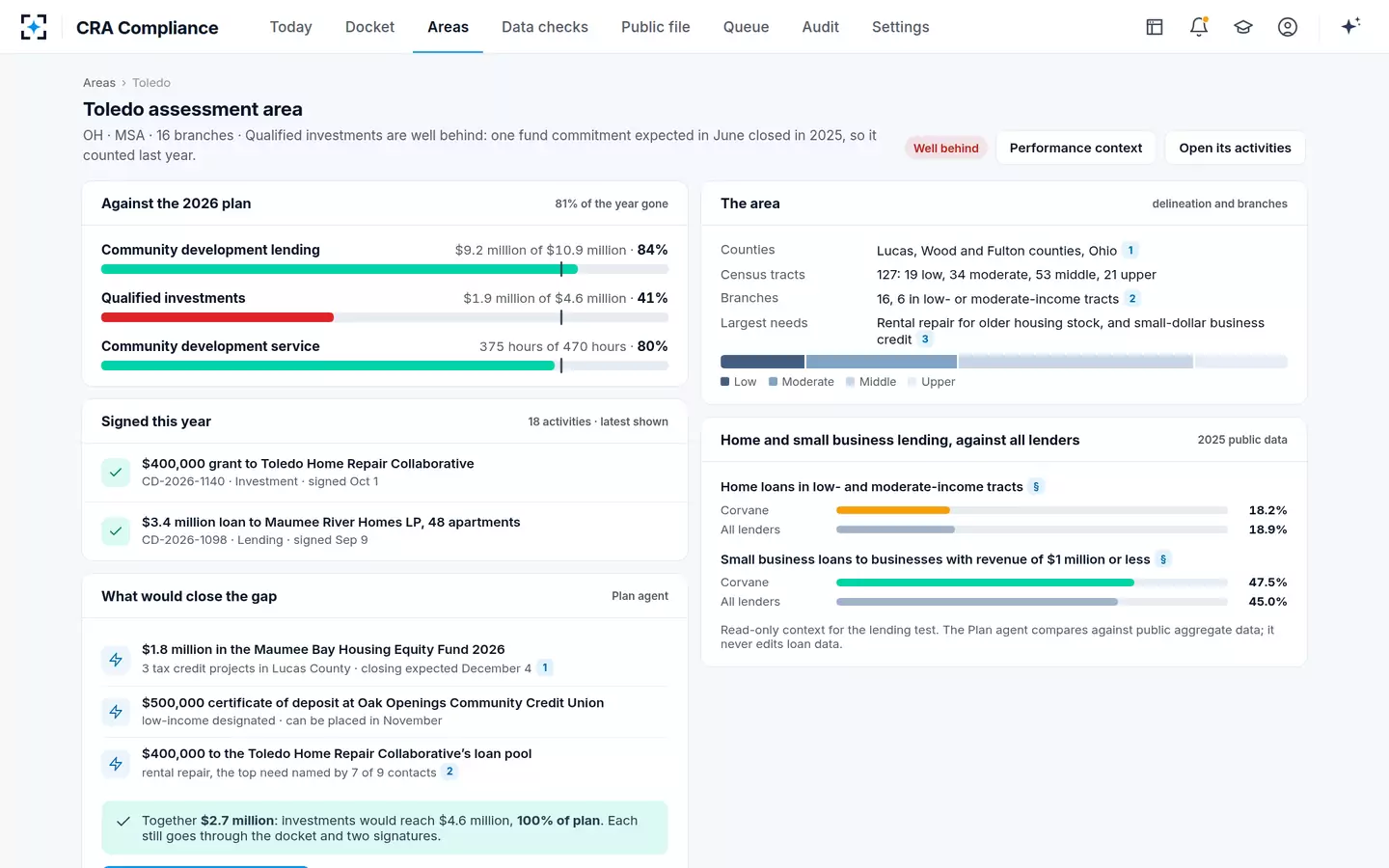
A good file shows the tract, its level and the year, and keeps the area context beside it. On the Toledo assessment area of a fictional sample bank, Corvane National Bank, as it runs through CRA Compliance, the area's 127 tracts break down as 19 low, 34 moderate, 53 middle and 21 upper income, and the bank's share of home loans in low- and moderate-income tracts (18.2%) sits just below all lenders' (18.9%).
One assessment area in CRA Compliance, tract by tract, against all lenders
How the Geography agent in CRA Compliance records the designation
In CRA Compliance, the Geography agent geocodes each candidate's address, finds the tract, its income level and the assessment area, or the broader statewide or regional area that includes it, and writes all four onto the activity with the date. It never assigns an area to a tract with no income level; it holds the item for a person instead. For the Brookfield Commons loan in the sample bank's docket, it placed the property in census tract 0806.00, moderate income, inside the Dayton-Kettering assessment area, and the audit trail shows the geocode with a match score of 0.99.
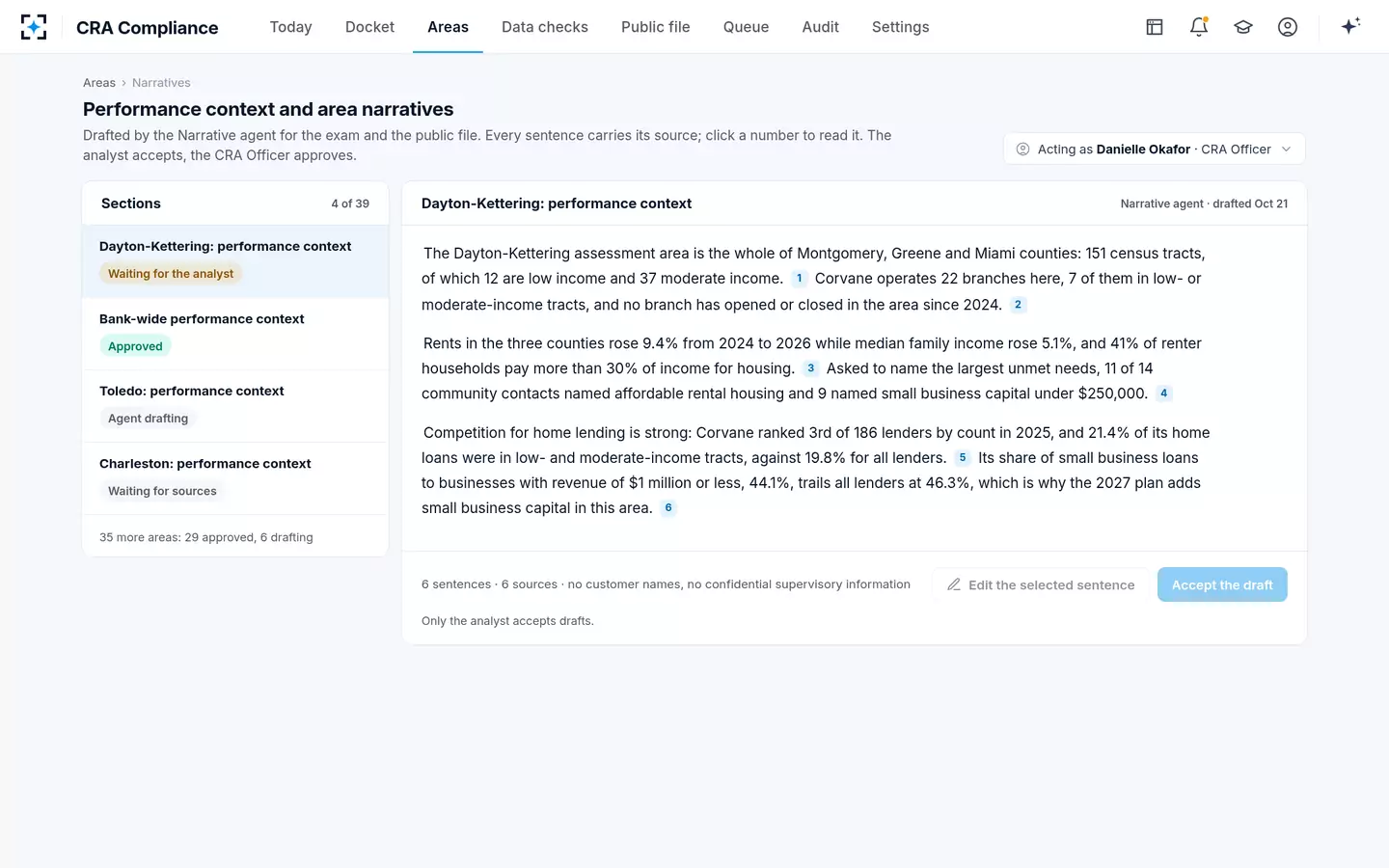
The same placement feeds the narratives examiners read. The Narrative agent drafts each area's performance context from those counts and public data, one source per sentence, and a person approves it. The tract counts in that narrative are only as good as the lookup underneath, which is why the lookup is kept, dated, with the activity. What else CRA software needs on day one to do this is listed in CRA management software for banks.
Performance context, drafted from tract data, one source per sentence
Questions people ask
What does LMI census tract mean?
A low- or moderate-income census tract: one whose median family income is under 80% of the median family income of its metropolitan area or division, or of the state's nonmetropolitan area. Under 50% is low income; 50% to under 80% is moderate.
How do I use the FFIEC geocoding system?
Enter the address and the year; it returns the census tract and the tract's income level and demographic data for that year. Use the year of the loan or activity, and the right address: for a small business loan, the main business facility or where the proceeds are used, not the owner's home.
Is an LMI census tract the same as a low-income community for other programs?
Not necessarily. Other federal programs publish their own low-income maps with different income tests and geographies. For CRA purposes, the tract's income level under the CRA definition is what counts.
Do loans to LMI borrowers in middle-income tracts count for CRA?
Yes, in the borrower distribution: examiners count home mortgage loans by borrower income as well as by tract income. A loan to a moderate-income family in a middle-income tract counts as a loan to a moderate-income borrower.
How long does a distressed tract keep its CRA status after removal?
Twelve months. Activities that would have qualified in a distressed or underserved nonmetropolitan middle-income tract still count during the 12 months after the tract is removed from the list.
What is the most common CRA geocoding error?
In the Federal Reserve's 2024 review of Regulation BB violations, examiners highlighted small business loans geocoded to the owner's home instead of the main business facility, and software that geocoded addresses incorrectly.