CRA ratings, best to worst, are Outstanding, Satisfactory, Needs to Improve and Substantial Noncompliance. The four are written into the statute, which requires each bank's rating to be published (12 U.S.C. 2906), and a large bank reaches one by adding points from five-level ratings on its lending, investment and service tests. At the end of 2025, 98% of FDIC-supervised institutions were rated Outstanding or Satisfactory. The consequences of the other 2% are what make the rating matter: regulators must weigh a bank's CRA record on applications to merge, acquire or open branches, a financial holding company with a bank rated below Satisfactory may not start new financial activities, and the bank must publish its plan to improve. A rating is built from hundreds of qualified activities across every assessment area, so the time to see it coming is during the year. Botminds' CRA Compliance qualifies each activity from its documents and recomputes every area's progress against plan the moment the CRA officer signs.
The four CRA ratings, best to worst, and what each one does
- 1
Outstanding
“Outstanding record of meeting community credit needs”
How it is reached: At a large bank: 20 or more points across the three tests
What it does: Full weight in applications; a strategic plan can name Outstanding goals
- 2
Satisfactory
“Satisfactory record of meeting community credit needs”
How it is reached: 11 to 19 points, and at least Low Satisfactory on lending
What it does: Meets the financial holding company test; no improvement statement needed in the public file
- 3
Needs to Improve
“Needs to improve record of meeting community credit needs”
How it is reached: 5 to 10 points, or any bank below Low Satisfactory on lending
What it does: Can be grounds to deny or condition an application; public file must describe the fix, updated quarterly
- 4
Substantial Noncompliance
“Substantial noncompliance in meeting community credit needs”
How it is reached: 0 to 4 points
What it does: The same consequences as Needs to Improve, at the lowest rating the statute provides
What are the four CRA ratings?
The statute fixes the wording. A bank's written evaluation must contain its rating, and the rating "shall be 1 of the following": "Outstanding record of meeting community credit needs", "Satisfactory record of meeting community credit needs", "Needs to improve record of meeting community credit needs" or "Substantial noncompliance in meeting community credit needs" (12 U.S.C. 2906(b)(2)). The regulation repeats the four and adds that the rating "reflects the bank's or savings association's record of helping to meet the credit needs of its entire community, including low- and moderate-income neighborhoods, consistent with the safe and sound operation" of the bank (12 CFR 25.21(c)).
Inside an evaluation there is a finer scale. Large banks get one of five ratings on each test: Outstanding, High Satisfactory, Low Satisfactory, Needs to Improve or Substantial Noncompliance. Multistate banks also get a rating for each state and multistate metropolitan area where they have branches, and a single-state bank's conclusions are presented separately for each metropolitan area. A Satisfactory overall can hide a Needs to Improve in a state, and the public evaluation shows it.
What is the best CRA rating, and how do the tests add up to it?
Outstanding. For a large retail bank it is reached by points. The Q&A assigns points to each test rating, with lending worth double, and converts the total into the overall rating; the regulation adds two rules on top: an Outstanding on lending guarantees at least Satisfactory overall, and "no bank or savings association may receive an assigned rating of 'satisfactory' or higher unless it receives a rating of at least 'low satisfactory' on the lending test" (25.28(b)).
How a large bank's CRA test ratings become the overall rating
| Test rating | Lending test points | Investment test points | Service test points |
|---|---|---|---|
| Outstanding | 12 | 6 | 6 |
| High Satisfactory | 9 | 4 | 4 |
| Low Satisfactory | 6 | 3 | 3 |
| Needs to Improve | 3 | 1 | 1 |
| Substantial Noncompliance | 0 | 0 | 0 |
The arithmetic explains where banks win and lose. High Satisfactory on lending (9), Outstanding on investment (6) and Low Satisfactory on service (3) make 18: Satisfactory. Outstanding on lending (12) with High Satisfactory on both the others (4 + 4) makes exactly 20: Outstanding. Needs to Improve on lending (3) caps the total at 9 whatever the other tests say: Needs to Improve. Lending generally carries half of a large bank's rating, as the OCC and FDIC note in their 2026 proposal.
Where a large bank's CRA rating comes from
Maximum points
- Lending test · 50%
- Investment test · 25%
- Service test · 25%
Innovation is a bonus, not a requirement. The Q&A says the lack of innovative products or complex investments "alone will not result in a 'needs to improve' CRA rating", though innovation can lift a rating under the large-bank tests (§ __.28-1). What lowers a rating outside the tests is evidence of discriminatory or other illegal credit practices: violations of fair lending law, certain Truth in Lending, RESPA and FTC Act provisions, judged on "the nature, extent, and strength of the evidence" and on any corrective action (25.28(c)).
How many banks fail CRA?
Very few. The FDIC reported that at 31 December 2025, "98 percent were rated 'Outstanding' or 'Satisfactory' for the Community Reinvestment Act" among the institutions it supervises (FDIC Consumer Compliance Supervisory Highlights, 2026). The FDIC's monthly list tells the same story at small scale: of the 35 state nonmember banks whose ratings were assigned in July 2026, 33 are listed as S and 2 as O, and none lower (our count of the October 2026 list).
CRA ratings are high, so a low one stands out
98%
of FDIC-supervised institutions rated Outstanding or Satisfactory for CRA at the end of 2025
35banks
rated by the FDIC in July 2026: 33 Satisfactory, 2 Outstanding, none below
1990
since 1 July 1990 every CRA rating has been disclosed to the public
High ratings do not make the work easy; they make it unforgiving. When nearly every peer is Satisfactory, a Needs to Improve is visible to every regulator reviewing an application, every community group commenting on one and every reader of the bank's public file. What causes the low ratings is a weak record under the bank's tests or plan, as the FDIC put it: "weak performance under the lending, investment and service tests, the community development test, the small bank performance standards, or an approved strategic plan".
Are CRA ratings public?
Yes. Each evaluation has a public section that states the agency's conclusions, "the facts and data supporting such conclusions" and the bank's rating with its basis, and the statute says the ratings "shall be disclosed to the public on and after July 1, 1990". Names of customers, employees and people who gave information in confidence go in a confidential section instead. The bank must place the public evaluation in its public file within 30 business days of receiving it (12 CFR 25.43(a)(2)).
What happens if a bank gets Needs to Improve?
Four things, most of them public. The bank must add to its public file "a description of its current efforts to improve its performance in helping to meet the credit needs of its entire community" and "update the description quarterly" (25.43(b)(5)). Any application in which CRA performance is a factor gets harder, as the next section explains. A financial holding company with a bank rated below Satisfactory is barred from starting new financial activities or acquiring companies engaged in them (12 U.S.C. 1843(l)(2)). And the bank is examined more often: exam cycles lengthen only for banks with good ratings, as set out in FDIC compliance exam frequency.
What follows a CRA rating below Satisfactory
- A quarterly public statement
The public file must describe current efforts to improve, updated every quarter until the next evaluation.
- Harder applications
The record "may be the basis for denying or conditioning approval" of a branch, relocation, merger or charter conversion.
- No new financial activities
A financial holding company may not start activities or acquire companies under the expanded powers.
- Shorter exam cycles
Longer intervals between CRA evaluations are reserved for banks with good ratings.
- More data in the next evaluation
The FDIC tells examiners to present additional years of data where there is an unfavorable rating at any level.
Can a bad CRA rating block a merger?
Yes, it can be the reason one is denied or conditioned. The statute requires each agency to "take such record into account in its evaluation of an application for a deposit facility", and the regulation lists the applications it covers: a new branch, relocating a main office or branch, a merger, consolidation or purchase of an insured institution's assets under the Bank Merger Act, a charter conversion, and acquisitions under the Home Owners' Loan Act. It then says plainly that the bank's "record of performance may be the basis for denying or conditioning approval" of any of them (25.29(d)).
The Q&A explains how much the rating weighs. In reviewing an application, the most recent CRA examination is "an important, and often controlling, factor" (§ __.29(a)-1). Promises made during the application do not rescue a weak record: "institutions cannot use commitments made in the applications process to overcome a seriously deficient record of CRA performance", though commitments may address "specific weaknesses in an otherwise satisfactory record" (§ __.29(a)-2). Written comments from the public become part of the application record (§ __.29(b)-1), and the bank's own public file holds three years of comments on its CRA performance for anyone to read.
A merger application is decided on the CRA record the bank already has. The rating that stops a deal was earned in the years before anyone planned it.
How often are banks rated for CRA, and where can you find a rating?
Each regulator sets a cycle by size and rating; small banks are typically evaluated every 48 to 72 months, the FDIC notes (FDIC manual XI-11), and larger or lower-rated banks more often. Each agency also publishes, at least 30 days before each quarter, the list of banks it plans to examine for CRA (12 CFR 25.45).
Ratings and full public evaluations are searchable at each regulator: the OCC's CRA database for national banks and federal savings associations (OCC), the FDIC's performance evaluation search for state nonmember banks (FDIC), and the Federal Reserve's search for state member banks (Federal Reserve). The bank's own public file has its latest evaluation.
How CRA Compliance keeps the rating in view during the year
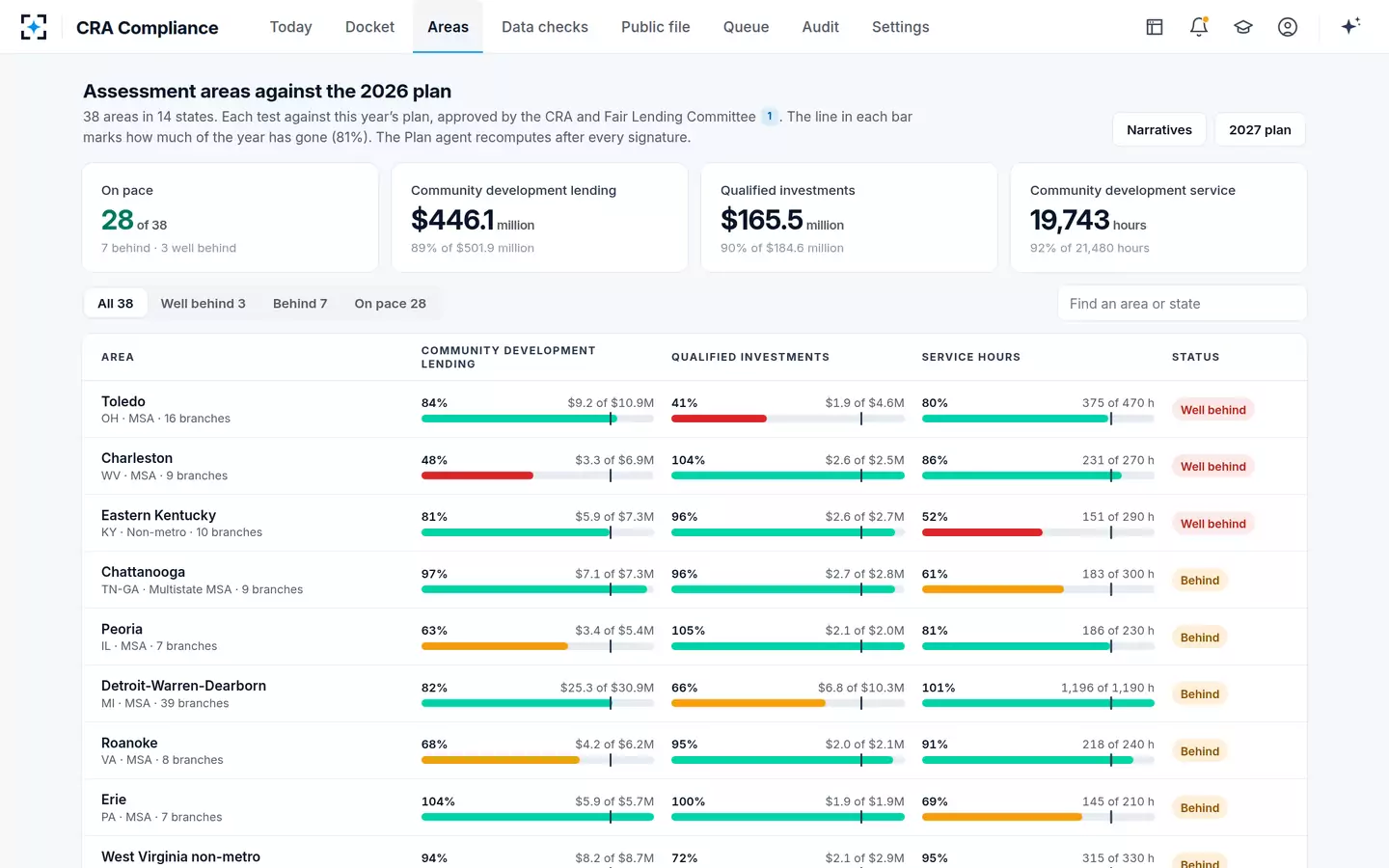
A rating is the sum of hundreds of qualified activities across every assessment area, and most banks find out where an area stands at quarter end, when it is too late to source a deal. Take a fictional sample bank, Corvane National Bank, as it runs through CRA Compliance: 38 assessment areas, each tracked against the year's plan on its lending, investment and service tests, recomputed after every signature. With 81% of the year gone, 28 areas are on pace, Toledo is furthest behind on qualified investments at 41%, Charleston on lending at 48% and Eastern Kentucky on service hours at 52%.
All 38 assessment areas against plan in CRA Compliance, worst first
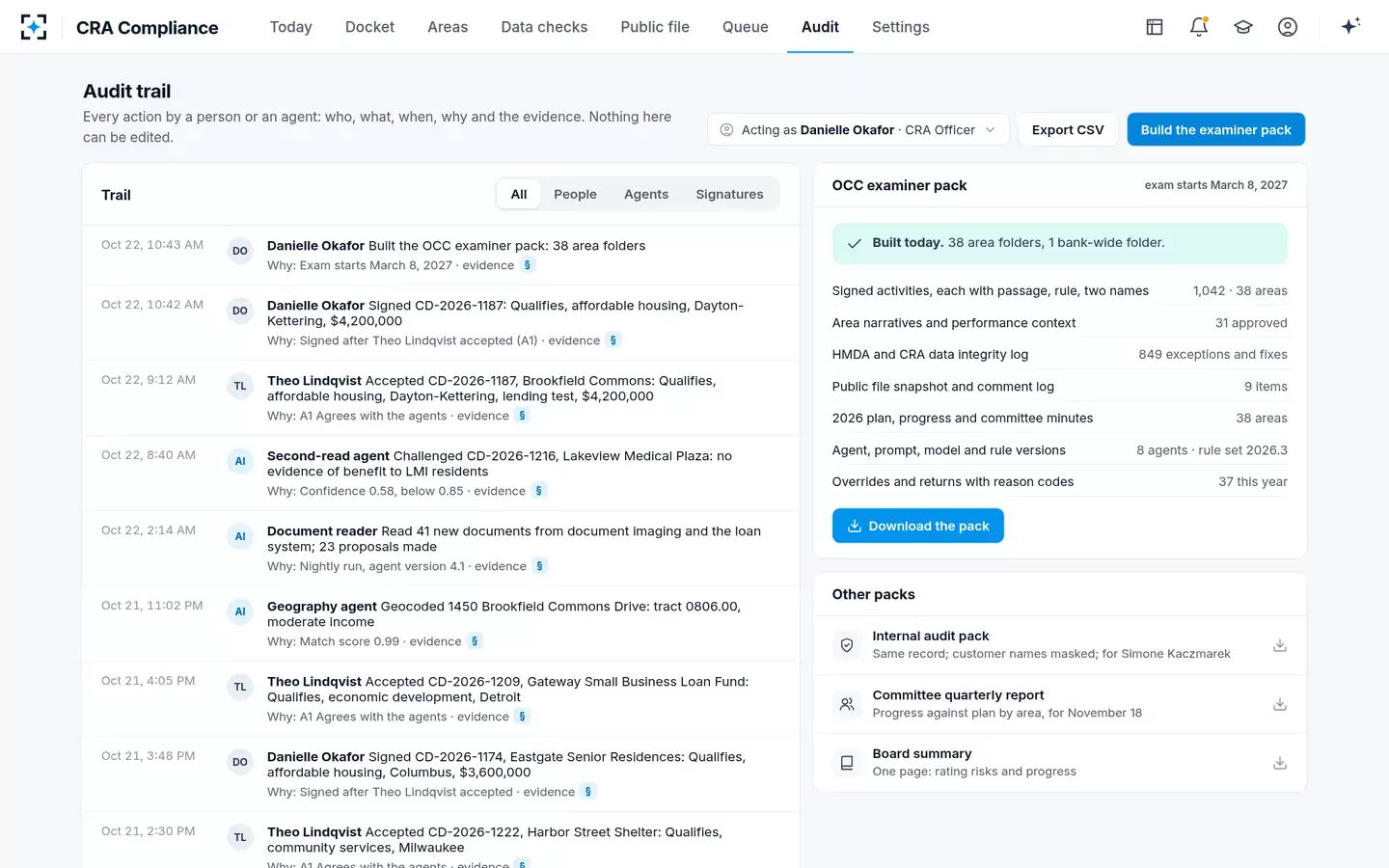
At exam time, the same record becomes the examiner's starting point: one folder per assessment area with each signed activity, its deciding passage, its rule and both signatures, the narratives, the data integrity log, the public file and the committee minutes. The CRA officer's part in that, seat by seat, is set out in the bank CRA officer job description, and what makes each activity count in what makes a loan CRA eligible.
The examiner pack, built from the signed activities
Questions people ask
What is the difference between High Satisfactory and Low Satisfactory?
They are two of the five ratings large banks receive on each test. High Satisfactory earns 9 points on lending and 4 on investment or service; Low Satisfactory earns 6 and 3. The overall rating has only one Satisfactory.
Can a small bank get an Outstanding CRA rating?
Yes. A small bank is rated mainly on its lending, and examiners may consider qualified investments, services and delivery systems toward Outstanding if the bank already meets the Satisfactory standard on lending.
Does a fair lending violation lower a CRA rating?
It can. Evidence of discriminatory or other illegal credit practices adversely affects the evaluation, weighed by the nature, extent and strength of the evidence, the bank's policies and any corrective action. Other consumer violations generally do not affect the rating.
Is a CRA rating the same as a consumer compliance rating?
No. The consumer compliance rating is a separate 1-to-5 scale under the FFIEC's uniform rating system. The FDIC reported 98% of its institutions at 1 or 2 for consumer compliance and, separately, 98% Outstanding or Satisfactory for CRA at the end of 2025.
Can one weak assessment area pull down a CRA rating?
It can show. A multistate bank gets a separate rating for each state and multistate metropolitan area where it has branches, built from its performance in the areas there, and the public evaluation presents conclusions area by area. A weak area is visible to anyone who reads it.
Do CRA ratings affect deposit insurance applications?
Yes. The applications in which the agencies consider CRA performance include deposit insurance, branch, relocation, merger and charter applications, as the OCC and FDIC summarize the current rules in their 2026 proposal.