A bank CRA officer job description, stripped to what regulators actually require, has five parts: make sure every loan, investment and service the bank claims for the Community Reinvestment Act qualifies and is counted once; collect and report the CRA data the bank's size requires; keep the public file current; prepare the bank for its CRA evaluation; and report to the board. No regulation defines a "CRA officer". The FDIC expects every bank to appoint "a compliance officer with authority and accountability" who reports to the board, and the CRA rule supplies the rest through the duties it puts on the bank (FDIC manual II-3). In practice the work is a chain of seats: the CRA officer, a data analyst, a community development manager, a board committee and internal audit. Most exam problems trace to the seat that reads loan files, prospectuses and volunteer logs by hand. That reading is what Botminds' CRA Compliance hands to agents, so each person in the chain decides on the passage itself.
The five seats in a bank's CRA program, before and after agents read the documents
Today
Signs batches of qualifications, often without the source pages in front of them, and learns where an area stands at quarter end.
With agents
Signs one qualification at a time with the deciding sentence on screen, and sees the area’s plan move as they sign.
Still theirs: Every signature, the exam, the board report
Today
Spends half the week finding the page of a loan file that proves units are restricted, then types the answer into a tracker.
With agents
Opens each candidate with the passage highlighted beside the rule, and accepts, edits or rejects it with a reason code.
Still theirs: The first human decision on every activity
Today
Knows a deal qualifies but has to work out which document proves it, and hears an area is behind too late to source a deal.
With agents
Answers the agents’ questions, adds the missing document, and gets the pipeline items that would close an area’s gap.
Still theirs: Relationships, deals, board seats
Today
Reviews progress quarterly and asks where the bank is behind, and why, before approving next year’s plan.
With agents
Sees every area against plan, worst first, with the reason for each, and approves the plan on that.
Still theirs: Approval of the annual CRA plan
Today
Asks who decided an activity qualifies, on what evidence, and whether it was someone other than the preparer.
With agents
Reads two names, a reason code, the passage and the rule on every activity, and exports the audit pack.
Still theirs: Independence: reads everything, changes nothing
What does a CRA officer do?
The CRA officer owns the bank's record under the Community Reinvestment Act, which is the record the regulator rates and every merger reviewer reads. Day to day that means deciding, or signing off on, which activities the bank claims; watching each assessment area against the year's plan; answering public comments; and keeping the bank ready for an evaluation it can be told about with a quarter's notice. Each of those duties comes from a specific provision of the regulation, and each one lands on a seat.
What the CRA rule asks of a bank, and which seat usually carries it
| Duty | Where the rule says it | Usual seat | What goes wrong |
|---|---|---|---|
| Delineate assessment areas | 12 CFR 25.41: whole tracts, no arbitrary exclusion of low- and moderate-income tracts | CRA officer, approved by the board or committee | Areas not updated after branch openings, closings or new metropolitan boundaries |
| Qualify community development activities | 25.12(g)–(i), (t) and the Q&A; "prepared to demonstrate" each one | Data analyst reads; CRA officer signs | Over-claimed activities removed at the exam |
| Collect and report CRA data (large banks) | 25.42: small business, small farm and community development loan data by 1 March | Data analyst | Wrong amounts, tracts and revenue codes |
| Keep the public file | 25.43: comments, evaluation, branches, services, maps; current as of 1 April | CRA officer, with branch operations | Branch closings and comments not filed |
| Post the lobby notice | 25.44: in the main office and every branch | Branch operations | Out-of-date notices after a branch change |
| Prepare for the evaluation | Performance context, community contacts, examiner requests | CRA officer and community development manager | Context written late, without sources |
| Report to the board | FDIC: regular reports from the compliance officer to the board | CRA officer to the committee | Progress known only at quarter end |
Who is responsible for CRA compliance in a bank?
The board, ultimately, and the CRA officer it appoints, day to day. The FDIC's examination manual puts final responsibility for the compliance management system on the board (UDAAP training for the board of directors quotes it). Among the board's key actions it lists "appointing a compliance officer with authority and accountability", "allocating resources to compliance functions commensurate with the level and complexity of the institution's operations", "conducting periodic compliance audits" and regular reports from the compliance officer to the board (FDIC manual II-3).
The manual also allows a committee: one "consisting of the compliance officer, representatives from various departments, and member(s) of management or the Board" may replace or support a full-time officer. Larger banks commonly have a CRA and fair lending committee that approves the annual CRA plan and receives progress reports. Responsibility can be shared with third parties, too, but not handed off: the board and management answer for the risks of a third-party relationship exactly as if the bank's own staff had done the work.
What does a CRA data analyst do?
Collects, checks and reports the loan data that examiners test, and in many banks also does the first read on every community development candidate. A large bank must collect for each small business and small farm loan a loan number, the amount at origination, the loan's location and an indicator of whether the borrower's gross annual revenue was $1 million or less, and report aggregate data by 1 March (12 CFR 25.42). Examiners validate exactly those fields: loan type, amount, location and income or revenue, in the FDIC's list.
Those are also the fields where banks are cited. Regulation BB was the second most-cited consumer regulation at Federal Reserve-supervised state member banks in 2024, with 53 violations of the small business and small farm data requirements in § 228.42(a), 8.0% of all violations. Examiners found incorrect loan amounts, census tracts and revenue codes, caused by software reading the wrong fields in the core system, owners' home addresses geocoded instead of the business, and "weak bank controls and secondary review processes that did not verify collected data against source documents" (Consumer Compliance Outlook, 2025). The seat that compares data with the document is the one examiners care about.
The CRA seat in numbers
$80,730
median annual pay of compliance officers in the US, 2025 (O*NET, from BLS)
436,400
compliance officers employed across all industries in 2025
60%+
of community banks’ compliance spending goes on personnel, in every size group studied
53violations
of Regulation BB data rules at Fed-supervised banks in 2024, the second most cited
Who maintains the CRA public file?
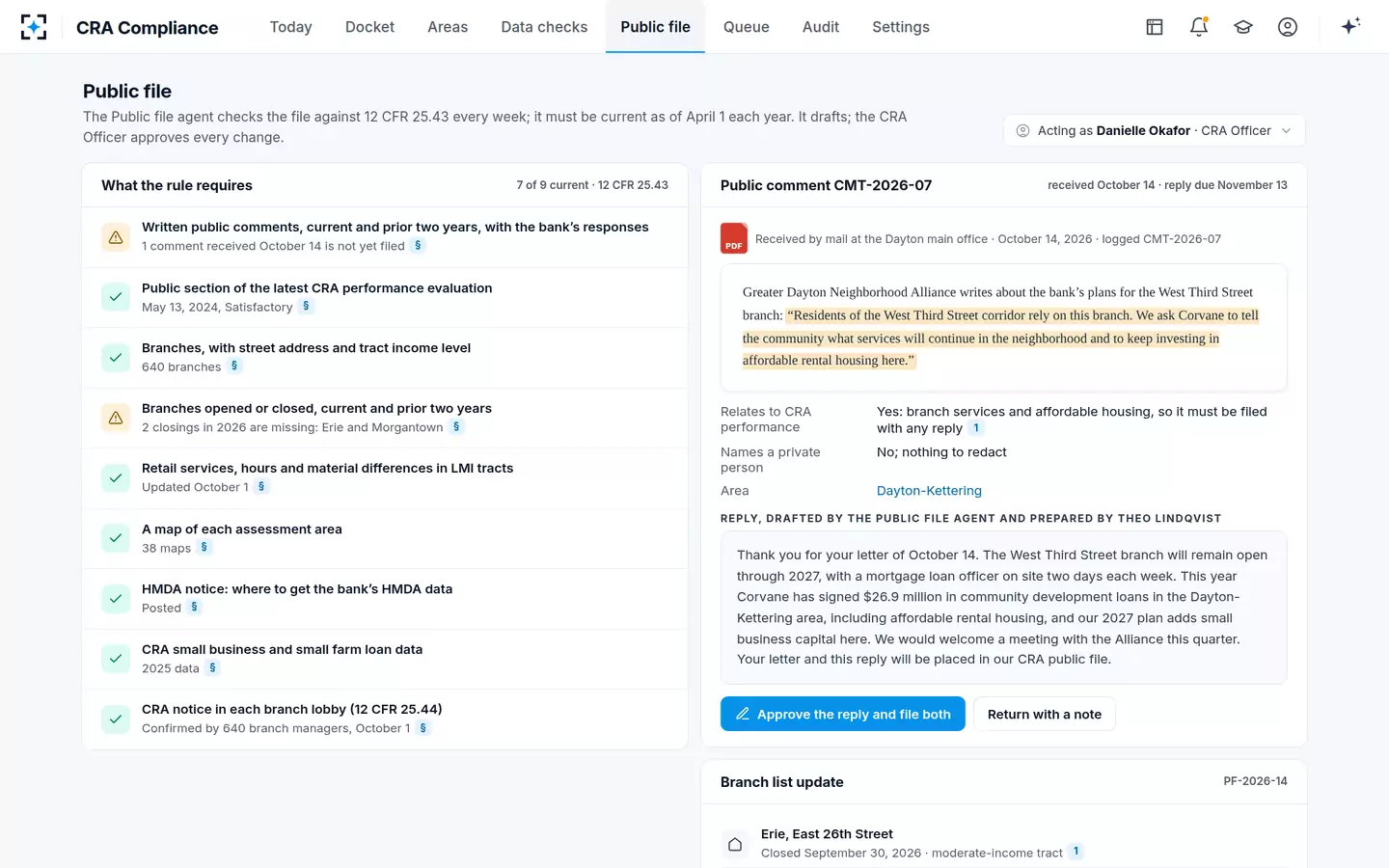
The CRA officer, in most banks, with branch operations supplying branch and service changes. The rule fixes the contents: written public comments for the current and two prior years "that specifically relate to the bank's or savings association's performance in helping to meet community credit needs", with any response; the public section of the latest evaluation, within 30 business days of receipt; branch lists with addresses and tracts; branches opened or closed in the current and two prior years; services, hours and fees; and a map of each assessment area (12 CFR 25.43(a)). Large banks add their CRA disclosure statement; small banks add quarterly loan-to-deposit ratios; banks rated below Satisfactory add a description of their improvement efforts, updated quarterly.
The file must be current as of 1 April each year, kept in full at the main office, and each branch must produce the material for its assessment area within five calendar days of a request. Comments that reflect adversely on the good name of anyone other than the bank stay out. The OCC–FDIC proposal of August 2026 would let the file live on the bank's website (91 FR 52114), which changes the medium, not the duty.
The CRA public file in CRA Compliance, checked against the rule
What is the board's role in CRA?
Setting expectations and resources, receiving reports, and approving the plan. The FDIC's list of board actions above applies to CRA as to every consumer law. When Federal Reserve examiners looked at the root causes of 2024 Regulation BB violations, they pointed at the board: "inadequate change management oversight with boards of directors not ensuring that banks reviewed and updated their compliance management systems" after changes in "strategy, structure, staff, or software". A board that changes the core system, merges a branch network or replaces the CRA officer without asking what happens to CRA data is the pattern examiners describe.
Some decisions belong to the board or its committee by their nature: a strategic plan, which must be published for at least 30 days of public comment before it is submitted (25.27(d)); the delineation of assessment areas; and the annual CRA plan, where a bank sets one. Under the large-bank rating rules, lending carries half the weight, a point worth making to any board deciding where community development money goes (see CRA ratings best to worst).
The CRA officer signs. The analyst reads. The board answers for both, which is why it needs to see what was read.
Does a small bank need a CRA officer?
It needs someone accountable for CRA, not necessarily a full-time officer. In the FDIC's words, "In smaller or less complex institutions, where staffing is limited, a full-time compliance officer may not be necessary"; duties can be split by regulation, and "several banks may share a compliance officer". A small bank's CRA duties are also lighter: in 2026, a bank under $412 million at either prior year-end is examined on its lending alone, keeps a public file with its quarterly loan-to-deposit ratios and reports no CRA data. An intermediate small bank, up to $1.649 billion, adds a community development test, which brings the qualification work, though still no data reporting.
The seat that grows fastest with size is the analyst's. A large bank reports data annually, faces three tests and must be ready to defend every community development claim with documents. At a large bank with hundreds of candidates a year the reading alone is a substantial job; in CRA Compliance's fictional sample bank, about 1,400 candidates at an estimated 45 minutes each is around 1,050 hours a year before anyone signs (our arithmetic on the product's estimate). The cost side of that is worked in CRA consulting fees vs the cost of qualifying one activity.
How many people work on CRA at a bank?
No regulator publishes a headcount, and it varies widely with size. The best public measure is the agencies' own paperwork estimates, which cover recordkeeping, reporting and disclosure but not the analysis behind them. The FDIC estimates 191,953 hours a year of CRA paperwork across the 2,689 banks it supervises for CRA, about 71 hours a bank on average (our arithmetic), at a fully loaded $93.97 an hour; its 2026 proposal would cut that by 55.3% (91 FR 52114). The averages hide the spread: a small bank's CRA work can be a share of one officer's year, while a large bank's community development pipeline alone can keep a team busy.
How one activity moves across the CRA seats in CRA Compliance
In CRA Compliance, the seats stay where they are and the reading moves to agents. Each person decides on the same view: the deciding passage beside the rule. Six roles are separated by duty; the person who accepted an item can never sign it, and bulk signing is off by policy.
One community development loan across the CRA seats
A person decides
Community development managerBrings the deal and uploads or points to the loan file, agreement and any prospectus. Decides nothing about qualification.
Agent
Document reader, Geography and Qualification agentsRead the documents, place the property in a tract and an area, and propose: qualifies or not, purpose, test and credit, with the passage and the rule.
Never: Never sign; below 0.85 confidence the answer is always Needs you.
Agent
Second-read agentArgues against every proposed yes and samples 20% of the rest.
Never: Never overrides a person; it can only send an item to one.
A person decides
CRA data analystAccepts, edits or rejects with a reason code. Signs nothing.
A person decides
CRA officerSigns one qualification at a time; the area’s progress against plan updates on signature.
A person decides
Committee and internal auditThe committee sees every area against plan and approves the next plan; the auditor reads and exports everything and changes nothing.
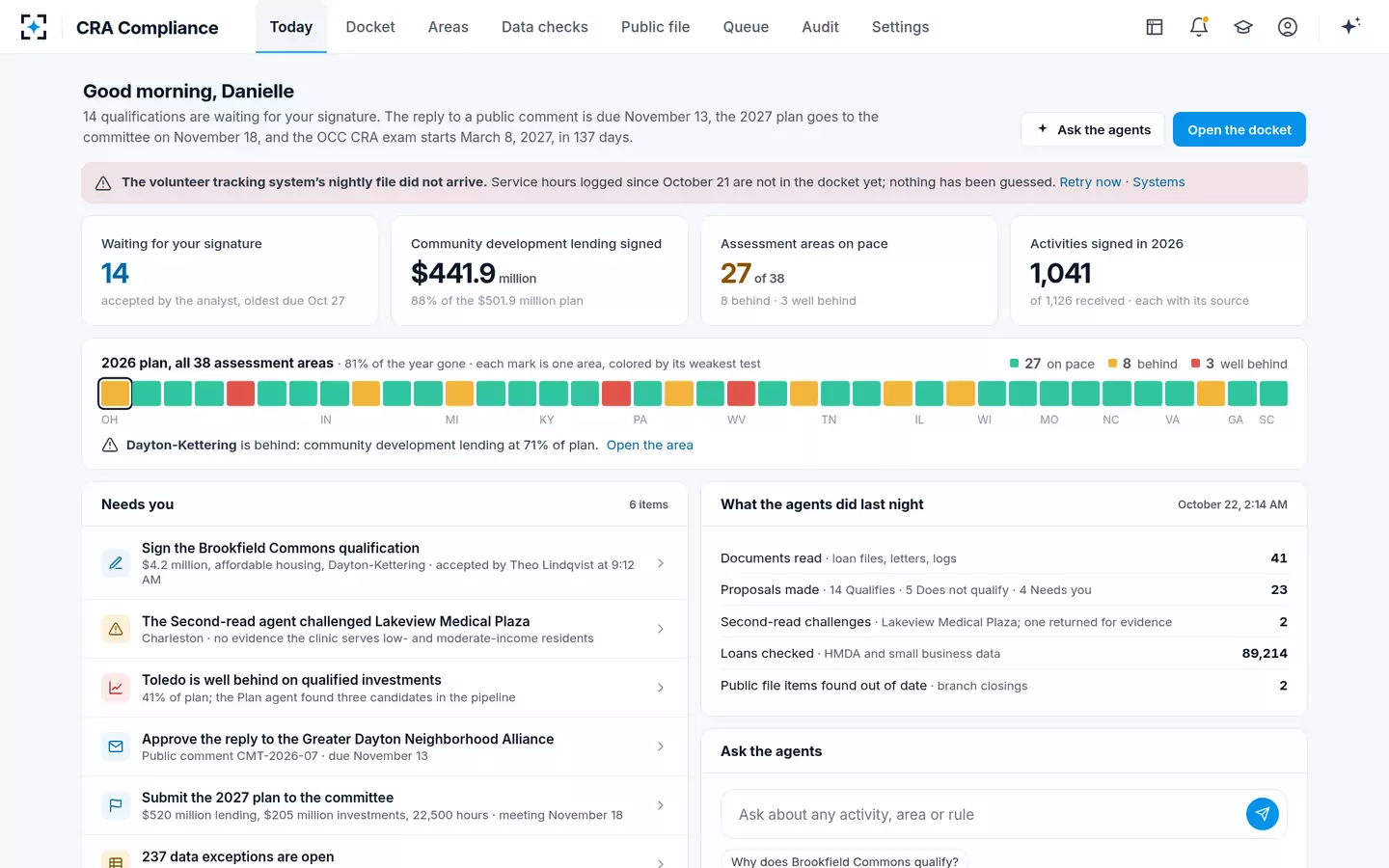
The CRA officer's morning in CRA Compliance
A CRA officer job description you can use
Built from the duties above, a job description that an examiner would recognize has seven sections. Adapt the scope to the bank's size: a small bank's officer will carry several of them alongside other compliance work.
Sections of a bank CRA officer job description
- Purpose and authority
Owns the bank’s CRA program; appointed by and reports to the board or its CRA committee; authority to stop a claim.
- Qualification and sign-off
Approves every community development loan, investment and service claimed, on documented evidence and the rule in force.
- Data integrity
Oversees collection, geocoding and annual reporting of CRA data where required; second review against source documents.
- Assessment areas and plan
Maintains area delineations; sets and monitors the annual plan by area and test; reports progress to the committee.
- Public file and comments
Keeps the public file current by 1 April; logs, answers and files public comments; maintains the lobby notice.
- Community engagement
Works with the community development manager on needs, community contacts and the performance context.
- Exam readiness and change
Leads the evaluation; reviews CRA procedures after changes in strategy, structure, staff, software or rules.
Questions people ask
What qualifications does a CRA officer need?
No regulation sets any. The FDIC describes a qualified compliance officer as having knowledge of "all consumer protection laws and regulations that apply" to the bank and general knowledge of its operations; for CRA that means the CRA rule and Q&A, lending products, community development finance and data.
Can the CRA officer also be the compliance officer?
Yes, and at many smaller banks they are the same person. The FDIC allows compliance duties to be divided by regulation or shared, as long as the person has authority, time and resources and reports to the board.
Who signs off on CRA community development activities?
The bank decides; the regulation does not name a signer. Good practice separates the person who reviews an activity from the person who approves it, and keeps the evidence with the decision, because examiners verify that each claimed activity qualifies.
What does a community development manager do for CRA?
Finds and structures the loans, investments, grants and volunteer work that meet community needs, keeps in touch with community organizations and supplies the documents that prove each activity. In a well-run program this seat brings deals but does not approve its own claims.
Does internal audit review CRA?
It should. The FDIC lists periodic compliance audits among the board's key actions, and Federal Reserve examiners recommend monitoring and audit "commensurate with data volume" and with any changes in strategy, structure, staff or software.
Who answers CRA public comments?
The bank, usually through its CRA officer. Comments that relate to the bank's CRA performance go into the public file with any response, for the current year and the two before, unless they reflect adversely on someone's good name.