The UCITS 5/10/40 rule, explained in one sentence: a UCITS may put up to 10% of its assets in the securities of a single issuer, but every issuer above 5% counts toward a 40% ceiling, so only a handful of positions can sit between 5% and 10% at once. It comes from Article 52 of the UCITS Directive and from each member state's law that transposes it, and it is the rule every UCITS compliance engine runs first. It is also where coding errors cluster, because the 40% sum leaves out government bonds, covered bonds and deposits, and because the same issuer can be capped by four other limits at once. Botminds' Compliance Rule Coding drafts each of those limits as a separate rule cited to its article, reads the fund's own documents for anything stricter, and tests both on the fund's holdings before a person signs.
The worked fund on this page is invented for illustration; the articles are quoted from Luxembourg's Law of 17 December 2010 as consolidated by its regulator, the CSSF, which transposes the Directive. Product screens show the solution's own fictional sample firm.
The UCITS issuer limits in four numbers
10%
of assets in any one issuer’s transferable securities and money market instruments
40%
for all issuers held above 5%, added together
20%
with any one body across securities, deposits and uncleared derivatives combined
35%
with any one body under all the issuer limits together, government tier included
What is the 5/10/40 rule, simply explained?
Start from 5%. The Directive's base rule is that a UCITS invests no more than 5% of its assets in securities or money market instruments of the same body, and member states may lift that to 10%, provided the issuers held above 5% add up to no more than 40% of the fund (Directive 2009/65/EC, Article 52(1) and (2)). Luxembourg took the option and wrote it directly as the rule: "A UCITS may invest no more than 10% of its assets in transferable securities or money market instruments issued by the same body", with the 40% condition in the next paragraph (Law of 17 December 2010, Article 43).
So 5/10/40 is two tests. The cap: no issuer above 10%. The sum: add every issuer above 5%, and the total stays at or below 40%. Four positions at 10% use the whole 40% and leave no room for a fifth issuer above 5%; eight positions just under 5% use none of it. The 5% is not a limit at all in this form, only the threshold that decides which positions enter the sum.
That matters for coding because the two tests behave differently over time. The cap is per issuer and can be checked order by order. The sum changes whenever any position crosses 5% in either direction, so a price move in one stock can break the 40% while every single position is well under 10%. A rule that only tests the issuer in the order will miss it.
A UCITS 5/10/40 rule example: one fund, worked line by line
Tarnmoor European Leaders Fund is a fictional Luxembourg UCITS with net assets of €500 million. Its large positions are four equities between 5% and 10%, a bank it holds as a share, a deposit and a currency-forward counterparty, German federal bonds and one covered bond. Each line below is a separate rule in the engine, with its own article.
Tarnmoor European Leaders Fund: nine UCITS issuer tests on one day
Single issuer, securities
RuleArt. 43(1): at most 10% in one body’s securities
CalculationLargest issuer: Hallberg Industrie 9.6%
ResultPass, 0.4 pts left
The 40% aggregate
RuleArt. 43(2): issuers above 5% together at most 40%
CalculationHallberg 9.6 + Nordmark 8.2 + Oriel 7.4 + Vasquez 6.1 = 31.3%
ResultPass, 8.7 pts left
Deposits with one body
RuleArt. 43(1): at most 20% with the same body
CalculationArdent Bank deposit 9.0%
ResultPass
OTC counterparty
RuleArt. 43(1): 10% if a credit institution, 5% otherwise
CalculationArdent Bank FX forwards, not centrally cleared: 3.1%
ResultPass
One body, all exposures
RuleArt. 43(2): securities + deposits + OTC with one body at most 20%
CalculationArdent Bank 4.2 + 9.0 + 3.1 = 16.3%
ResultPass, 3.7 pts left
Government issuer
RuleArt. 43(3): up to 35% for a state’s securities
CalculationGerman federal bonds 12.0%
ResultPass; outside the 40%
Covered bonds
RuleArt. 43(4): up to 25% per issuer; above-5% holdings at most 80%
CalculationKessler Pfandbrief 7.5%
ResultPass; outside the 40%
Any one body, combined
RuleArt. 43(5): paragraphs 1 to 4 together at most 35% per body
CalculationLargest body: Germany 12.0%
ResultPass
Share of an issuer’s debt
RuleArt. 48(2): at most 10% of one issuer’s debt securities
CalculationHallberg Finance notes: €15.0m of a €160m issue = 9.4%
ResultPass, measured on the issue, not the fund
Every test passes, and three are close: the largest issuer at 9.6% against 10%, the single-body total for Ardent Bank at 16.3% against 20%, and the fund's share of one Hallberg bond issue at 9.4% against 10% of the issue. None of the three is the 40% sum, which is the test most dashboards headline. On this fund the 40% has the most room of any limit that binds.
What counts toward the 40%, and what stays outside it
Does the 40% bucket include deposits?
No. The 40% condition counts only transferable securities and money market instruments, and the law says so twice. Luxembourg's Article 43(2) adds that the 40% "shall not apply to deposits" and to derivative transactions "made with financial institutions subject to prudential supervision", and Article 43(5) says securities in the 35% government tier and the 25% covered-bond tier "shall not be taken into account for the purpose of applying the limit of 40%" (Law of 17 December 2010, Article 43(2) and (5)). The Directive's Article 52(5) carries the same carve-out.
Deposits are not unlimited, though. They have their own 20% limit per body, and they count in the separate single-body total. That is the trap in the Tarnmoor example: the bank is a small equity position, a large deposit and a derivatives counterparty, and only the combined test sees all three. Placing another €20 million on deposit with Ardent Bank (4% of the fund) would take the combined figure to 20.3%, a breach, while every individual limit still passed.
Four ways a 5/10/40 rule is coded wrong
The arithmetic of 5/10/40 is easy; the inputs are not. The errors below are the ones a back-test on real holdings tends to expose, because each produces either false breaches that teach people to ignore the alert or silent passes that hide a real one.
Where UCITS issuer rules go wrong, and what the coded rule must say instead
| Error | What happens | What the rule must specify |
|---|---|---|
| Counting government or covered bonds in the 40% | False breaches; on the example fund 50.8% instead of 31.3% | The 35% and 25% tiers excluded from the sum, with the eligibility test for each tier |
| Counting deposits in the 40% | False breaches, or the sum is "fixed" by moving cash between banks | Deposits in the 20% deposit limit and the 20% single-body total only |
| Testing the issuer, not the body or group | A bank’s shares, deposits and swaps are never added up; a group’s companies are tested one by one | One identifier for the body, the issuer hierarchy from the security master, and the fund’s reading of the group rule |
| The wrong denominator | A fund that borrows or has large unsettled trades shows different percentages in the engine and at the administrator | Which assets figure, from which system, at which time of day, cited to the prospectus |
| The boundary operator | "No more than 10%" read as "less than 10%" blocks a trade the law allows | The comparison written from the text: at most, so 10.00% passes |
The fourth error is the one that makes the engine and the fund administrator disagree. France's market regulator found exactly this kind of gap when it compared five managers' own alerts with their depositaries': besides human error in setting up the pre-trade tool, managers blamed "a difference of interpretation regarding the content of a ratio or its calculation (e.g. in connection with the use of different securities repositories by the AMC and its depositary)" (AMF, summary of SPOT inspections on fund investment ratios, February 2025). Two systems with different security masters will disagree about what a 5% position is, and both will be right by their own data.
The other UCITS issuer concentration limits a 5/10/40 build forgets
5/10/40 is the best-known UCITS issuer concentration limit, not the only one. Article 43 alone sets eleven percentage limits, and Article 48 adds a family of limits measured against the issuer rather than the fund, which need data most engines do not hold by default.
The single-body total is the first: "a UCITS shall not combine, where this would lead to investment of more than 20% of its assets in a single body", its securities, deposits with it and uncleared derivative exposure to it (Article 43(2)). The second is the overall cap: limits under paragraphs 1 to 4 "shall not be combined", so investments with one body under all of them "shall not exceed in total 35% of the assets of the UCITS" (Article 43(5)). The third is the group rule: companies in the same group for consolidated accounts count as one body, and a UCITS may put up to 20% of its assets, in total, into the transferable securities and money market instruments of one group. How that allowance interacts with the 10% cap is a reading the fund must settle and document; the issuer-or-group question works it through on Hallberg's 12.6%.
Article 48(2) is the one a new build most often lacks. A UCITS may acquire no more than 10% of the non-voting shares of one issuer, 10% of its debt securities, 25% of the units of one fund and 10% of its money market instruments, and the debt and money market limits "may be disregarded at the time of acquisition if at that time the gross amount of bonds or of the money market instruments, or the net amount of the instruments in issue cannot be calculated" (Article 48(2)). The denominator is the issue outstanding, so the rule needs issue sizes from the security master and moves when the issuer buys bonds back, not only when the fund trades.
The counterparty limit has also changed recently. Luxembourg's current text caps exposure to a counterparty in "a derivative transaction that is not centrally cleared" through an authorised or recognised central counterparty, wording inserted by a Law of 5 May 2026 (Article 43(1), CSSF consolidated text). The Directive as published on the UK legislation site, frozen at the end of 2020, still speaks of OTC derivative transactions. A rule coded from the older text tests a slightly different population of trades.
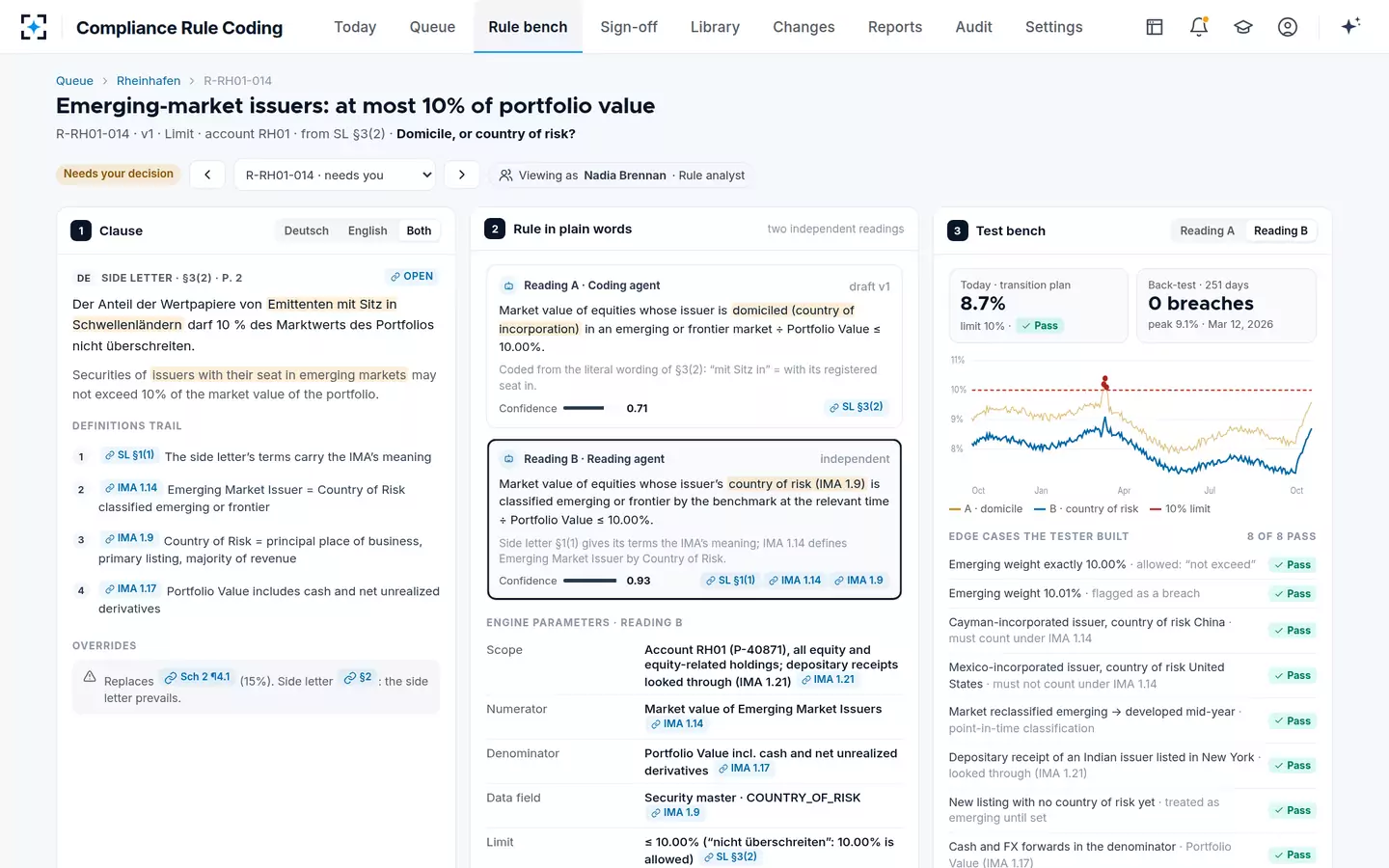
Each engine parameter cited to the clause it came from
What happens when a UCITS breaches 5/10/40?
It depends on why. If the limit is exceeded for reasons the fund could not control, or because it exercised subscription rights, the fund must make remedying it the first aim of its sales, with due regard to unit-holders, and the Directive sets no deadline (Directive 2009/65/EC, Article 57(2); Luxembourg's Article 49(2) carries the same rule). A breach caused by the manager's own trade is active, and in Luxembourg CSSF Circular 24/856 treats active and passive breaches differently, including in whether the regulator must be told (CSSF Circular 24/856, point 55).
For the coder, cause is a property of the alert, not the rule, but the rule has to make cause knowable. A post-trade alert that cannot say whether a trade or a price move pushed the sum over 40% leaves the investigation to a person with a spreadsheet. Recording the fund's position the moment before and after each order is what lets the next stage, the passive breach procedure, start from facts.
One timing rule belongs in the rule set from day one. A newly authorised UCITS may derogate from the spread limits for six months: "newly authorised UCITS may derogate from Articles 43, 44, 45 and 46 for six months following the date of their authorisation" (Article 49(1)). A launch fund's rules therefore need two effective dates: the date they start alerting, and the date they start counting as breaches.
Coding 5/10/40 once for every fund, without losing the fund's own limits
Most managers configure the UCITS regulatory limits once and attach them to every UCITS. The AMF found this at the French managers it inspected: at two of them the tool lets all the UCITS regulatory ratios be "configured once and then replicated" and each new UCITS "inherits all the applicable regulatory ratios through a single operation"; the AMF listed it as good practice because it "reduces the number of operational configuration errors" (AMF SPOT summary, section 4.1.2). At a third manager the UCITS group held 28 ratios.
The library approach has a blind spot: the fund's own documents. A prospectus that limits any issuer to 5% of net assets, or excludes covered bonds from the 25% tier, overrides the regulatory default, and the stricter limit wins. The AMF's own definition of a ratio covers both sources: it is "set out in the rules or contractual documentation" and "must be complied with at all times". Coding UCITS rules well means both: the regulatory group from the library, and every stricter clause read from the fund's prospectus and supplement, each cited to where it came from.
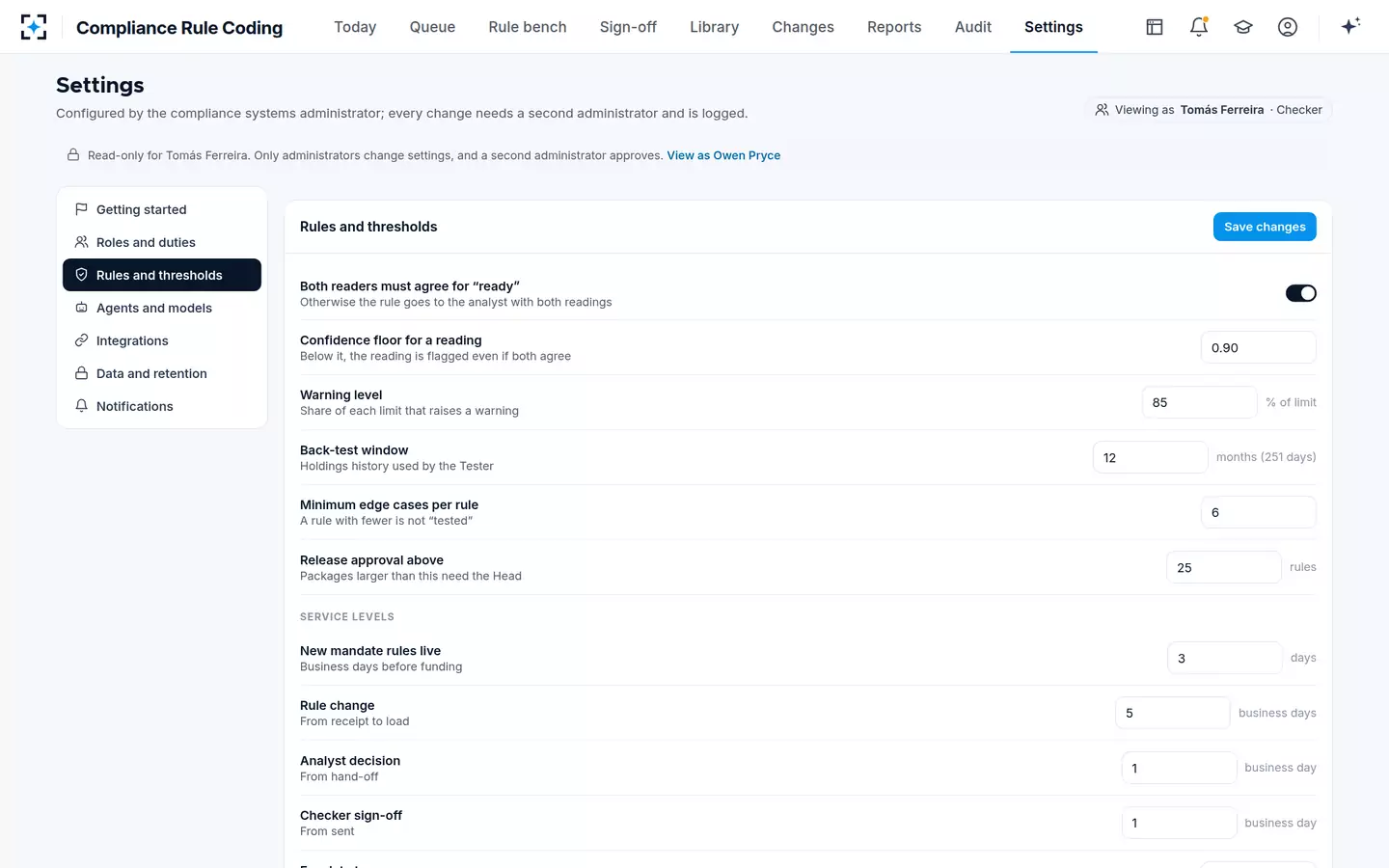
A warning level set below each limit, for every rule
A UCITS 5/10/40 build that will survive a back-test
- Code the cap and the sum as two rules
The 10% cap per issuer, and the 40% sum over issuers above 5%, each with its own alert.
- Exclude the 35% and 25% tiers from the sum, with eligibility tests
Government and covered-bond holdings stay outside the 40% only if they qualify for their tier.
- Keep deposits out of the 40% and in the single-body total
The 20% single-body rule adds securities, deposits and uncleared derivatives with one body.
- Settle the group reading in writing
One body for consolidated groups, and the 20% group allowance: decide and cite how they combine.
- Load issue sizes for Article 48
Holdings as a share of the issuer’s debt or non-voting shares need the issue outstanding.
- Cite the denominator and its source system
Name the assets figure and the time it is taken, so engine and administrator can be reconciled.
- Give launch funds two dates
Six months of derogation after authorisation: alert from day one, breach from month seven.
- Layer the fund’s own stricter limits on top
A 5% issuer limit in the prospectus governs even though the law allows 10%.
How a UCITS limit compares with the US 75-5-10 test is set out on a sister page comparing the two rulebooks; how to prove a coded rule against a year of holdings is the subject of backtesting compliance rules. To see clauses drafted into cited, tested rules on sample mandates, start from Compliance Rule Coding.
Questions people ask
Is the 5/10/40 rule measured on net assets or total assets?
The Directive and Luxembourg's law say "of its assets" without defining the figure further in Article 43, so the fund's documents and its administrator's convention decide which figure is used. The coded rule should cite which figure it uses and from which system, so the engine and the administrator compute the same percentage.
Can a UCITS hold 10% in five issuers?
No. Five positions at 10% add up to 50%, above the 40% ceiling for issuers held above 5%. At most four issuers can sit at the 10% cap, and only if every other issuer is at or below 5%.
Do index-tracking UCITS follow 5/10/40?
Not for their index constituents. Luxembourg's Article 44 raises the issuer limit to 20% for a UCITS whose stated aim is to replicate a recognised, sufficiently diversified index, and to 35% for a single issuer where exceptional market conditions justify it. The coded rule should switch on that exception only for funds whose documents state the index aim.
Can a UCITS hold 100% in government bonds?
Only with the regulator's authorisation. Luxembourg's Article 45 lets the CSSF authorise a UCITS to invest up to 100% in government and public international body securities if it holds at least six different issues and no single issue exceeds 30% of total assets, and names the issuers in its documents.
Do the UCITS limits apply to a fund's holdings in other funds?
Separately. Article 46 caps holdings in a single UCITS or other UCI at 20% of assets and in non-UCITS funds at 30% in aggregate, and says the assets of the underlying funds need not be combined with the direct holdings for the Article 43 limits. Article 48 adds that a UCITS may hold no more than 25% of the units of any one fund.