1940 Act fundamental policies are the investment policies a registered fund may change only with a vote of a majority of its outstanding voting securities: its stance on borrowing, issuing senior securities, underwriting, concentrating in an industry, real estate and commodities, and lending, plus any other policy the fund itself declares fundamental. For the analyst who codes a fund's restrictions into the compliance engine, the first question about any policy is therefore legal, not numeric: who can change it? Botminds' Compliance Rule Coding exists because that question is answered in documents (the prospectus, the statement of additional information and the Act itself) while the rules live in an engine that knows nothing of votes; its agents read each policy to the clause and cite every element of the coded rule to the words it came from, so a vote-locked limit is visible as one, and no rule changes without an analyst's decision and a second person's signature.
The figures below come from the statute, SEC forms and rules, and two SEC cases, each linked where it appears. Where the page shows the solution, the funds and people are fictional sample data.
Four numbers that decide whether a fund policy can move
8
activities Section 8(b)(1) makes every registered fund state a policy on, from borrowing to portfolio turnover
67%
of the shares present carries a fundamental change, if holders of more than half the outstanding shares attend
25%
of net assets in one industry or group of industries is concentration in Form N-1A’s terms
60days
of notice a fund may promise instead of a vote before changing its names-rule 80% policy
What are 1940 Act fundamental policies, and where do they come from?
Fundamental policies are a creation of two sections of the Investment Company Act that work as a pair. Section 8(b) says what a fund's registration statement must recite; Section 13(a) says which of those recitals the fund cannot depart from without its shareholders. Together they turn a disclosure into a promise that only the owners of the fund can release.
Section 8(b)(1) is the core. For each listed activity the registration statement must give "a statement whether the registrant reserves freedom of action to engage in activities of such type, and if such freedom of action is reserved, a statement briefly indicating, insofar as is practicable, the extent to which the registrant intends to engage therein" (15 U.S.C. 80a-8(b)(1)). The activities are the fund's classification and subclassification, borrowing money, issuing senior securities, underwriting other issuers' securities, concentrating in an industry or group of industries, buying and selling real estate and commodities, making loans, and portfolio turnover.
Two further paragraphs widen the net. Section 8(b)(2) adds any other investment policy the fund states can be changed only by shareholder vote, and Section 8(b)(3) adds policies "which the registrant deems matters of fundamental policy" (15 U.S.C. 80a-8(b)(3)). A fund can therefore make a policy fundamental simply by calling it so, and many make their investment objective fundamental this way.
The coder's consequence is direct. Every sentence in the fund's restrictions section that falls under Section 8(b) must be coded as a rule whose limit, scope and exceptions cannot be changed by anyone in the firm, because the law gives that power to shareholders. A rule engine has no field for "who may change this"; the coder has to supply it.
The 1940 Act fund investment restrictions every fund must recite
Form N-1A turns Section 8(b)(1) into a checklist. Item 16(c)(1) requires the statement of additional information to describe the fund's policy on issuing senior securities, borrowing money "including the purpose for which the proceeds will be used", underwriting, concentration, real estate or commodities, making loans, and "Any other policy that the Fund deems fundamental or that may not be changed without shareholder approval, including, if applicable, the Fund's investment objectives" (Form N-1A, Item 16(c)(1)). Where the fund reserves freedom of action, the instruction says to "state the maximum percentage of assets to be devoted to the practice and disclose the risks of the practice".
That instruction is the coder's friend: it means most fundamental policies carry a number. The table below shows what each subject typically becomes once it leaves the SAI.
From Form N-1A subject to coded rule: what each fundamental policy tests
| Subject (Item 16(c)(1)) | Statute behind it | What the coded rule tests | The trap |
|---|---|---|---|
| Borrowing money | Sections 8(b)(1)(B), 13(a)(2), 18(f)(1) | Borrowings against asset coverage of at least 300%, i.e. borrowings no more than one third of total assets including the borrowed cash | The statutory 300% applies even if the fund’s own policy is silent; a stricter policy (say, 10% for temporary purposes) governs on top |
| Issuing senior securities | Sections 8(b)(1)(C), 13(a)(2), 18(f) | Instruments that may count as senior securities: reverse repos, short sales, derivatives | Derivatives now sit under Rule 18f-4, a separate program; the policy text often still refers to it |
| Underwriting | Sections 8(b)(1)(D), 13(a)(2) | Usually a prohibition with a carve-out for being deemed an underwriter on resale | Coded as a manual control, not a numeric limit |
| Concentration | Sections 8(b)(1)(E), 13(a)(3) | Share of assets in each industry or group of industries against 25% | The industry classification scheme and the exclusions (governments, municipals) are part of the rule |
| Real estate and commodities | Sections 8(b)(1)(F), 13(a)(2) | Direct holdings of real estate or physical commodities; often permits REITs and commodity futures | The carve-outs are where breaches hide |
| Making loans | Sections 8(b)(1)(G), 13(a)(2) | Securities lending and repo as a share of assets; buying debt is usually excluded | A securities-lending cap may be one third of total assets by the fund’s own wording |
| Anything else deemed fundamental | Sections 8(b)(2), 8(b)(3), 13(a)(3) | Whatever the fund wrote: an objective, a diversification status, a quality floor | Read the whole section; a fundamental policy can appear far from the list |
Borrowing deserves a worked line because its arithmetic surprises people. Section 18(f)(1) lets an open-end fund borrow from a bank provided that immediately afterwards there is "an asset coverage of at least 300 per centum for all borrowings", and if coverage falls below that, the fund must cut its borrowings within "three days thereafter (not including Sundays and holidays)" (15 U.S.C. 80a-18(f)(1)). Asset coverage is total assets less liabilities other than the borrowings, divided by the borrowings. A fund with $100 million of net assets can therefore borrow up to $50 million: total assets become $150 million, and $150 million over $50 million is exactly 300%. The coded rule tests borrowings against one third of total assets, not against one third of net assets, which would allow only about $33 million.
Can a fund change a fundamental policy without a shareholder vote?
No. Section 13(a) forbids a registered fund, without the vote of a majority of its outstanding voting securities, to switch between open-end and closed-end or from diversified to non-diversified, to deviate from its recited policy on concentration or from any policy changeable only by shareholder vote, or from any policy recited under Section 8(b)(3) (15 U.S.C. 80a-13(a)). For the other recited activities the wording is plainer still: no fund shall "borrow money, issue senior securities, underwrite securities issued by other persons, purchase or sell real estate or commodities or make loans to other persons, except in each case in accordance with the recitals of policy contained in its registration statement in respect thereto" (15 U.S.C. 80a-13(a)(2)).
What the board can do is everything around the vote. It can propose the change, call the meeting, approve the proxy statement and decide when a new policy takes effect once the vote passes. It cannot make the change itself, and nor can the adviser by coding a looser rule. The one direction the statute leaves open is the diversification label the other way round: a non-diversified fund that becomes diversified needs no vote under Section 13(a)(1), which names only the move from diversified to non-diversified. The 75-5-10 diversification test itself is worked through on a sister page.
What counts as a majority vote under the 1940 Act
A "majority" here is not a simple majority of votes cast. Section 2(a)(42) defines the vote of a majority of the outstanding voting securities as the lesser of "(A) of 67 per centum or more of the voting securities present at such meeting, if the holders of more than 50 per centum of the outstanding voting securities of such company are present or represented by proxy; or (B) of more than 50 per centum of the outstanding voting securities of such company" (15 U.S.C. 80a-2(a)(42)). It is the reason proxy campaigns for fundamental changes are expensive: a fund held by many small retail accounts can struggle to get half its shares to the meeting at all.
The 1940 Act majority, worked on a fund with 100 million shares outstanding
| Shares present or by proxy | Test (A): 67% of present | Test (B): over 50% of outstanding | Votes needed (the lesser) |
|---|---|---|---|
| 80 million | 53.6 million | more than 50 million | more than 50 million |
| 60 million | 40.2 million | more than 50 million | 40.2 million |
| 50 million exactly | not available: half is not more than half | more than 50 million | more than 50 million, so every share present plus at least one more |
| 45 million | not available | more than 50 million | cannot pass at this meeting |
For the coder, the vote is evidence, not arithmetic. A change to a vote-locked rule should carry the meeting date, the shares outstanding, the shares voted and the result, so that whoever checks the rule can see the vote met Section 2(a)(42) before the new limit loads.
Fundamental vs non-fundamental investment policies: examples a coder meets
A non-fundamental policy is any policy the fund describes but reserves the right to change without a vote, usually on board approval and a prospectus supplement. The distinction is in the text, not in the subject: the same 15% limit on illiquid securities can be fundamental at one fund and non-fundamental at another, depending on what the SAI says about it.
Fundamental vs non-fundamental investment policies, side by side
Fundamental (vote-locked): "The Fund may not, as a fundamental policy…" or listed under "Fundamental Investment Restrictions"
Non-fundamental (board-changeable): "The following restrictions are non-fundamental and may be changed by the Board without shareholder approval"
Fundamental (vote-locked): Borrowing within Section 18 limits; no concentration in an industry; no physical commodities; diversified status; often the investment objective
Non-fundamental (board-changeable): Illiquid investments cap; limit on other investment companies; restriction on short sales; credit-quality floor
Fundamental (vote-locked): Shareholders, by a Section 2(a)(42) majority
Non-fundamental (board-changeable): The board; the adviser proposes
Fundamental (vote-locked): Proxy statement, meeting, vote, amended registration statement
Non-fundamental (board-changeable): Board resolution, supplement, effective date
Fundamental (vote-locked): Hard limit; any edit needs evidence of the vote
Non-fundamental (board-changeable): Limit with an owner, a version and an effective date
Fundamental (vote-locked): A Section 13(a) violation as well as a breach of the fund’s own policy
Non-fundamental (board-changeable): A breach of the fund’s policy, and possibly of its disclosure
There is a third kind that sits between them, and it is the one most often coded wrong. Rule 35d-1, the Names Rule, requires a fund whose name suggests a focus to invest at least 80% of its assets in line with that name, and lets the fund protect the policy either by making it fundamental or by adopting "a policy to provide the fund's shareholders with at least 60 days' prior notice of any change" (17 CFR 270.35d-1(a)(2)(ii)). The amended rule also requires the fund to review its 80% basket "at least quarterly" and, once it falls short, to come back within 90 consecutive days. Large fund groups have had to comply since 11 June 2026 and smaller groups from 11 December 2026 (90 FR 13076, March 20, 2025). That policy is notice-locked: the board can change it, but not quickly. How the 80% test itself is run is set out in the Names Rule 80% test; for the coder the point is that the 80% rule needs a 60-day clock in its change control, not just a number.
Four kinds of limit in one fund's documents, and what it takes to change each
Fundamental policy
Where it comes fromSection 8(b)(1) recitals, any policy the fund says only a vote can change, and anything it deems fundamental
What a change needsA vote of a majority of the outstanding voting securities, then a registration statement amendment
How it is codedHard limit; no change loads without evidence of the vote
Names-rule 80% policy
Where it comes fromA fund whose name suggests a focus; fundamental, or protected by a 60-day notice promise
What a change needsA vote if fundamental; otherwise 60 days’ written notice to shareholders first
How it is codedHard limit at purchase, quarterly basket review, 90-day return clock
Non-fundamental policy
Where it comes fromProspectus and SAI policies the fund reserves the right to change
What a change needsThe board, usually with a prospectus supplement before the change takes effect
How it is codedLimit with an owner and an effective date; change logged against the board resolution
Statutory limit
Where it comes fromThe Act itself: Section 12(d)(1) fund-of-funds limits, Section 18(f) borrowing coverage
What a change needsNobody: neither shareholders nor the board can vote it away
How it is codedRegulatory rule held in a library, inherited by every fund it applies to
What is a 25% industry concentration policy?
A 25% industry concentration policy is the fund's recital, under Section 8(b)(1)(E), of whether it will concentrate in an industry or group of industries; Form N-1A defines concentrating as "investing more than 25% of a Fund's net assets in a particular industry or group of industries" (Form N-1A, Item 9(b)(1), Instruction 4). A fund that does not intend to concentrate says it will not invest 25% or more in any one industry; a sector fund says it will concentrate in its sector. Either way the statement is fundamental: Section 13(a) singles out concentration by name.
Coding it takes three decisions the policy sentence rarely makes explicit. First, the industry scheme: the fund's own classification, a vendor's industry codes or the SEC's, and at which level of the hierarchy, because "banks" and "financials" give very different answers. Second, the exclusions: most policies carve out US government securities and many carve out municipal securities, and the coded rule must know how to recognise each. Third, the denominator: Form N-1A speaks of net assets, while many funds' own wording says total assets, and the fund's text governs its own policy.
The rule analyst also has to decide what "more than 25%" and "25% or more" mean at the boundary. A fund that wrote "25% or more" is in breach at exactly 25.00%; one that wrote "more than 25%" is not. That single character is coded into the engine's comparison operator, and it is exactly the kind of choice a second reader should confirm.
What happens if a fund deviates from its concentration policy?
A deviation without a vote breaches Section 13(a) as well as the fund's own promise, and the SEC has pursued it as such. In 2021 the SEC found that the adviser to Upright Growth Fund had "violated its policy by investing more than 25 percent of its assets in one industry between July 2017 and June 2020". In March 2025 it sued the same adviser and its principal, alleging that the fund kept "investing more than 25 percent of Upright Growth Fund's assets in a single company over multiple years", between at least November 2021 and June 2024, and that waiting "more than two-and-a-half years to sell the relevant stock" caused losses of about $1.6 million to the fund and its investors (SEC press release 2025-55, March 17, 2025). Those later charges are allegations in a complaint, amended in April 2025, and have not been decided.
The case shows why a concentration policy is coded as a hard rule with an alert that escalates, not a soft warning. A single holding that grows past a quarter of the fund is a concentration breach and a single-issuer problem at once, and the policy gives the adviser no discretion to wait for a better price. The fund's chief compliance officer must report each "Material Compliance Matter" to the board at least annually under Rule 38a-1 (17 CFR 270.38a-1), and for fiscal 2027 the SEC's examiners say they will look particularly at whether fund portfolio management matches the strategies the fund disclosed (SEC Division of Examinations, Fiscal Year 2027 priorities).
Where the investment restrictions sit in the statement of additional information
The statement of additional information is where the full list of investment restrictions lives, usually in a section headed "Investment Restrictions" or "Fundamental and Non-Fundamental Policies", with the fundamental list first and a sentence explaining the vote. The prospectus summarises the principal strategies and must disclose any concentration policy (Form N-1A, Item 9(b)); the SAI carries the legal text. A coder who works from the prospectus alone will miss most of the fundamental list.
Three passages outside that section also bind the rule. The definition of "majority of the outstanding voting securities" in the SAI's general section confirms which vote is meant. Explanatory notes after the list often say how a restriction is measured, for example that a percentage limit applies at the time of purchase and a later market move is not a violation, except for borrowing. And the glossary, if there is one, may define "industry". Each of these belongs in the coded rule's citation, which is why an example restrictions section, annotated clause by clause, is the next thing to read.
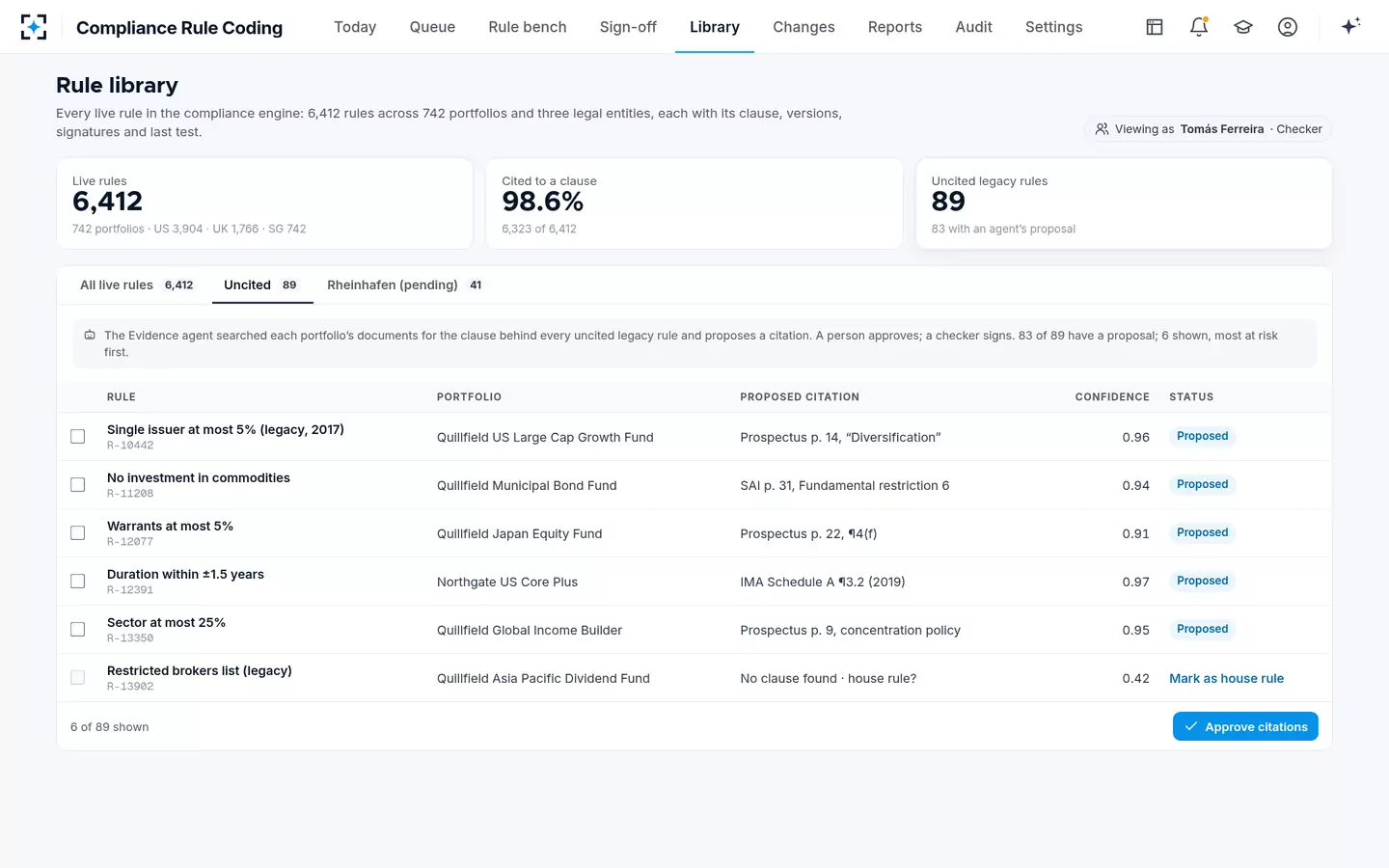
Every live rule cited to its clause, including the fundamental restrictions
How Compliance Rule Coding codes a vote-locked policy
The solution makes the citation part of the rule, not a note beside it. When its Intake agent splits an SAI into clauses, the Coding agent drafts each restriction in plain English and as engine parameters (scope, numerator, denominator, data field, limit, warning and test timing) and cites every element to its clause, so a rule drawn from the fundamental list says so in its source: "SAI p. 31, Fundamental restriction 6" rather than a bare limit. A Reading agent reads the same clause again, blind and on a different model, and the analyst decides wherever the two readings differ.
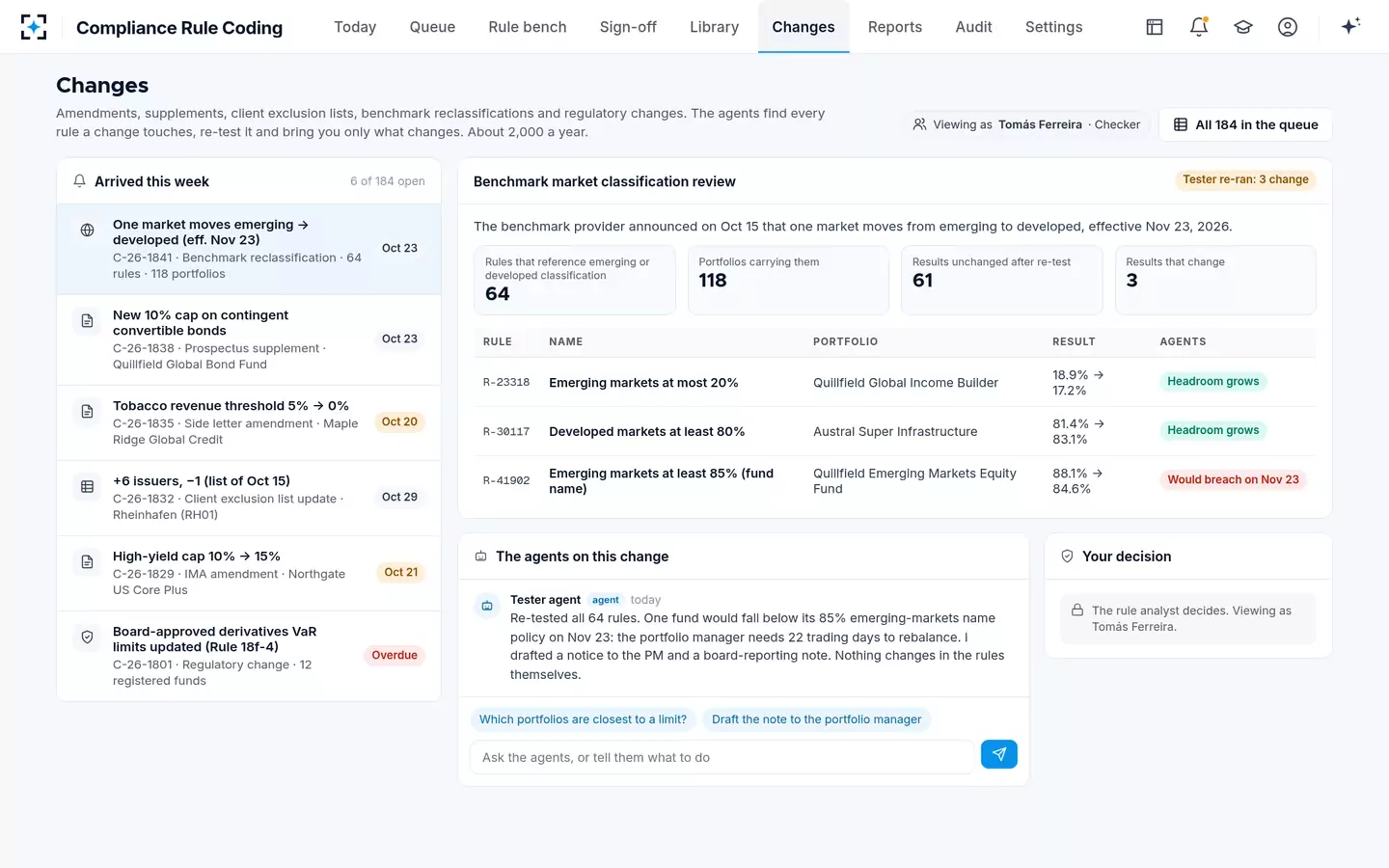
What happens next stays with people. A senior compliance officer who did not code or decide the rule checks it against the clause, the decision and the tests; the Head of Investment Compliance releases the package; and the agents never load a rule or change a signed one. When an amendment, a supplement or a proxy result arrives later, the agents find every rule it touches and re-test it, and the analyst decides whether the new text has been validly adopted. The solution does not judge whether a vote passed; it makes sure the engine cannot drift away from what the fund's documents say without someone signing for it.
A regulatory change re-tested across every fund that carries it
Before a fund's policies go live as rules
- Sort every restriction into one of four kinds
Fundamental, notice-locked names policy, board-changeable, or statutory. The kind decides the change control.
- Find the fundamental list in the SAI, not the prospectus
Form N-1A puts the full list in Item 16(c); the prospectus carries only principal strategies and the concentration policy.
- Settle the concentration rule’s three hidden choices
Industry scheme and level, exclusions, and net or total assets, each cited to the fund’s own words.
- Code the comparison operator from the text
"25% or more" and "more than 25%" differ at the boundary; so do "not exceed" and "less than".
- Read the notes after the list
At-time-of-purchase language and its exceptions (often borrowing) change when a breach is a breach.
- Guard vote-locked limits
No edit loads without the meeting date, the shares voted and the result.
- Hold statutory limits once, in a library
Section 12(d)(1) and Section 18(f) apply to every fund that meets their terms, and no vote changes them.
A fund's policies are only half of what a coder meets: separate accounts bring investment management agreements and side letters that no shareholder vote governs at all, and the week of one mandate from signature to tested rules follows that path. To see fundamental restrictions read, coded and cited on sample funds, start from Compliance Rule Coding.
Questions people ask
Is a fund's investment objective a fundamental policy?
Only if the fund makes it one. Form N-1A asks the fund to describe "Any other policy that the Fund deems fundamental or that may not be changed without shareholder approval, including, if applicable, the Fund's investment objectives", so the SAI states whether the objective needs a vote. Many older funds made it fundamental; many newer funds let the board change it on notice.
Is diversification a fundamental policy under the 1940 Act?
The status is protected in one direction. Section 13(a)(1) requires a shareholder vote to change from a diversified to a non-diversified company; the reverse needs none. Section 5(c) adds that a diversified fund does not lose its status because of a later change in market values, so long as the discrepancy is not caused by an acquisition.
Does the 25% concentration test use net assets or total assets?
Form N-1A's instruction defines concentration as more than 25% of net assets, but a fund's own policy may be written against total assets, and the fund's wording governs its policy. The coded rule should cite the sentence it takes its denominator from, because on a fund that borrows the two answers differ.
How long does a fund have to reduce borrowings after coverage drops below 300%?
Three days, not counting Sundays and holidays, under Section 18(f)(1), or longer only if the SEC prescribes it by rule. That is one of the few cases where a limit is tested continuously rather than only at the time of the transaction, so the rule needs a daily check, not just a pre-trade one.
Can a fund change its names-rule 80% policy without a vote?
Yes, if the policy is not fundamental and the fund has promised shareholders at least 60 days' prior written notice. The notice must be sent separately, in plain English, under the heading "Important Notice Regarding Change in Investment Policy" or a similar statement. The rule also lets the fund fall temporarily below 80% once that notice has been given, to reposition, so the coded rule needs that window as well as the new limit.
Who reports a fundamental policy breach to the fund board?
The fund's chief compliance officer, who under Rule 38a-1 must give the board a written report, no less frequently than annually, addressing each material compliance matter since the last report. A matter is material when the board would need it to oversee the fund's compliance, and the rule lists a violation of the federal securities laws among them; a deviation from a fundamental policy without a vote is a violation of Section 13(a) itself.