An investment compliance automation tool earns its cost in the days between a signed mandate and tested rules in the engine, not in the hours it saves an analyst. Every one of those days, the client's money is either not yet invested, invested under a substitute control such as manual pre-clearance of every order, or invested under rules nobody has tested. Each has a price, and together they are the business case. Botminds' Compliance Rule Coding was designed to shrink that gap: its agents read the mandate's documents, draft every rule with citations, read each clause a second time independently, test both readings and prepare the load, with a design target of one day from signed mandate to tested rules against a sample firm's eleven by hand. This guide shows how to put a number on the gap for your own firm, using no vendor's figures, including ours.
Mandate figures on this page are the solution's fictional sample data and design targets, not a customer's results. Cost examples use hypothetical inputs, labelled where they appear.
The numbers a delay case is built from
11days
the sample firm’s 2025 median from signed documents to rules live, by hand
1day
the solution’s design target for the same journey
3days
before funding: the sample firm’s own deadline for new mandate rules to be live
0.1–2.3%
of operating costs: what five French managers spent in 2023 on the tools that configure and monitor investment limits
How long does it take to onboard a new mandate's rules?
Measure it; nobody else has. No regulator or independent study publishes how long asset managers take to code a new mandate, and vendors' claims are not evidence. The useful figure is your own median over the last ten or twenty mandates, from the date the signed documents reached compliance to the date the rules were live and verified, split by stage.
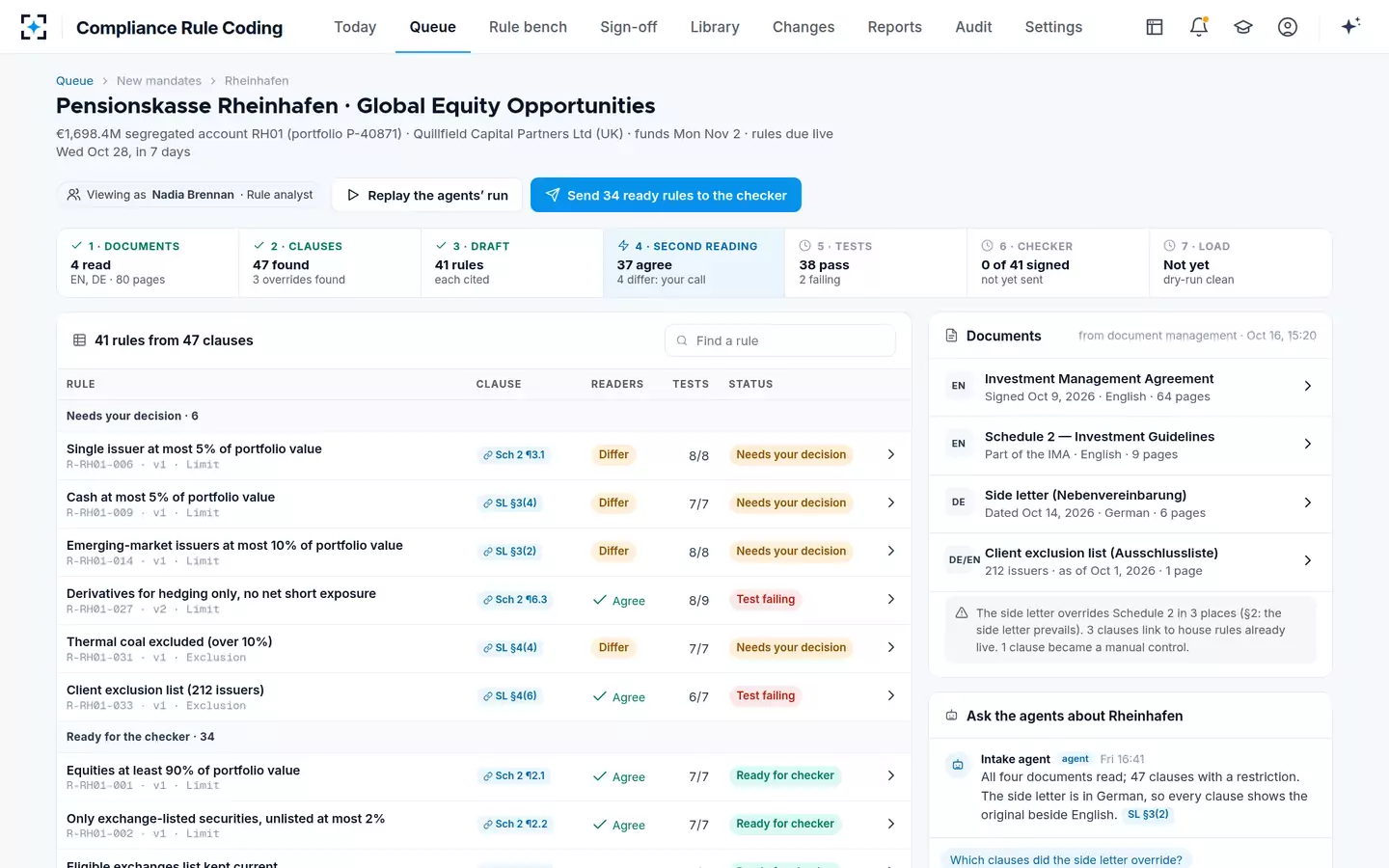
The solution's sample firm did this for 2025 and found 11 business days. Put that against the sample mandate's own calendar and the problem is plain. The package for Pensionskasse Rheinhafen's €1,698.4 million account reached compliance on Friday 16 October; the client funds on Monday 2 November; the firm's policy wants rules live three business days before funding. Eleven business days after 16 October is 2 November: the rules would go live on funding day, with none of the three days of margin the firm's own policy requires.
From package to funding: the sample mandate's calendar
- Coding, checking and testing by hand16 Oct → 2 Nov
- Agents’ run and analyst’s decisions1 day
- Checker sign-off, release, load and verification, with room for client questionsto 28 Oct
- Policy margin before funding3 days
Can you trade a new mandate before its rules are coded?
Only under a substitute control, because the adviser's written procedures must be "reasonably designed to prevent violation" from the first trade, not from the day the engine is ready (17 CFR 275.206(4)-7(a)). Firms use four substitutes, and each costs money or carries risk.
Four ways to trade before the rules are live, and what each one costs
| Substitute | How it works | What it costs | What can still go wrong |
|---|---|---|---|
| Delay funding | Ask the client to fund later | Management fees deferred for every day of delay; the client’s view of your readiness | Nothing in compliance; a lot in the relationship |
| Restricted start | Invest only in a narrow, obviously eligible universe, or hold a transition portfolio | Tracking difference against the mandate’s benchmark and strategy | A restriction coded as a placeholder may itself be wrong |
| Manual pre-clearance | Compliance clears every order by hand against the documents | Analyst time per order, and slower execution | A person reading under time pressure, without a back-test |
| Load untested rules | Code fast and test later | Nothing up front | A rule that is wrong in a way nobody has seen; the cost arrives as a breach |
The price of a delay: four costs, one sum
The cost of a delay is the sum of what the substitute costs for each day it runs, plus the expected cost of an error it lets through. Each term can be priced from your own records. The figures below are hypothetical, to show the arithmetic; replace them with yours.
What each day between signature and tested rules costs
Deferred fees
Assets × fee rate × days delayed ÷ 365
Hypothetical: €1,698.4m at 0.30% is about €14,000 a calendar day of delayed funding
Finance
Manual pre-clearance
Orders a day × minutes per order × days × cost per minute
From your own pre-clearance log; include the analyst’s and the portfolio manager’s time
Compliance
Restricted start
Assets held out of strategy × days × expected return difference
Agree the expected difference with the portfolio manager before the mandate, not after
Investment team
Error exposure
Chance an untested rule is wrong × expected cost of the breach it misses
Compensation, remediation, client confidence and, at worst, regulatory action
Head of compliance
One week's delay on the sample mandate, priced with hypothetical inputs
| Term | Hypothetical input | Arithmetic | Cost for five business days |
|---|---|---|---|
| Deferred fees, if funding slips a week | 0.30% a year on €1,698.4 million | €1,698.4m × 0.003 ÷ 365 × 7 calendar days | about €97,700 |
| Manual pre-clearance, if funding goes ahead | 40 orders a day, 5 minutes each for compliance and 5 for the portfolio manager | 40 × 10 minutes × 5 days | about 33 hours of two senior people, plus slower execution |
| Restricted start, if funding goes ahead | Half the account held in a transition portfolio | Depends on the return difference you agree in advance | Tracking difference, reported to the client |
| Error exposure, if untested rules load | Your own error rate from last year | Errors per rule × rules × cost per missed breach | Small on average; large in the tail |
Firms usually skip the fourth term because it is uncomfortable to estimate, and it is the one that dominates when it goes wrong. Two inputs help. The first is your own history: how many of last year's rules were later found wrong, and how many breaches those errors let through. The second is what breaches cost when they happen, which regulators have recorded.
What does a compliance breach cost an asset manager?
Usually little, occasionally a great deal, and the distribution is the point. France's market regulator found that active breaches at the five managers it inspected led to compensation only rarely, and in small amounts: one manager made ten compensation payments ranging from €10 to €48,000 over the period inspected (AMF SPOT summary, section 4.3.5). At that manager, nine of those ten excesses came from a pre-trade control that was missing or configured wrongly, such as a ban on exchange-traded commodities. Those are the costs of coding errors caught quickly.
The tail is different. When an adviser to four collective investment trusts failed for more than two years to bring holdings in one company down to a 10% limit the trusts' board had adopted, the SEC ordered disgorgement of $4,978,448, most of it treated as satisfied by $4,132,132 the adviser had already paid into two of the trusts, and a $2.7 million civil penalty (SEC order, Advisers Act Release 5416, December 10, 2019). In a pending case, the SEC alleges that a mutual fund adviser's breach of a 25% concentration limit over more than two and a half years caused about $1.6 million of losses to the fund and its investors (SEC press release 2025-55, March 17, 2025; allegations, not findings).
What breaches have cost, from small to large
€10–€48k
range of ten compensation payments at one French manager over the inspection period
9 of 10
of those excesses traced to a pre-trade control missing or configured wrongly
$2.7M
SEC civil penalty for not enforcing a 10% single-issuer limit, 2019, besides disgorgement
$1.6M
losses the SEC alleges a fund’s 25% concentration breach caused (pending case, 2025)
The same delay, on every amendment: why changes cost more than mandates
New mandates are the visible case; changes are the larger one. The solution's sample firm onboards about 150 mandates a year and handles about 2,000 rule changes: agreement amendments, side letters, prospectus supplements, exclusion-list updates, benchmark reclassifications and new regulations. Its own service level is five business days from receipt of a change to a tested rule in production. Every day beyond that is a day the engine runs the old rule against the new document.
The cost runs in two directions, and the direction decides who pays. When a change tightens a limit, as when a side letter amendment cuts a tobacco revenue threshold from 5% to 0%, the old rule still permits holdings the client has now excluded: the exposure is a breach from the day the change takes effect. When a change loosens a limit, as when an agreement amendment lifts a high-yield cap from 10% to 15%, the old rule blocks trades the client now allows: the cost is performance and a portfolio manager's patience. Both examples are in the sample firm's queue in the same week. A business case that counts only onboarding misses most of the days.
Automate investment compliance: what to automate, and what not to
Automate the reading, drafting, second reading, testing and packaging; keep the decisions, signatures and release with people. That split follows the work. On a hand-coded mandate the time goes to finding clauses, chasing definitions and side letters, typing rules, checking, testing and loading, in roughly that order of tedium; on the sample firm's estimate, entering rules was barely more than a quarter of the eleven days. Agents compress all of it except the moments a person must choose.
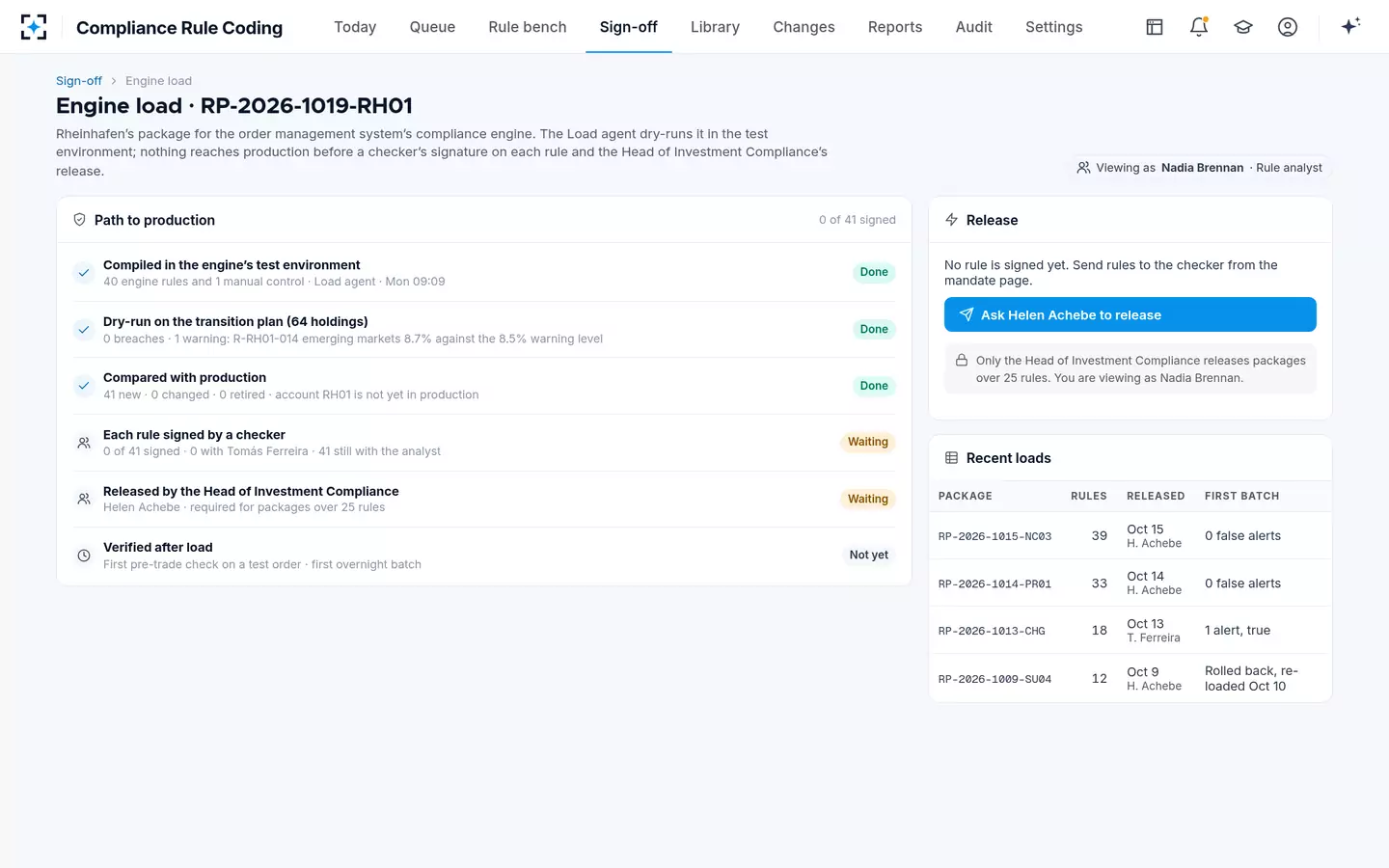
What should never be automated is the choice between two readings of a clause, the checker's signature and the release to production. Those are the controls an examiner will ask about, and the ones that make an automated process defensible. In the solution, agents never load a rule, never sign, never resolve a disagreement and never change a signed record; a package over 25 rules needs the Head of Investment Compliance to release it.
A new mandate's stages, rules-live date and funding date on one page
An investment compliance automation framework: price, pilot, then decide
A sound framework for the decision has three steps, in order. First, price the delay with your own numbers, using the four terms above, for a typical mandate and for your largest. Second, pilot on real documents, ideally a recent mandate with a side letter and at least one clause your team argued about, and measure the same stages you measured by hand. Third, decide on the comparison, including the cost of the tool, which vendors do not publish and you will have to obtain in writing.
The comparison must include the cost of the control you already have. The AMF found the annual cost of the tools that configure and monitor investment limits ranged from €30,900 to €363,000 at the five French managers, 0.1% to 2.3% of their 2023 operating costs, and one manager had spent €400,000 building its own tool before that (AMF SPOT summary, section 4.1.2). A coding tool sits in front of that engine, not in place of it, so its cost is additional and should be justified by the delay it removes and the errors it catches. How to run and score the pilot is set out on its own page.
Where the solution shortens the wait, and where it does not
The solution shortens the stages that are reading and testing: finding clauses across documents and languages, following definitions, drafting rules, running a second reading, building edge cases and back-tests, dry-running in the engine's test environment. On the sample mandate the agents' run took 36 minutes, ending with six items that needed a person.
It does not shorten the stages that wait on people outside compliance. A side letter the client has not sent, an answer from the client's counsel on what a clause means, an identifier a data vendor does not carry: the agents can draft the question, in the client's language, but they cannot make the client answer. Nor does it replace your compliance engine, investigate post-trade alerts, which is the work of post-trade compliance monitoring, or change your engine's own release process. The days it removes are real, and so are the days it leaves.
The path to production, with every signature still to come
Building the delay case for your own firm
- Measure your median days from signed documents to verified rules
Last ten to twenty mandates, split by stage; this is the number the case rests on.
- List the substitute controls you used while waiting
Delayed funding, restricted starts, manual pre-clearance, untested loads, and how often each.
- Price each substitute per day
Fees, analyst and portfolio manager time, return difference; use finance’s numbers.
- Count the coding errors found after go-live
From breach logs and rule changes; each is an input to the error-exposure term.
- Separate what a tool can shorten from what waits on others
Client answers and missing documents do not get faster with software.
- Get the tool’s full cost in writing
Licence, implementation, engine integration and internal time; vendors do not publish prices.
- Pilot on a mandate your team argued about
The disputed clauses are where the time and the risk are.
Questions people ask
What does investment compliance automation software do?
It depends on the tool: some automate post-trade monitoring, some pre-trade questions, and some, like Compliance Rule Coding, the step before both: turning documents into tested, cited rules for the engine. Ask which stage of your process a tool shortens, and measure that stage before and after.
How do you automate the investment compliance process without losing control?
Automate preparation and evidence, not decisions. Agents can read, draft, re-read, test and package; a named analyst decides every interpretation, a different officer signs, and a senior person releases. The audit trail then shows more about each decision than a hand-coded process usually keeps.
Is headcount reduction a good business case for compliance automation?
Rarely the best one. Rule coding teams are small, and the same people are needed to make the decisions the tool does not. The stronger case is time to tested rules on each new mandate and change, and fewer coding errors reaching production.
How much does a delayed mandate funding cost?
At minimum, the management fees on the mandate for each day of delay: assets times fee rate times days divided by 365. On a hypothetical €1.7 billion mandate at 0.30%, that is about €14,000 a calendar day, before any cost to the client relationship.
What is the cost of a compliance coding error?
Usually small and caught quickly, sometimes very large and caught late. At one manager the AMF inspected, ten compensation payments ranged from €10 to €48,000, nine of the ten breaches traced to controls missing or configured wrongly; at the other end, the SEC's 2019 Kornitzer order combined a $2.7 million penalty with nearly $5 million of disgorgement for a limit not enforced for over two years.