Post-trade compliance monitoring is the check, after trades are booked, that every fund and mandate still meets its investment limits: the compliance engine re-tests the portfolios against their coded rules, usually overnight on the closing positions, and hands an alert queue to the investment compliance team. The engine part is automated; the morning that follows is not. France's AMF found that breaches are mostly detected automatically, but "the investigation of these breaches remains a manual activity, due to the diversity of the ratios monitored and of the quantity of possible breach scenarios". Each alert passes through several people before it is closed or confirmed: the analyst who re-performs the test, the data team that checks a price or a rating, the portfolio manager who explains a trade, the reviewer who signs. Botminds' Investment Guideline Monitoring puts agents on that queue: they recompute each alert from the custodian position and the clause and check its inputs against a second source, so the people spend the morning on the alerts that need them.
The example morning below is the solution's sample data, on a fictional manager, Quillfield Capital, that monitors 618 mandates and funds against 14,820 coded rules. The regulatory findings come from the AMF's inspection of five managers and from Luxembourg's CSSF.
One analyst's day after the overnight run, by hand and with agents
- Pull and sort1.0 h
- Re-perform each test against custodian file and agreement3.0 h
- Second source1.5 h
- Second reviewer re-performs1.5 h
- Cures and notices2.0 h
- Sort, 0.1 h
- Check the recomputation0.5 h
- Second source, 0.2 h
- Review, 0.3 h
- Cures, notices0.5 h
Post-trade compliance monitoring requirements: what regulators expect after the trade
Regulators expect a post-trade check that runs on every valuation, finds every breach, and records enough to classify and cure it. Luxembourg is the most explicit. Circular CSSF 24/856 requires pre-trade controls and, in addition, post-trade controls after transactions are concluded, which must establish whether a breach is active or passive so that a correction, an impact calculation and any compensation can follow, and which must run no later than the next NAV calculation (point 58). Funds trading heavily between valuations need controls between NAVs as well.
In the United States the requirement is framed as policies and procedures: an adviser must adopt written policies and procedures designed to prevent violations of the Advisers Act and review them at least once a year, and a fund's compliance officer reports material compliance matters to its board. Neither rule says how often to run a post-trade test, so the frequency becomes part of what the firm must justify. How the US, UCITS, Luxembourg and French rules fit together for a cross-border manager is laid out in the guide to investment compliance monitoring requirements.
Pre and post trade compliance: who checks what, and when
Pre-trade checks stop a planned order that would breach a limit; post-trade checks find the breaches that happened anyway, from market moves, flows and the trades the pre-trade check let through. At the five managers the AMF inspected, the two together formed what it called "the tightly woven net": three pre-trade steps and four post-trade ones, owned by four different parties. The detail of the pre-trade half is in the guide to pre-trade vs post-trade compliance; the table shows where the post-trade half sits.
Seven checks on one fund, and who runs each
| Check | Owner | When | How |
|---|---|---|---|
| 1. Simulate the planned order against the limits | Portfolio manager | Each planned order | Semi-automatic in the order system at four; a spreadsheet at one |
| 2. Pre-trade check on the order sent to the desk | Risk control | Each order to the trading desk | Automatic at all five |
| 3. Second pre-trade check before the desk sends to brokers | Risk control | Each order sent for execution | Automatic, at two of the five |
| 4. Post-trade test on portfolios valued at the close | Risk control | Daily | Semi-automatic at three; manual at one |
| 5. Managers' own morning check of their portfolios | Portfolio managers | Daily | Manual, from an export into a spreadsheet, at two |
| 6. Test on the accounting inventory | Fund valuer | Each NAV | Automatic at all five |
| 7. Test on the fund inventory | Depositary | Variable | Manual at all five; alerts after several NAVs in breach |
Two things in the table explain why the morning is hard. The same breach can arrive three times, from the manager's own run, the valuer and the depositary, each "in different formats and by different people", and the depositaries' alerts come as non-standardised emails that do not lend themselves to automatic processing. And the checks that run on accounting data and the checks that run on the order system's view of the portfolio disagree in predictable ways, which is where most false alerts come from.
Who reviews post-trade compliance alerts?
The risk control or investment compliance function reviews them, in three stages the AMF found at every manager it inspected: identify the reason for the alert and confirm it is genuine, classify a confirmed breach as active or passive, and notify the manager to correct it. Where the review shows a valuer's or depositary's alert was unfounded, the function tells the sender, and checks whether the cause was a wrongly configured rule or poor data. In any disagreement with the portfolio manager about whether a breach is proven, risk control had the final word at all five.
One post-trade alert, from engine to approval
Agent
Compliance engineRe-tests every portfolio against its coded rules overnight and writes the alert file.
Agent
Intake and Triage agentsLink repeats to their open twin, recompute each alert from the custodian position and the clause, and propose a reason with citations.
Never: Never close anything
Agent
Data Check agentRe-sources the price, rating, sector code or corporate action from a second vendor, filings or the security master.
Never: Never picks a winner when sources disagree
A person decides
Compliance analystClassifies what the agents could not settle, and spot-checks the groups of proposed closes.
A person decides
Portfolio managerExplains a trade, then confirms the cure trade for a real breach.
Never: Cannot close alerts on portfolios they manage
A person decides
Head of Investment ComplianceApproves every close, classification and notice; no one approves their own work.
What causes false post-trade compliance alerts?
Mostly the gap between the data the test ran on and the data the limit is measured on. The AMF recorded the causes of breaches that appeared only post-trade at two of the managers: prices that moved between the manager's order and its execution; management fee provisions loaded into the order system a day later than into the accounting inventory, so the two disagree about net assets; the manager seeing its orders at once while the valuer sees them only when the trade advice arrives; and buy and sell orders placed together on markets with different settlement cycles, where one leg fills and the other does not. One manager's policy lists its own false positives: differences between its reference data and the valuer's for fund classification or the rating of interest rate instruments, one of several cash accounts overdrawn while the fund's total is in credit, and a replacement bond bought before the old one matures.
Where 412 overnight alerts went on one sample Monday
Sample queue, 412 alerts
- Repeat of an open alert, 97 · 23.5%
- Bad or late input, 141 · 34.3%
- Soft warning inside the band, 118 · 28.6%
- The agreement rules it out, 47 · 11.4%
- Needs a person, 9 · 2.2%
The four big groups have different fixes. Repeats need linking, not re-reading. Bad inputs need a second source and a record of which one was right. Soft warnings need a band defined in the procedure, so that a value at 92% of a limit is logged as a warning and not investigated as a breach. And alerts the agreement rules out, such as a credit floor coded on the lowest of three ratings when the agreement uses the second-highest, need a change to the coded rule, or they return every morning.
Post-trade compliance examples: the sector code that moved overnight
A sector reclassification is the clearest example of an alert that is real in the data and wrong in substance. Classification vendors remap issuers between sectors, sometimes in bulk, and the post-trade run tests sector limits against whatever the feed said at the cut-off. If the vendor moved an issuer into a sector where the fund is near its cap, the engine fires on a fund nobody traded. Whether that is a breach depends on the agreement: which classification it names, whether a reclassification counts before the next rebalancing, and whether a second classification or the issuer's own filings agree with the move.
In the sample data, the overnight run is reconciled against two classification vendors. Vendor B's file arrived 22 minutes late, so the Data Check agent re-ran 29 sector checks when it landed; no result changed. Over October, remaps from vendor A produced 41 false alerts across 77 mandates, each proposed for closing with the second vendor and the issuer's filing cited, and the agents drafted a rule fix for the rule-coding team to decide.
When two agents read the same alert differently, it goes to a person
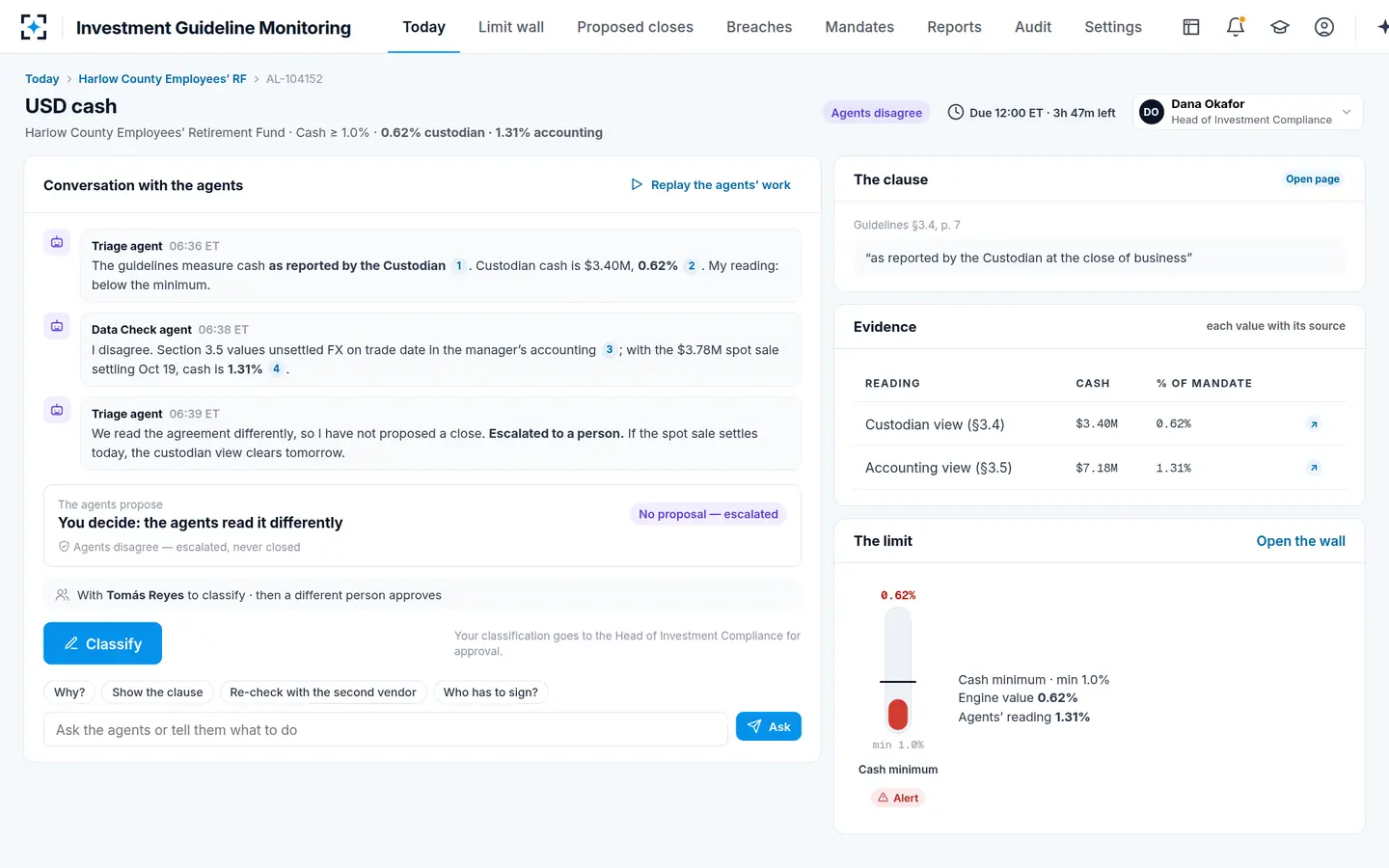
The handoffs that stall: depositaries, portfolio managers and escalation
The slowest handoffs are the ones that leave the compliance team. Depositary alerts arrive late and unstructured, and every one needs a reply: the managers the AMF inspected answer each depositary email with the corrective action already taken, or open a fresh investigation if the breach is new to them. Portfolio managers are asked to correct a breach from the first NAV after it is found, and when they do not, an escalation ladder runs: at one manager, a daily-NAV active breach goes to the head of the management unit and the compliance officer after two NAVs and to general management after six.
Senior management sees the results on different clocks. At three of the five managers, risk control sends senior management a daily report of the previous day's breaches; at all five, breaches are reviewed at risk committees, monthly at one and quarterly at the others. The AMF's sample tests show what happens when that reporting step is thin: at two managers senior management received no information on the breaches tested, and at two others the reports left out some breaches or how long they lasted, which are exactly the cases that most need a decision.
Every key limit of one mandate, recomputed before the analyst arrives
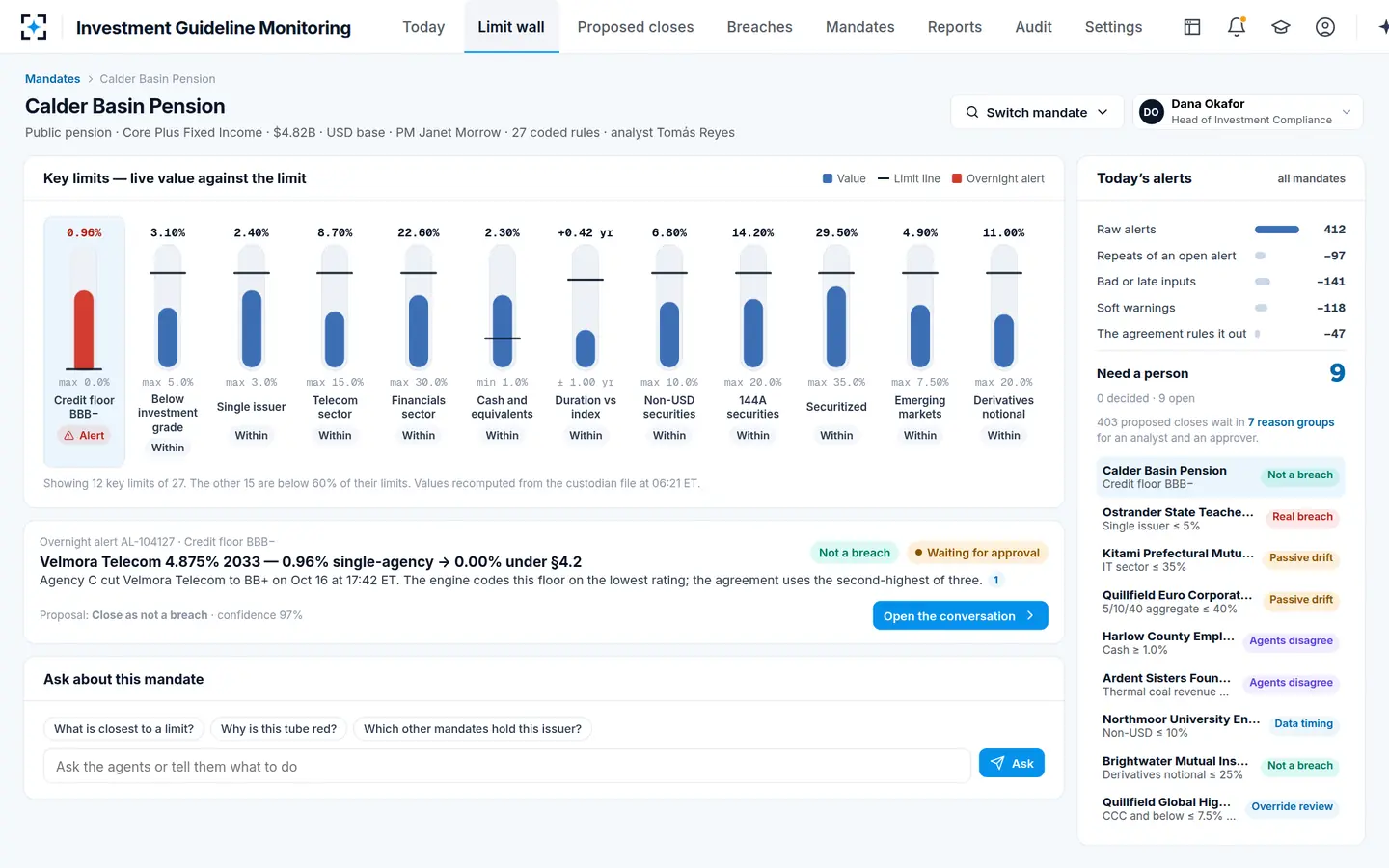
Post-trade compliance monitoring tool: what to look for
A post-trade compliance monitoring tool should be judged on the morning, not on the run. Most rules engines already test the portfolios overnight; the questions that separate tools are whether each alert arrives recomputed from the custodian position and the governing clause, whether every input is checked against a second source before anyone reads it, whether repeats are linked rather than re-raised, and whether the people who confirm a breach can see why the alert fired without re-performing the test. The guide to post-trade compliance software splits the morning's tasks between agents and people; the guide to a monitoring tool beside your engine covers what it connects to.
Investment Guideline Monitoring on one Monday morning
In the sample data, the overnight run finished at 07:38 ET on Monday 19 October 2026, on positions as of Friday's close. Between 06:02 and 07:38 the agents linked 97 repeats, recomputed 315 alerts from custodian positions and their clauses, re-sourced 141 prices, ratings, sectors and corporate actions, escalated two alerts on which they disagreed, tested cure options for three breaches and drafted three notices. At 08:12 the Head of Investment Compliance opened a home screen with three numbers: 9 alerts needing a person, 403 proposed closes in seven reason groups, 5 open breaches.
Investment Guideline Monitoring: nine of 412 alerts need a person
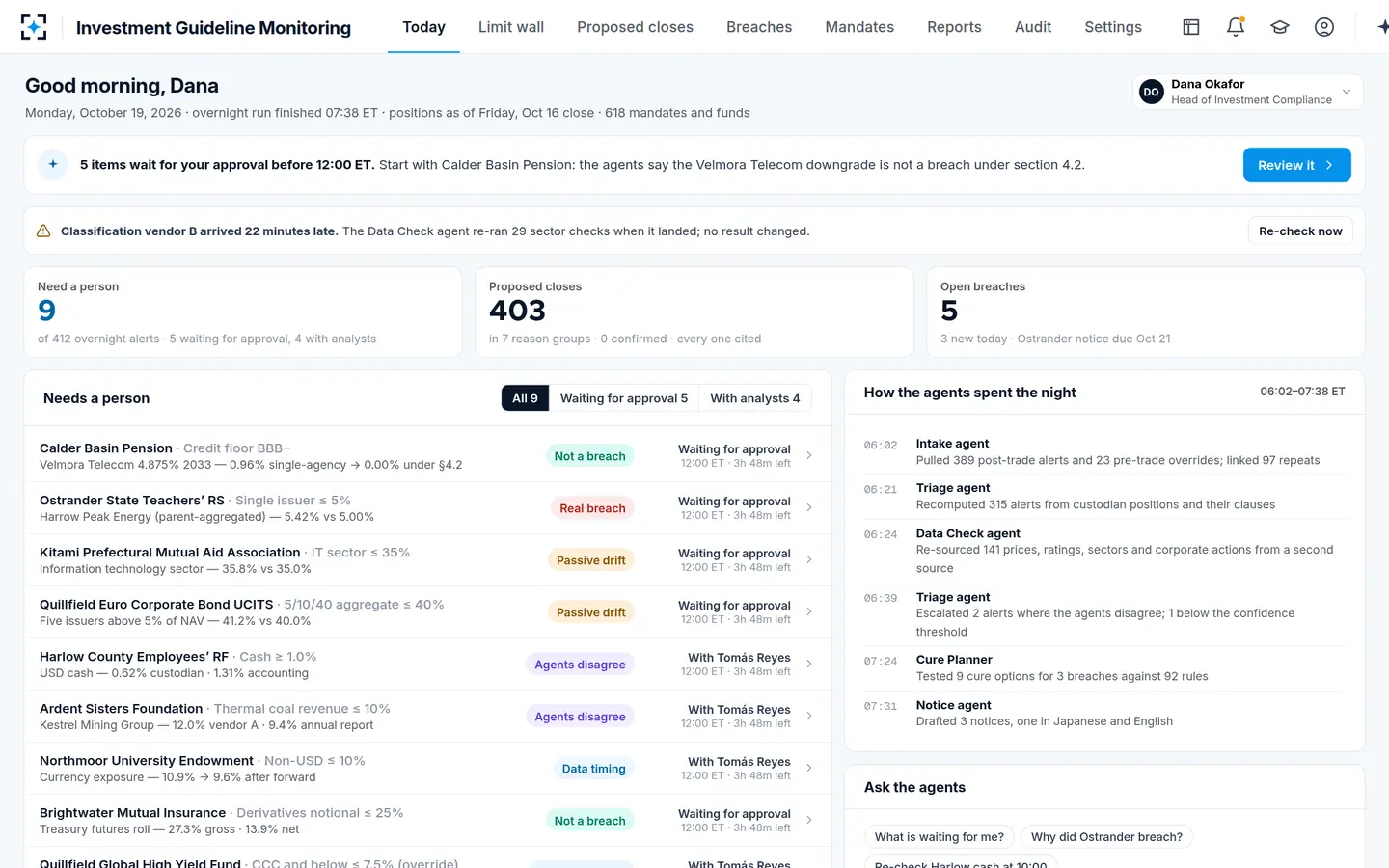
The design follows the AMF's map of the work rather than replacing it. The engine still finds the alerts. The agents do the reading the AMF found was manual, and the people keep the three decisions it found at every manager: whether the breach is genuine, whether it is active or passive, and what the manager must do about it.
Questions people ask
What is the difference between pre-trade and post-trade compliance?
Pre-trade compliance tests a planned order against the limits before it is sent, and can block it. Post-trade compliance tests the whole portfolio after trades are booked, usually daily, and finds breaches from market moves, flows and trades the pre-trade check missed. The CSSF requires both for Luxembourg funds, with the post-trade test no later than the next NAV.
How often should post-trade compliance monitoring run?
At least at every valuation of the fund, and daily for daily-NAV funds. The CSSF accepts a check at each NAV for diversification limits in most funds, but expects controls between NAVs for funds that trade heavily between valuations; at the French managers the AMF inspected, the post-trade test ran daily.
Who is responsible for post-trade compliance at an asset manager?
The risk control or investment compliance function runs and investigates it, independently of the portfolio managers. The fund's valuer and depositary run their own checks on accounting and fund inventories, and senior management reviews breaches and their resolution at risk committees.
Why do depositaries report breaches later than the manager?
Because they test on the fund inventory and alert only after a breach has lasted several NAVs, four at two of the managers the AMF inspected. The managers treat the depositary's check as a second-level control and reconcile its alerts against their own.
What is a soft warning in post-trade compliance?
A value inside a warning band below the limit, such as 90% to 100% of it, logged so the portfolio manager knows headroom is thin but not investigated as a breach. In the sample run, 118 of 412 overnight alerts were soft warnings inside the band.