Investment breach notification requirements are not one rule but several, and each recipient has its own clock. The client of a segregated mandate hears under the notice clause of its investment management agreement, within two business days in the sample agreement below. The fund's depositary and administrator hear without delay in Luxembourg. A US fund's board hears through its compliance officer, at once for a serious matter and in the annual report otherwise. The regulator hears about active breaches in Luxembourg and France, on a form or a quarterly report, and a UK firm tells the FCA immediately of a significant breach of its rules. Investors hear when they are owed compensation. Botminds' Investment Guideline Monitoring tracks those clocks from the moment a breach is confirmed: its Notice agent drafts each letter from the breach's own details, every sentence cited, the Head of Investment Compliance approves it and the Client Service Director sends it.
The examples are the solution's sample data, on fictional clients of a fictional manager. Rule text is quoted from the regulators, and practice from France's AMF, which inspected how five managers inform investors, delegating managers and the regulator.
Who hears about one active breach, in order
A person decides
Compliance analyst confirms the breachClassifies it active or passive; the clocks below start here, not at the cure.
Agent
Depositary, administrator and fund's managerInformed without delay of an active breach in a Luxembourg fund; a short note drafted from the breach.
Agent
Client under the agreementNotice drafted to the clause's deadline, often two business days, in the client's language.
A person decides
Head of Investment Compliance approves; Client Service sendsNo notice leaves without a named approver; the agents never send.
Agent
RegulatorCSSF form within four to eight weeks; AMF quarterly report; FCA at once if significant.
Agent
Fund board and investorsMaterial compliance matters to the board; letters to investors owed compensation.
Investment breach notification rule: there is no single one
There is no general rule requiring a manager to notify anyone of every investment breach. The duties come from four sources: the contract with the client, fund regulation in the fund's home country, the manager's own regulator, and the duty to compensate. Each sets its own trigger. A client agreement may require notice of any exception to the guidelines; Luxembourg requires notice of active breaches only; the UK asks for notice of breaches that are significant; the US asks the fund's compliance officer to tell the board what the board would reasonably need to know.
The trigger also depends on the label. Whether a breach was active or passive decides most regulatory notices, so the classification has to be settled before the first notice goes, and the reason for it written down. A notice sent on a passive classification that is later reversed has to be corrected, and the regulator's clock for the active breach started when it was detected.
Investment breach notification requirements, by recipient
| Recipient | When | Which breaches | Source |
|---|---|---|---|
| Client of a segregated mandate | As the agreement says | As the agreement defines; some include passive | Investment management agreement |
| Depositary, administrator, management company (Luxembourg fund) | Without delay | Active | CSSF 24/856 point 65 |
| Fund board (US fund) | Promptly if serious; otherwise in the annual compliance report | Material compliance matters | Rule 38a-1 and its 2003 release |
| CSSF | Four to eight weeks after detection where no investor compensation is due | Active | CSSF 24/856 points 152 to 158 |
| AMF | Quarterly, within a month of quarter-end; immediately for an incident over 5% of capital | Active | AMF General Regulation 321-75-1 and 321-35 |
| FCA | Immediately on becoming aware | Significant breaches of a rule | FCA SUP 15.3.11R |
| Delegating manager | As the delegation agreement says | Ad hoc for active; periodic for all | Delegation agreements reviewed by the AMF |
| Investors owed compensation | When compensation is paid | Active breaches that caused a loss | AMF practice; CSSF Chapter 7 |
Investment guideline breach notice: what the client letter must say
The client letter must say what happened, why, what was done and what the client is owed, and each statement must be one the manager can prove. The agreement sets the deadline and sometimes the form, and the letter follows the clause it is written under. In the sample data, Ostrander State Teachers' Retirement System's agreement requires written notice within two business days under section 9.3, so a breach confirmed on Monday 19 October 2026 has a notice due on Wednesday 21 October.
A breach notice drafted from the breach, every statement cited
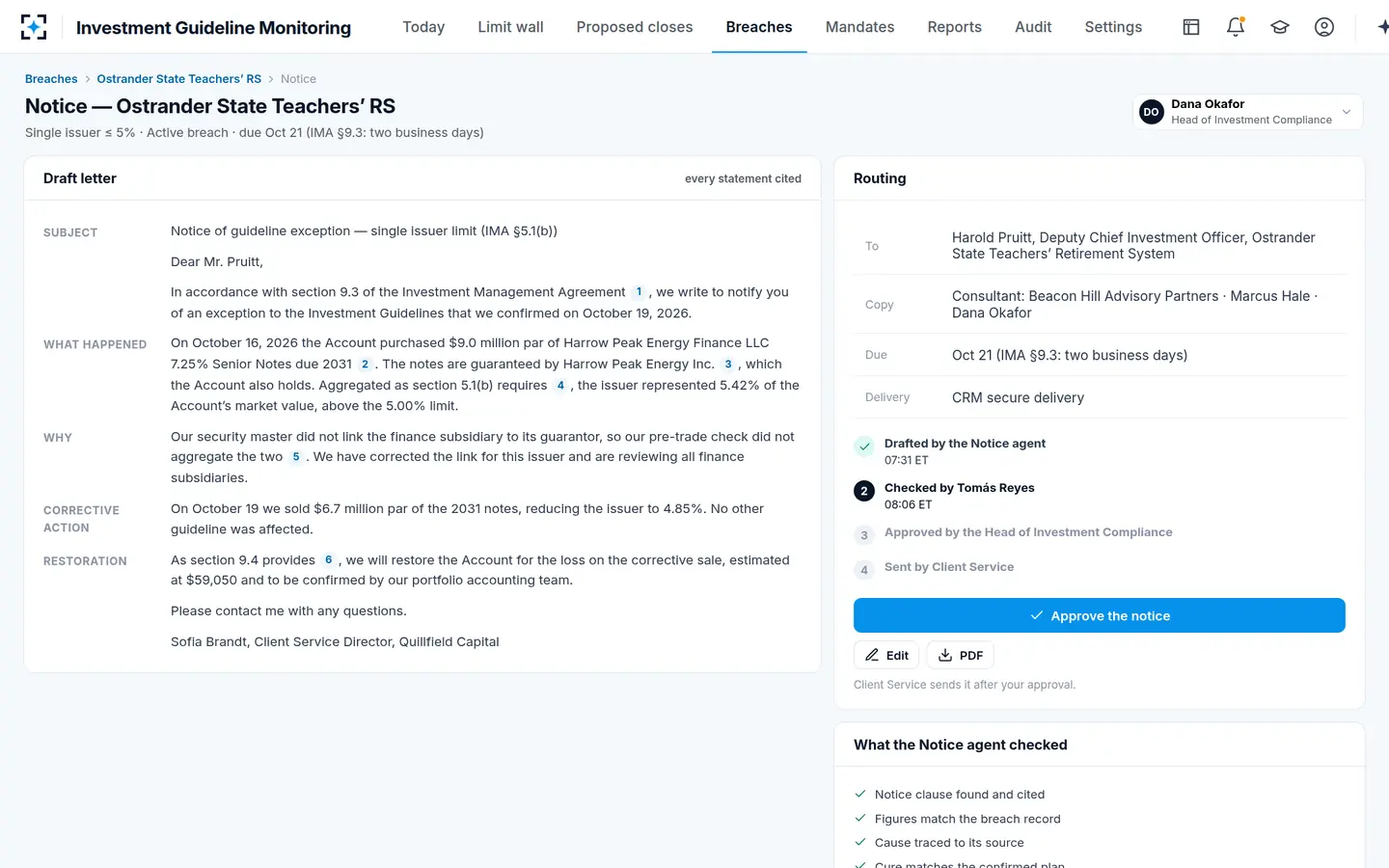
What an investment breach notification letter contains
- The clause and the deadline
Which section of the agreement requires the notice, and that it is met.
- The limit, the measure and the level
The limit as written, how it is measured under the agreement, and the value reached: 5.42% against 5.00%.
- The date found and the date it began
The confirmation date and the trade or event that started the breach.
- The cause, in plain terms
Active or passive, and why: the trade, the data gap or the market move.
- The correction
What was or will be sold or bought, and the position after it.
- What the client is owed
The restoration method in the agreement and the estimated amount, flagged as an estimate until confirmed.
- What changes so it does not recur
The control fixed: here, the guarantor link and a review of all finance subsidiaries.
Do you tell the client about a passive breach?
If the agreement says so, yes. Regulation is mostly silent for mandates: the CSSF and AMF rules on notification cover funds, and the AMF's inspection left mandate ratios out of scope. In the sample data, Kitami Prefectural Mutual Aid Association's Japanese guidelines require the manager to report promptly and correct within 10 business days even when the limit was passed "for reasons not attributable to the Manager", and the solution drafts that report in Japanese and English.
For funds, the regulators' answer is no. Luxembourg's passive breaches are not notified to the CSSF, and the AMF's quarterly report covers active breaches only. Between managers, the AMF found that delegation agreements limit the ad hoc notice to active breaches, while periodic reporting to the delegating manager covers all of them. It also found two managers that had not told the delegating manager about six breaches in funds they ran under delegation, which is how a notice duty fails in practice: not in the rule, but in the routing.
When must the fund board hear about a breach?
Promptly if it is serious, and in the annual compliance report otherwise. Rule 38a-1 requires the fund's chief compliance officer to report each material compliance matter to the board in writing at least once a year, and defines one as a matter the board would reasonably need to know about to oversee fund compliance (17 CFR 270.38a-1). The SEC's 2003 release adds two things: serious issues go to the board promptly rather than waiting for the annual report, and individual matters that are not material alone may together amount to a material weakness (68 FR 74714, note 84).
For a monitoring team that means two routes out of the breach register. A breach that cost the fund money, lasted long, or came from a control failure goes to the compliance officer the day it is confirmed, so the officer can decide whether the board hears now. Every other breach waits for the annual report, where it is counted with the rest and grouped by cause, because a pattern is what the release warns the board may need to see.
Investment guideline breach reporting to the CSSF
In Luxembourg, every active breach is notified to the CSSF on the specific form it publishes, through the organisational arrangements the fund must have for that purpose. The form is strict: all data fields must be completed, the text fields must explain the origin of the breach and the remediation plan clearly, a quantitative impact calculation must be attached (point 154), and "The CSSF refuses incomplete notifications" (point 155). The CSSF does not approve the corrective actions or reply to each notification; it uses them in its risk-based supervision and may ask for more, require other remedies or require better organisation (points 159 and 160).
The clock runs from detection. Where no compensation is owed to investors, "the deadline for notification is 4 to 8 weeks at the latest after the date on which the error/non-compliance has been detected"; where investors in several jurisdictions must be compensated, the notification still goes within that window without the payment date, and the CSSF must be told of the progress of payments every month (point 158). Before any of that, point 65 requires the fund's policies to ensure that "the IFM, where applicable, as well as the UCI administrator and the depositary are informed thereof without delay".
The clocks one active breach in a Luxembourg fund starts
- Inform on day 0
- Notice within days 0–2
- Prepare and priceUp to week 4
- LatestWeeks 4–8
Investment breach notification form: France and the UK
France has no breach-by-breach form; it has a quarterly report. Each active breach in the quarter is listed with the ratio, the threshold exceeded, the level reached, the reason, the time taken to rectify it and any compensation paid. At the managers the AMF inspected, risk control prepared the report, the compliance officer checked it for completeness and the impact calculations, and general management validated it before it went to the AMF. The AMF found the reports were not free of anomalies and plans to publish data quality checks for them (AMF summary, §4.4).
The UK sets a trigger rather than a form. A firm must notify the FCA of "a significant breach of a rule", and "must make the notification in (1) immediately it becomes aware, or has information which reasonably suggests, that any of the matters in (1) has occurred, may have occurred or may occur in the foreseeable future" (FCA SUP 15.3.11R). The guidance asks for the circumstances, the rule breached and the steps taken or planned to put it right. How a firm decides what is significant, and keeps the evidence for that judgement, is the subject of the guide to the compliance breach register.
Investors: the letter that comes with compensation
Investors hear when they are owed money. At the French managers the AMF inspected, when compensation was triggered the compliance officer informed the fund's depositary and statutory auditor and the AMF, and investors in the French funds affected were informed, in consultation with the AMF, by an individual letter to those who suffered a loss, followed by a mention in the fund's periodic report. The AMF also tested this: information to investors was missing for three of 21 breaches tested at one manager and for all those tested in directly managed funds at another.
Luxembourg adds a duty that reaches the prospectus. Funds that cannot compensate each final beneficiary individually when units are held through intermediaries must tell investors that those beneficiaries' rights may be affected, in the prospectus at its next update or through the fund's usual channels (point 164). That disclosure is written once; the breach letters are written each time.
Each breach with its notice status beside its cure
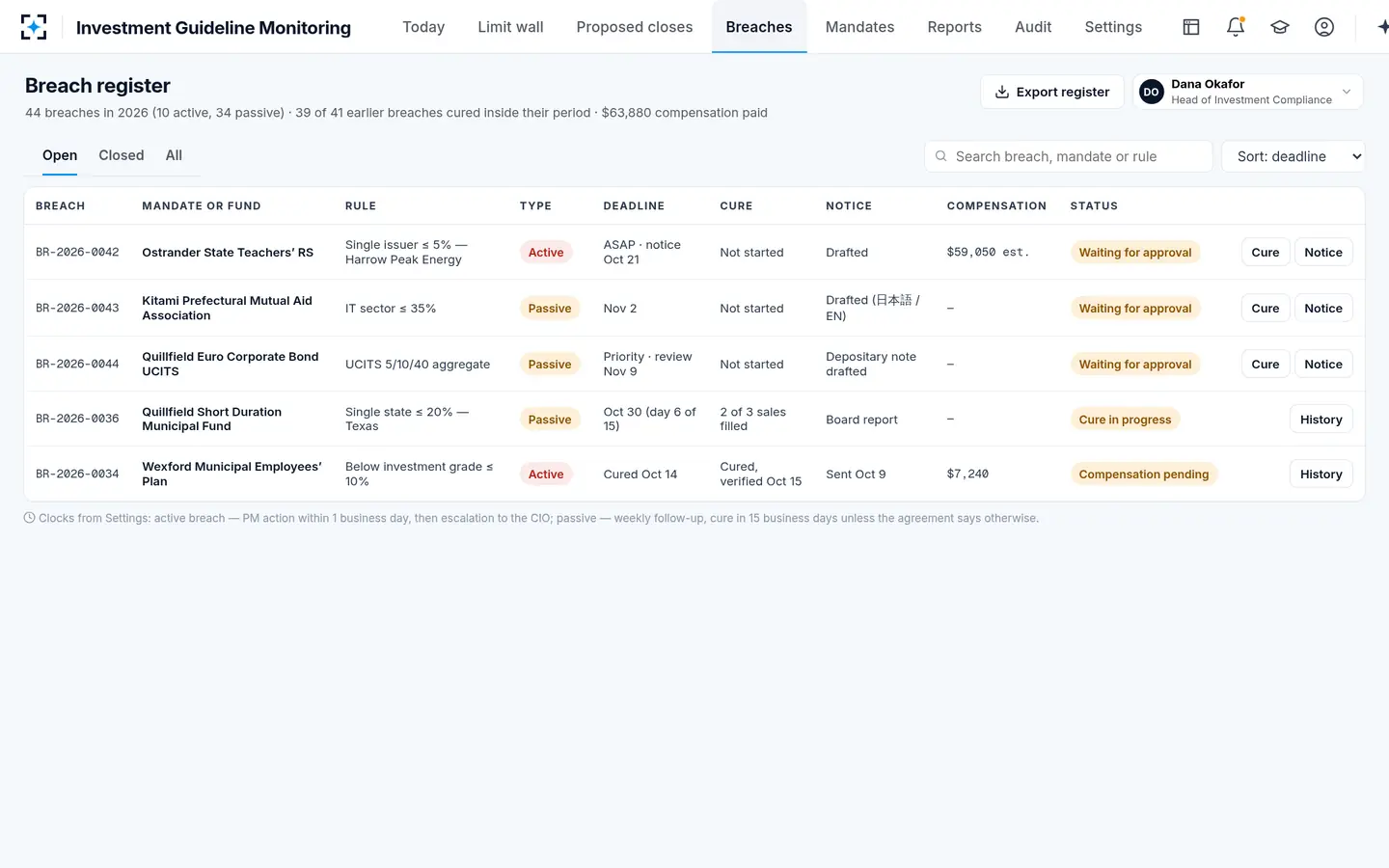
How Investment Guideline Monitoring runs the notice plan
The solution treats notices as part of the breach, not as correspondence. When an analyst confirms a breach, the Agreement agent finds the notice clause and its deadline in the agreement or prospectus, the SLA Watch agent starts the clock, and the Notice agent drafts each notice the breach owes, client, depositary or board, from the breach's own details, in the client's language where the agreement is not in English. Where the agreement is silent, a setting the compliance officer approves applies: two business days in the sample configuration.
Nothing goes out without people. The Head of Investment Compliance approves each notice; the Client Service Director sends client notices through the client system; regulatory filings stay with the compliance team. In the sample year to date, 12 of 12 notices went on time, and the October board report draft states that no breach required regulator notification, a statement the compliance officer checks before it goes to the board.
Questions people ask
How quickly must a client be told about an investment guideline breach?
As fast as the investment management agreement requires; no general regulation sets the period for a segregated mandate. An agreement may ask for written notice within a set number of business days of confirmation, and some, like the sample Japanese client's guidelines, require a prompt report even when the manager did not cause the breach.
Do passive breaches have to be notified to the CSSF?
No. Under Circular CSSF 24/856 passive breaches are not notified; they are corrected within a reasonable period in investors' interest and monitored by the fund's directors until they are. Active breaches are notified on the CSSF's form.
What happens if a CSSF breach notification is incomplete?
The CSSF refuses it, and a new, complete notification must be submitted without delay. Every field of the form must be filled in and a quantitative impact calculation attached, so the impact has to be computed before the form can be sent.
Does a US fund have to report an investment restriction breach to the SEC?
Not as a general rule; the route is the fund board, through the chief compliance officer's report of material compliance matters, with serious matters raised promptly. Breaches that are not reported internally tend to surface in examinations or enforcement, as in the SEC's 2025 case over a fund's 25% limit.
Who should approve a breach notice before it is sent?
Someone senior to the person who drafted it and independent of the portfolio manager whose trade caused it. At the French managers the AMF inspected, general management validated each quarterly report, and senior management approved every compensation payment.