A guideline monitoring analyst, also called an investment guidelines monitoring analyst or investment guideline compliance analyst, works the alerts a compliance engine raises when a fund or mandate may have broken a limit in its prospectus, client agreement or regulation. The analyst decides whether each alert is a real breach, classifies a real one as active or passive, and follows it through cure and notice. The decision is never made in one seat: a price or rating may need the data team, a trade needs the portfolio manager's account, a notice needs client service, and the close needs an approver. That is why one alert can take a morning. Botminds' Investment Guideline Monitoring gives each seat its part already prepared: agents recompute the alert from the custodian position and the clause, check every input against a second source and draft the cure and the notice, and the people in the five seats decide.
The people below are the solution's sample personas at a fictional manager, Quillfield Capital. The figures on team size and practice come from France's AMF, which inspected how five asset managers staff and run the monitoring of their funds' investment limits.
Five seats around one guideline alert
Today
Spends half the morning proving again that a single-agency downgrade does not count under the agreement's rating clause.
With agents
Gets each alert recomputed from the position and the clause with a second source, and classifies where the agents disagree.
Still theirs: The classification; never approves their own
Today
Answers the analyst's emails about a stale price, a sector remap or a missing guarantor link one at a time.
With agents
Receives the inputs the agents could not settle, with both sources side by side.
Still theirs: Which source is right, and the fix to the master data
Today
Gets breach emails mid-trade and works out what to sell without tripping another limit.
With agents
Receives the smallest sale tested against every rule of the mandate, and confirms it.
Still theirs: The trade; cannot close alerts on portfolios they manage
Today
Writes each breach letter from scratch and answers the consultant from email threads.
With agents
Sends a letter drafted from the breach, every statement cited and approved first.
Still theirs: The client relationship and the send
Today
Signs off closes without seeing the evidence, and rebuilds the breach log for the board by hand.
With agents
Approves each close, classification and notice with the evidence on screen, and reads the board draft built from the register.
Still theirs: Approval, rule and threshold changes, the board report
What does a guideline monitoring analyst do?
A guideline monitoring analyst confirms or dismisses each alert, classifies confirmed breaches, and makes sure each one is cured and reported on time. France's AMF found the same three steps at every manager it inspected: identify the reason for the alert and confirm it is genuine, classify the overrun as active or passive, and notify the manager so it can be corrected (AMF summary of SPOT inspections, February 2025). Around those steps sit the tasks that fill the day: re-performing the test against the custodian file and the agreement, checking prices, ratings and sector codes against a second source, answering the depositary's and valuer's alerts, keeping the breach register, and preparing the figures for the risk committee.
The function is usually called risk control in European asset managers and investment compliance in US ones; the work is the same. At the five French managers, the function also configured the limits in the monitoring system, which is where the AMF found a conflict worth separating, and decided in any disagreement with portfolio management whether a breach was proven. Its independence rested on reporting directly to a member of senior management and on controlling the technical unblocking of any order the pre-trade check had stopped.
One alert, five seats: who asks what
Each seat asks one question about the alert, and the alert waits until it is answered. The table follows a single alert through all five.
The question each seat answers about one alert
| Seat | Question | Decides | Typical wait |
|---|---|---|---|
| Compliance analyst | Is the alert real, and is the breach active or passive? | Close as false, or confirm and classify | Until the inputs are trusted |
| Data and operations | Is the price, rating, sector code or issuer link right? | Which source stands; the data fix | A reply to an email, or a late file |
| Portfolio manager | What traded, and what is the cheapest cure? | The cure trade | Until the manager is off the desk |
| Client service | What must the client hear, and by when? | Sending the notice | Until the facts are settled |
| Head of compliance and CCO | Is the evidence enough, and does the board need to know? | Approval; escalation to the board | Until the evidence is in one place |
The waits in the last column are the morning. None is long on its own; together they explain why an alert that takes ten minutes of thought can take half a day of elapsed time, and why the AMF found the investigation step still manual even at managers whose detection was automated.
How big is a guideline monitoring team?
Smaller than the work suggests. At the five French managers the AMF inspected, running from fewer than 10 funds to between 100 and 200, the function that configures the limits and investigates breaches had a dedicated head at two of them, and three to five full-time equivalents behind the head at three. At the smaller ones the work was part-time: a manager seconded for half their hours at one, the managing director with 1.5 full-time equivalents at another, and the secretary general at the smallest (AMF summary, §4.1.1).
Who monitors fund limits at five French managers
3–5FTE
behind the head of the limit-monitoring function at three of the five managers
2.5FTE
of one compliance officer's 10.7-person team dedicated to monitoring investment ratios
1of 5
managers with a training programme on ratio monitoring for its fund managers
1person
configured the limits and supervised the results at one manager, a segregation risk the AMF flagged
The compliance side is separate from that function and also thin. One manager's compliance officer spent half her time on the role but had 10.7 full-time equivalents behind her, 2.5 of them on investment ratios; two others had a full-time compliance officer and three full-time equivalents, a fourth a full-time officer with half a person's help, and the fifth a compliance officer working alone. Every one of them reported directly to a member of senior management.
How many alerts does a compliance analyst clear a day?
No regulator or independent study publishes alerts per analyst, because the number depends on how the rules are coded, how clean the data is and how many repeats the engine raises. What regulators do publish is breaches. The AMF found between 20 and 800 breaches a year per manager, against 100 to 10,000 transactions a year; the busiest manager recorded 2,368 breaches over the three years inspected, about three every working day by our arithmetic, before counting the false alerts that had to be dismissed to find them.
Alerts outnumber breaches by far. In the solution's sample data, one overnight run raised 412 alerts across 618 mandates and funds, of which nine needed a person after repeats, bad inputs, soft warnings and alerts the agreement rules out were set aside. To know your own number, count for four weeks: alerts raised, alerts closed per analyst-day, the share closed as data issues, and the share confirmed as breaches. The guide to an investment guideline monitoring tool's KPIs shows how to baseline them.
Where the agents take the reading, and each seat keeps the call
Agent
Triage agentRecomputes the alert from the custodian position and the exact clause; proposes a reason and a classification with citations.
Never: Below 90% confidence it hands to a person
Agent
Data Check agentRe-sources the price, rating, sector and revenue figure from a second vendor, filings or the security master.
Never: Escalates instead of picking a winner
A person decides
Analyst and data teamClassify what the agents could not settle; fix the master data that caused it.
Agent
Cure Planner and Notice agentPropose the smallest cure tested against every rule; draft the client, board or depositary notice.
Never: Never send an order or a letter
A person decides
Portfolio manager, client service, Head and CCOConfirm the cure trade; send the notice; approve every close, classification, notice and rule change.
When the seats miss each other: the AMF's cash case
The AMF described one incident that shows how a breach slips between seats even when every control fires. In July 2023, at a manager running an equity fund under delegation, a request from the delegating firm to release €46 million for an ETF purchase was misread, and the portfolio manager placed twice the cash needed on the market. The fund's cash rose to 18.89% against a 10% limit. The pre-trade check blocked the order; risk control unblocked it on the manager's written justification, which cited a genuine instruction from the delegating firm in a known withdrawal operation (AMF summary, §4.3.3).
It was the middle office, watching fund cash levels, that found the breach. The markets moved in the fund's favour and the surplus was later invested as the client wanted, so the fund suffered no loss, and the manager logged the incident without changing its controls, judging that the alerts had worked and the cause was human error. Each seat did its job on the information it had: the portfolio manager on the instruction, risk control on the justification, the middle office on the cash. The breach lived in the gaps between them, which is why the AMF lists doubling the cash controls with the middle office's own monitoring among its good practices.
Who may configure a limit, and who may close an alert?
Different people. The AMF's first good practice on organisation was separating those who configure the limits from those who monitor compliance with them, and it flagged a risk where the same person "both configures the internal systems for monitoring compliance with investment ratios and supervises the results of the controls" (AMF summary, §4.1.1). One manager split configuration itself: the compliance officer set generic limits that apply to every portfolio, such as a sector exclusion from the firm's ESG policy, and the risk manager set the limits specific to one fund.
The same logic applies to closing alerts. In Investment Guideline Monitoring the analyst classifies and the Head of Investment Compliance approves, no one approves their own classification, a portfolio manager cannot classify or close alerts on portfolios they manage, and administrators cannot approve alerts. Changes to thresholds, rules and agents need the compliance officer's approval. Writing and testing the coded rules is a separate discipline again, covered by who writes compliance rules and who tests them.
The analyst's seat: one alert as a cited conversation with the agents
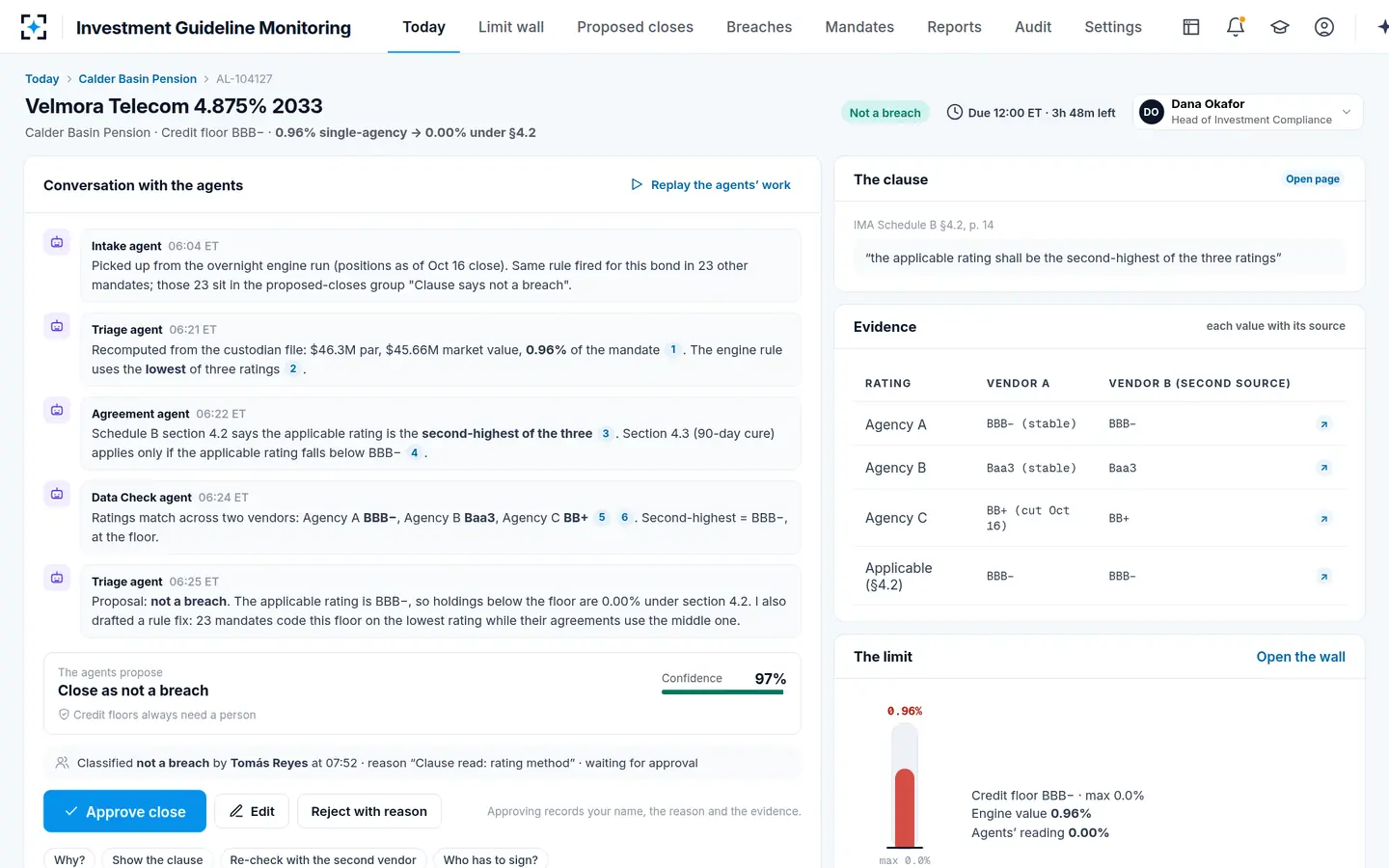
Compliance analyst asset management job description: the guideline seat
Read as a job description, the guideline seat combines four kinds of work. It is investigative: confirm or dismiss alerts against the governing document and the data. It is classificatory: label breaches by cause on written criteria and justify any reclassification. It is administrative: keep the register, chase the cure and the notice, reconcile with the valuer's and depositary's alerts. And it is analytical: find the rules and data feeds that cause repeat alerts and the funds that cause most breaches.
The last kind is the one most teams never reach. The AMF found that only one of the five managers analysed trends in its breaches, and called that a significant shortcoming at the other four, because such analysis can reveal structural anomalies in the management approach, the configuration of the limits or the control system itself. The broader investment compliance analyst role, including the pre-trade questions portfolio managers bring, is described in the guide to the investment compliance analyst; this seat is the post-trade half.
The portfolio manager's seat: one sale, tested against every rule
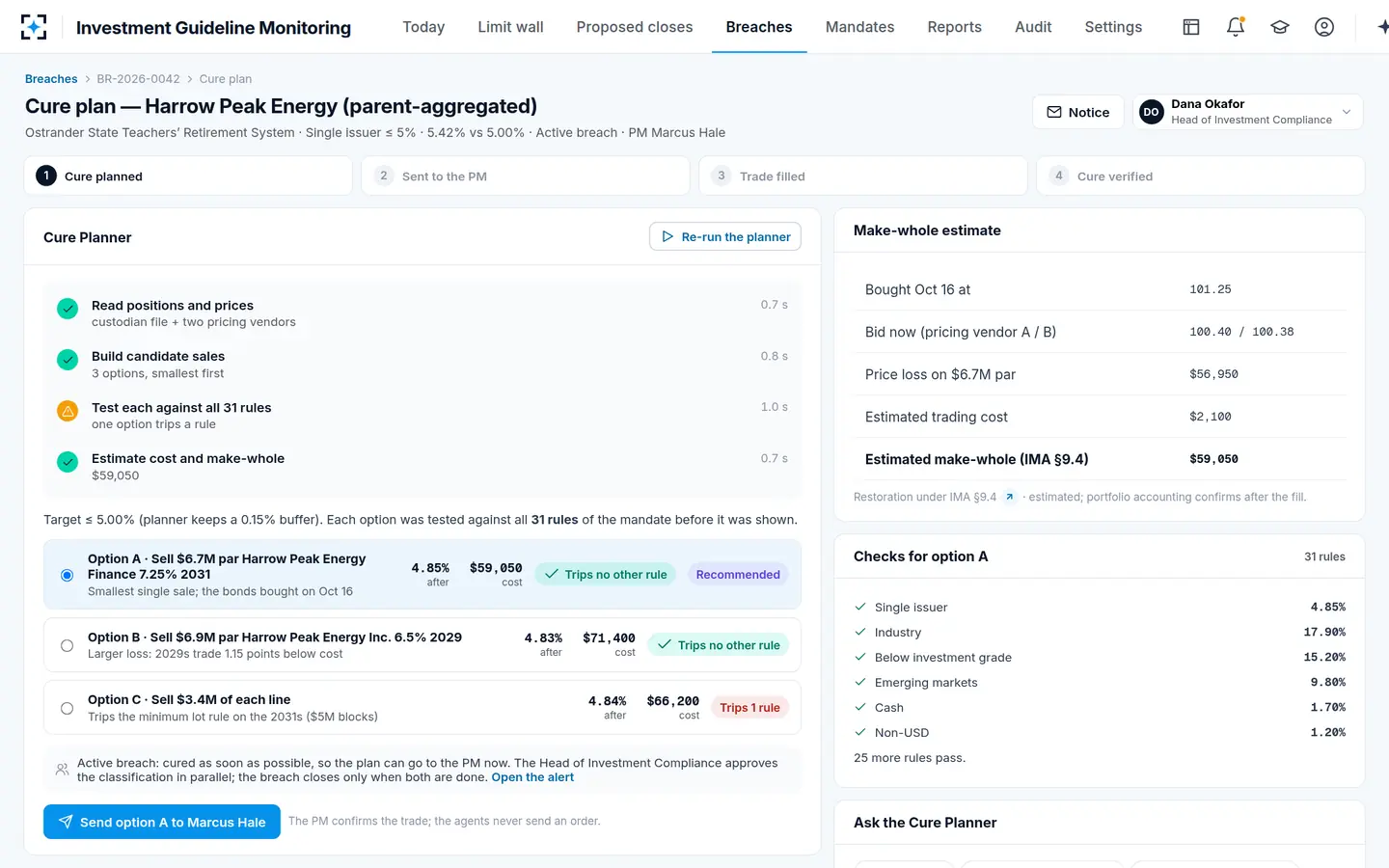
Investment compliance officer job description: what changes at the top
The compliance officer's seat changes least in the decisions and most in the evidence. Under Luxembourg's Circular CSSF 24/856 the fund's directors must be informed of active breaches so they can do their job, and must monitor passive ones until they are corrected (points 55 and 65); in the US, a fund's chief compliance officer reports material compliance matters to the board. At the French managers, approving compensation was the prerogative of senior management at all five. Those duties stay where they are.
What changes is how the officer reaches them. Instead of a breach log rebuilt each month, the officer reads dispositions by noon, breaches cured inside their period and the noisy rules with fixes proposed, and a board report the agents draft from the register and the audit trail for the officer to edit and own. The officer also approves every change to the agents themselves, which is a new duty: an agent version is a control, and changing it is a control change.
Questions people ask
Who should a guideline monitoring analyst report to?
To someone independent of portfolio management. At all five French managers the AMF inspected, the function that investigates breaches reported directly to a member of senior management, and it had the final word in any disagreement with the portfolio managers about whether a breach was proven.
Can a portfolio manager close a compliance alert?
Not on their own portfolios. The portfolio manager explains the trade and confirms the cure, but the decision that an alert is false or a breach is passive belongs to compliance; in Investment Guideline Monitoring a portfolio manager cannot classify or close alerts on portfolios they manage.
What systems does a guideline monitoring analyst use?
A monitoring module in the order or portfolio management system, the custodian and accounting files, pricing, rating and classification feeds, and the governing documents. At all five managers the AMF inspected, breaches were also tracked in spreadsheets, and depositary alerts arrived as emails in no standard format.
What training does a guideline monitoring analyst need?
Training in the limits, the system and the alert types. Only one of the five managers the AMF inspected had a formal programme: it trained fund managers on simulating an order's impact on their limits, and gave new risk managers core training on configuring limits and investigating each type of alert.
How many people monitor investment guidelines at an asset manager?
No regulator publishes an industry figure. At the five French managers the AMF inspected, the function ranged from a head with five full-time equivalents to a single senior executive doing it part-time, and the AMF judged the investigation work feasible with those resources at the panel's volumes.