Post-trade compliance software tests portfolios after trades are booked and raises an alert wherever a fund or mandate may be outside a limit. Most firms already own that part: a compliance module in the order or portfolio management system, or a standalone rules engine, runs every night. What the software has not done is the work after the alert, which France's AMF found still manual at every manager it inspected: confirming the alert is real, checking its inputs, reading the clause, classifying the breach, planning the cure and writing the notice. The useful way to evaluate the next layer of post-trade compliance software is to split that work by who must sign for it. Botminds' Investment Guideline Monitoring puts agents on the reading, recomputing each alert from the custodian position and the clause and checking every input against a second source, and leaves every decision with a named person.
The figures and screens below are the solution's sample data on a fictional manager, Quillfield Capital, and its fictional clients; the regulators' positions are quoted from their own publications.
One sample morning, divided: what the agents proposed, what went to people
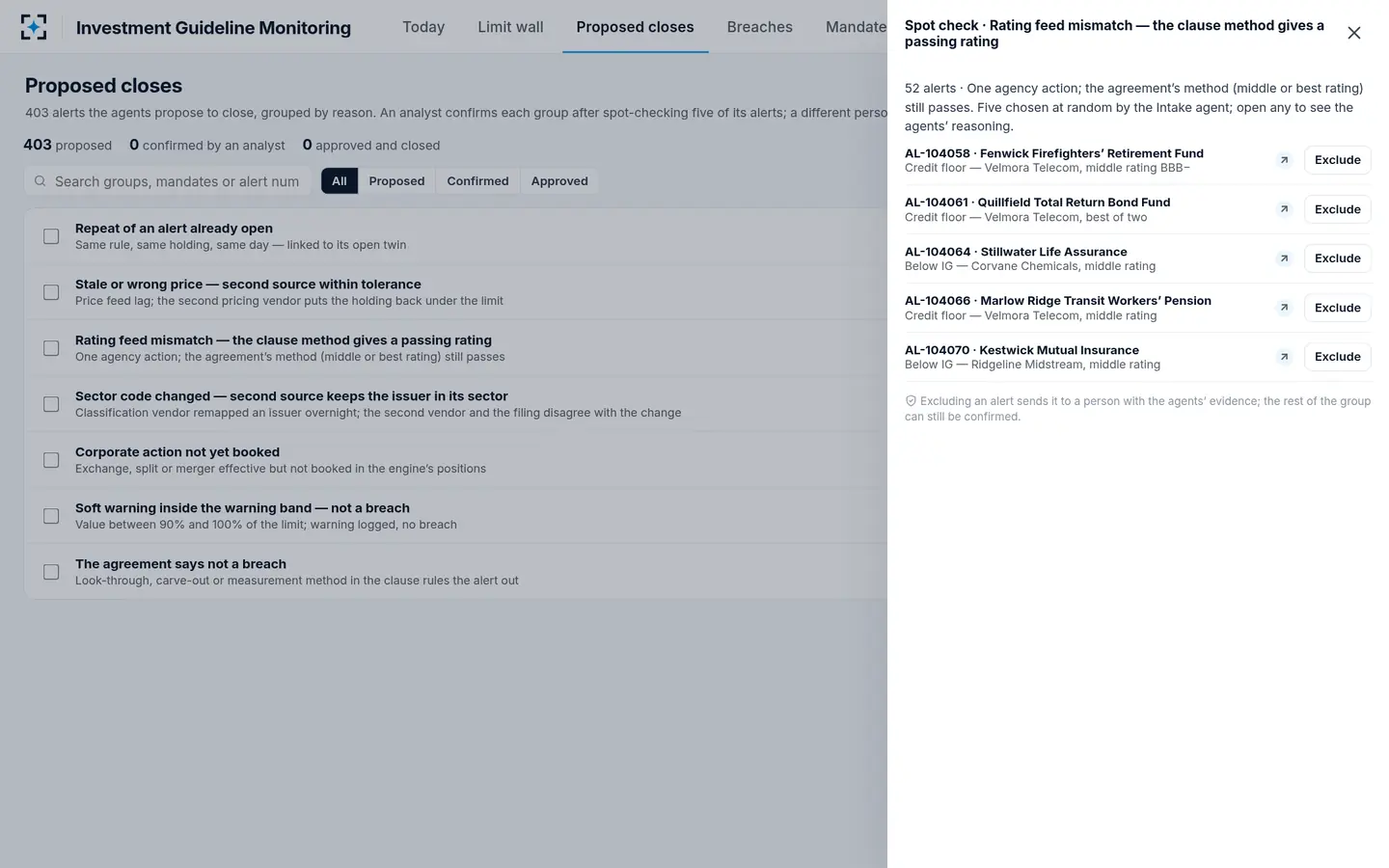
403 alerts the agents proposed to close, by reason
- Repeats, 97 · 24.1%
- Prices, 38 · 9.4%
- Ratings, 52 · 12.9%
- Sectors, 29 · 7.2%
- Corporate actions, 22 · 5.5%
- Soft warnings, 118 · 29.3%
- Agreement rules out, 47 · 11.6%
9 alerts that went straight to a person
- Not a breach, to approve, 2 · 22.2%
- Real breach, 1 · 11.1%
- Passive drift, 2 · 22.2%
- Agents disagree, 2 · 22.2%
- Data timing, 1 · 11.1%
- Override review, 1 · 11.2%
Post-trade compliance software: split the morning by who signs
Every task in the post-trade morning ends either in a finding or in a decision. A finding can be checked: the custodian holds $46.3 million par, two rating vendors agree on three ratings, section 4.2 of the agreement uses the second-highest. A decision cannot be checked in the same way, because it commits the firm: this alert is not a breach, this breach is active, this sale is the cure, this letter goes to the client today. Agents can establish findings and cite them; people make decisions and sign them.
The split matters because the AMF found that the findings are most of the work. Its inspectors put the manual investigation down to the sheer variety of limits monitored and of ways each can be breached (AMF, February 2025), and at the five managers they inspected the manual steps were the ones least well evidenced. A tool that moves the checking to agents and records every decision against its evidence addresses both findings at once.
The morning's tasks, and who takes each
| Task | Agents | People |
|---|---|---|
| Pull the overnight alerts and pre-trade overrides; link repeats | Do it; never drop or close an alert | Spot-check the grouping |
| Recompute the alert from the custodian position and the clause | Do it, with citations | Read the recomputation |
| Check price, rating, sector, corporate action against a second source | Do it; escalate when sources disagree | Decide which source stands when they disagree |
| Find and read the governing clause, in its own language | Do it, page-cited, with an English reading | Decide the reading when it is contested |
| Close a false alert | Propose, at 90% confidence or more | Analyst confirms; a different person approves |
| Confirm a breach and classify it active or passive | Assemble the evidence | Analyst classifies; Head of Investment Compliance approves |
| Choose the cure | Test options against every rule of the mandate | Portfolio manager confirms the trade |
| Notify the client, board or depositary | Draft from the breach, every sentence cited | Head approves; Client Service sends |
| Change a coded rule or a threshold | Draft the fix with the clauses as evidence | Rule-coding team and compliance officer decide |
Which checks agents can take
Agents can take the checks whose answer exists somewhere and can be cited: a price, a rating, a sector code, a corporate action, a guarantor link, a clause. These are the checks the AMF's managers ran by hand to separate false alerts from breaches, and they are the reason most alerts close. The managers' own lists of false positives include differences between the manager's reference data and the valuer's for fund classification or the rating of interest rate instruments, a single overdrawn cash account when the fund's total cash is in credit, and a bond bought ahead of a maturity that interim inventories count twice.
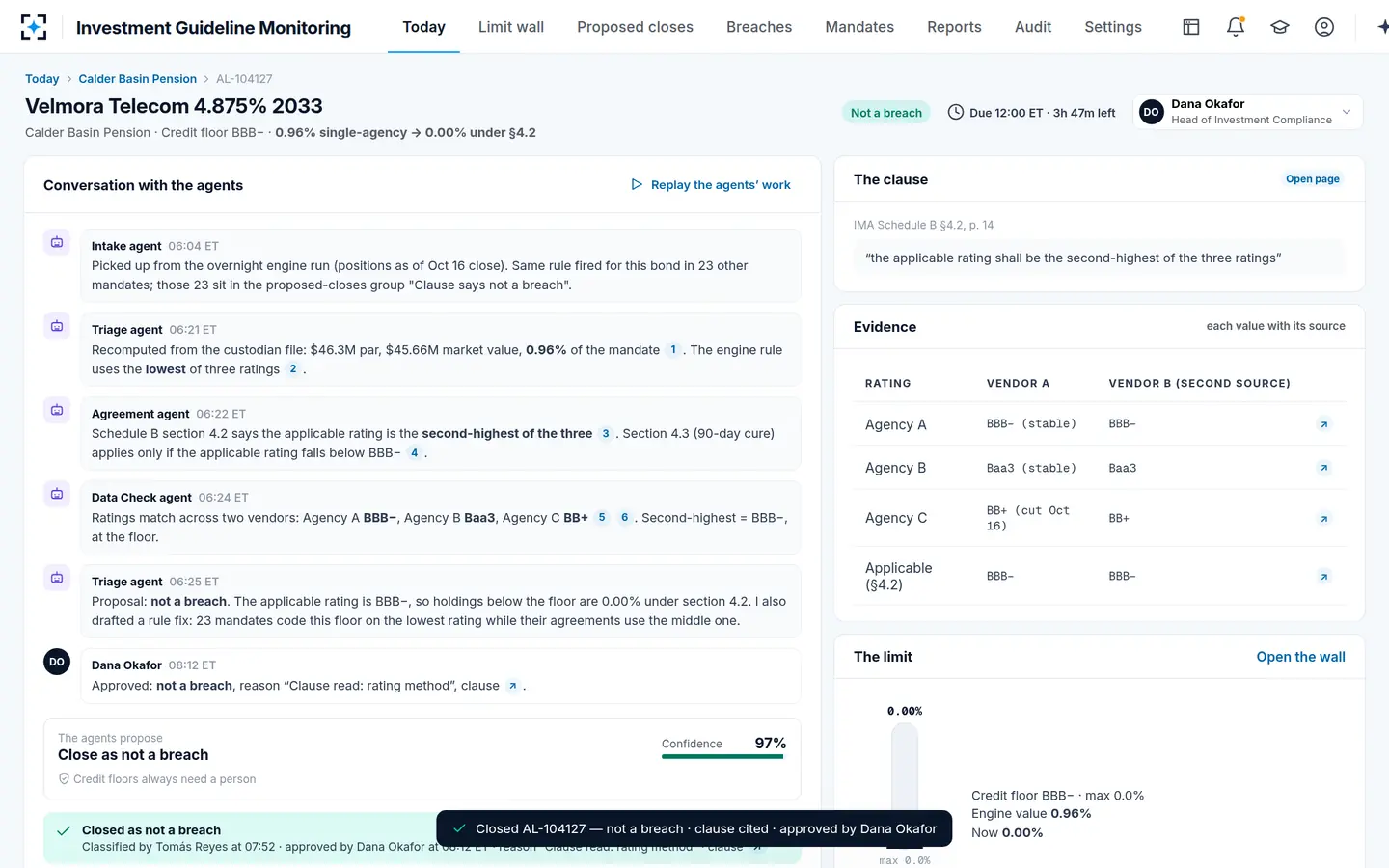
The agreement look-up is the check that saves most re-work. An engine codes a limit once, and when the code and the agreement differ, the alert fires every day. In the sample data a credit floor coded on the lowest of three ratings fires on a single-agency downgrade in a mandate whose agreement uses the second-highest rating; the Agreement agent quotes the clause, the Data Check agent confirms the three ratings from a second vendor, and the alert is proposed as not a breach, with the same pattern found in 23 mandates.
Proposed closes arrive in reason groups, and an analyst opens five before confirming
Which decisions stay human
Every decision that commits the firm or the client stays with a person: that a breach occurred, whether it was the manager's doing, how to cure it, what the client is told, and whether a coded rule changes. These are also the decisions regulators attach to named functions. At the managers the AMF inspected, risk control had the final word on whether a breach was proven, senior management approved every compensation payment, and general management validated the quarterly breach report before it went to the AMF.
Two design rules keep the line from blurring. An agent never closes an alert; it proposes, and below a confidence threshold, 90% in the sample settings, it does not even propose. And when two agents read the same alert differently, such as the custodian's cash figure against the manager's trade-date accounting, no close is proposed at all: the alert goes to a person with both readings side by side. The same split, applied before the trade, is set out in the guide to a pre-trade compliance solution.
Can AI triage compliance alerts?
Yes, if triage means preparing the decision rather than making it, and if the firm can show what the tool did on each alert. Regulators have said their rules do not change because the work is done by software. The SEC's Division of Examinations, in its fiscal 2027 priorities, notes firms applying what it calls "super intelligence (SI)" to compliance monitoring, and says it wants to see how such tools shape results while it tests the same duties as before (SEC, October 23, 2026). FINRA has said its rules are technology-neutral and apply when firms use generative AI as they would to any other tool (Regulatory Notice 24-09), and ESMA expects investment firms using AI to keep meeting their MiFID II obligations (ESMA, 30 May 2024).
An agent that proposes a close is a control. Its version, its threshold and its error rate belong in the compliance programme like any coded rule.
In practice that means three things a buyer should see. Every agent statement links to its source: the clause page, the custodian file or the vendor record. Every proposal carries the agent's confidence and version. And every change to an agent is approved like a change to a rule; in the sample data, the October board report records that the Triage agent's new version was approved on 15 October after scoring 98.1% on a set of past alerts with known answers.
How does post-trade compliance software reduce false alerts?
By fixing them at three levels: the alert, the input and the rule. At the alert level, repeats are linked to the open alert instead of re-raised, and values inside a warning band are logged as soft warnings rather than investigated. At the input level, every price, rating and sector code is checked against a second source before anyone reads the alert. At the rule level, the alerts that keep firing for a reason the agreement rules out are traced to the coded rule and a fix is drafted.
The rule level is the one that makes tomorrow quieter. In the sample October, the top three coded patterns by false alerts were: a credit floor coded on the lowest rating, 61 false alerts across 23 mandates; sector remaps from one classification vendor, 41 across 77 mandates; and cash measured before FX settlement, 22 across 31 mandates. Each has a drafted fix, but none is applied by the agents: changing a coded rule belongs to the rule-coding team and the compliance officer, and the evidence goes to the rule writers and testers.
One click, with the reason code and the clause on file
Post-trade compliance software list: four kinds of product
Lists of vendors change faster than any guide, and vendors do not publish comparable prices, so it is more useful to know the four kinds of product a list will mix. The first is the compliance module of an order or portfolio management system, which runs the pre-trade check and usually the overnight post-trade test; at four of the five managers the AMF inspected it was bought from a vendor, and at the fifth it was built in-house. The second is a standalone rules engine run beside the order system. The third is a service: fund valuers and depositaries test limits on the accounting and fund inventories, and at one manager some valuers charged extra to cover the fund's own statutory limits on top of the regulatory ones.
The fourth kind works the queue the other three produce. It does not find breaches; it reads the alerts, checks them, and prepares the decisions. Investment Guideline Monitoring is that kind of product, and it assumes one of the first three is already in place. The AMF's figures show why the first three alone leave the work undone: publishers' modules covered natively between 20% and 64% of the limits the managers needed, by the managers' own estimates, and every alert, from any source, was still investigated by hand.
Post-trade compliance software solutions: what to ask in a demo
Questions that separate post-trade compliance software solutions
- Show me one alert recomputed from the custodian file
Not the engine's number: the position, the clause, the measure, and how they produce the result.
- Show me where every input came from
A second source for prices, ratings and sector codes, and what happens when the sources disagree.
- Show me what the agent cannot do
Close, trade, send, change a rule. Which permissions it lacks, not which it promises not to use.
- Show me a disagreement
Two readings of one alert, side by side, with no proposal made.
- Show me the threshold and the version
The confidence below which a person decides, and who approved the current agent.
- Run it on last month's alerts
With known answers, so its accuracy is measured on your rules and your data, not a demo set.
- Show me the export an examiner gets
Every alert, disposition, approver and evidence file for a period, sealed.
The sixth question deserves the most time. A demonstration on a vendor's sample shows the screens; a run on a month of your own alerts, with your own analysts' decisions as the answer key, shows whether the agents agree with them, and where. The method is set out in the guide to testing post-trade compliance checks.
Where Investment Guideline Monitoring fits, and where it does not
Investment Guideline Monitoring fits after your engine and before your decisions. It reads the engine's alert file, the order system's pre-trade overrides, the custodian and accounting positions, the pricing, rating and classification vendors, the security master and the governing documents, all through read-only access, and it writes back proposals, drafts and an audit trail. It is a fit where the overnight queue is large, the alerts are mostly false and the evidence for closing them is scattered.
It is not a rules engine and does not replace one; it does not check orders before they are placed; it does not write or change coded rules; and it does not send orders or letters. A manager with few mandates, simple limits and a short queue may find its engine and one careful analyst enough. How the solution connects to the systems already in place, and what go-live involves, is covered in the guide to an investment compliance monitoring tool beside your engine.
Questions people ask
What is post-trade compliance software?
Software that tests portfolios against their investment limits after trades are booked, usually overnight, and raises an alert where a limit may be breached. It is often a module of the order or portfolio management system; newer tools add agents that investigate the alerts and prepare the decisions a person then makes.
What is a post-trade compliance monitoring system?
The combination of the post-trade test, the alert queue and the process that works it: investigation, classification, cure and notice. At the French managers the AMF inspected, the system included the manager's own daily test, the fund valuer's test at each NAV and the depositary's test, reconciled against each other.
Does post-trade compliance software replace compliance analysts?
No. It moves analysts from re-performing tests to reviewing evidence and deciding. Confirming and classifying breaches, approving closes and choosing cures remain human decisions, and regulators attach them to named functions.
How accurate are AI agents at triaging compliance alerts?
No regulator or independent study publishes an accuracy figure for agents on investment compliance alerts. Measure it yourself: run the agents on a month of past alerts whose outcomes your analysts already decided, and count agreements, disagreements and the cases the agents rightly escalated.
Can post-trade compliance software read client agreements?
Agents can find the governing clause in an investment management agreement, prospectus or side letter and quote it with its page. In the sample data the Agreement agent reads a Japanese client's guidelines and shows each sentence beside its English reading; the decision about what the clause means stays with a person.