An investment restrictions section in a prospectus or statement of additional information is a numbered list of things a fund may not do, such as borrow beyond a set share of its assets, put 25% or more in one industry, or hold more than 5% in one issuer, each followed by its exceptions. The example below is a typical one, annotated clause by clause. Read as a rule analyst must read it, every sentence has to yield five things before it can be coded: what is measured, against which figure, across which holdings, with which exceptions, and at what moment. Leave any of them implicit and the rules engine fills the gap with a default nobody chose. Botminds' Compliance Rule Coding was built for this reading: its agents split the restrictions into clauses, draft each one as a rule with every element cited to its words, read it again independently, and test it on the fund's holdings before an analyst decides.
The fund, its restrictions and its numbers on this page are invented for illustration, written to the subjects Form N-1A requires; the law and the regulators' findings are linked where they appear.
An example restrictions section, as an analyst receives it
Investment Restrictions
The Fund has adopted the following fundamental restrictions, which may not be changed without the approval of a majority of its outstanding voting securities, and the non-fundamental restrictions that follow, which the Board may change. The Fund may not:
Fundamentalborrow money, except as permitted under the 1940 Act, and then not in excess of 33⅓% of its total assets (including the amount borrowed), less liabilities other than borrowings;
Fundamentalissue senior securities, except as permitted under the 1940 Act;
Fundamentalpurchase the securities of any issuer if, as a result, 25% or more of its total assets would be invested in issuers in any one industry, except securities issued or guaranteed by the U.S. government, its agencies or instrumentalities, and tax-exempt municipal securities;
Fundamentalpurchase or sell real estate, except that the Fund may invest in securities secured by real estate or issued by companies that invest in real estate, including REITs;
Fundamentalpurchase or sell physical commodities, except that the Fund may enter into futures contracts and options on futures;
Fundamentalmake loans, except by purchasing debt securities, entering into repurchase agreements, and lending portfolio securities up to one-third of its total assets.
Non-fundamentalinvest more than 10% of its net assets in securities rated below B− by S&P or the equivalent, or unrated securities the Adviser judges of comparable quality;
Non-fundamentalinvest more than 5% of its total assets in the securities of any one issuer, other than U.S. government securities, measured at the time of purchase.
Except for the limitation on borrowing, if a percentage restriction is adhered to at the time of an investment, a later increase or decrease in percentage resulting from a change in values or assets will not constitute a violation of that restriction.
What are investment restrictions? The meaning in a fund's documents
Investment restrictions are the limits a fund's own documents put on what it may buy, hold or do, as distinct from its investment objective and strategies, which say what it aims to do. In a US mutual fund they come in three kinds: fundamental restrictions that only a shareholder vote can change, non-fundamental restrictions the board can change, and policies the law requires, such as the 80% investment policy of a fund whose name suggests a focus. In a separate account the same function is served by the investment guidelines schedule of the investment management agreement, and in a UCITS by the limits in the prospectus on top of the regulatory ones.
They matter because they are promises with an owner. A fund that breaks a fundamental restriction breaches Section 13(a) of the Investment Company Act, which forbids certain deviations from recited policy without a shareholder vote (15 U.S.C. 80a-13(a)); one that breaks a non-fundamental restriction breaks its disclosure. Regulators read them the same way the coder must: France's market regulator, describing how five managers configure investment limits in their order systems, put the hierarchy in one parenthesis.
Each project to create or modify ratios is set out in a dedicated Excel file, which "does not constitute the golden source of investment ratios (which remains the prospectus)".
AMF, summary of SPOT inspections on fund investment ratios, February 2025, section 4.3.2
Where the SEC puts prospectus investment restrictions: Item 9 and Item 16
Form N-1A splits a fund's restrictions between two documents. The prospectus, under Item 9(b), describes the principal investment strategies and must "Disclose any policy to concentrate in securities of issuers in a particular industry or group of industries" (Form N-1A, Item 9(b)(1), Instruction 4). The statement of additional information, under Item 16(c), carries the full list of policies on senior securities, borrowing, underwriting, concentration, real estate and commodities, and loans, and must "State whether shareholder approval is necessary to change any policy" (Item 16(c)(2)).
A coder therefore needs both documents and a third: any supplement filed since. The SAI holds the legal text; the prospectus holds the strategies that the SEC's examiners compare with the portfolio; the supplement changes either. In its November 2024 review of fund deficiencies, the SEC's Division of Examinations listed funds that "disclosed investment processes or analyses that were not consistent with advisers' practices, or repeatedly exceeded stated asset investment thresholds" (SEC risk alert, Registered Investment Companies, November 4, 2024). The second half of that sentence is a coding failure as often as a trading one.
Five things every restriction sentence must give the rule
A rule in a compliance engine is a comparison: a numerator over a denominator, for a set of holdings, against a limit, at a time. A restriction sentence states the limit clearly and usually leaves the rest to the reader. The five elements below are the questions to ask of every sentence, and the order in which they usually go wrong.
The five elements of a coded restriction, and where the text hides each
| Element | The question | Where the answer usually is |
|---|---|---|
| Measure (numerator) | What is added up: market value, notional, exposure, number of issuers? | The verb and object of the sentence, and the fund’s glossary or derivatives policy |
| Denominator | Total assets, net assets, or something defined, and including what? | Often in the same sentence; sometimes only in the definitions; sometimes nowhere, which is itself a finding |
| Scope | Which holdings count: issuer, group, guarantor, look-through? | Defined terms, the "issuer" convention, notes after the list |
| Exceptions | What is carved out: government securities, municipals, REITs, futures? | After "except" or "other than", and in a separate paragraph of permitted investments |
| Timing | Tested at purchase, continuously, at month-end, at launch? | The note after the list; the statute for borrowing and names policies |
Clause by clause: the example section coded
Applied to the eight clauses above, the five questions produce a short list of decisions. Half of them are mechanical. The other half are readings, and a reading deserves a second reader and a named person who chose it.
The Corrie Point restrictions, decoded into what the engine needs
| Clause | Measure and denominator | Scope and exceptions | Timing, and the reading to settle |
|---|---|---|---|
| 1. Borrowing | All borrowings over total assets including the borrowed amount, less non-borrowing liabilities; at most 33⅓% | All bank borrowing and anything the fund treats as borrowing | Continuous: the note excludes borrowing, and Section 18(f)(1) gives three days to restore 300% asset coverage |
| 2. Senior securities | No numeric limit in the clause; the 1940 Act and Rule 18f-4 supply it | Reverse repos, short sales, derivatives, as the fund’s derivatives program treats them | Coded as a pointer to the derivatives rules and a manual control |
| 3. Concentration | Market value of issuers in one industry over total assets; breach at 25.00%, because the text says "25% or more" | Exceptions: US government and agency securities, tax-exempt municipals; the industry scheme is not named and must be chosen | At purchase, per the note. Reading to settle: which industry classification, at which level |
| 4. Real estate | Direct real estate: prohibited | Allowed: real-estate-secured securities, real estate companies, REITs | At purchase; a security-type rule, not a percentage |
| 5. Commodities | Physical commodities: prohibited | Allowed: futures and options on futures | At purchase. Reading to settle: is a commodity-linked note or ETC a physical commodity? |
| 6. Loans | Securities on loan over total assets; at most one third | Purchases of debt and repos are not loans by this clause | At each new loan |
| 7. Credit floor | Securities below B− or unrated equivalents over net assets; at most 10% | "Or the equivalent" names no other agency; unrated paper depends on an Adviser judgment | At purchase. Reading to settle: split ratings, and who records the unrated judgment |
| 8. Single issuer | One issuer’s securities over total assets; at most 5% | US government securities excluded; "issuer" undefined: guarantor and group not addressed | At purchase, by its own words. Reading to settle: issuer or group |
Four of the eight clauses carry a reading the text does not settle, and none of the four is exotic. Clause 5 is the kind of gap that produced most of the compensation the AMF saw in its inspections: of the overruns that led to investors being compensated at one manager, nine in ten came from "the absence or incorrect configuration of pre-trade controls", for example "the prohibition on investing in ETCs" (AMF SPOT summary, section 4.3.5). Clause 8 is the issuer-or-group question, which decides whether a bond guaranteed by a parent counts against the parent.
Fundamental investment restrictions examples, and the carve-outs that matter
Fundamental restrictions follow the statute's list closely, which makes them look boilerplate across fund families. The exceptions are where they differ, and where coded rules most often diverge from the text. The REIT carve-out in clause 4 means a real estate rule that blocks the asset class blocks good trades; the futures carve-out in clause 5 means a commodity rule that ignores derivatives is too loose, and one that bans them is too tight.
Exceptions also move the denominator. Clause 3 excludes government securities from the industries but not from total assets, so a fund that shifts into Treasuries gains room in every industry without selling anything. A rule coded with the exclusion applied to both numerator and denominator will show the wrong headroom on every day the fund holds government paper, and will look right on a test portfolio that holds none.
How to read "at the time of purchase" in a restriction
"At the time of purchase" means the limit is tested when the fund acquires a holding, and a later breach caused only by market moves or by shareholders redeeming is not a violation of that restriction. The note at the end of the example says so, in the form many funds use. The statute has the same idea for diversification: a diversified fund does not lose its status because of a later discrepancy, so long as no part of the discrepancy was caused by an acquisition (15 U.S.C. 80a-5(c)).
For coding, the phrase changes two things. The pre-trade rule tests the post-trade position of the order, against the limit. The post-trade rule still runs every day, but a passive excess is recorded as an excess, not a breach, and the next purchase of the same issuer is blocked until it clears. Three exceptions break the pattern. Borrowing is continuous, as the note says and Section 18(f) requires. The Names Rule applies "at the time a fund invests its assets" but adds a quarterly basket review and a 90-day return clock (17 CFR 270.35d-1(b)(1)). And a UCITS limit applies at all times, with passive excesses remedied as a priority rather than excused.
Are SAI restrictions binding on the adviser?
Yes, in practice, though by more than one route. The SAI is part of the fund's registration statement, and Section 13(a) binds the fund to its fundamental recitals; the adviser that manages the fund's money typically agrees in its advisory contract to manage within the fund's stated policies, and owes the fund a fiduciary duty. The SEC has charged advisers directly for ignoring a client's investment policy. In its 2019 order against Kornitzer Capital Management, adviser to four collective investment trusts, it found that the adviser's compliance manual, as of May 2016, had no procedure at all for keeping fund investments within client objectives and restrictions, and held the firm in violation of the Advisers Act's compliance rule (SEC order, Advisers Act Release 5416, December 10, 2019).
The same logic reaches the coder. An adviser's written compliance procedures are what make a fund's restrictions operational, and a restriction that exists in the SAI but not in the engine is a policy without a procedure. That is why the coded rule should carry its citation: when an examiner asks how clause 3 is enforced, the answer is a rule that names clause 3.
Look-through clauses: a rule, not a default
Whether a fund looks through a holding to what sits underneath is decided by the documents and the law, not by the engine's default. Luxembourg's UCITS law says that when a UCITS buys units of other funds, the assets inside those funds need not be added to its own for the Article 43 limits (Law of 17 December 2010, Article 46(2)), so a UCITS issuer limit does not look through a fund holding unless the prospectus says it does. An investment management agreement may say the opposite for depositary receipts, counting them as the underlying shares.
The coder's task is to find the sentence that decides it and cite it. Where no sentence exists, the honest output is a question to the client or the fund's counsel, not a guess.
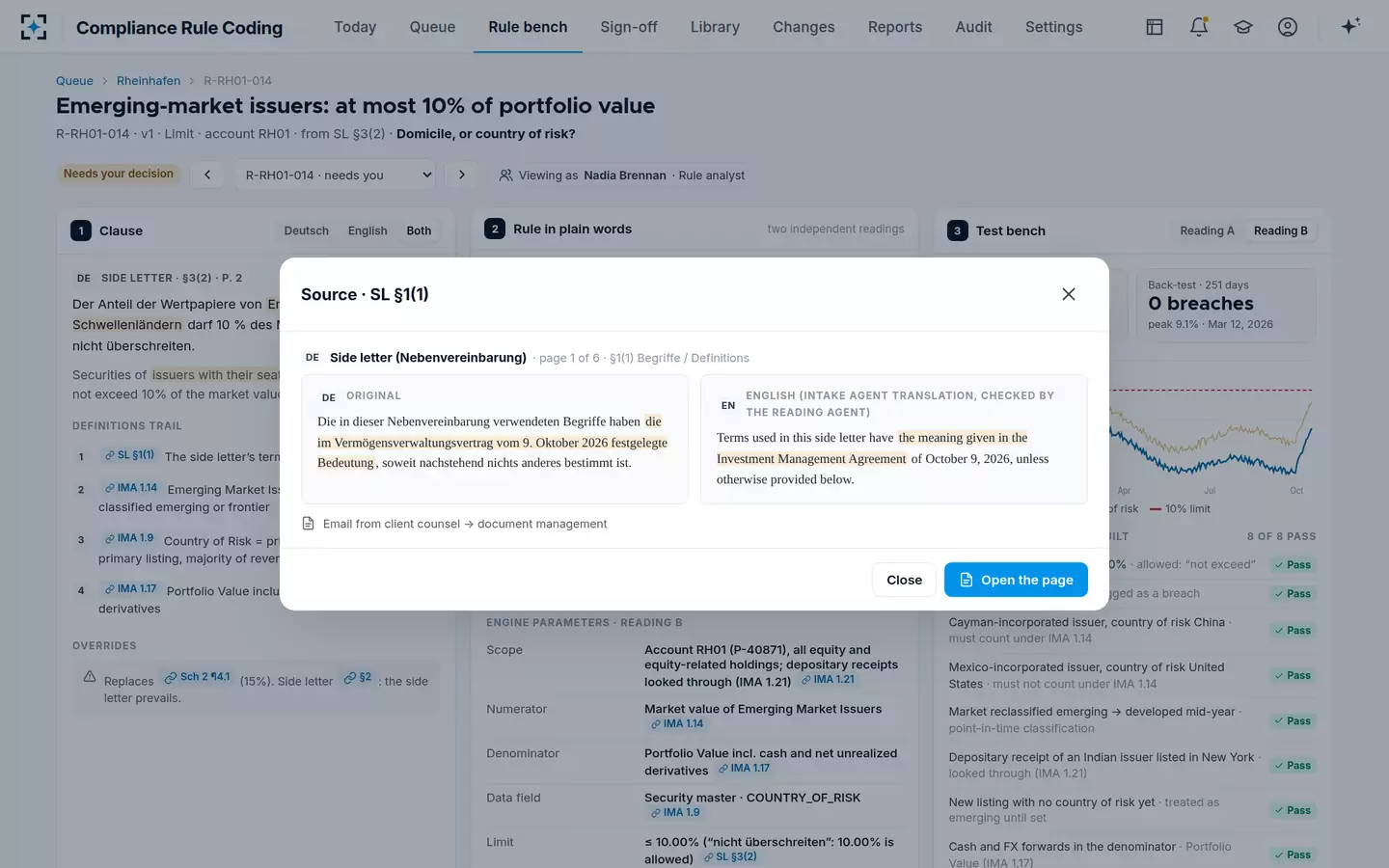
The clause in its original language, opened from the definitions trail
From the clause to the coded rule, with Compliance Rule Coding
The solution reads restrictions the way this page does, at volume. Its Intake agent collects the documents and splits them into clauses, keeping the original language beside an English translation; on the sample mandate it found 47 clauses with a restriction across an 80-page package and three places where a German side letter overrides the guidelines schedule. The Coding agent drafts each restriction as plain English and engine parameters, citing every element to its words. The Reading agent reads every clause again on a different model without seeing the draft, and where the two readings differ, the rule goes to the analyst with both.
The analyst keeps the readings that matter: the industry scheme behind clause 3, the treatment of an ETC under clause 5, the issuer convention under clause 8. A senior compliance officer who did not code or decide the rule checks it against the clause, and nothing loads without that signature and a release.
Forty-seven restriction clauses found, and every rule cited

Before you code a restrictions section
- Collect the SAI, the prospectus and every supplement
The SAI holds the list; the prospectus the strategies; supplements change both.
- Mark each clause fundamental, non-fundamental or required by law
The kind decides who can change the rule later.
- Ask the five questions of every sentence
Measure, denominator, scope, exceptions, timing; write the answer and the words it came from.
- Code the boundary from the text
"25% or more" breaches at 25.00%; "more than 5%" does not breach at 5.00%.
- Apply exceptions to the numerator only, unless the text says otherwise
Excluded holdings usually stay in total assets.
- Read the closing notes
At-time-of-purchase language and its exceptions, usually borrowing, change what a breach is.
- List the readings the text does not settle
Industry scheme, issuer or group, split ratings, unrated paper: each needs a named decision.
- Test on holdings that exercise the exceptions
A test portfolio with no government bonds or REITs will pass a wrong rule.
Which of these restrictions a shareholder vote protects is the subject of 1940 Act fundamental policies; separate accounts add side letters, whose obligations are best kept in a side letter obligations register. To see clauses split, drafted, read twice and tested on sample mandates, start from Compliance Rule Coding.
Questions people ask
What is the difference between investment restrictions and investment strategies?
Strategies describe how a fund intends to pursue its objective; restrictions are the limits it may not cross while doing so. Form N-1A puts principal strategies in the prospectus under Item 9 and the full list of fundamental and other policies in the SAI under Item 16, and a coder needs both because a strategy can imply a limit, such as an 80% names policy.
Are investment restrictions in the prospectus or the SAI?
Mostly the SAI. The prospectus must disclose any policy to concentrate in an industry and the principal strategies; the SAI, Part B of the registration statement, carries the full list of restrictions and says which need shareholder approval to change.
What does "except as permitted under the 1940 Act" mean in a restriction?
It imports the statute's own limit instead of writing a number. For borrowing, that means bank borrowing with asset coverage of at least 300% under Section 18(f)(1); for senior securities, the statute and the SEC's derivatives rule. The coded rule has to carry the statutory limit and cite both the clause and the section it points to.
Does a 5% issuer limit include bonds guaranteed by the issuer?
Only if the fund's documents or its written convention say so; a restriction like clause 8 that does not define "issuer" leaves it open. Money market fund rules show the range of answers: Rule 2a-7 treats a guarantor as a separate 10% limit and aggregates issuers under more than 50% common control.
How often should a restrictions section be re-read against the coded rules?
At every supplement or amendment, and in full at least once a year as part of the annual compliance review. The AMF noted managers that review the consistency of all their configured ratios every two years, every six months, or every time the prospectus is updated; it listed that review as good practice, and not reviewing past configuration changes as a poor one.