Issuer concentration limits cap how much of a portfolio may sit in the securities of a single issuer, typically 5% or 10% of assets in a fund's documents, an investment management agreement or a regulation. The number is the easy part. The hard part is the word: an issuer can be the legal entity named on the security, the company that guarantees it, or the whole group under common control, and each reading gives a different percentage for the same holdings. The law itself uses all three, which is why a limit that does not say which one it means has to be read by a person and the choice written down. Botminds' Compliance Rule Coding exists for exactly that kind of clause: two agents read it independently, a third back-tests both readings on the portfolio's holdings, and the rule analyst decides which one the engine runs.
The SEC case and the rules on this page are linked where they appear. Worked examples use an invented portfolio; product screens show the solution's fictional sample firm.
One portfolio, one 5% limit, three answers
Reading the issuer as the legal entity: 3.8% for Vellmar AG
Reading the issuer as the group: Counted in the Vellmar group
Reading the issuer as the legal entity: 2.1% for Vellmar Finance, a separate issuer
Reading the issuer as the group: Counted in the group (and against Vellmar AG as guarantor)
Reading the issuer as the legal entity: 1.4% for Ostrava, a separate issuer
Reading the issuer as the group: Counted in the group: control above 50%
Reading the issuer as the legal entity: 3.8%: passes the 5% limit
Reading the issuer as the group: 7.3%: over the limit by 2.3 points
Reading the issuer as the legal entity: Vellmar AG plus the notes it guarantees: 5.9%, a breach
Reading the issuer as the group: The same 5.9% sits inside the group’s 7.3%
What are issuer concentration limits? The meaning behind the number
An issuer concentration limit is a cap on the share of a portfolio invested in securities of one issuer, set so that the failure of a single company cannot do outsized damage. It appears in three places: in law, as with the UCITS 10% limit or the 5% inside a US diversified fund's 75% basket; in a fund's own restrictions, often stricter than the law; and in a client's investment guidelines, where it may be the only diversification rule the client has.
The Investment Company Act defines the word as widely as possible: "'Issuer' means every person who issues or proposes to issue any security, or has outstanding any security which it has issued" (15 U.S.C. 80a-2(a)(22)). That is a legal-entity definition. It says nothing about guarantees, parents or subsidiaries, and a limit that uses the word without more inherits that silence. Most portfolio documents say no more than "any one issuer".
The concentration limit formula, and the word inside it
The concentration limit formula is simple: the value of all holdings attributed to the issuer, divided by the portfolio figure the limit names, compared with the limit. Headroom is the limit times the denominator, less what is already held. For a 5% limit on a €400 million portfolio, headroom against an issuer holding €15.2 million is €20.0 million less €15.2 million, or €4.8 million.
Every term in that formula hides a choice, and the word "attributed" hides the largest. Which holdings belong to the issuer depends on the definition of issuer; whether a derivative counts depends on the measure the document uses; and whether the denominator includes cash and derivatives depends on its definitions. On the solution's sample mandate the investment management agreement defined Portfolio Value as including "cash and net unrealized derivatives", so the denominator of every limit in that agreement moved with the forward book.
Four legal answers to "who is the issuer?"
Regulators have answered the question differently for different purposes, and each answer is available to a firm drafting or reading a limit. The money market fund rule alone uses three of them at once, which makes it the clearest illustration of how much the word can carry.
Who the issuer is, in four rules
| Definition | Where it is used | What it adds together | Coding consequence |
|---|---|---|---|
| The legal entity that issued the security | Investment Company Act, Section 2(a)(22) | Only securities that entity issued | Needs the issuer identifier per security; misses guarantees and affiliates |
| The obligor ultimately responsible | Rule 2a-7: a conduit security "shall be deemed to be issued by the person (other than the municipal issuer) ultimately responsible for payments" | Securities issued through a conduit, attributed to the real payer | Needs the obligor field, not the issuing vehicle |
| The control group, above 50% | Rule 2a-7: issuers that control, are controlled by or are under common control with each other are "a single issuer" | Parent and subsidiaries with more than 50% of voting securities | Needs a parent hierarchy with ownership percentages |
| The consolidated accounting group | UCITS (Luxembourg Law of 2010, Article 43(5)): companies in the same group for consolidated accounts are one body | Every company consolidated with the parent | Needs the consolidation perimeter, which vendors may not hold |
How are affiliated issuers aggregated?
Affiliated issuers are aggregated only when the limit's definition says so, and then by the test the definition names. Rule 2a-7 gives the most precise version: a money market fund "must treat as a single issuer two or more issuers of securities owned by the money market fund if one issuer controls the other, is controlled by the other issuer, or is under common control with the other issuer", where control means "ownership of more than 50 percent of the issuer's voting securities" (17 CFR 270.2a-7(d)(3)(ii)(F)). A 49%-owned joint venture is outside the group; a 51%-owned subsidiary is inside it.
The UCITS rules use accounting consolidation instead, which can give a different perimeter for the same companies, and then add a twist: after saying a group counts as a single body, Luxembourg's law lets a UCITS "cumulatively invest up to a limit of 20% of its assets in transferable securities and money market instruments within the same group" (Law of 17 December 2010, Article 43(5)). How the 20% group allowance sits beside the 10% single-body cap is a reading each manager has to settle and record, and the UCITS 5/10/40 rule worked on one fund shows what it does to a 12.6% group position.
For a coder, aggregation is a data question as much as a legal one. The rule needs a parent hierarchy, the ownership percentage at each link, and a date for each, because groups change with every acquisition and disposal. A rule coded with the right definition and a stale hierarchy is still wrong.
Is a guarantor the issuer for a concentration limit?
Not by default. A guarantee creates a second obligor, and most limits that say "issuer" do not mention it. Where a rule does address guarantees, it usually treats them as a separate exposure rather than replacing the issuer. Rule 2a-7 does exactly that: alongside its 5% issuer limit, it caps at 10% of total assets the securities "issued by or subject to demand features or guarantees from the institution that issued the demand feature or guarantee" (17 CFR 270.2a-7(d)(3)(i)(A)(2)). The guarantor is tested in its own right; the issuer is not replaced.
The consequence in the Vellmar example is a breach that appears under one reading and not the other. Vellmar AG's own shares and the notes it guarantees come to 5.9%. Under a legal-entity reading of a 5% limit that is two issuers at 3.8% and 2.1%, both passing. Under a guarantor-aware reading it is one obligor over the limit. Neither reading is wrong in the abstract; one of them is what the document means, and someone has to decide which.
Single issuer concentration: what an unenforced 10% limit cost one adviser
The SEC's 2019 order against Kornitzer Capital Management is the clearest public record of a single issuer concentration limit that existed on paper and nowhere else. The adviser managed four collective investment trusts for retirement and personal trust assets. By the end of 2015, after years of buying and a strong price, the securities of one company, "Company A", made up 30% of two of the trusts and 79% and 89% of the other two. In May 2016 the trusts' board adopted investment policies "restricting investment in a single issuer of debt and equity securities to 10%" (SEC order, Advisers Act Release 5416, December 10, 2019).
Kornitzer: from the board's instruction to compliance, 2016 to 2018
- Plan asked for: reduce to 10% in 12 to 18 months (Feb–May 2016)3 mo
- Single-issuer limit adopted; no plan delivered; requests in April and July 2017May 2016–Aug 2018, 27 months
- New portfolio manager; plan; 10% reached (Aug–Dec 2018)5 mo
The order's account of what followed is a catalogue of a limit without a procedure. As of May 2016 the adviser's compliance manual "lacked any policies and procedures requiring that fund investments be consistent with client objectives and restrictions". During 2017 the concentrations rose rather than fell, partly through appreciation and sales of other assets. Asked in August 2017 to confirm compliance by February 2018, the adviser declined.
"KCM responded that it was impossible for it to guarantee a timeframe for compliance with the investment policies and failed to confirm that it was going to start reducing concentrations in the near term."
SEC order, Kornitzer Capital Management, Advisers Act Release 5416, paragraph 12
Company A's stock fell from $33.81 at the end of 2017 to $16.10 at the end of 2018, and the trusts lost millions. The adviser and its principal paid a $2.7 million civil penalty, jointly and severally, and disgorgement of $4,978,448, most of which was treated as satisfied by $4,132,132 the adviser had already paid into two of the trusts in December 2018. The violations found were Advisers Act Sections 206(2) and 206(4) and the compliance rule, Rule 206(4)-7: a fiduciary failure and a procedures failure, not a failure of arithmetic.
The limit itself held one useful lesson for coders. It covered "debt and equity securities" of a single issuer together, and two of the trusts were fixed income funds with 79% and 89% of their assets in Company A's equity and debt. A rule coded on equities alone, or on one share class, would have shown only part of the exposure. The issuer, in that policy, was everything the company had issued.
What is issuer concentration risk, and why limits reach past one security?
Issuer concentration risk is the loss a portfolio takes when one obligor fails or reprices, in every instrument at once. Equity, senior bonds, subordinated bonds and loans of the same company are different securities but largely one risk: a default reaches all of them. That is why sound limits are written per issuer rather than per security, and why the definition of issuer determines how much of the risk the limit actually captures.
The same logic explains why a fund's industry concentration policy and its issuer limit can both fire on one position. In March 2025 the SEC alleged that an adviser had held more than a quarter of Upright Growth Fund's assets in one company for years, a single holding large enough to break the fund's 25% industry concentration limit on its own; the case, a litigated complaint, alleges about $1.6 million of losses to the fund and its investors (SEC press release 2025-55, March 17, 2025).
Country of risk vs country of domicile: the same question for geography
Country limits have the issuer problem in another form: is a company "in" the country where it is incorporated or the one where its business is? A Cayman Islands holding company that earns all its revenue in China is domiciled in the Caymans and has China as its country of risk. A limit that says "issuers in emerging markets" catches it only under the second reading. The SEC's Names Rule leans toward economics: a fund whose name suggests a country must count investments "tied economically to the particular country or geographic region suggested by its name" (17 CFR 270.35d-1(a)(2)(i)).
On the solution's sample mandate this was the sharpest disagreement of the 41 rules. A German side letter capped "Emittenten mit Sitz in Schwellenländern" (issuers with their seat in emerging markets) at 10%; read literally, that is domicile. But the side letter's first clause gives its terms the meaning in the investment management agreement, which defines an Emerging Market Issuer by country of risk. Replayed over 251 business days, the literal reading would have shown three days over 10% in March 2026, peaking at 10.4%; the defined term peaked at 9.1%. Four holdings explained the gap, two of them Cayman-incorporated China issuers.
The readings, the breach days and the holdings that explain them
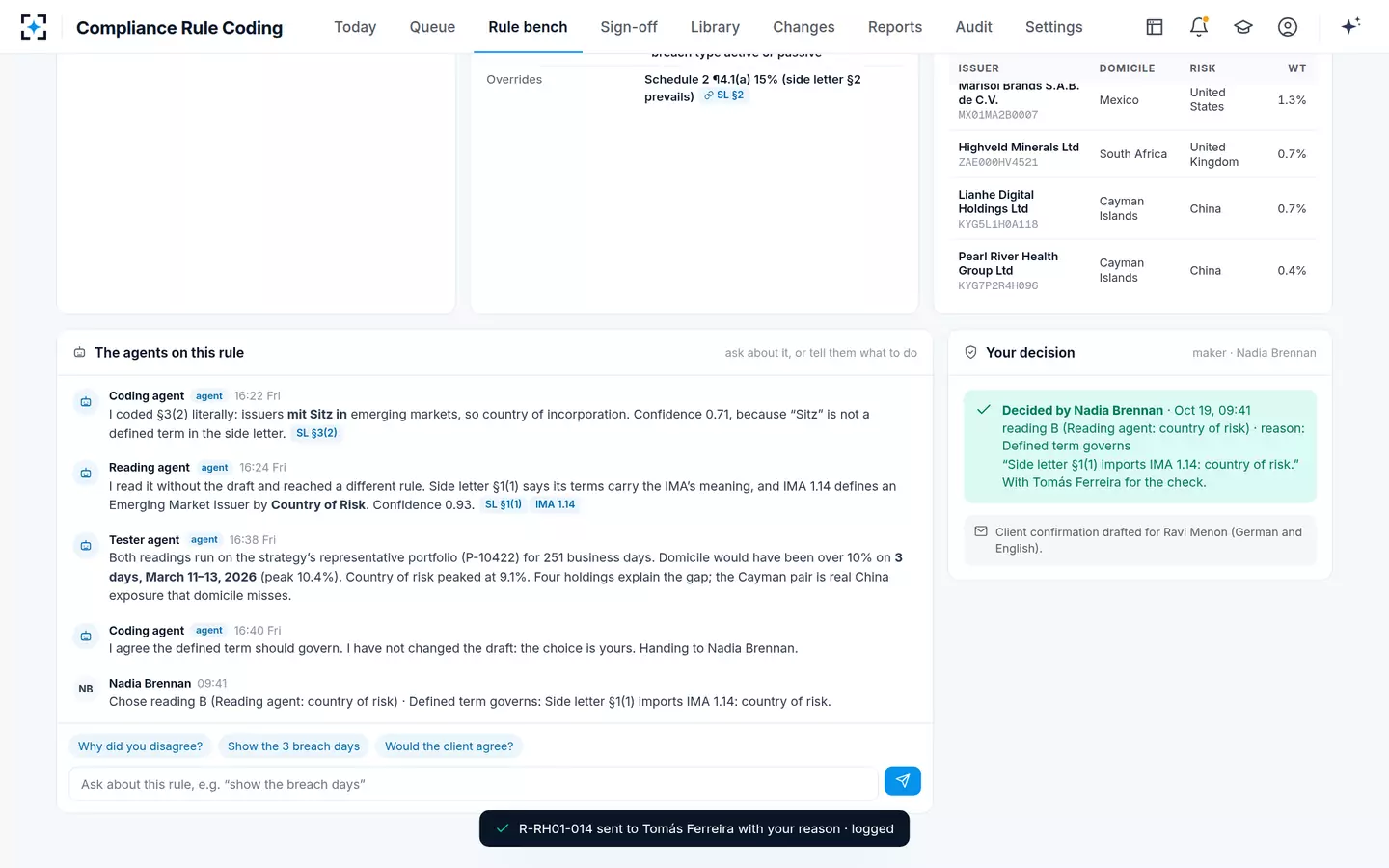
Deciding issuer or group with Compliance Rule Coding
The solution treats "issuer or group" as a decision with evidence, not a configuration default. On the sample mandate the second reader disagreed with the first draft on four of the 41 rules, and the single-issuer 5% limit was one of them: the morning list asked the analyst "issuer or issuer group?", noting that, grouped, the Arvane group sat at 4.9% of the transition plan. The steps below are how such a rule reaches the engine.
How an issuer-or-group limit becomes a tested rule
Agent
Intake agentSplits the agreement, guidelines and side letters into clauses, keeps each in its original language with English beside it, and finds where a side letter overrides the guidelines.
Never: Discards a page it cannot read
Agent
Coding agentDrafts the limit as engine parameters, with scope, numerator, denominator and data field each cited to the clause, and states its confidence.
Never: Resolves a disagreement
Agent
Reading agentReads the same clause again on a different model, without the draft, following definitions across documents, and writes its own rule.
Never: Sees the first draft
Agent
Mapping agentMaps the defined terms to the data that measures them, such as issuer group, country of risk and ratings, and resolves names to ISIN, CUSIP and LEI.
Never: Guesses an identifier below 0.90 confidence
Agent
Tester agentRuns today’s holdings and a 12-month back-test under each reading and lists the holdings that make the answers differ.
Never: Marks a rule tested with fewer than six edge cases
A person decides
Rule analystChooses the reading, edits it or returns it, with a reason code such as "Defined term governs".
A person decides
Senior compliance officerChecks the clause, the decision and the tests, and signs, or returns with a reason. Cannot check a rule they coded or decided.
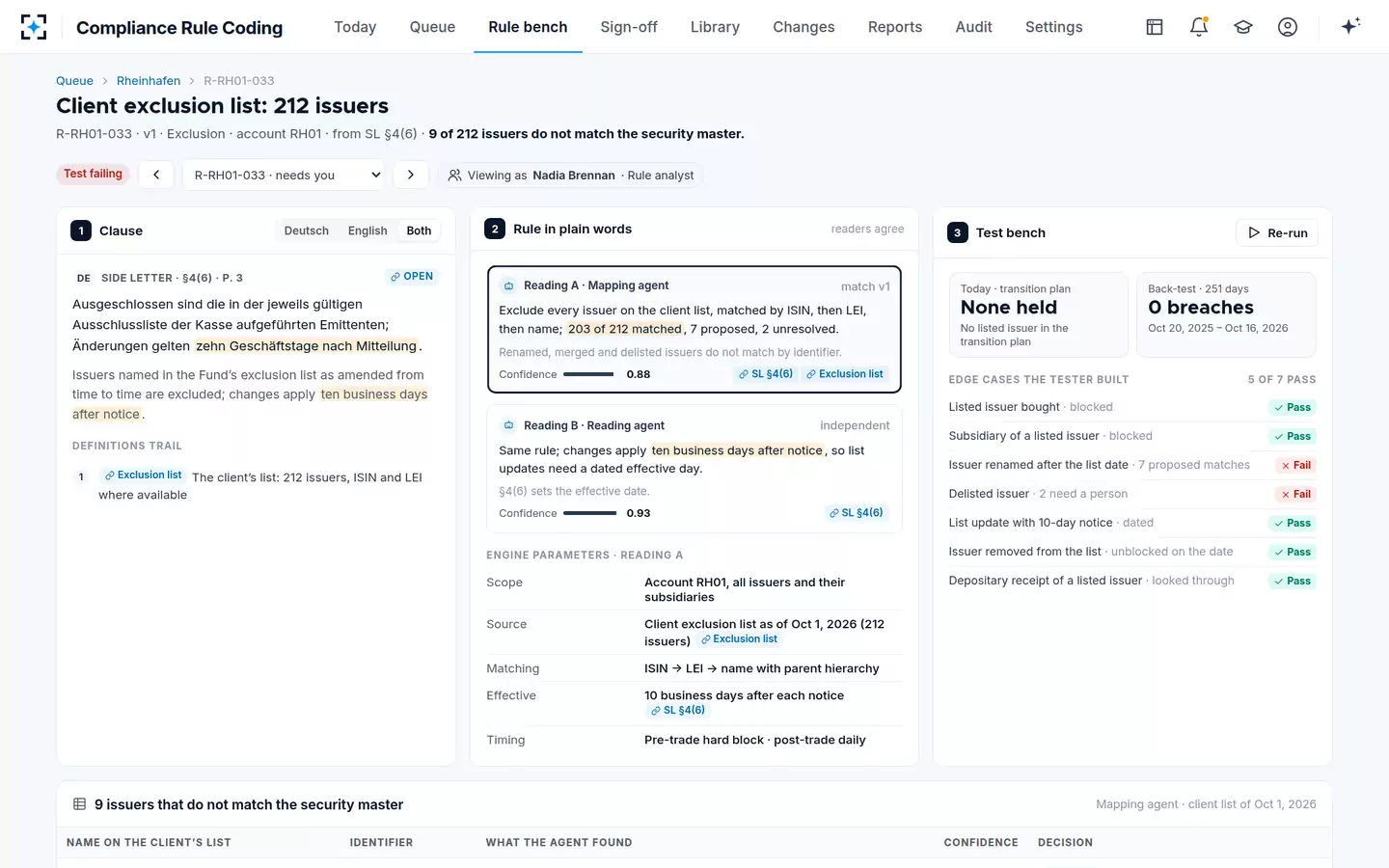
The exclusion list on the same mandate shows the data half of the problem. The client's list of 212 issuers was matched to the security master by ISIN, then LEI, then name with the parent hierarchy, and the rule's own edge cases included a subsidiary of a listed issuer, which must be blocked too. Seven renamed or merged issuers had proposed matches; two needed a person. Group membership is not a fixed fact, and a rule that relies on it should say which hierarchy and which date it used.
Issuers matched through the parent hierarchy, and the ones that need a person
Regulators have noticed that interpretation is where systems diverge. Comparing their own alerts with their depositaries', the five French managers the AMF inspected blamed either configuration error or the two sides reading a ratio, or its calculation, differently (AMF SPOT summary, February 2025, section 4.3.4). An issuer limit is the most common place for that difference to live. The answer is not a cleverer default but a recorded decision, which is why backtesting both readings over a year of holdings comes before anyone signs. To see readings, back-tests and decisions on sample mandates, start from Compliance Rule Coding.
Questions people ask
What does "any one issuer" mean in an investment guideline?
On its own, the legal entity that issued the security, as the Investment Company Act defines it. If the guideline intends guarantors or group companies to count, it has to say so or define the term; where it is silent, the reading is a decision the manager should record and, for a client account, confirm with the client.
Do government securities count against an issuer limit?
Usually not, or not at the same level. Most fund issuer limits exclude US government securities, and the UCITS rules give government issuers a 35% tier outside the 40% aggregate. The exclusion must be coded with its eligibility test, because agency debt, supranationals and state-guaranteed bonds are treated differently from one document to the next.
Should an issuer limit include derivatives on the issuer?
Only if the measure in the document reaches them. A limit on "securities of any one issuer" measured at market value does not obviously include a single-name swap; one on "exposure to any one issuer" does. The UCITS rules add a separate single-body total that adds securities, deposits and uncleared derivative exposure with one body.
How often should an issuer hierarchy be refreshed for compliance rules?
As often as the data changes, and at least whenever a corporate action touches a held issuer. The rule should record which hierarchy version it used, so that an alert, or a missed one, can be explained against the group as it stood on that day.
What was the Kornitzer case about?
An adviser to four collective investment trusts that failed, from 2016 to 2018, to bring holdings in one company down to a 10% single-issuer limit the trusts' board had adopted. The SEC found violations of Advisers Act Sections 206(2) and 206(4) and Rule 206(4)-7, and the adviser and its principal paid a $2.7 million penalty in December 2019.