Investment compliance rule coding is the work of turning the investment restrictions in a client's investment management agreement, its guidelines schedule, side letters and exclusion lists, or a fund's prospectus, into rules the compliance engine runs before and after every trade. It sits with a rule analyst, sometimes called an investment guidelines compliance analyst, and it starts every time a mandate is won, a fund launches or an agreement changes. Followed through a single mandate, the job turns out to be mostly reading and chasing: finding every clause, following each defined term to its definition, waiting for a side letter or a client's answer, then proving the rule fires when it should. Botminds' Compliance Rule Coding gives that analyst seven agents for the reading, drafting, second reading, testing and loading, and keeps every decision and signature with people.
The mandate on this page is the solution's fictional sample: Pensionskasse Rheinhafen, a German pension fund, awarding Quillfield Capital a €1,698.4 million segregated global equity account. Where the page shows days by hand, they are the sample firm's figures and an estimated split, not a measured result.
What the analyst starts with on one sample mandate
4
documents, 80 pages, in English and German: the agreement, its guidelines schedule, a side letter and a 212-issuer exclusion list
47
clauses containing a restriction, three of them overridden by the side letter
11days
the sample firm’s 2025 median from signed documents to rules live, by hand
1day
the solution’s design target for the same journey
What is investment compliance, and where does rule coding fit?
Investment compliance is the part of an asset manager's compliance function that makes sure portfolios stay within their investment restrictions: regulatory limits, a fund's own policies and each client's guidelines. It runs in three motions. Rules are coded from documents; the engine checks orders against them before trading and holdings against them every night; and analysts investigate what the engine flags. Rule coding is the first motion, and every later one inherits its mistakes.
In the United States the duty rests on the adviser's compliance rule, which requires written policies and procedures "reasonably designed to prevent violation" of the Advisers Act and a review of them "no less frequently than annually" (17 CFR 275.206(4)-7). A client restriction that is not coded, or is coded wrong, is a procedure that does not do what the policy says. The SEC's 2019 order against an adviser that took more than two years to bring four trusts down to a 10% single-issuer limit turned on exactly that gap, as the issuer concentration guide sets out.
Friday afternoon: the mandate package arrives
The sample week starts on a Friday at 15:20 London time, when the client onboarding manager, Ravi Menon, files the package from document management: the investment management agreement (64 pages, signed 9 October 2026), Schedule 2 investment guidelines (9 pages), a German side letter, the Nebenvereinbarung (6 pages), and the client's exclusion list, the Ausschlussliste, naming 212 issuers. The client funds on Monday 2 November; the firm's own service level wants rules live three business days earlier, on Wednesday 28 October.
By hand, this is where the reading begins, and it is slow for reasons that have nothing to do with the analyst's skill. The side letter is in German. It begins by giving its own terms the meaning in the agreement, so no limit in it can be read alone. And its second clause says it prevails over Schedule 2, so every guideline must be checked against it. The analyst's annotation spreadsheet starts with 80 pages, two languages and three documents that amend each other.
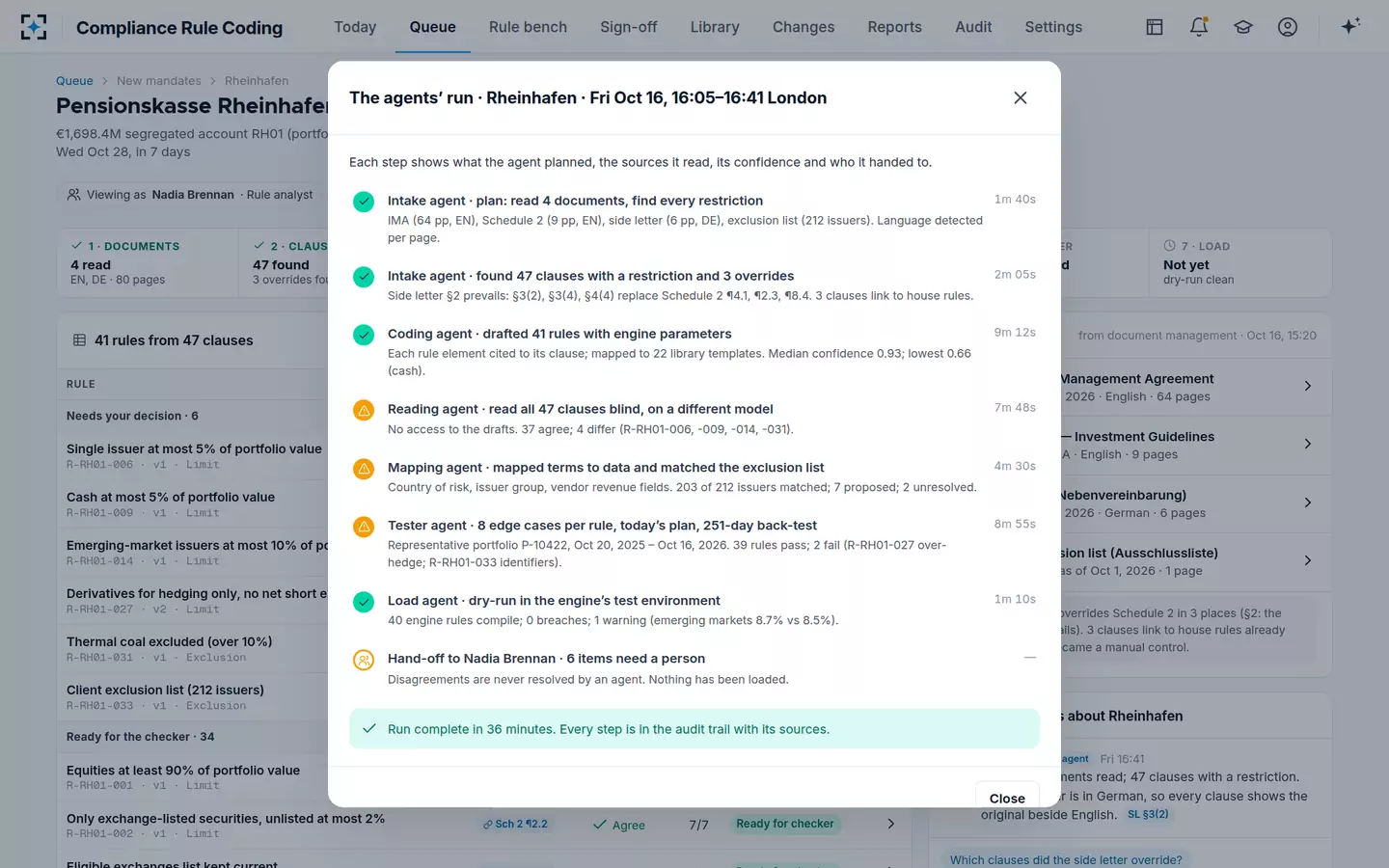
With the solution, the agents start at once. The run took 36 minutes, from 16:05 to 16:41. The Intake agent read the four documents and found 47 clauses with a restriction and three side-letter overrides; the Coding agent drafted 41 rules with engine parameters, each element cited to its clause, in 9 minutes 12 seconds; the Reading agent read all 47 clauses again, blind, on a different model; the Mapping agent tied terms to data and matched 203 of the 212 excluded issuers; the Tester agent ran edge cases and a 251-day back-test; the Load agent dry-ran the package in the engine's test environment. The run ended with a hand-off to the analyst and nothing loaded.
The agents' run on a Friday afternoon, step by step
How long does it take to code a new mandate?
No regulator or independent study publishes a figure for how long a new mandate takes to code, or for how many rules a typical mandate carries. The honest answer is your own number: count business days from signed documents to rules live for the last ten mandates, and split them by stage. The sample firm in the solution did that for 2025 and found a median of 11 business days for a mandate of about 40 restrictions.
Where a new mandate's business days go, by hand and with the solution
- Collect the package, find each restriction1.5
- Chase definitions, side letters, overrides2
- Code each rule3
- Four-eyes check1.5
- What-if and back-tests2
- Load and first batch1
- All six stages: agents prepare, the analyst decides, a checker signs1 day
Two stages dominate the hand-coded lane, and neither is coding. Chasing definitions and side letters takes two days because the analyst is waiting on other people: the client's counsel for the side letter, the relationship team for a missing schedule, a data team for an issuer hierarchy. Back-testing takes two days because it is done in a spreadsheet, if it is done at all. The agents compress both for the same reason: they read every document at once and run the tests themselves, leaving the analyst only the questions that genuinely need a person.
Where the eleven days go: reading, chasing and waiting
Split the same eleven days by the kind of work and the shape of the job is plain. Barely more than a quarter is entering rules into the engine. The rest is reading, chasing, checking and proving, which is why a faster rule editor does little for the onboarding date.
A hand-coded mandate, by kind of work
Share of 11 business days
- Finding clauses · 13.6%
- Chasing terms and side letters · 18.2%
- Typing rules · 27.3%
- Four-eyes · 13.6%
- Testing · 18.2%
- Load · 9.1%
Investment compliance rule coding jobs: what the seat does all year
The analyst who codes rules is rarely doing only onboarding. The sample firm's analyst handles about 30 mandates and 400 rule changes a year, and the firm as a whole sees about 2,000 changes: agreement amendments, prospectus supplements, client exclusion-list updates, benchmark reclassifications and new regulations. Each change means finding the rules it touches, re-coding them and re-testing them, so the seat's real workload is maintenance as much as set-up.
Regulators' descriptions of the function show how small the teams are. In the AMF's inspection of five French managers, the risk control function that configures the limits had a dedicated head at two of them, supported by three to five full-time equivalents, and was run part-time at the other three: by a manager seconded half-time from the group, by the managing director, and by the company secretary (AMF, summary of SPOT inspections on fund investment ratios, February 2025, section 4.1.1). The four that could count their limits maintained between 77 and 1,312 investment ratios each.
How many limits one team maintains
1,312
investment ratios mapped at one manager the AMF inspected, 293 of them regulatory
212
at another of the five
77
at a manager running three funds
20–64%
of ratios offered ready-made by the control tool’s publisher; the rest built in-house
The skills follow from the work: reading legal drafting precisely, in more than one language where clients are international; knowing how the engine computes a numerator and denominator; knowing the security master well enough to map a defined term to a data field; and the judgement to know when a sentence has two meanings. The last is the one no tool supplies.
Who checks coded compliance rules?
A second person who did not code the rule, and the separation is the point. The AMF found that four of the five managers it inspected apply a "four-eye control" to every configuration, meaning "the configuration operation and the verification of this configuration are not carried out by the same person"; at the fifth, it flagged a risk of non-segregation of duties because the same person both configured the limits and supervised the results (AMF SPOT summary, sections 4.1.1 and 4.3.2). It listed not using four-eye checks when creating or modifying ratios as a poor practice.
What the checker checks matters as much as who. A checker who sees only the engine's rule, not the clause it came from, can confirm the rule is well formed but not that it is right. In the solution, the checker is a senior compliance officer who opens one page with the clause in its original language, the rule, the analyst's decision and reason, the edge cases and the back-test, and works a four-point checklist before signing. The system blocks anyone from checking a rule they coded or decided.
Monday: what the analyst decides, and what the agents did
The analyst's Monday starts with a list, not a document. Nine decisions wait: six on Rheinhafen and three on rule changes elsewhere. The agents' morning brief reads like a hand-over from a colleague: the second reader agreed with 37 of the 41 draft rules and differed on four; the tester re-ran 64 rules overnight after a benchmark reclassification; the load dry-run compiled 40 engine rules with one warning.
The analyst's Monday: nine decisions, and the agents' morning brief
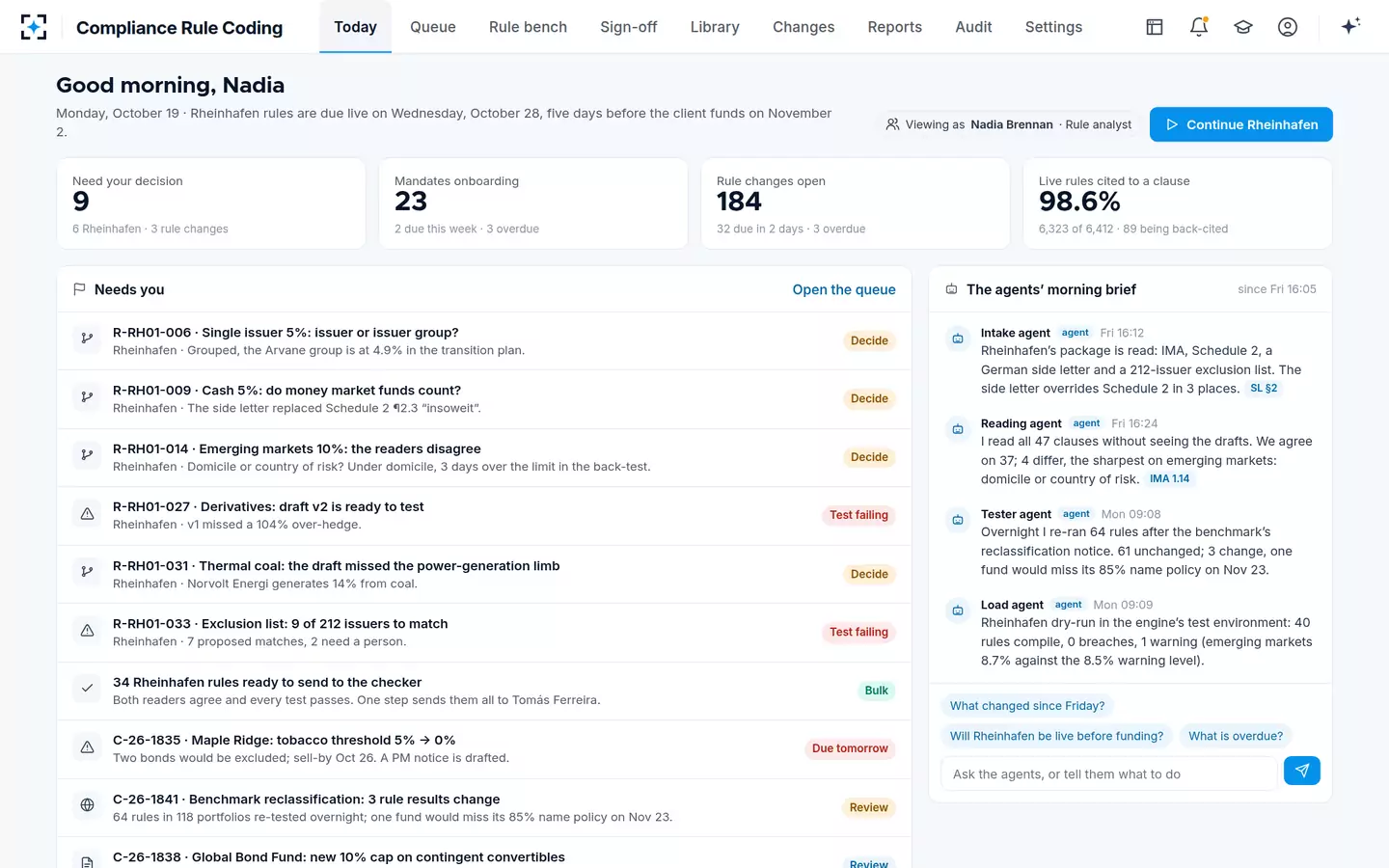
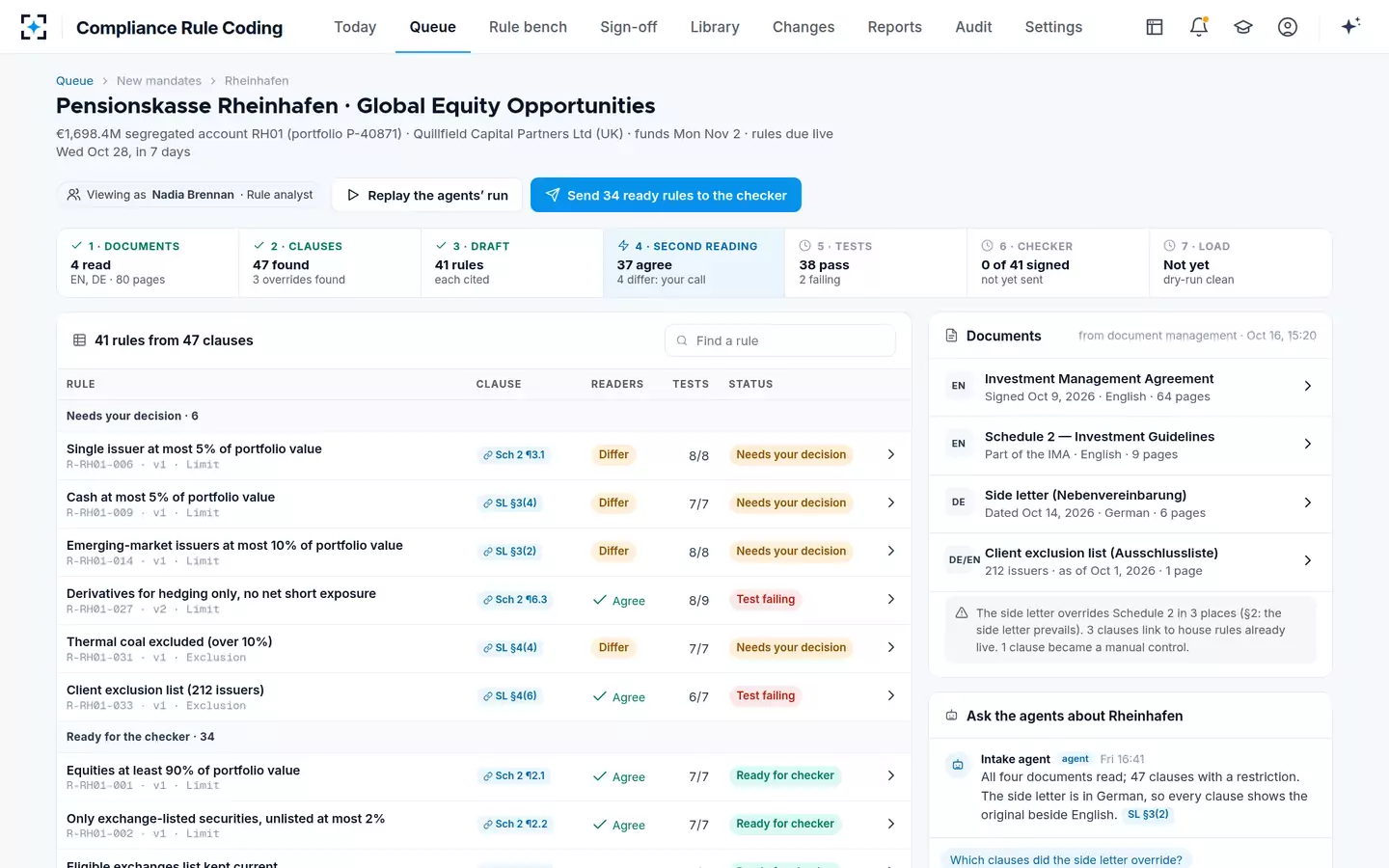
Each of the six Rheinhafen items is a reading, not a typing task. Does "5% per issuer" mean the issuer or its whole group? Does "cash" include money market funds now that the side letter replaced the schedule's wording? Is an emerging-market issuer defined by its seat or its country of risk? The sharpest of them, the emerging-markets cap, the analyst settled at 09:41 by choosing the defined term over the literal wording, after asking the agents for the breach days each reading would have produced; the back-test behind that decision is worked through on its own page. Thirty-four rules where both readers agreed and every test passed went to the checker in one step.
One mandate, seven stages, and only six rules that need the analyst
The people around one mandate, before and after
A mandate does not belong to the analyst alone. Five people carry it from award to audit, and each spends part of the week on rule coding whether or not it is in their job title. The change agents make is different for each of them.
Five seats around one mandate's rules
Today
Reads every clause, chases every definition and hand-codes each rule, with a back-test only when there is time.
With agents
Opens rules already drafted, read twice and tested, and decides where the readings differ.
Still theirs: Every interpretation, with a reason code
Today
Ticks a coded rule in the engine, often without the clause in front of them and with no tests to look at.
With agents
Sees the clause, the decision and the tests on one page; blocked from checking a rule they coded.
Still theirs: The checker’s signature
Today
Answers for a library in which some rules have no clause behind them.
With agents
Releases each package after a dry-run and a comparison with production.
Still theirs: Release of packages over 25 rules
Today
Chases compliance by email to learn whether rules will be live before the client’s money arrives.
With agents
Sees each mandate’s stages, rules-live date and funding date on one page.
Still theirs: The conversation with the client
Today
Rebuilds one rule’s history from email, spreadsheets and engine logs.
With agents
Exports one rule or one mandate end to end, with every signature and time.
Still theirs: The annual test of the coding control
What the week leaves behind for the next examination
An onboarding week is also the week the evidence is created, or not. The SEC's examiners, reviewing advisers' annual compliance reviews, found reviews that recorded testing and corrective actions without keeping the records of "the testing performed, issues identified, and/or corrective actions recommended" (SEC Division of Examinations risk alert, September 14, 2026). For rule coding, the record that matters is short: which clause, which reading, who decided, who checked, what was tested, and when it loaded.
By hand, that record is an annotation spreadsheet, a chain of emails and the engine's change log, kept in three places by three people. With the solution, every agent step and human decision is on one audit trail, and one export gathers a mandate's clauses, readings, decisions, signatures, tests and load results with a hash manifest. That is also what makes the rules testable later, when the agreement is amended and every affected rule needs a re-test. To see the sample week from the analyst's chair, start from Compliance Rule Coding.
Questions people ask
What does an investment guidelines compliance analyst do?
They read each client's investment guidelines and each fund's restrictions, code them as rules in the compliance engine, investigate the alerts those rules raise, and keep the rules current as documents change. In smaller firms one person does all four; larger firms split coding from monitoring, which also gives the separation of duties regulators look for.
Is investment compliance rule coding a technical job?
Partly. The analyst must understand how the engine computes a limit and how the security master describes a holding, but most of the judgement is legal reading: definitions, overrides between documents and the meaning of words such as "issuer" or "cash".
How many rules does a typical mandate have?
No regulator or independent study publishes a typical count. The solution's sample mandate had 47 clauses with a restriction and became 41 rules; the AMF's inspected managers held between 77 and 1,312 ratios across all their funds. Count your own last ten mandates to get a figure you can plan with.
Can a mandate start trading before its rules are coded?
Only with a substitute control, such as manual pre-clearance of every order or a temporary restriction to a narrow universe, because the adviser's procedures must still prevent breaches from the first trade. The cost of that substitute is part of the business case for coding faster, and the price of a two-week delay works it through.
Who should sign off a coded compliance rule?
A senior compliance officer who neither coded the rule nor decided its interpretation, looking at the clause, the decision and the tests rather than the rule alone. Some firms add a more senior sign-off for large releases; in the solution's sample settings, any package over 25 rules needs the Head of Investment Compliance.