Investment compliance testing tools, for the people who code rules, are tools that prove a coded investment restriction does what its clause says before it reaches the compliance engine: edge cases from the clause's own words, a back-test over real holdings, a dry-run in the engine's test environment, and a record of each. Rule coders trust such a tool when every rule it produces can be checked against its source in a minute, and stop using it the first time it is confidently wrong. That makes the buying question practical: will your coders still be using it in six months? Botminds' Compliance Rule Coding was built around that question, with every rule element cited to its clause, a second reading that can disagree, tests of every reading, and a stated confidence below which a rule is flagged even when the readers agree. This guide gives the criteria, a pilot plan and a scorecard you can apply to it or to anything else.
Screens show the solution's fictional sample firm. The pilot plan and scorecard are our recommendation, not a regulatory requirement.
Why trust is the go-live question
1 of 5
managers the AMF inspected had a fully operational map of its investment limits; others had inconsistent entries
1 of 5
had a training programme for managers on monitoring investment limits
0.90
the sample confidence floor: below it a reading is flagged even if both readers agree
6
edge cases at least, in the sample settings, before a rule counts as tested
What should investment compliance testing tools do?
They should answer, for every rule, three questions a checker or an examiner will ask: which words does this rule come from, what happens on the edge of those words, and what would it have done over the past year. A tool that answers only the third, by running a portfolio against rules, is an engine; one that answers none, by generating rules from text, is a drafting aid. The tools rule coders keep using answer all three, show their working, and say when they are unsure.
The examiners' interest is the same. Among the documents the SEC's staff typically request from funds are the compliance policies with their inventories of risks, testing and exception reports, and information about the tools and systems used for compliance oversight (SEC risk alert, Registered Investment Companies, November 4, 2024, attachment). A testing tool is part of the evidence, so its outputs have to be evidence: dated, attributable and unchanged.
Three kinds of testing tool, and which one rule coders need
The phrase covers three different products, and buyers waste pilots by testing the wrong one. Program-testing tools support the annual compliance review: sampling, workpapers, findings. Portfolio-testing tools are compliance engines: they test orders and holdings against rules. Rule-testing tools test the rules themselves against their source and history. Rule coders need the third, and it must work beside the second.
The distinction matters because the failure modes differ. A portfolio test that passes says the portfolio met the coded rule, not that the coded rule met the clause. France's market regulator found how often the map behind the engine is the weak point: of five managers, "only AMC 1's mapping is fully operational", while others listed the same restriction under three codes or labelled a regulatory constraint inconsistently across funds (AMF SPOT summary, section 4.3.1).
Investment compliance testing tools, free: what a spreadsheet and the engine already give you
Two free tools exist in most firms, and a pilot should beat them on the same rules. The first is the engine's own what-if or simulation function; the AMF found that three of the five managers could simulate an order's effect on their limits in the tool, while the other two did it in a separate Excel file that was not compulsory (AMF SPOT summary, section 4.1.2). The second is a spreadsheet back-test built from portfolio accounting extracts.
Both work, for a few rules, with an analyst who knows what to look for. What they lack is what a coder needs at volume: an independent second reading, point-in-time reference data, edge cases generated from each clause, a citation for every parameter, and an audit trail that shows who decided what. If your volumes are small and your documents simple, the free tools may be enough, and a pilot should be allowed to conclude that.
Investment compliance software companies: compare the categories, not the brochures
Vendors in this space fall into four categories, and the categories differ more than the vendors within them. Order and portfolio management systems with built-in compliance engines and rule libraries; standalone post-trade compliance engines; rule-writing services, in which the vendor's staff code your rules; and document-reading tools, including agents, that draft and test rules from your documents for your engine. No regulator or independent study publishes market shares or prices for any of them, and vendors do not publish prices, so ask each for a written quote on the same scope.
The questions that separate them are the same across categories: where does the rule's interpretation get decided, by whom, with what evidence; can the vendor show every rule's source; what happens when the documents change; and what does the firm still have to check. A rule-writing service moves the typing outside the firm but not the duty to check it. A built-in library covers part of the regulatory rules: at the AMF's inspected managers, 20% to 64% of ratios came ready-made from the tool's publisher.
What makes rule coders abandon a tool, and what keeps them
Abandoned: The rule appears; where it came from is a guess
Kept: Every element (scope, numerator, denominator, data field, limit) cites its clause, in the original language
Abandoned: Every rule is presented with the same confidence
Kept: Each reading states its confidence; below a floor, it is flagged even if both readers agree
Abandoned: One reading, chosen silently
Kept: Two independent readings; where they differ, both go to the analyst with their back-tests
Abandoned: Passes today’s portfolio
Kept: Edge cases from the clause’s words and a 12-month back-test of each reading, with the holdings that explain each day
Abandoned: The tool loads what it drafts
Kept: People decide, sign and release; the tool never loads unsigned rules
Abandoned: Re-coding starts from scratch after an amendment
Kept: Affected rules found and re-tested; only changed results come back
What a rule-coding tool should say when it is unsure
A tool earns trust fastest by being right about its own doubt. Every reading it produces should carry a confidence, and the low ones should cluster on the clauses a person would also hesitate over. If they do, the analyst can spend time where it matters and wave through the rest with a checker's signature; if they do not, the confidence is decoration and the analyst must read everything again.
The solution's sample mandate shows what to look for. Across the 41 drafted rules the Coding agent's median confidence was 0.93; its lowest, 0.66, was on the cash limit, where a German side letter had replaced the schedule's wording and left open whether money market funds count as cash. That rule was also one of the four where the independent second reading disagreed, and one of the six items handed to the analyst. The emerging-markets limit, read literally at 0.71 and through the agreement's definitions at 0.93, was another. In a pilot, list the clauses your team considers hard before the tool runs, then check whether its lowest confidences and its disagreements land on them.
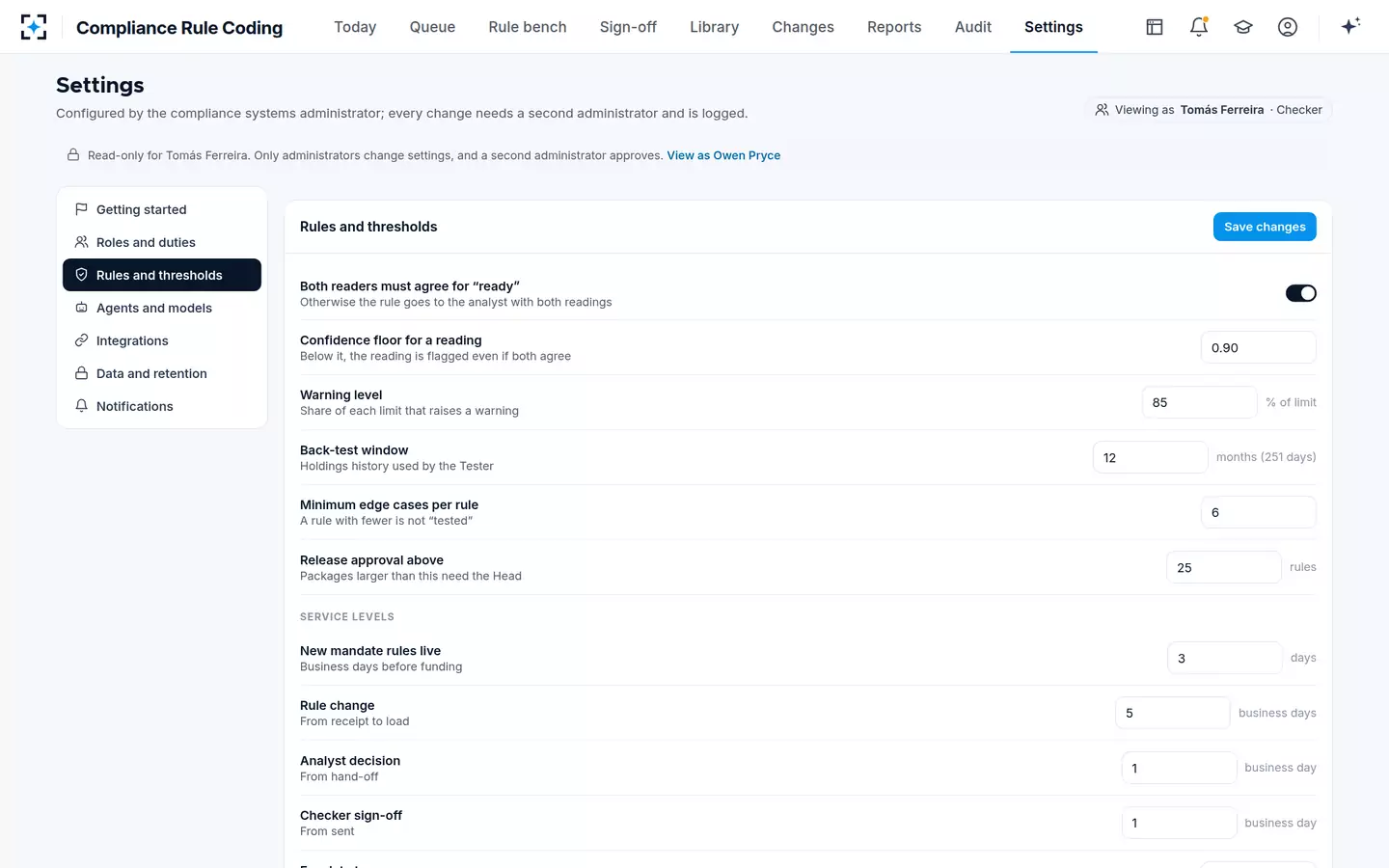
The firm, not the vendor, should set the threshold. In the sample settings a reading below 0.90 is flagged even when both readers agree, and both readers must agree before a rule counts as ready; changing either needs a second administrator. A pilot should run on your thresholds, so that what you score is what you would live with.
Red flags in a rule-coding demonstration
Demonstrations are built to impress, so watch for what they leave out. The vendor's own sample documents, clean and in English, tell you nothing about your side letters. A rule shown without the clause it came from cannot be checked. A second reading on the same model, or one that can see the first draft, is a single reading performed twice. A tool that loads rules without a person's signature, or resolves a disagreement itself, has removed the control an examiner will ask about. And a tool that cannot export one rule end to end, with every decision, signature and test, cannot help you at the next examination.
Ask to see the hard case live: one of your own disputed clauses, read by both readers, back-tested under both readings, decided by your analyst and signed by your checker, in the session. A tool that can do that once on your documents will do it again; one that cannot will not improve after purchase.
What documents does a rule-coding pilot need?
A pilot needs one complete, real mandate package and the rules you already run for it. Without both, there is nothing to compare. Choose a recent mandate that includes a side letter or amendment, ideally in another language, and at least one clause your team argued about; a clean, standard mandate will make every tool look good.
The pilot's document set
- The full package as signed
Investment management agreement, guidelines schedule, side letters and amendments in their original language; or for a fund, prospectus, SAI and supplements.
- Client exclusion lists, with their dates
As received, including any updates since go-live.
- The live rules for that mandate, exported from the engine
With their parameters and change history, so differences can be explained.
- Twelve months of holdings
From portfolio accounting, daily, or a representative portfolio for a new strategy.
- A security master extract
Country of risk, issuer hierarchy, ratings and classifications, point-in-time if you have it.
- Your interpretation policy
How the firm reads defined terms, issuer, cash and similar words, and who decides when documents conflict.
- The disputes and known errors
Clauses your team argued about, and rules later found wrong. They are the answer key.
How long does a compliance software pilot take? A four-week plan
Four weeks is enough for a rule-coding pilot on one mandate, if the documents are ready on day one. The calendar below assumes one mandate of about 40 restrictions and a rule analyst and a checker available for a few hours a week. Longer pilots usually reflect waiting for documents or data, which is worth knowing in itself.
A four-week rule-coding pilot, week by week
- Assemble the package, live rules, holdings and data; agree the scorecardWeek 1
- Run the tool; compare every rule with the live oneWeek 2
- Analyst decides disputed readings; checker signsWeek 3
- Dry-run in the engine’s test environment; score; decideWeek 4
Agree the pass criteria in week one, in writing, before anyone sees output. The most common way a pilot fails to inform a decision is that the criteria are set after the results, by whoever liked or disliked the tool.
How do you score a pilot of rule-coding software?
Rule by rule, against the live rules and the disputes. The question is not whether the tool's rules match yours, since some of yours may be wrong, but whether every difference is explained and whether the tool found the ambiguities your team already knew about, and any it did not.
A rule-by-rule pilot scorecard
| Measure | How to score it | A reasonable pass mark to agree in advance |
|---|---|---|
| Clause coverage | Restriction clauses found by the tool against your own list | Every clause on your list found; extras reviewed |
| Citation | Rules where every parameter cites a clause | All, with citations checked on a sample by the checker |
| Known disputes surfaced | Clauses your team argued about that the tool flagged as ambiguous | All of them, with both readings |
| New ambiguities | Disputes the tool raised that your team agrees were real | Recorded; each one is value found |
| Differences from live rules | Rules that differ from the engine, with the reason | Every difference explained; each live-rule error found is logged |
| Testing | Edge cases per rule; back-test of each reading | Your minimum, e.g. six edge cases and twelve months |
| Stated doubt | Readings flagged below the confidence floor that were in fact wrong or ambiguous | Low-confidence flags concentrate where the problems are |
| Time | Days from package to signed rules, by stage, against your hand-coded median | Measured, not estimated |
The checker's page: clause, decision, tests and a four-point checklist
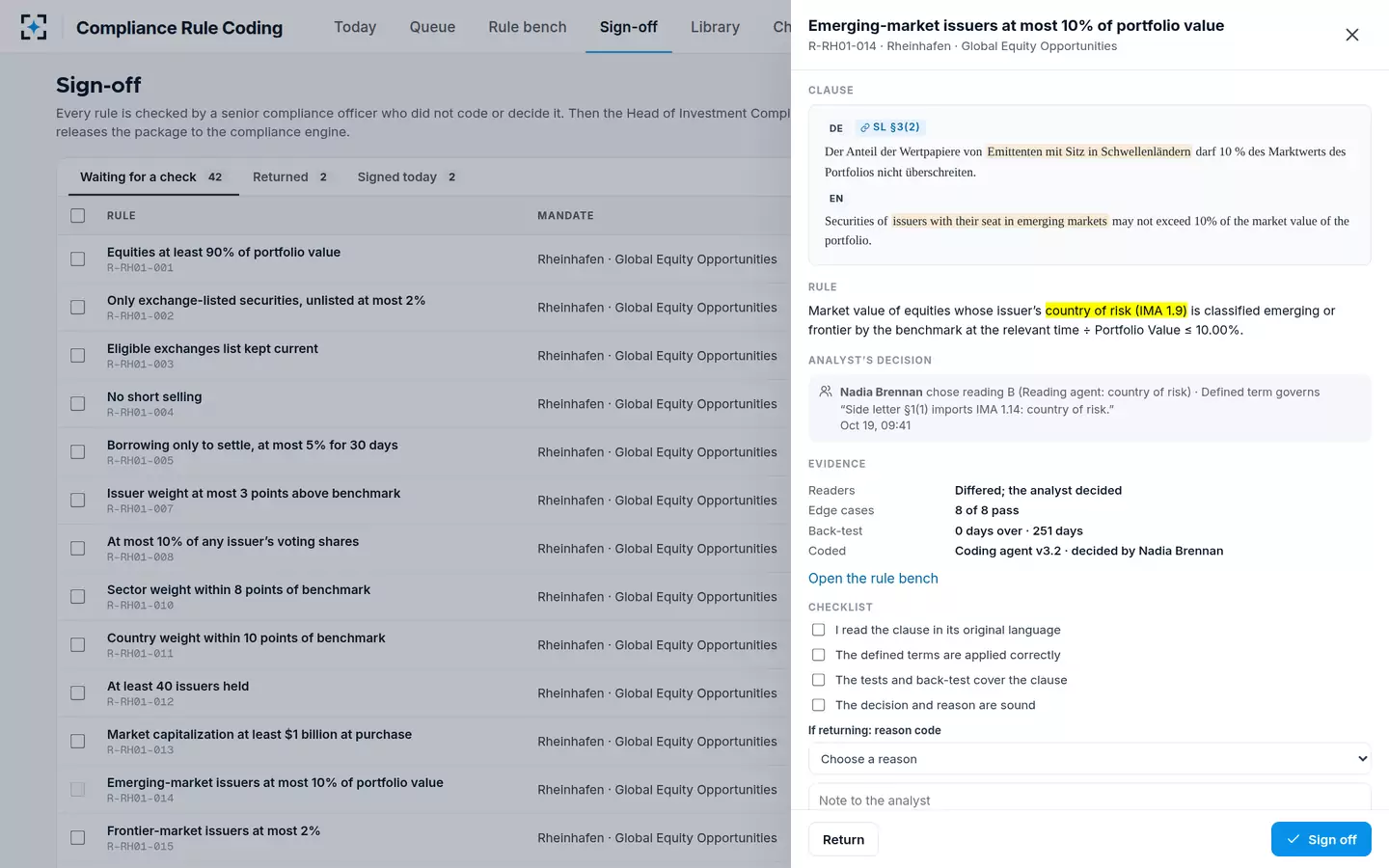
Going live rule by rule, starting with the rules people argue about
Trust is earned per rule, so go-live should be too. Start with the rules your team already disputes: they are where the tool's second reading and back-tests add most, and where a coder will see quickly whether it is useful. Load them through the normal checker and release, and let the clean rules follow once the team has seen the hard ones handled well. A tool that is right on the easy rules and wrong on the hard ones is worse than none.
Legacy rules are the second step. A library built over years carries rules nobody can trace to a clause; on the solution's sample firm, 89 of 6,412 live rules, all coded before 2022, had no citation. Its Evidence agent proposed a citation for 83; one, a restricted brokers list, had no clause at all and may be a house rule. Approving those citations, or retiring the rules, is a visible early win, and it is what lets the Head of Investment Compliance say, in the sample persona's words, that "every rule in the library must have a clause, a test and two names".
Settings the firm owns: agreement, confidence, warnings, tests, release
Finally, keep the evidence from day one. The SEC's examiners say they will typically analyse an adviser's annual compliance review, and for fiscal 2027 they list portfolio management among the compliance-program areas they review (SEC Division of Examinations, Fiscal Year 2027 priorities). A pilot's records, with decisions and signatures, are the first entries in that file. Why the writer must not be the tester explains the controls behind those records; the price of a two-week delay gives the case for buying at all. To see the rule bench and sign-off on sample mandates, start from Compliance Rule Coding.
Questions people ask
Can a rule-coding tool replace our compliance engine?
It should not, and Compliance Rule Coding does not: it prepares, tests and packages rules for the engine you already run, in its test environment and then production. The engine remains the system that checks every order and every portfolio.
What if the tool disagrees with a rule we already run?
That is the pilot's most valuable output. Each difference is either a tool error, a live-rule error or a genuine ambiguity, and all three are worth knowing. Score whether every difference is explained, and log each live-rule error you find as a finding in its own right.
Should the pilot use a different model for the second reading?
If the tool uses agents, yes: a second reading on the same model with the same prompt tends to repeat the first reading's mistakes. The solution's Reading agent runs on a different model family and has no access to the first draft.
Who should run the pilot on our side?
A rule analyst who codes rules today and a senior compliance officer who checks them, with a few hours a week each, and the systems administrator for the engine's test environment. Their time is the true cost of the pilot, and their verdict is the one that decides adoption.
What happens after a successful pilot?
Extend mandate by mandate, starting with new ones and amendments, and work through legacy rules without citations. Keep measuring days from package to signed rules and errors found after go-live; those two numbers tell you whether the tool is still earning its place.