The tariff impact on banks arrives through their borrowers. Tariff exposure in a commercial loan portfolio is the share of the book whose borrowers depend on imported inputs, so that a rise in duties or a supply shock would cut their cash flow and their ability to service debt. It is an indirect concentration, and the usual tool for finding it, a screen of industry codes, is built for direct ones. A NAICS code describes what a borrower makes or sells, not what it buys, so a code screen misses the solar installer or IT reseller that imports most of its costs and flags the manufacturer that buys domestically. Botminds' Commercial Loan Portfolio Analysis was built for this gap. Its agents read memos, reviews, statement notes and supplier lists across the whole book and return each borrower with the passage that shows its exposure.
The same blind spot covers two other exposures examiners now ask about: borrowers that lend to others, and borrowers that depend on one customer. This guide takes all three in turn and ends with a method a portfolio team can apply with or without software.
Trade exposure is already a credit factor; codes are a weak way to find it
65banks
surveyed by the Fed in October 2025; a significant net share were less likely to approve C&I loans to firms with high trade exposure
25%
of tier 1 capital plus the allowance: the OCC’s concentration threshold, counting indirect and contingent obligations
6of 63
import-dependent borrowers at a sample bank sat outside trade-sensitive industry codes
14of 41
sample borrowers that are themselves lenders were coded as ordinary C&I in the loan system
How will tariffs affect banks? Through borrowers' margins, debt service and appetite
Tariffs are not levied on banks, so they reach a bank through the borrowers that pay them: higher input costs squeeze margins, coverage falls, and lenders tighten. Three channels are visible in regulators' own surveys. The first is credit quality. A firm that imports a large share of its cost of goods sold either passes the rise to customers or absorbs it, and what it absorbs comes out of the cash flow that services its debt. The European Central Bank's analysts put the mechanism plainly: “For banks, these developments increase credit risk: the firms affected can face volatile demand, supply disruptions” (ECB Blog, July 2026).
The second channel is appetite. A net 11% of euro-area banks reported stricter credit standards in 2025 “owing to changes in global trade policies,” and the same post found banks “stepping up their monitoring of exposed borrowers.” In the US, the Federal Reserve's October 2025 survey found significant net shares of banks less likely to approve C&I loans to firms with high trade exposure. The third is demand: the same survey recorded banks citing firms' “investment needs to build inventories due to trade developments” as a reason demand strengthened (SLOOS, October 2025). Inventory bought ahead of a duty is financed, often on a revolver or a borrowing base, before it is sold.
Each channel lands on named borrowers, and none of them is visible in a balance or a code. A bank that wants to know its own tariff impact needs three things per borrower: the imported share of its costs, how much of a rise it can pass on, and its coverage against the policy line. The rest of this guide is about where those three facts live.
What is an indirect concentration of credit, and why tariffs are one
An indirect concentration is a group of borrowers exposed to the same outside factor, such as a supplier, a customer or an input cost, even though they sit in different industries. A concentration is not only lending to one industry. The OCC's 2026 booklet defines it as “the sum of direct, indirect, or contingent obligations exceeding 25 percent of a bank's tier 1 capital plus the allowance for credit losses” (Concentrations of Credit, Version 3.0). It goes on to describe correlated exposures, credits whose performance metrics “improve or deteriorate at the same time” because of “specific macroeconomic factors or other interrelated characteristics.” Borrowers in six different industries that all buy steel wire rod from the same two countries are correlated in exactly that sense.
Supervisors have seen this pattern end badly. Citizens Bank in Sac City, Iowa, failed in 2023 after building trucking loans to 310% of tier 1 capital plus the allowance, 43% of its portfolio. Its borrowers' condition “worsened as the commercial trucking industry faced supply-chain issues and increased costs of fuel, insurance, and repairs” (FDIC OIG). That was a direct concentration, visible in any code screen; an input-cost shock was what turned it into losses. When the shock is a tariff, the borrowers it hits share an input, not a code, and a code screen does not see them as one group.
Lenders are already treating trade as a credit factor at the front door. In the Federal Reserve's October 2025 survey of 65 domestic banks, “significant net shares of banks reported being less likely to approve loan applications from firms of all sizes with high trade exposures,” while moderate net shares were more likely to approve firms with low trade exposure (SLOOS, October 2025). The survey measures sentiment at origination, not exposure in existing books, and no federal series publishes how much of the commercial book depends on imports. A bank that wants the number has to take it from its own files.
Tariff exposure by industry: what a code can and cannot tell you
An industry code is a good first cut and a poor final answer. It is assigned once, usually at onboarding, and describes the borrower's primary activity. It does not change when a contractor starts buying panels from overseas, and nobody re-codes a distributor whose biggest supplier moves its plant. Screening by code answers “which of our borrowers are in industries that import?” The board's question is “which of our borrowers import?”
A code screen against reading the files, on one tariff question
Industry-code screen: NAICS or SIC code, commitment, rating, maturity
Every file read for the question: Memos, annual reviews, statement notes, supplier lists, field exams, call memos
Industry-code screen: The borrower is in a trade-sensitive industry
Every file read for the question: The file says imports are at least a set share of costs, or names a foreign supplier
Industry-code screen: Not looked at
Every file read for the question: Read like any other; found where the file says so
Industry-code screen: All flagged, exposed or not
Every file read for the question: Flagged or cleared, each with its passage
Industry-code screen: Indistinguishable from “not exposed”
Every file read for the question: Named as not in file, left out of the count, sent to the RM
Industry-code screen: One loss rate on the flagged pool
Every file read for the question: Coverage on each borrower’s spread, on the imported share its file states
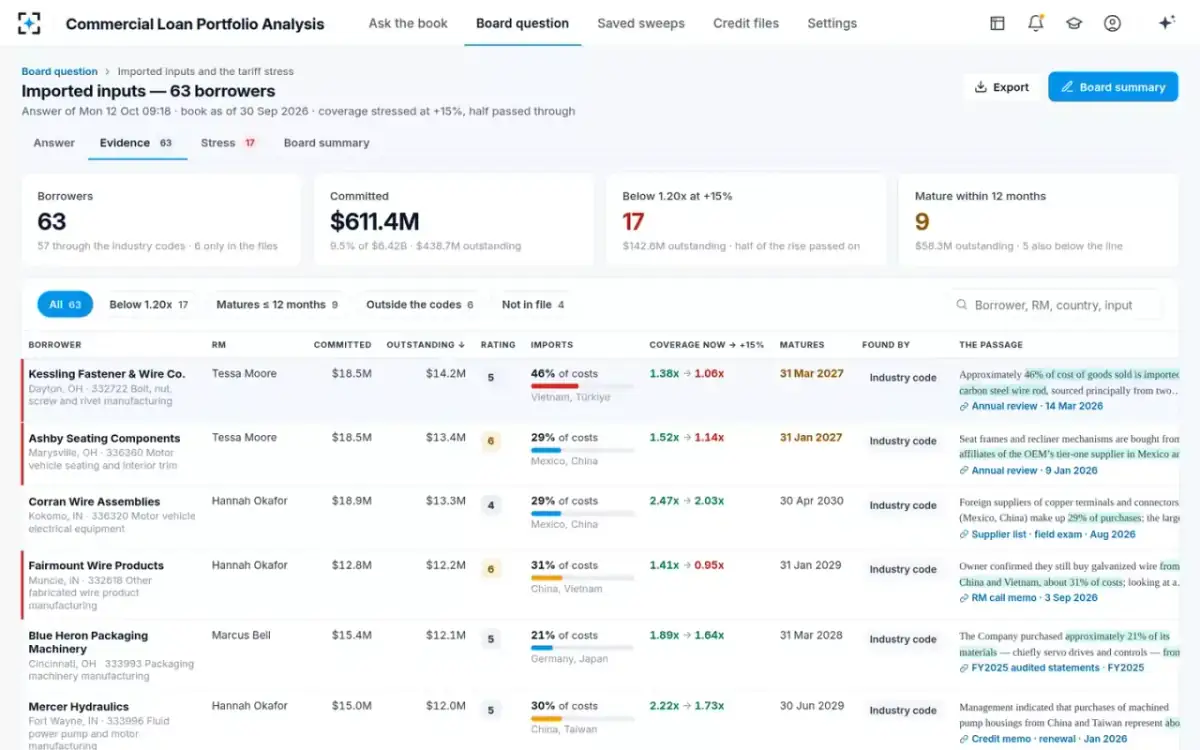
The difference shows up at both ends. At a fictional sample bank, 412 relationships sat in trade-sensitive codes. Reading their files confirmed 57 as dependent on imports and cleared 351 with a passage showing domestic sourcing. Four had files that did not say. Reading the files of every other relationship found six more: a solar installer, a flooring contractor, a pool builder, an IT reseller, a marine service yard and an event-rental firm. Together they carried $39.6M of commitments that a code screen would have reported as zero. The whole morning is told in the board question, by the clock.
Where a sample bank’s 63 import-dependent borrowers sit, by committed exposure
Where import dependence is written down in a credit file
Import dependence is rarely in one place, which is why a reader has to look in several. An annual review's operations section often states the main inputs and sources. The notes to audited statements may carry a concentrations note on major suppliers. A field exam for an asset-based line lists the top suppliers by share of purchases. An RM's call memo notes what the CFO said on the last plant visit, such as a new surcharge and whether it was passed on. The Federal Reserve's examination manual expects the file to hold enough to “identify the borrower's business” and “the loan officer's contact with the borrower” (CBEM §2010.1). It does not say where in the file each answer will be.
On the sample bank's largest import-dependent borrower, three documents told one story. The annual review of 14 March 2026 says about 46% of cost of goods sold is imported carbon steel wire rod from two mills in Vietnam and Türkiye. The July field exam puts those mills at 31.2% and 14.9% of purchases. A September call memo adds that the Türkiye mill imposed a 10% surcharge and the borrower passed about half of it on. When documents disagree, the reader prefers audited figures over memos and newer over older, and shows both.
The evidence table in Commercial Loan Portfolio Analysis: imported share, countries and how each borrower was found
Loans to NDFIs: the same blind spot, now on the call report
Loans to nondepository financial institutions led the industry's loan growth over the year to June 2026, and part of that growth is relabelling. Bank loans to NDFIs totalled $1.4 trillion at the end of 2025, 5.6% of industry assets, and grew 35.2% in the year. The FDIC notes that “some of this growth is attributed to banks reclassifying loans due to revised … Call Report instructions on NDFI loans” (FDIC Risk Review 2026). The revisions created item 9.a, “Loans to nondepository financial institutions,” and instructions that “more broadly define NDFIs” (Federal Register, May 2024). By the second quarter of 2026 the line was still growing 22.4% a year (FDIC QBP).
Reclassification depends on someone knowing that a borrower lends. Fund subscription lines and warehouse lines to mortgage companies are easy. The hard cases are ordinary commercial borrowers with a finance arm: a car dealer holding the retail instalment contracts it wrote, a farm-supply wholesaler carrying growers' notes until harvest, an equipment distributor that starts funding its dealers. Their codes say retail or wholesale. Their files say they lend. The OCC flags the same territory in its spring 2026 outlook: “Credit conditions and refinancing risk in certain segments of commercial real estate lending and of private credit markets warrant ongoing monitoring” (Semiannual Risk Perspective).
Borrowers that are themselves lenders, whatever their industry code
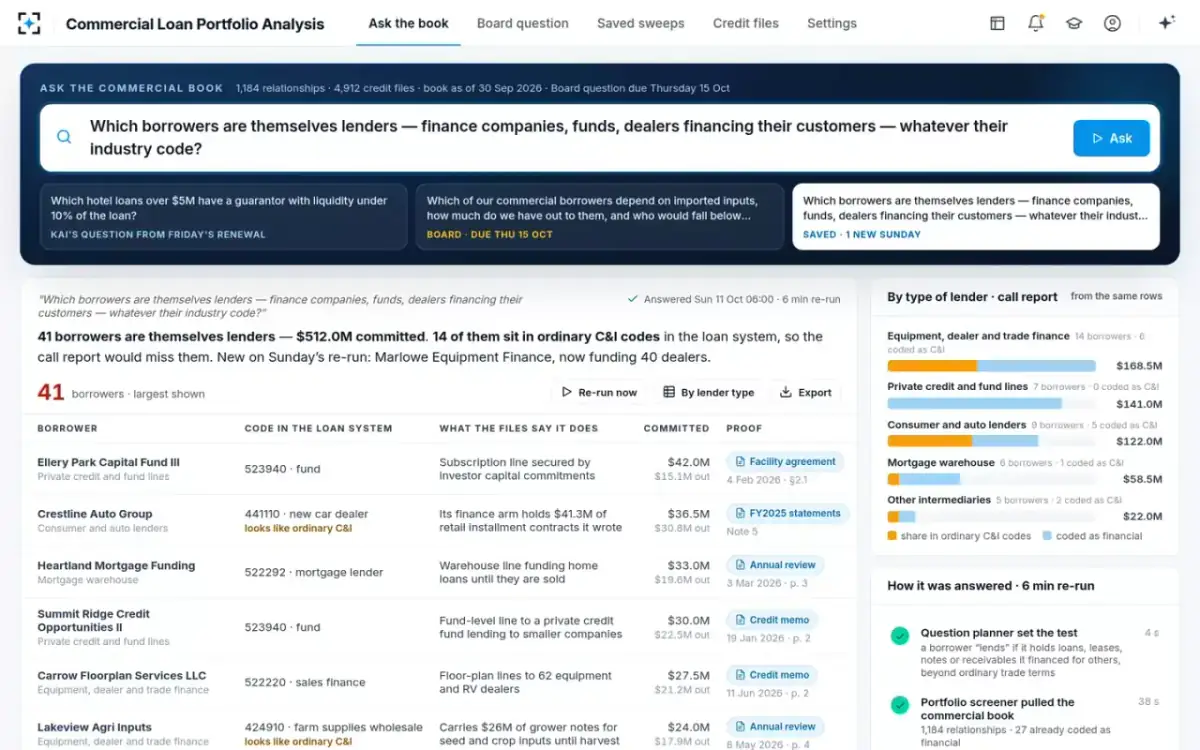
At the sample bank, 41 borrowers turned out to be lenders, with $512.0M committed, and 14 of them sat in ordinary C&I codes. Whether each one belongs on the NDFI line is a judgment for the bank's call report preparers under the FFIEC instructions. The file is where that judgment starts, and a saved question that re-reads the book every week catches the borrower that started lending last month. Its Sunday re-run picked up an equipment wholesaler, coded 423810, newly funding floor-plan loans to 40 dealers.
Customer concentration: the exposure that sits in a footnote
The third indirect exposure runs the other way: borrowers that depend on one customer. If a retailer cuts orders, every supplier that sells it a third of its revenue is hit at once, whatever their codes. The information is usually in a concentrations note to audited statements or in the annual review. It changes with each fiscal year, so it is current in the file and stale everywhere else.
At the sample bank, a senior analyst keeps a question running for borrowers with one customer over 25% of revenue. It covers 88 borrowers and $1.04B committed. In one week it added three names, including a logistics firm whose FY2025 statements show its largest retail customer rising from 22% to 38% of revenue. Their industry codes say nothing about it.
How to measure tariff exposure of borrowers: a code-free screen
Measure it borrower by borrower from what the files state, not by industry: a definition the files can answer, every relationship read, and a total tied to the book. The method does not need software to start; it needs a definition the files can answer and the discipline to read every relationship. Commercial Loan Portfolio Analysis automates the reading. The screener never clears a borrower on its industry code alone, and the reader marks “not in file” rather than guessing. The steps below are the same either way.
A tariff and supplier exposure screen that does not depend on codes
- Define dependence in terms a file can confirm
For example, imports of at least 20% of cost of goods sold, or one named foreign supplier. Write it into policy so the board approves the test, not just the result.
- Read every relationship, not only the coded ones
Use codes to order the work, never to clear a borrower. The six borrowers outside the codes were 6.5% of the sample bank’s committed exposure on this question.
- Clear with a passage
A borrower in a trade-sensitive code that sources domestically should be cleared with the page that says so, so an examiner can see why.
- Count the unknowns separately
Borrowers whose files do not say belong on a named list for their RMs, not in the total and not silently out of it.
- Use one as-of date and tie to the book
Committed and outstanding from the loan system at one date; if the totals do not tie, the answer is not ready.
- Stress each borrower on its own spread
Apply the cost rise only to the imported share the file supports, net of what the borrower passes on, and compare coverage with the covenant line.
- Keep the question running
New supplier lists, reviews and call memos change the answer between board meetings; re-read when they arrive.
Two cautions apply. A stress that assumes a rise in duties applies to every imported dollar overstates the effect on borrowers with long-term contracts or domestic alternatives. Applying it only to the share the files support, net of stated pass-through, is more defensible and still conservative. And a supplier exposure screen is not a concentration limit until the board sets one. How the 25% definition and the CRE screens turn into tests the board can see is set out in the 25%, 100% and 300% tests, step by step. How the industry's C&I and NDFI numbers moved this year is in what the FDIC's numbers say about your C&I book.
Tariff risk assessment for one borrower: five facts and where they sit
A tariff risk assessment for a single borrower comes down to five facts: how much of its cost is imported, from where, on what terms, how much it can pass on, and how much coverage it has to spare. Most of them are in the file already; the ones that are not are what the RM should ask. Asking for everything again, from every borrower, is how the six-week spreadsheet route starts.
Tariff risk assessment for one commercial borrower: the facts, where they usually sit, and what to ask if the file is silent
| Fact | Where it usually sits | If the file is silent, ask |
|---|---|---|
| Imported share of cost of goods sold | Annual review operations section; field exam supplier list (share of purchases) | Top five suppliers by spend last year, and their countries |
| Countries and named suppliers | Field exam; audited statement concentrations note; RM call memo | Whether any single foreign supplier exceeds the bank’s threshold |
| Contract terms and lead times | Call memo; annual review; borrower’s own management letter | Fixed-price or index-linked contracts, and order cycle (the sample borrower ordered 90 days ahead) |
| Pass-through | Call memo after a price change; customer concentration note | How much of the last surcharge reached customers, and which ones |
| Coverage headroom | The latest audited spread and covenant compliance certificate | Nothing: compute it, and stress only the share the file supports |
Two collateral effects are easy to miss. Inventory bought early to beat a duty swells a borrowing base before it is sold, and the eligibility of goods in transit from overseas is set in the loan agreement, not the code. And when the rise is passed on, the customer concentration of the borrower decides whether it sticks: a supplier that sells a third of its output to one retailer passes on what that retailer accepts.
Questions people ask
Do tariffs affect banks directly?
Rarely: banks do not pay duties on goods, so the effect comes through borrowers whose costs, margins and inventory needs change. The Federal Reserve's October 2025 survey shows both sides, with banks less willing to approve firms with high trade exposure and some reporting stronger loan demand from firms building inventories ahead of trade changes.
How exposed is my loan portfolio to tariffs?
No published series will tell you; it depends on what your borrowers buy and from where. The reliable route is to read each borrower's reviews, statement notes and supplier lists for an imported share or a named foreign supplier, then total committed and outstanding at one as-of date and stress coverage borrower by borrower.
Which industries are most exposed to tariffs in a commercial loan book?
No federal series ranks them by loan exposure. In the sample bank's run, fabricated metal and machinery, auto parts and wholesale distribution led by committed exposure, as an industry screen would expect. But in the same run 6 of 63 import-dependent borrowers, $39.6M committed, sat in codes such as solar installation and IT reselling that an industry screen would not flag, so a list by industry is a starting order, not an answer.
What are loans to nondepository financial institutions on the call report?
They are loans to lenders that do not take deposits, such as mortgage companies, finance companies, funds and business development companies, reported on Schedule RC-C item 9.a after the 2024 revisions broadened the definition. US bank loans to NDFIs reached $1.4 trillion at the end of 2025, 5.6% of industry assets, according to the FDIC.
Are loans to car dealers or equipment distributors loans to NDFIs?
Sometimes, and it depends on what the loan funds and on the FFIEC instructions in force, so the answer is your call report preparers'. The practical problem is that the loan system usually codes these borrowers by what they sell. That they also lend is written in the credit file.
Does a supplier concentration count toward the OCC's 25% concentration test?
The OCC's definition counts “direct, indirect, or contingent obligations,” and describes correlated exposures that move together for shared reasons. How a bank groups indirect exposures for its own limits is a policy decision; what matters to an examiner is that the bank can identify, measure and report them.