Leveraged lending guidance in the United States changed in December 2025. The OCC and the FDIC rescinded the 2013 Interagency Guidance on Leveraged Lending and its 2014 FAQs. They told each bank to “determine its own definition of a ‘leveraged loan’” and apply it bank-wide, including to indirect exposures (NR-IA-2025-119). The Federal Reserve, the third signatory, had not announced a rescission as of October 2026. For a chief credit officer this is less a relaxation than a transfer: the bank, not the agencies, now decides which credits count as leveraged, and that decision shapes concentration reports, limits and what the board is told. Botminds' Commercial Loan Portfolio Analysis fits the second half of the job. Once a bank writes its definition, the agents can apply it to every credit file and show the page behind each borrower's inclusion.
Since December 2025, two regimes for the same kind of loan
- 2013 guidance and 2014 FAQs in forceto 5 Dec 2025
- Each bank’s own definitionDec 2025 →
- SR 13-3 still posted; no rescission announcedthrough Oct 2026
Leveraged lending guidance withdrawn: what changed on 5 December 2025
The OCC and FDIC withdrew a definition and kept a duty. The joint release rescinds the 2013 guidance and the 2014 FAQs and says the agencies “expect banks to manage leveraged lending exposures consistent with general principles for safe and sound lending.” It gives reasons: the guidance “was overly broad and captured certain types of loans that were not intended to be covered, including loans to investment-grade companies,” and pushed lending to nonbanks, “outside of the regulatory perimeter.” It also notes the GAO had found the 2013 guidance was a rule for Congressional Review Act purposes, and it was never submitted to Congress.
What replaced it is short. Each bank should have a risk appetite that covers leveraged lending, controls over its pipeline, and a definition: “A bank's application of a bank-wide, consistent definition supports its ability to identify, measure, monitor, and control its aggregate exposure to leveraged lending and to determine adherence to its risk appetite and concentration limits, including for indirect exposures.” Underwriting should compare “past and current performance compared with projections,” and a bank buying a participation should evaluate it “as if the bank were originating the loan internally.”
Leveraged lending guidance and the Federal Reserve: SR 13-3 is still posted
For state member banks and Fed-supervised holding companies, the 2013 guidance has not been withdrawn. As of 25 October 2026 the Federal Reserve's 2026 supervision letters ran from SR 26-2 to SR 26-8 and none concerned leveraged lending (SR letters index), while SR 13-3, which transmitted the 2013 guidance, remained posted. The page is not neglected: it shows a revision of 13 November 2014, for the FAQs, and a note added after 23 June 2025, when the Board dropped reputational risk from its examination programs. The guidance itself was left in place.
That produces two regimes inside some banking groups. A holding company supervised by the Federal Reserve can own a national bank supervised by the OCC: the bank answers to a definition of its own, while the parent's examiners may still read SR 13-3. The practical answer for such a group is one bank-wide definition that the bank can defend to the OCC and that also maps to the 2013 common elements, so that a Federal Reserve examiner can see where it departs from them and why. Nothing in the December release stops a bank from keeping the 2013 template as its own.
Leveraged lending guidance 2013: what the test said, and what replaces it
The 2013 guidance did not impose one definition either, but it gave banks a template many built their policies on. Its list of common elements included proceeds “used for buyouts, acquisitions, or capital distributions,” and total debt to EBITDA above 4.0x or senior debt to EBITDA above 3.0x, “or other defined levels appropriate to the industry or sector.” It also counted “a borrower recognized in the debt markets as a highly leveraged firm,” and post-financing leverage that “significantly exceeds industry norms or historical levels.” Separately it said leverage above “6X Total Debt/EBITDA raises concerns for most industries” (78 FR 17766).
The 2013 template against a bank-defined leveraged loan
2013 interagency template: Bank policy, built on the agencies’ common elements
Bank-defined, after December 2025: Bank policy alone, applied bank-wide and consistently
2013 interagency template: Total debt / EBITDA above 4.0x or senior debt / EBITDA above 3.0x, or an industry level
Bank-defined, after December 2025: The bank’s own metric and level, which may vary by industry
2013 interagency template: Not netted against debt
Bank-defined, after December 2025: The bank decides, and must say so
2013 interagency template: Buyouts, acquisitions, capital distributions
Bank-defined, after December 2025: The bank decides whether purpose alone qualifies
2013 interagency template: Above 6x total debt / EBITDA for most industries
Bank-defined, after December 2025: None stated; underwriting must assess capacity to de-lever
2013 interagency template: Not intended to be covered
Bank-defined, after December 2025: The bank’s definition decides
2013 interagency template: Not central to the definition
Bank-defined, after December 2025: Expressly included: lending to BDCs, debt funds, CLO investments
A bank may keep a 4x or 6x line, and that can be defensible. The change is that the line is now the bank's to justify. A definition is a credit policy decision, and the release's emphasis falls on a definition applied “bank-wide” and “consistent,” not on any particular number.
What is a leveraged loan? One borrower, four answers
A leveraged loan is a loan to a borrower whose debt is high relative to its cash flow, usually measured as debt to EBITDA, or one that funds a buyout, acquisition or distribution; since December 2025 the exact line is each OCC or FDIC bank's to draw. The choices inside the ratio matter as much as the threshold. Take an illustrative borrower, invented for the arithmetic: total debt of $260M, of which $170M is senior, $40M of cash, reported EBITDA of $50M, and a credit agreement whose covenant EBITDA adds back $12M of “synergies” and one-off costs, for $62M.
The same borrower under four versions of a 4.0x leveraged loan test
| Debt measure | EBITDA used | Leverage | Leveraged at 4.0x? |
|---|---|---|---|
| Total debt, cash not netted ($260M) | Reported ($50M) | 5.20x | Yes: the 2013 template’s method |
| Net debt, cash netted ($220M) | Reported ($50M) | 4.40x | Yes |
| Total debt ($260M) | Covenant, with add-backs ($62M) | 4.19x | Yes, by a margin of 0.19x |
| Net debt ($220M) | Covenant, with add-backs ($62M) | 3.55x | No |
Two policy choices, cash netting and which EBITDA, move this borrower in and out of the leveraged population without anything about its business changing. The 2013 guidance settled the first in a footnote: “Cash should not be netted against debt for purposes of this calculation.” It left the second open, and add-backs are where most disagreement between a borrower's model and a bank's spread lives. A bank-wide definition has to settle both in writing, or two analysts reading the same file will report different answers and the concentration total will depend on who did the reading.
Why the definition decides what the board sees
In syndicated credit, leveraged loans are where the weak paper is. The 2025 Shared National Credit review found “nearly half of total SNC commitments are leveraged, and leveraged loans comprise 81 percent of non-pass loans” (SNC report). The FDIC's risk review said that in 2025 “signs of stress in leveraged lending continued” (Risk Review 2026). A bank that tightens or loosens its definition by half a turn of EBITDA moves credits in or out of the group that carries most of the risk, and moves its concentration figure with them.
Leveraged loans in the 2025 Shared National Credit review
≈ ½
of $6.9 trillion in SNC commitments are leveraged
81%
of non-pass SNC loans are leveraged
8.6%
of SNC commitments were non-pass, down from 9.1%, “primarily due to growth in new commitments”
Inside the bank, the definition does three jobs. It sets the population for the leveraged concentration measured against the OCC's 25% threshold, which counts “direct, indirect, or contingent obligations” (OCC, 2026). It decides which credits get the projection-versus-actual analysis the release asks for. And it decides which participations purchased are underwritten to the same standard. A loose definition understates all three; a definition applied unevenly makes them meaningless.
Indirect exposure: funds, BDCs and lenders to leveraged firms
The release names indirect exposure explicitly: “Banks also have indirect exposure to leveraged borrowers via lending to business development companies and certain debt funds, as well as investments in collateralized loan obligations that contain securitized leveraged loans.” That ties the leveraged lending definition to lending to other lenders, the line that led the industry's loan growth over the past year. Loans to nondepository financial institutions totalled $1.4 trillion at the end of 2025 (FDIC), and the leveraged borrowers behind a fund-level line never appear in the lending bank's own loan system.
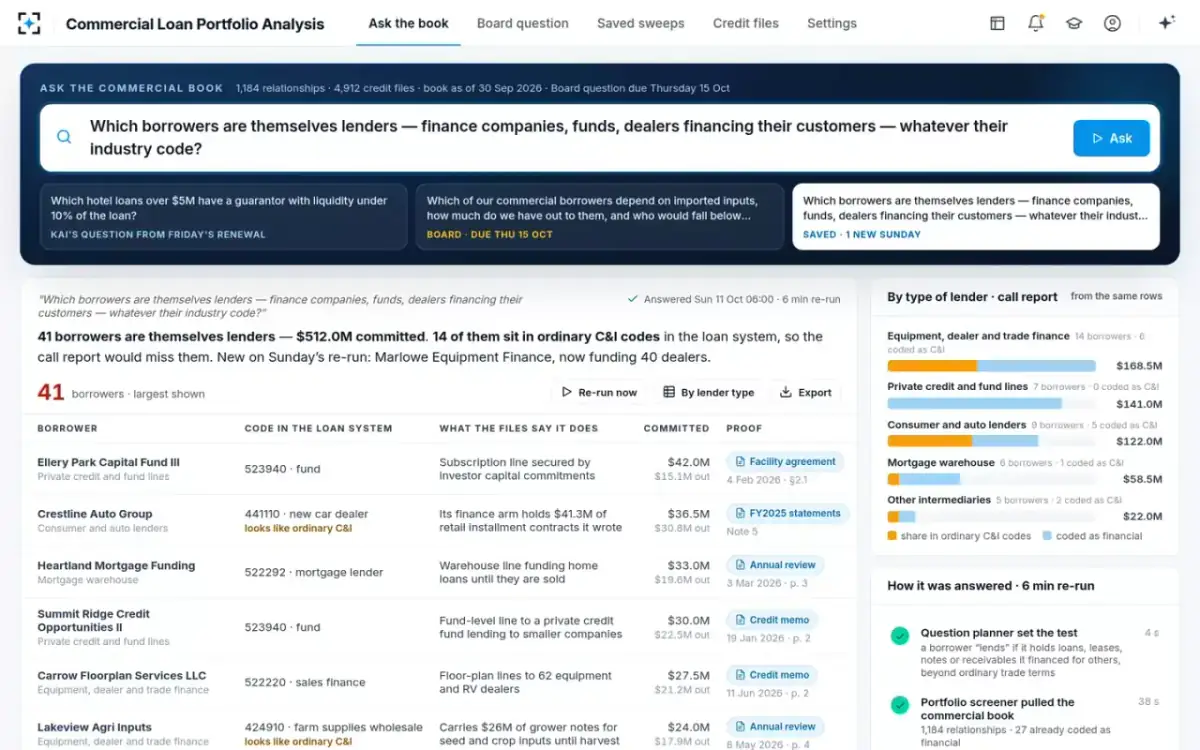
Finding indirect exposure is a reading problem. A fund-level line's credit memo says what the fund lends to; a BDC's statements say how levered its portfolio companies are. Neither appears in the bank's loan system as “leveraged.” At a fictional sample bank, a question about which borrowers are themselves lenders found 41, including private credit funds and fund lines, and 14 of them were coded as ordinary C&I. The same files are where a leveraged-lending look-through starts. The wider pattern of exposure that codes miss is in what industry codes miss.
The first step of a look-through: which borrowers are themselves lenders
Writing a definition that can be applied to every file
A definition is only bank-wide if every credit can be tested against it from what is in the file. That rules out tests that depend on someone's memory of the deal, and favours tests built from documents the bank already holds: the latest audited spread, the credit memo's statement of purpose, the sponsor named in the loan agreement, the borrower's own covenant definition of EBITDA. Write the definition so that an analyst who has never seen the borrower would reach the same answer from the file.
What a bank-wide leveraged loan definition should state
- The leverage metric and its inputs
Total or senior debt to EBITDA, or a balance-sheet measure for smaller borrowers; whether cash is netted; which EBITDA (reported, covenant, or bank-adjusted).
- The threshold, by industry where it differs
One number for most industries and stated exceptions, approved by the credit committee.
- Which statements the test uses
Latest audited, latest interim, or pro forma at closing; and what happens when the latest is stale.
- Purpose and sponsor tests
Whether acquisition, buyout or distribution financing qualifies regardless of leverage; whether sponsor ownership does.
- Exclusions
Asset-based loans governed by a borrowing base, small C&I loans under a size, investment-grade borrowers — each stated, not assumed.
- Indirect exposure
Lines to BDCs, debt funds and other lenders to leveraged borrowers, and how they are counted against the limit.
- Participations purchased
Tested the same way as loans the bank originates, from the bank’s own analysis.
- How the result is reported
The leveraged population, its trend, its stress result and the borrowers whose files cannot yet be tested.
Most of those choices are about evidence, not appetite. “Which EBITDA” is the most contested: a borrower's covenant definition may add back items that a bank's own spread does not. A definition that names its EBITDA, and a reading that cites the page each figure came from, removes most of the room for argument.
Running the definition across the book
Applying a new definition to an existing book is a one-off project with a long tail. Every relationship has to be tested once, and every new statement, amendment or participation re-tests the borrower. Done by hand, it starts with a loan-system screen by size and industry. Then analysts read memos and spreads for the candidates, and the borrowers outside the screen go unread. That is the same pattern that misses import-dependent borrowers whose codes look safe.
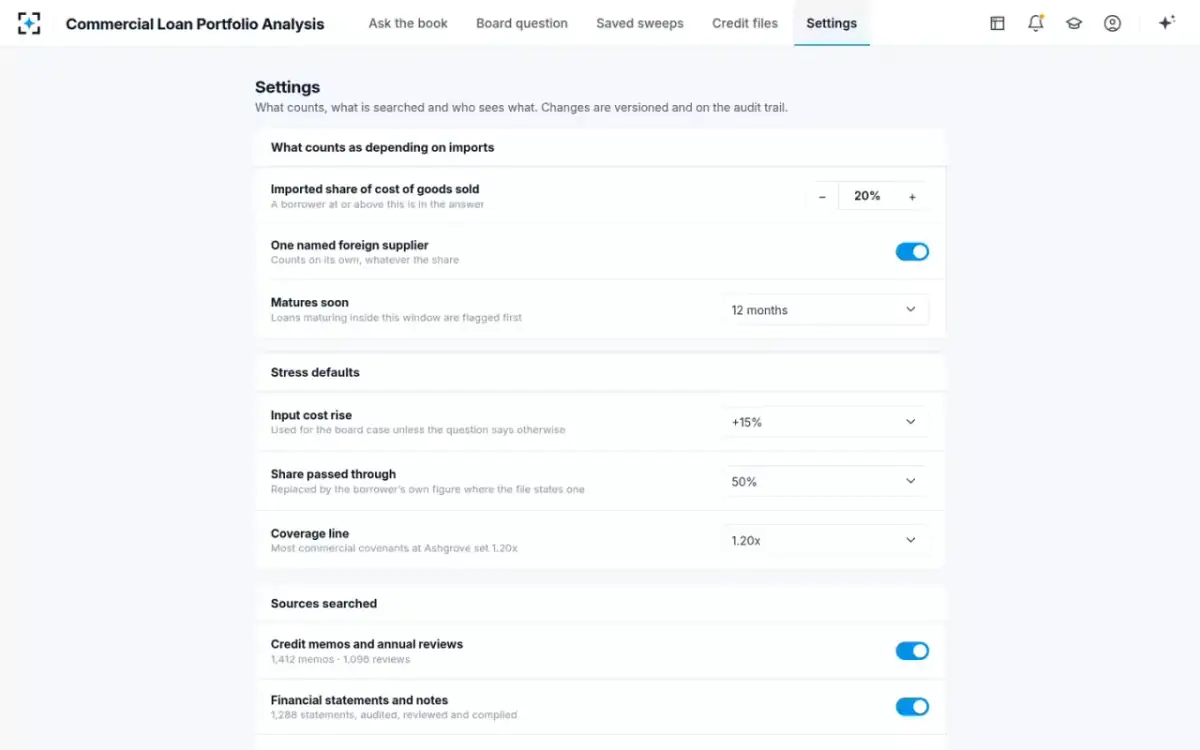
Commercial Loan Portfolio Analysis treats a definition as a setting and a question. At a fictional sample bank, the import question used a stated test, imports of at least 20% of cost of goods sold or one named foreign supplier, printed on every answer and versioned when it changes. A leveraged definition works the same way. The planner states the metric and threshold, the reader finds the figures in each file with document, page and date, and borrowers whose files cannot be tested are named rather than assumed out. The answer can be saved to re-run when new statements arrive. The agents apply the bank's definition; they never change a risk rating, and what goes to the board is approved by the chief credit officer.
A definition as a setting: what counts, versioned and on the audit trail
A definition changes what the concentration report counts, so it belongs beside the other concentration tests. The arithmetic of those is in the 25%, 100% and 300% tests. Model risk teams asking whether a tool that applies the definition is itself a model will find the 2026 position in the second line's questions about an AI that reads loan files.
Questions people ask
Was the leveraged lending guidance rescinded by all three agencies?
No. The OCC and FDIC rescinded the 2013 guidance and 2014 FAQs on 5 December 2025. The Federal Reserve had not announced a rescission as of October 2026, and SR 13-3 remained on its website. Banks supervised by the Fed should check its current position before relying on the change.
Why did the OCC and FDIC withdraw the leveraged lending guidance?
Their release said it was “overly broad,” captured loans it was not meant to cover, “including loans to investment-grade companies,” and pushed leveraged lending to nonbanks outside the regulatory perimeter. It also noted that the GAO had found the 2013 guidance was a rule under the Congressional Review Act, and it had never been submitted to Congress.
Is 6x leverage still the line?
Not as an agency expectation for OCC and FDIC banks. The 2013 guidance said leverage above 6x total debt to EBITDA “raises concerns for most industries”; that text is withdrawn for them. A bank may keep 6x, or any level, as its own threshold if it can justify it and apply it consistently.
What is an example of a leveraged loan?
A term loan funding a private equity buyout at five times EBITDA is the classic case: it meets both the purpose test and the leverage test of the 2013 template. Less obvious cases are a dividend recapitalisation for a long-standing middle-market borrower, or a fund-level line to a private credit fund whose own loans are leveraged, which the December 2025 release names as indirect exposure.
Do small business loans count as leveraged loans?
The 2013 guidance said it was not intended to apply to “small portfolio commercial and industrial loans, or traditional asset-based lending loans.” Under a bank-defined regime that is the bank's choice, and it should state the exclusion in policy rather than leave it to judgment loan by loan.
Should cash be netted against debt in a leveraged loan test?
The 2013 template said no, in its footnote 6. A bank writing its own definition can choose either way, but the choice moves borrowers across the line: in the illustrative example above, netting $40M of cash takes leverage from 5.20x to 4.40x, so the definition should state it.