In credit portfolio management at a commercial bank, five seats share every question about the book. The board's credit committee sets the risk appetite and asks; the chief credit officer, often with the chief risk officer, answers for the response; the director of portfolio management owns the analysis; senior credit analysts read the files; relationship managers know the borrowers. A routine report moves along that chain without trouble. A new question, one nobody built a report for, exposes it. Botminds' Commercial Loan Portfolio Analysis exists for that moment: its agents read every credit file against the question and return a table in which each borrower is tied to the page that proves it, so the people in each seat do their own part of the work rather than everyone's.
One unplanned question, five seats, one signature
6
duties the OCC lists for a board credit committee, from setting appetite to receiving loan review reports
64,390
credit analysts employed in the US, May 2025, at a median wage of $83,510
BLS; includes consumer credit analysts
≈400files
read by three analysts over six weeks for a sample bank’s last tariff question
1
person approves the board summary: the chief credit officer
Who owns a portfolio question at a commercial bank?
The board owns the appetite, the chief credit officer owns the answer, and the portfolio manager owns the work of producing it. That split follows the supervisory texts. The OCC's “Lending and Loan Portfolio Risk Management” booklet, which replaced the old “Loan Portfolio Management” booklet in June 2026 (Bulletin 2026-29), quotes the Director's Book: the credit committee should “establish and guide the bank's lending strategy, credit risk appetite, and risk limits” and “monitor the loan portfolio's performance, exceptions, and the [ACL].” The committee does not read files. It asks, and it decides what the answers mean for limits and strategy.
Below the board, titles vary but the jobs do not. Someone must turn a question into a definition, pull the book, read the files, total the exposure, run a stress and write the answer. In a large bank those are separate teams. In a $5 billion bank they may be three people and a spreadsheet. The questions that strain the chain are not the quarterly concentration report, which is built once and refreshed. They are the ones that arrive on a Thursday: who depends on imported inputs, which borrowers are themselves lenders, which hotel loans have a guarantor with thin liquidity.
Five seats in commercial credit portfolio management: what each asks and what it needs from the files
| Seat | Asks | Answers for | Needs from the credit files |
|---|---|---|---|
| Board credit or risk committee | Where are we exposed, and is it within appetite? | Limits, strategy and the bank’s risk appetite | Nothing directly; a summary it can rely on, with what is not known stated |
| Chief credit officer / chief risk officer | Is the answer right, and what are we doing about it? | What goes to the board and to examiners | The passages behind the largest and most surprising names |
| Director of portfolio management | What exactly counts, and how much is out? | The analysis: definition, totals, stress, the draft | Every borrower that meets the definition, tied to the book at one date |
| Senior credit analyst | What does this borrower’s file actually say? | The reading, and the spread the stress runs on | Memos, annual reviews, statement notes, supplier lists, guarantor statements |
| Relationship manager | What will the borrower do about it? | The conversation, the questionnaire, the plan | Only the borrowers the files cannot answer, and the ones the stress hits |
What does a commercial loan portfolio manager do?
A commercial loan portfolio manager looks after the loans already on the books rather than the ones being sold: their monitoring, their exceptions, their ratings, their concentrations and the reports that carry all of it to management and the board. In the OCC's 2026 booklet that is the back half of a loan's life cycle, after underwriting and approval. In a $20 billion bank the title may head a team of analysts; in a $2 billion bank it may be one officer who also runs credit administration.
The standing work is set out, duty by duty, in the supervisory texts. Credit administration includes “monitoring the status of required periodic borrower financial statements and loan covenant testing” and “monitoring the status of periodic commercial loan reviews (e.g., annual analysis and risk-rating reviews)” (OCC, 2026). The booklet sorts exceptions into financial ones, such as “Covenant breaches (even if waived)” and “DSCR below policy at the time of annual review”, and administrative ones, such as “Stale financial statements, tax returns, or borrowing base certificates”, and it warns that unidentified exceptions “are often the result of errors, miscalculations, breakdowns in the pre- or post-closing review process, or system failures.” Finding those is portfolio work, because nobody else is looking across every file.
The standing work of a commercial loan portfolio manager, and the text behind each duty
- Track statements, covenant tests and annual reviews
OCC 2026 booklet: credit administration monitors required borrower statements, covenant testing and the status of annual and risk-rating reviews.
- Find and report exceptions, including the unflagged ones
Financial (covenant breaches even if waived, DSCR below policy) and administrative (stale statements, missing lien recordation), per the same booklet.
- Watch risk-rating migration
OCC “Rating Credit Risk”: examiners “should be most concerned when rating inaccuracies understate risk.”
- Measure concentrations
OCC: a concentration is direct, indirect or contingent obligations above 25% of tier 1 capital plus the allowance.
- Stress the portfolio at least once a year
OCC Bulletin 2012-33 treats stress testing or sensitivity analysis “on at least an annual basis” as key for community banks.
- Build the management and board reports
Fed CBEM §2010.1: “analyses of the bank’s credit exposure by type, geographic areas, collateral, and large employers.”
What no job description lists is the work that takes the most time: the question nobody built a report for. Concentration reports, past-due lists and rating-migration tables are refreshed from the loan system every month. A question about import dependence, guarantor liquidity or borrowers that are themselves lenders has no field in that system, so the portfolio manager has to define it, decide which part of the book could be affected and get the files read. That is the job the rest of this guide follows.
Board risk committee responsibilities: what the committee should receive
The committee receives reports, not files, so the quality of its oversight is the quality of what reaches it. The OCC's list gives the shape of a sound package. It includes performance and exceptions, compliance with limits and law, and periodic reports from loan review that “opine on the effectiveness of the bank's loan rating systems and credit risk management practices.” The safety-and-soundness guidelines in 12 CFR part 30, Appendix A add the same expectation from the other side: underwriting should “establish a system of independent, ongoing credit review and appropriate communication to management and to the board of directors.”
What a board credit committee is expected to do, and what each duty needs from below
- Set lending strategy, risk appetite and limits
Needs exposure by industry, collateral and borrower type that management can actually measure against those limits.
- Approve lending policies and underwriting standards
Needs to know where the book departs from policy, including exceptions nobody flagged.
- Approve the largest credits
Needs the credit decision distilled, with the analysis behind it available on request.
- Monitor performance, exceptions and the allowance
Needs trends, not snapshots: what moved since last quarter, and why.
- Oversee compliance with policies, limits and law
Needs concentrations measured on the bank’s own definition, applied the same way across the book.
- Receive loan review reports
Needs an independent view, from people not involved in originating or approving the credits.
Two items on that list are where unplanned questions land: limits and monitoring. A board that reads in the news about tariffs, private credit funds or a hotel market will ask whether the bank is exposed. Answering “we do not track that” is honest but weak. Answering with a number nobody can trace is worse. The OCC's examination request list for a portfolio review already asks for “concentration and portfolio diversification reports” and “results of the most recent loan portfolio stress tests.” When the board's question is new, those reports have to be built from scratch.
Chief credit officer responsibilities: approve the answer, not produce it
The chief credit officer approves what the credit team tells the board and examiners; the portfolio manager produces it, and the two should not be the same person. The chief credit officer approves what leaves the credit team, which makes the CCO the person examiners will ask about it. The portfolio manager owns the content: the definition used, the part of the book searched, the totals and the stress assumptions. Keeping those apart is ordinary maker-checker discipline, and it matters most when the question is new and nobody has a template to compare against.
The approval is only as strong as what the approver can check. On the morning of a committee meeting a CCO cannot re-read 63 borrower files. What a CCO can do is open the five names that matter most and see the passage that put each one there. In Commercial Loan Portfolio Analysis that is how the summary arrives. Each number is footnoted to its source, and each borrower in the evidence table opens at the page behind it.
The approver’s view: the summary, its footnotes and the approval
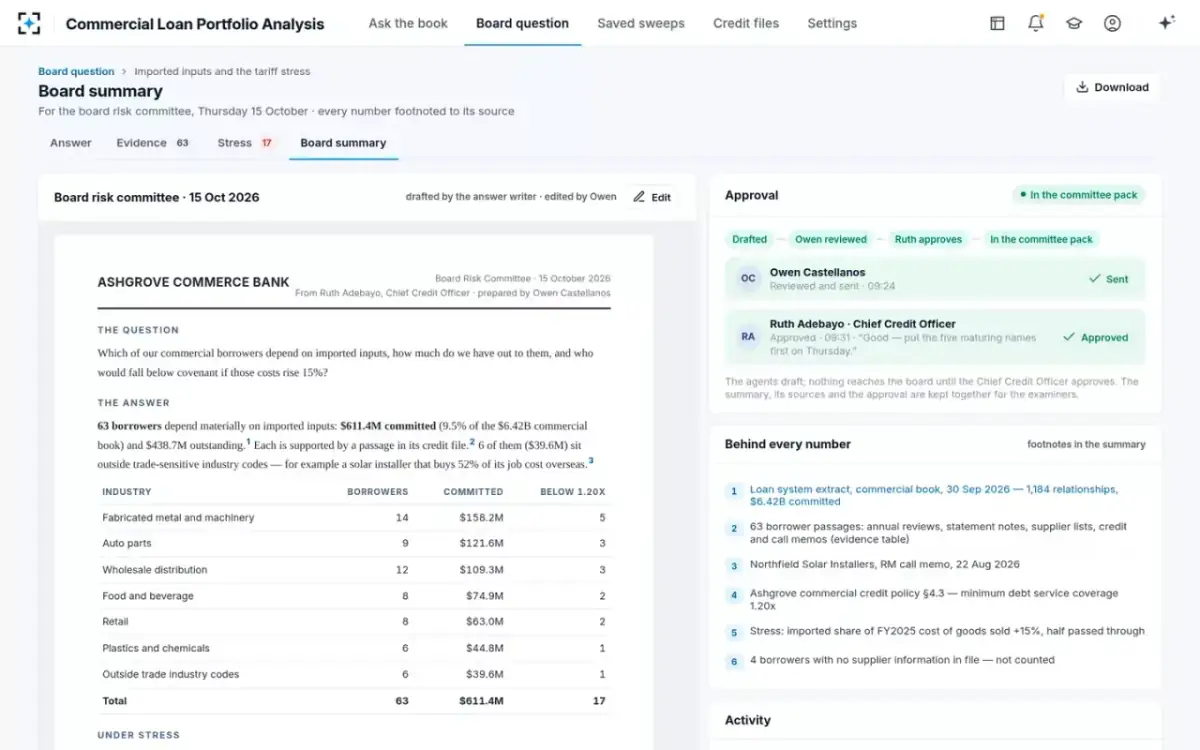
The CRO's seat varies more by bank. Where the CRO chairs the board risk committee's management reporting, the same summary goes out under both names; the sample bank's settings allow either “the chief credit officer” or “the chief credit officer and the CRO” as approvers. What should not vary is that a named person, not a system, sends the answer to the board.
Relationship manager vs portfolio manager in commercial banking: who knows what
The relationship manager knows the borrower; the portfolio manager measures the book; the analyst reads the file in between. What a new question needs to know is mostly in text, and text is read by analysts and known by relationship managers. A loan system holds what Liberti and Petersen call hard information: “almost always recorded as numbers.” Whether a borrower buys 46% of its cost of goods sold from two foreign mills is soft information in their sense, “communicated as text,” in an annual review or a call memo (NBER w25075). The Federal Reserve's manual expects the file to carry it: a current file should “identify the borrower's business or occupation” and document “the loan officer's contact with the borrower” (CBEM §2010.1).
So when the question is new, the reading falls to the people who can read. At the sample bank, the last tariff question took three senior analysts about six weeks and roughly 400 files, and they still missed borrowers whose industry codes never looked exposed. Relationship managers received a spreadsheet, filled it in from memory and their own notes, and sent it back over eight working days. Every seat was busy and nobody was sure the list was complete.
This is also where incentives bend the answer. The Federal Reserve's study of rating practice at the fifty largest banks noted that all of them set relationship managers' pay “on the basis of the profitability of the relationships in question” (Treacy and Carey). An RM is the right person to ask the borrower what it will do about a cost rise. An RM is not the right person to decide alone whether the borrower is exposed. Reading the file first, and asking the RM only where the file is silent, keeps each seat to the part it does best.
How each seat's week changes when the files can be asked
The change is not that a seat disappears; it is that each seat stops doing another seat's work. In the sample bank's morning, the portfolio manager typed the board's question in plain words at 08:40. Six agents read all 4,912 credit files for 1,184 relationships in 38 minutes, and the answer came back tied to the loan system at the 30 September book. It named 63 borrowers that depend on imported inputs: $611.4M committed, 9.5% of the book. The chief credit officer approved the summary at 09:31. The whole morning is told minute by minute in the board question, by the clock.
Four seats in Commercial Loan Portfolio Analysis, before and after
Today
Screens the book by industry code, sends RMs a spreadsheet, waits, then re-reads files for weeks.
With agents
Asks the whole book in plain words and owns an answer where every borrower carries its passage, document, page and date.
Still theirs: the definition, the stress assumptions and the draft
Today
Takes a number to the board risk committee without the pages behind it.
With agents
Approves a summary with every number footnoted, and opens the borrowers that matter most at their passages.
Still theirs: the approval, and what is said to the board
Today
Reads hundreds of files by hand for each new question, and still misses borrowers.
With agents
Opens the statement at the highlighted lines, checks the division, and keeps the question as a weekly sweep.
Still theirs: the judgment on what a passage means
Today
Gets a spreadsheet every time a question comes down; the team fills it in by hand.
With agents
Gets only the borrowers the files cannot answer, by name, and sends questionnaires where the stress bites.
Still theirs: the borrower conversation
Two details in that morning show the boundaries working. The four borrowers whose files did not say where their inputs came from were not guessed at; they were named, left out of the count, and sent to their RMs. And the stress tester moved coverage, not ratings. A stress result does not change a risk rating, which still moves only through the bank's credit process. Both rules are explained in why an AI portfolio answer must name what it cannot find.
One question’s path through the seats, with Commercial Loan Portfolio Analysis
A person decides
Board risk committee chairAsks the question: who depends on imported inputs, how much is out, who would fall below covenant.
A person decides
Portfolio managerTypes it in plain words, checks the definition the agents propose, and owns the answer.
Agent
Question planner and screenerTurns it into what counts, pulls the book at one as-of date, and passes every relationship to the reader.
Never: Clears a borrower on its industry code alone.
Agent
Credit file readerFinds the passage that answers the question in each file, with document, page and date.
Never: Claims anything without a passage.
Agent
Calculator, stress tester and writerTotals and ties to the book, stresses coverage on each spread, drafts the footnoted summary.
Never: Changes a risk rating, or sends anything to the board.
A person decides
Relationship managersAsk the borrowers the files cannot answer for, and send the questionnaire where the stress bites.
A person decides
Chief credit officerApproves the summary, with name and time, before it goes into the committee pack.
Loan review is a seat of its own, and it should stay independent
Credit risk review is the one seat that checks the others, so it should not be the seat that produces the answer. The interagency guidance expects a review function whose scope is risk-based and whose staff, at small banks, are “not involved with originating or approving the specific credits being assessed and whose compensation is not influenced by the assigned risk ratings” (Interagency Guidance on Credit Risk Review Systems). Portfolio questions often reach loan review because it is the team that already reads files. That is convenient and slowly corrodes its independence.
A shared, cited answer helps here too. Loan review can re-run the portfolio manager's question, read the same passages and reach its own view, without having been the team that drafted the board summary. The answer, the plan the agents used and the approval stay together on the audit trail, which is where an examiner will look.
What stays with people in commercial credit portfolio management
Everything that is a decision stays with a named person. The definition of “depends on imported inputs” is the portfolio manager's, set in the bank's own settings; at the sample bank, 20% of cost of goods sold or one named foreign supplier. The coverage line used in the stress is the bank's policy, not the software's. What a borrower will do is the RM's conversation. What the board hears is the CCO's approval. The agents read, total, stress and draft; they do not contact borrowers, move ratings or send to the board.
The analyst’s view: one row of the evidence table, opened at its passage
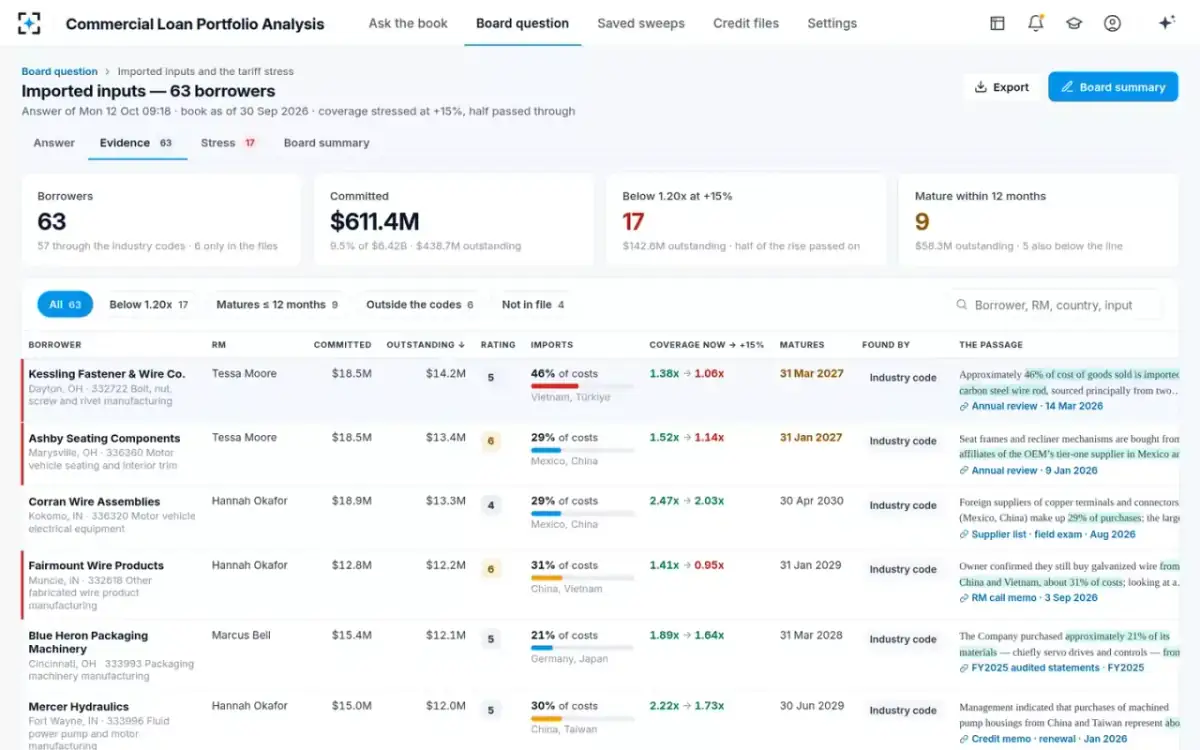
For a bank weighing whether the change is worth it, the cost of the old route is set out line by line in what a new portfolio question costs. To see the four seats on one question, screen by screen, start from Commercial Loan Portfolio Analysis.
Questions people ask
What is credit portfolio management in banks?
It is the oversight of the loan book as a whole rather than loan by loan: measuring concentrations, tracking risk-rating migration and exceptions, stress testing, and reporting the results against the limits the board has set. The OCC's June 2026 booklet “Lending and Loan Portfolio Risk Management” is now the national banks' main examiner text for it, replacing the older “Loan Portfolio Management” booklet.
What does a commercial loan portfolio manager do day to day?
Most days go to monitoring: statements and covenant tests that are due or late, exceptions, past dues, rating changes and the reports built from them. The unplanned days go to questions from the board, the chief credit officer or examiners that no standing report answers, which is where most re-reading of credit files happens.
What is the difference between a chief credit officer and a chief lending officer?
The chief lending officer runs production: the relationship managers, growth and pricing. The chief credit officer runs credit approval, policy and portfolio risk, and is meant to be the independent check on production. The OCC notes that “an independent loan approval authority (such as a senior credit officer or credit risk management team) whose primary goal is credit quality can introduce more objectivity to the loan approval process.”
Credit analyst vs portfolio manager: how do the roles differ?
A credit analyst works borrower by borrower: spreading statements, writing the credit memo and the annual review. A portfolio manager works across the book, adding those borrowers up against limits and stresses. The BLS counted 64,390 credit analysts in the US in May 2025, at a median wage of $83,510, a figure that includes consumer credit analysts.
Is the chief credit officer or the chief risk officer responsible for portfolio reporting to the board?
It depends on the bank's structure. The chief credit officer usually owns credit policy, approval and credit portfolio reporting; the chief risk officer owns the enterprise view across credit, market, liquidity and operational risk. Some banks have both sign board credit reports, and the approver should be named in policy.
Should relationship managers answer portfolio-wide questions?
They should answer for their borrowers' intentions, not act as the screen. A spreadsheet sent to every RM is slow and depends on memory, and the Federal Reserve found that all fifty of the largest banks set RM pay on the profitability of their relationships. Asking RMs only about borrowers whose files are silent, or where a stress shows real pressure, uses their knowledge where it adds most.