SR 26-2 changed how model risk management treats AI in April 2026. The Federal Reserve, OCC and FDIC replaced SR 11-7 and OCC Bulletin 2011-12 with revised interagency guidance (SR 26-2, OCC Bulletin 2026-13, FDIC FIL-15-2026) that narrows what counts as a model and states that “generative AI and agentic AI models are novel and rapidly evolving. As such, they are not within the scope of this guidance” (OCC Bulletin 2026-13). The agencies said a request for information on AI would follow; none had been published by late October 2026. For a model risk team asked to approve Botminds' Commercial Loan Portfolio Analysis, whose agents read credit files across a whole commercial book, that leaves a gap. No supervisory text sets the test, but the bank still owns the result. This guide fills the gap with questions a validator can ask and evidence a tool should be able to produce.
The guidance a validator works under in 2026
- SR 11-7 and OCC 2011-12to 17 Apr 2026
- Revised guidancegenAI out of scope
- 2023 interagency guidance in force; a replacement proposed 15 Sep 2026since June 2023
Does SR 26-2 apply to generative AI? Not yet, by design
No: generative and agentic AI sit outside SR 26-2, by design and for now. The revised guidance says generative and agentic AI are out of scope and adds that it is “expected to be most relevant to banking organizations with over $30 billion in total assets.” It also says it “does not set forth enforceable standards or prescriptive requirements; accordingly, non-compliance with this guidance will not result in supervisory criticism.” The bulletin promises more: the agencies “plan to issue in the near future a request for information that addresses model risk management generally and considers, in particular, banks' use of AI, including generative AI and agentic AI.”
Out of scope is not the same as unsupervised. The OCC's spring 2026 outlook observes that banks are adopting genAI and agentic AI “with guardrails and human-in-the-loop accountability.” It names the challenges examiners have in mind: “lack of explainability, data privacy and data poisoning issues, cybersecurity threats, and validation challenges” (OCC, 2026). The Federal Reserve's Vice Chair for Supervision drew the line by use, not technology. AI with “more direct impact on credit decisions affecting individual customers” presents “more substantial legal compliance challenges” (Bowman, July 2026). Portfolio analysis informs oversight rather than deciding individual credits, which places it at the lower end of that range, but not outside it.
SR 26-2 vs SR 11-7: what changed, line by line
SR 26-2 narrows what counts as a model, says plainly that it is not enforceable, aims itself at larger banks and leaves generative AI out. The Federal Reserve's letter says the revised guidance “supersedes and replaces SR letter 11-7, Guidance on Model Risk Management (issued April 4, 2011)” and that it “is expected to be most relevant to banking organizations with over $30 billion in total assets regulated by the Federal Reserve” (SR 26-2). On the OCC side, Bulletin 2026-13 formally rescinded Bulletin 2011-12 along with the Comptroller's Handbook booklet on model risk management.
SR 11-7 (2011) against SR 26-2 (2026), on the points that decide how AI is treated
SR 11-7, April 2011: Any quantitative method applying statistical, economic, financial or mathematical theories to produce quantitative estimates
SR 26-2, April 2026: “A complex quantitative method, system, or approach” applying statistical, economic or financial theories
SR 11-7, April 2011: None in the definition
SR 26-2, April 2026: Simple spreadsheet arithmetic; deterministic rule-based processes and software without such theories
SR 11-7, April 2011: Supervisory guidance examiners applied
SR 26-2, April 2026: “Does not set forth enforceable standards”; non-compliance “will not result in supervisory criticism”
SR 11-7, April 2011: All Fed-supervised banking organisations, scaled
SR 26-2, April 2026: “Most relevant” above $30 billion in total assets
SR 11-7, April 2011: Predates them
SR 26-2, April 2026: Expressly “not within the scope”; a request for information promised
SR 11-7, April 2011: No separate statement for community banks
SR 26-2, April 2026: The OCC says its guidance does not require community banks to validate annually
For AI the effect cuts both ways. A tool built from deterministic arithmetic and fixed rules is now plainly outside the model definition, which relieves the totals and the stress arithmetic of a portfolio tool. A tool that reads and interprets text is generative AI, and so falls outside the guidance's scope entirely, which removes the checklist without removing the risk. Banks that ran every vendor tool through an SR 11-7 inventory now have to decide, part by part, which regime each piece of a product belongs to.
Is generative AI a model? Reading an agent against the SR 26-2 definition
Parts of it may be, parts of it are not, and the 2026 definition makes the split clearer than SR 11-7 did. A model is now “a complex quantitative method, system, or approach that applies statistical, economic, or financial theories to process input data into quantitative estimates.” The term excludes “simple arithmetic calculations, such as those found within spreadsheets, as well as deterministic rule-based processes.” The OCC's 2026 lending booklet still lists “stress testing, and portfolio monitoring” among model uses and says models “used for credit underwriting and decisioning should be subject to sound model risk management” (OCC, 2026).
The parts of a portfolio answer, read against the 2026 definition of a model
| Component | What it does | Our reading of the 2026 definition | How to validate it |
|---|---|---|---|
| Totals by industry, rating, maturity | Sums committed and outstanding; ties to the loan system | Arithmetic: outside | Tie-out to the book at the as-of date |
| Coverage stress on each spread | Applies a cost rise to a stated share, net of pass-through, and recomputes debt service coverage | Deterministic arithmetic on stated inputs; the inputs are where judgment sits | Recompute a sample by hand; check that assumptions print with results |
| Reading files for the passage | Finds and quotes the text that answers the question | Generative AI: outside the guidance’s scope, not outside the bank’s risk management | Re-perform a sample, including cleared borrowers; plant gaps |
| Turning a question into a test | States what counts, which files, which part of the book | Generative AI interpreting policy settings | Check the plan against the bank’s settings; it is printed on every answer |
The practical consequence is to validate each part with the test that suits it, rather than treat the whole as one model or as none. Totals are tied out. Stress arithmetic is recomputed. Reading is re-performed. Interpretation is checked against written policy. A vendor that cannot separate those parts for a validator is asking the bank to accept a black box the guidance never contemplated.
Model risk management for generative AI in financial institutions: what carries over
Most of the old model risk toolkit carries over to generative AI if each practice is re-aimed at what the tool actually does: read, interpret and draft. What does not carry over is conceptual soundness in the old sense, because a language model has no economic theory to review. What replaces it is a review of the instructions and limits the bank sets, which are written down and can be read. The NIST framework's MEASURE function, and the OCC's own list of “validation challenges” for generative AI, point the same way: test what the tool produces, against evidence, repeatedly (NIST AI RMF 1.0; OCC, 2026).
Classic model validation practices, re-aimed at an AI that reads loan files
| Practice | For a statistical model | For an agent that reads files |
|---|---|---|
| Inventory | List the model, owner, use and tier | The same: list the tool, its uses, its owner and what it is barred from |
| Conceptual soundness | Review the theory and assumptions | Review the written definition, source rules and agent limits the bank set |
| Outcomes analysis | Back-test predictions against defaults | Re-perform a sample of answers from the files, cleared borrowers included |
| Benchmarking | Compare with a challenger model | Compare with a question the bank answered by hand, borrower by borrower |
| Ongoing monitoring | Track drift in inputs and performance | Re-run the same question; track the not-in-file rate and reversals |
| Change control | Re-validate after material changes | Version every setting; compare answers across versions |
The mapping also shows where the effort moves. Statistical validation is front-loaded: a model is built, validated and then monitored. A reading tool's errors are answer-specific, so more of the checking moves to each answer, which is why the portfolio manager's review and the chief credit officer's approval are part of the control, not a courtesy.
Third-party rules still apply in full
Whatever happens to model risk guidance, buying the capability does not move the responsibility. The 2023 interagency guidance says “the use of third parties does not diminish or remove banking organizations' responsibilities to ensure that activities are performed in a safe and sound manner and in compliance with applicable laws and regulations” (88 FR 37920). A replacement was proposed on 15 September 2026. The agencies said the 2023 text “frequently has been interpreted in an overly broad manner,” and the proposal leans toward tailoring by “reasonably assessed risk levels” (proposed guidance). Neither version lets a bank hand over accountability for what it tells its board.
For a portfolio tool, the third-party questions are concrete. Where do the credit files go, and are they used for anything beyond the bank's own answers? Who at the vendor can see them? Can the bank export every answer with its sources if it leaves? And can it see, for any answer, which settings and which version of the tool produced it?
Twelve questions for the second line
A validator does not need the RFI to start. The NIST AI Risk Management Framework, voluntary and “use-case agnostic,” organises the work into four functions, “GOVERN, MAP, MEASURE, and MANAGE,” and lists “valid and reliable” and “accountable and transparent” among the characteristics of trustworthy AI (NIST AI RMF 1.0). The questions below follow that shape.
Questions to ask of AI that reads loan files across a portfolio
- Who owns each answer, and who approves what leaves the team?
Govern. Expect a named owner and a named approver, with the approval and its time kept with the answer.
- What may the agents never do?
Govern. Change a risk rating, contact a borrower, send to the board: each should be prevented, not merely discouraged.
- Which users see which relationships?
Govern. Answers should respect the bank’s entitlements, for example an RM seeing only their own book.
- What is the tool used for, and what is it not used for?
Map. Portfolio oversight and board questions, not individual credit decisions, unless the bank decides otherwise and validates for it.
- Which sources does it read, and which does it ignore?
Map. A setting the bank controls, printed or retrievable for each answer.
- How is the question turned into a test?
Map. The definition used should be visible on the answer in the bank’s own words.
- Does every claim carry a passage, document, page and date?
Measure. Sample the passages; check they say what the row claims.
- What happens when the file is silent, stale or contradictory?
Measure. Plant gaps in a test copy; expect “not in file”, not a guess.
- Do totals tie to the loan system, and what happens when they do not?
Measure. The answer should stop, not footnote the difference.
- Does the same question on the same files give the same borrowers?
Measure. Re-run and compare; instability is a finding.
- What changes when settings or versions change, and is it versioned?
Manage. Every change to what counts should be on the audit trail.
- How are errors reported back and fixed?
Manage. A named route from a reviewer’s correction to the next run.
Evidence a validator can re-perform
The strongest evidence is what lets a validator repeat the work without the vendor. For each answer that means the question as asked, the plan the agents used, the as-of date, the totals and their tie to the book, each borrower's passage with document, page and date, the list of borrowers the files could not answer for, and the approval. In Commercial Loan Portfolio Analysis those sit on the answer screen and stay with it on the audit trail. Run times are shown agent by agent, so a validator can see what each step did.
What a validator sees in Commercial Loan Portfolio Analysis: the answer, each agent’s step and the numbered sources
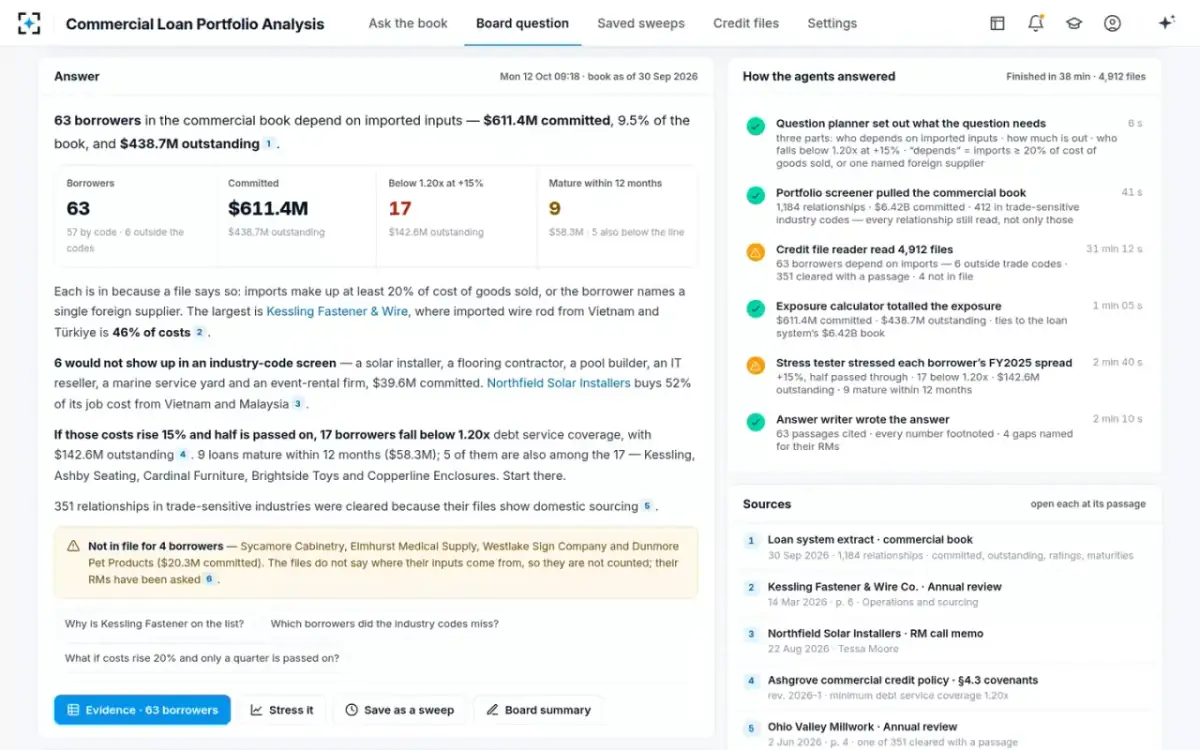
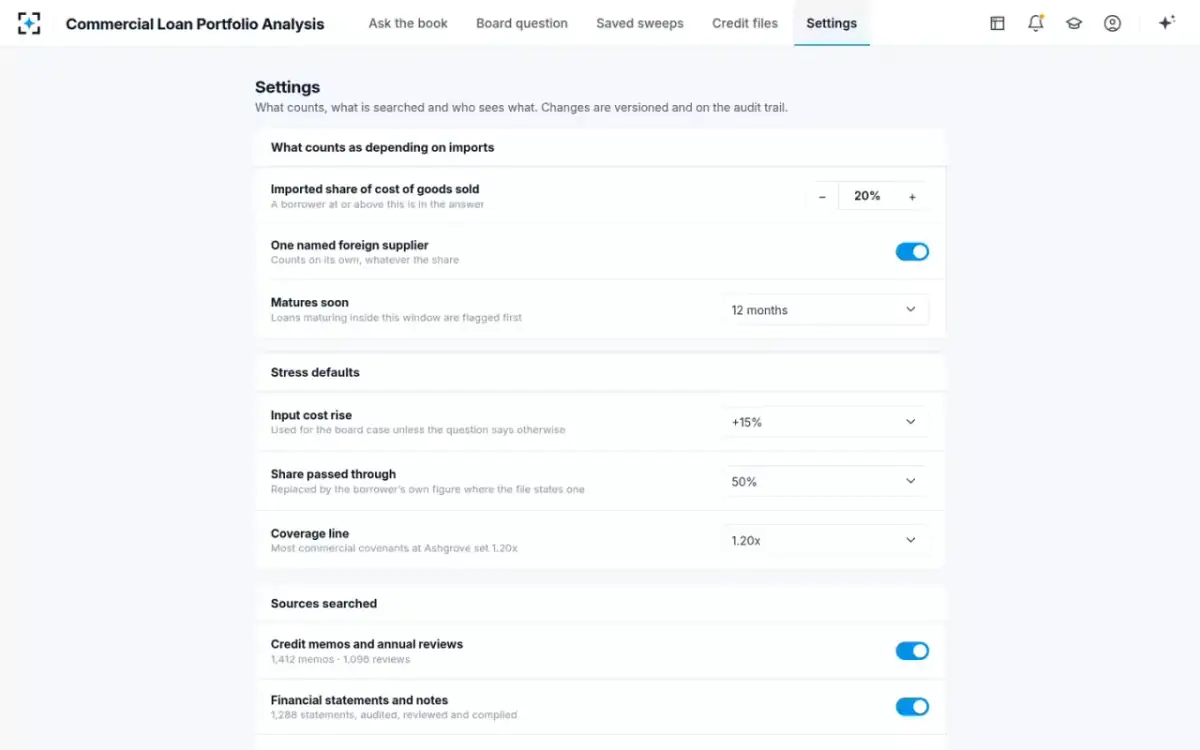
Three design choices make that evidence trustworthy rather than merely present. Assumptions print with every stress result, so a reviewer never has to infer them. Settings, such as the imported share that counts or the coverage line, are versioned, so a re-run months later can be compared. And the agents' limits are stated per agent: the screener never clears a borrower on its code alone, the reader never claims anything without a passage, the stress tester never changes a rating, the answer writer never sends to the board.
What a validator tests on arithmetic, and what it tests on reading
Arithmetic: totals and stress: A total that does not tie; a ratio recomputed differently
Reading: passages and gaps: A passage that does not say what the row claims; a borrower wrongly cleared
Arithmetic: totals and stress: Tie-out; recompute a sample
Reading: passages and gaps: Re-perform a sample from the files, cleared borrowers included
Arithmetic: totals and stress: Edge inputs: zero debt service, negative EBITDA
Reading: passages and gaps: Planted gaps, conflicting documents, stale statements
Arithmetic: totals and stress: Deterministic: same inputs, same result
Reading: passages and gaps: Re-run the same question; compare borrower lists
Arithmetic: totals and stress: Validator, on the arithmetic
Reading: passages and gaps: Validator on the method; portfolio manager and CCO on each answer
How the reader behaves when files are silent is examined in the borrowers it says it cannot answer for, including a seven-point test a validator can run on a first answer.
What the board should be told about the tool
The board should be told what the tool does, who is accountable for its answers and how they were tested, in a paragraph, not an appendix. A suitable form: the portfolio team uses software that reads the bank's credit files to answer portfolio questions. Each figure is traced to a source document, borrowers whose files cannot answer are listed separately, and the chief credit officer approves every summary. Model risk has validated the arithmetic and tested the reading on a sample. That is more than many board reports say about the spreadsheets they rest on.
Policy as settings: what counts, the stress defaults and the sources, all versioned
When the RFI arrives, banks that already validate AI this way will have evidence ready. Those waiting for a rule will be starting later. How the tool connects to the bank's systems, and what that means for third-party review, is in software that leaves your core where it is.
Questions people ask
What is SR 26-2?
It is the Federal Reserve's letter of 17 April 2026 issuing the revised interagency guidance on model risk management, published the same day by the OCC as Bulletin 2026-13 and the FDIC as FIL-15-2026. It narrows the definition of a model, states that it is not enforceable, and puts generative and agentic AI outside its scope.
Is SR 11-7 still in effect?
No. SR 26-2 “supersedes and replaces” SR 11-7 as of 17 April 2026, and the OCC formally rescinded its counterpart, Bulletin 2011-12, in Bulletin 2026-13. Articles that cite SR 11-7 as current predate the change.
Is agentic AI a model under SR 26-2?
The guidance does not decide it: it says generative and agentic AI models are “not within the scope of this guidance.” In practice a bank can split an agent into parts, treating its arithmetic as outside the model definition and testing its reading and planning under its own AI risk framework until the promised request for information produces something firmer.
Does SR 26-2 apply to banks under $30 billion?
It applies to Fed-supervised banking organisations generally but says it is “expected to be most relevant” to those with over $30 billion in total assets. Smaller banks still need to manage the risk of tools they rely on, scaled to that risk; the guidance itself sets no enforceable standard for any size.
What framework can a bank use for AI model validation now?
NIST's AI Risk Management Framework is the common choice: voluntary, use-case agnostic and organised into the GOVERN, MAP, MEASURE and MANAGE functions. Its “valid and reliable” characteristic translates directly into re-performing a sample of an AI tool's answers from the source files.
Do community banks have to validate AI tools annually?
The OCC has said its model risk guidance “does not, and should not be interpreted to, require community banks to perform annual model validation” (cited in Bulletin 2026-13). A community bank should still test any tool whose output it relies on, scaled to the risk, and document how.