Loan portfolio monitoring software is usually priced and justified on scheduled reports: the concentration report, the watch list, the stress test, the call report. The larger hidden cost is the unplanned question, the one the board or an examiner asks that no report answers. Each one pulls analysts off their work to re-read files, sends relationship managers a spreadsheet, and takes weeks. No published survey measures that cost, so a bank has to price it from its own hours. This guide shows how, using a fictional sample bank whose last tariff question took about six weeks by hand, and sets out what to measure once Botminds' Commercial Loan Portfolio Analysis is answering such questions from the credit files.
Where about 30 working days went on one question, by hand
Sample bank’s last tariff question, by hand
- Screening, totals, stress and writing · 23%
- Waiting on RM spreadsheets · 27%
- Re-reading memos, reviews and statements · 50%
What does loan portfolio monitoring software do?
It does two different jobs, and many tools are built for only the first, so know which job a product does before you compare prices. The first is scheduled monitoring from the loan system and the credit administration records: statements due and late, covenant tests, annual reviews outstanding, past dues, rating migration, and the concentration and watch-list reports built from them. The Federal Reserve's manual describes the need, expecting banks to run “a file documentation tickler system to help bank personnel obtain updated information on borrowers” (CBEM §2010.1). That job runs on structured data and is well served.
The second job is answering a question the data has no field for: which borrowers import, which guarantors are thin, which borrowers lend to others. That job runs on the text of memos, reviews, statement notes and supplier lists. A buyer should know which job a product does before comparing prices, because a tool built for the first will answer the second only for borrowers whose codes happen to fit.
Two jobs that both get called loan portfolio monitoring software
Scheduled monitoring from the loan system: Balances, codes, ratings, maturities, tickler dates
New questions answered from the credit files: Memos, annual reviews, statement notes, supplier lists, call memos
Scheduled monitoring from the loan system: Exception lists, concentration tables, watch lists
New questions answered from the credit files: A list of borrowers with the passage that puts each one there
Scheduled monitoring from the loan system: Once, then refreshed monthly or quarterly
New questions answered from the credit files: When the board, an examiner or the CCO asks
Scheduled monitoring from the loan system: The risk has no field in the system
New questions answered from the credit files: The file is silent: the answer must say so
Scheduled monitoring from the loan system: Reads the loan system extract to tie totals; does not replace it
New questions answered from the credit files: This is the job it does
The questions nobody budgets for
Supervisors expect banks to be able to answer them, even though nobody schedules them. The OCC's 2026 handbook lists among the documents examiners request “concentration and portfolio diversification reports” and “results of the most recent loan portfolio stress tests” (OCC, 2026). The Federal Reserve's 2025 priorities for community and regional banks start with “high-risk credit concentrations and credit risk management” (Supervision and Regulation Report, June 2026). The concentration that matters this year, such as tariff-exposed borrowers, lenders to lenders or hotels with thin guarantors, is rarely the one a report was built for.
The largest banks carry an enormous scheduled reporting load as it is. The Federal Reserve estimates the FR Y-14 collections at 774,828 burden hours a year across 35 holding companies with $100 billion or more in assets, about 22,000 hours each (Federal Register, May 2026). Those hours cover the schedules the Fed defined. They do not cover the next question a board asks, and at a smaller bank there is no Y-14 team to absorb it.
The scale of portfolio reporting, and the people who do the reading
774,828
hours a year: the estimated burden of FR Y-14 reporting across 35 large holding companies
≈22,000
hours per holding company per year, on the defined schedules alone
our arithmetic
$100,850
mean annual wage of a US credit analyst, May 2025, before benefits and overhead
≈6weeks
for a sample bank’s last unplanned tariff question, by hand
Where the six weeks go
Half of the elapsed time is reading and a quarter is waiting. At the sample bank, three senior credit analysts re-read about 400 files over about 15 working days. Relationship managers took eight working days to return a spreadsheet asking which of their borrowers imported. Screening by code, totalling, stressing and writing took the rest. The waiting is not idle. Every RM who fills in the spreadsheet is doing it between client calls, from memory, and the answers vary in quality.
The cost of the answer's gaps is harder to see. The code screen at the sample bank would have missed six import-dependent borrowers with $39.6M committed, sitting in codes nobody thought to screen. A spreadsheet reply that leaves a borrower out looks the same as one that clears it. The board receives a number with no way to tell how complete it is, and the bank cannot show an examiner why any borrower is or is not on the list.
How much does loan portfolio monitoring software cost? Price it against the questions
Each vendor sets its own price and no regulator publishes a benchmark, so the useful comparison is with what the bank spends answering questions by hand. Price a question with the bank's own inputs: files read, minutes per file, analyst and RM hours, and the loaded cost of each. For illustration only, suppose reading takes 45 minutes a file. Then 400 files is 300 analyst hours. At the BLS mean credit-analyst wage of $100,850 a year, about $48.50 an hour over 2,080 hours, that is roughly $14,500 in wages before benefits and overhead (BLS; our arithmetic). Add RM hours, the portfolio manager's assembly, and the analyst work that did not get done while the question ran.
The return on answering a portfolio question from the files
Analyst reading released
files re-read × hours per file × loaded analyst rate
The largest line by hand: about 400 files at the sample bank.
Portfolio manager prices it
RM time released
RMs surveyed × hours per spreadsheet × loaded RM rate
With the files read first, RMs are asked only about borrowers the files cannot answer.
RM team leads price it
Exposure found that a screen misses
commitments found outside the code screen
Not a saving; a risk the board now sees. $39.6M on the sample question.
CCO judges its value
Cost to run and check
subscription + set-up + review time per answer
Validation, the CCO’s approval and the RM follow-up remain.
Finance and model risk
Count questions per year, not one question. A bank that answers several unplanned questions a year by hand can spend months of senior analyst time on them, and some go unanswered because the cost is too high. When a question costs an hour, people ask more of them. At the sample bank a senior analyst kept a weekly question running on borrowers with one customer above 25% of revenue. It flagged three new names in one week from newly filed statements, a question nobody would have commissioned at six weeks a time.
ROI of credit portfolio analytics: one year of questions, worked through
The return is the hand cost of the questions a bank already answers, plus the value of the questions it stops refusing, less what the software and its checking cost. The first term can be priced from public wage data. Take an illustrative bank that answers four unplanned portfolio questions a year by hand, each like the sample bank's tariff question: 300 analyst hours of reading, 40 RMs spending two hours each on a spreadsheet, and 60 hours of the portfolio manager's assembly, stress and drafting.
The hand cost of four unplanned portfolio questions a year, illustrative bank
| Line | Hours per question | Hourly wage | Wages per question |
|---|---|---|---|
| Analysts reading files | 300 | $48.50 (credit analyst mean) | $14,550 |
| RMs filling in the spreadsheet | 80 | $42.21 (loan officer mean) | $3,377 |
| Portfolio manager: totals, stress, draft | 60 | $48.50 | $2,910 |
| Wages per question | 440 | $20,837 | |
| Loaded at +40% for benefits and overhead (an assumption) | $29,172 | ||
| Four questions a year | 1,760 | $116,688 |
Set against that is the subscription, the set-up, and the review time that remains with a faster answer: the portfolio manager checking the plan, the chief credit officer opening the largest names, model risk re-performing a sample. Those are real hours, and a business case that omits them will not survive finance. The term that usually decides the case is the one no spreadsheet captures. At the sample bank, saved questions re-ran 31 times in one month; at $29,000 a question by hand, none of them would have been asked.
Loan portfolio stress testing inside the question
Loan portfolio stress testing is usually budgeted as an annual exercise, yet most board questions about exposure end in one: if costs rise, who falls below covenant? The OCC expects “some form of stress testing or sensitivity analysis of loan portfolios on at least an annual basis” at community banks. It describes “bottom up” transaction stress tests that assess “the impact of changing economic conditions on a borrower's ability to service debt” (OCC Bulletin 2012-33). It adds that effective methods “can range from a single spreadsheet analysis to a more sophisticated model.” By hand, a borrower-level coverage stress across dozens of borrowers means re-keying each spread, which is why it is often replaced by one loss rate on the pool.
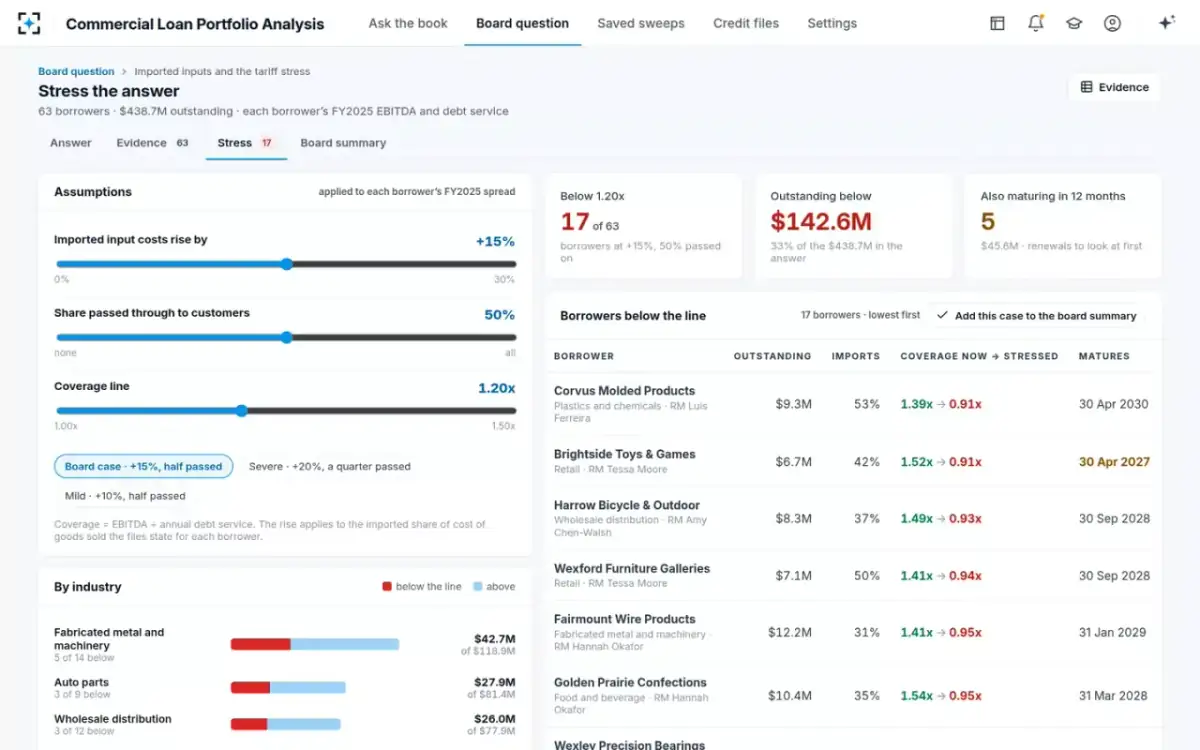
In the solution the stress runs on each borrower's latest audited spread and applies the cost rise only to the imported share the files state. At the sample bank's board case, a 15% rise with half passed through put 17 of 63 borrowers below the 1.20x coverage line, with $142.6M outstanding. Asked about a severe case, the agents re-ran it in the same answer.
Borrowers below 1.20x coverage under two stress cases, sample bank
A borrower-level stress in Commercial Loan Portfolio Analysis, with the assumptions on the page
What KPIs to track for loan portfolio management after go-live
Measure time and completeness, not only time. A faster answer that is less complete has lowered the cost by lowering the quality. The solution's design targets are one hour from a board question to a cited answer and 100% of credit files read for the question. Both are targets to measure in the bank's own deployment. They are not results.
Measures for a portfolio question, before and after
| Measure | How to count it | Why it matters |
|---|---|---|
| Time to a cited answer | Question asked to summary approved, in working hours | The board’s wait; target one hour |
| Share of relationships read | Relationships read ÷ relationships in the book for the question | A code screen reads a fraction; target 100% of files |
| Borrowers with a passage | Counted and cleared borrowers carrying a source ÷ all classified | Whether each inclusion and exclusion can be defended |
| Not-in-file rate | Borrowers the files cannot answer ÷ relationships read | The honest size of what is not known; also a documentation signal |
| Found outside the screen | Borrowers and commitments not in the code screen | What the old method would have missed |
| RM requests per question | Borrowers sent to RMs by name | Should fall to the not-in-file list and the borrowers the stress hits |
| Questions asked and kept | New questions per quarter; saved questions re-running | A falling cost should raise the number of questions asked |
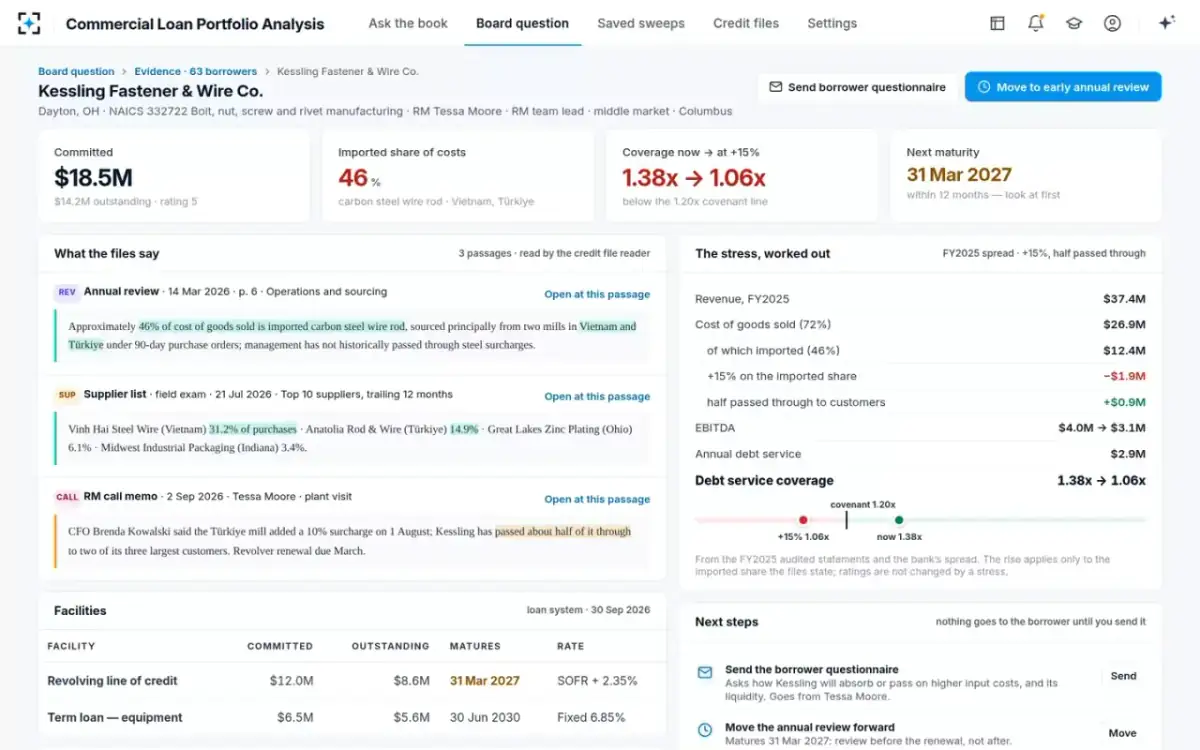
One borrower, the stress worked line by line
What it does not save
Some costs stay, and a business case should say so. The relationship manager's conversation with a borrower whose coverage falls below covenant is the point of the exercise. The chief credit officer's review of the summary, and model risk's validation of the tool, take time and should. Files that do not answer a question still have to be completed, and a not-in-file list makes that work visible rather than making it disappear.
The return comes from moving the reading off senior people's desks and from asking more questions, earlier. How the time divides between seats is in credit portfolio management roles. The minute-by-minute version of the sample bank's morning is in the board question, by the clock. What the bank needs to bring to start is in software that leaves your core where it is.
Questions people ask
What are credit monitoring tools in banks?
They are the systems and reports that keep track of loans after closing: tickler systems for statements and covenant tests, annual review tracking, risk rating and watch lists, past-due and exception reports, and concentration and stress reports for management and the board. The Federal Reserve's examination manual expects the tickler and the exposure analyses; the tools differ in whether they read only the loan system or the credit files too.
How many hours does an unplanned portfolio review take?
No regulator publishes a benchmark for one-off questions. For scale, the Federal Reserve estimates the defined FR Y-14 schedules alone at about 22,000 hours a year per large holding company. A bank should count its own: at the fictional sample bank, the last tariff question took about 30 working days across analysts, RMs and the portfolio team.
What does a credit analyst cost, for pricing analyst time?
The BLS put the median US credit analyst wage at $83,510 and the mean at $100,850 in May 2025, a figure that includes consumer credit analysts. Add benefits and overhead to reach a loaded rate, and use the bank's own payroll where it differs.
How do you stress test debt service coverage across a commercial portfolio?
Take each borrower's latest spread, apply the shock to the line it affects (such as the imported share of cost of goods sold), net of what the borrower can pass on, recompute EBITDA against annual debt service, and compare with the covenant or policy line. Aggregating the borrower results is the OCC's “bottom up” portfolio stress.
Does portfolio monitoring software replace annual reviews?
No. Lending policy should still require “an annual review of borrowers, including a reassessment of the appropriateness of credit lines,” in the Federal Reserve's words. What software can do is show which reviews are stale before a question relies on them: the sample bank had 58 relationships with a review older than 15 months, flagged on every answer.
Is loan portfolio monitoring software a model under the 2026 guidance?
Its arithmetic is not: the April 2026 guidance excludes “simple arithmetic calculations” and deterministic rules from the definition of a model. Software that reads files with generative AI falls outside that guidance's scope instead, and needs the bank's own testing; the second line's questions are set out in SR 26-2 and AI.