Loan portfolio analysis software usually means one of two things: a reporting layer over the loan system's data, or a new database the bank migrates its loans into. Both work on hard data, the numbers the core already holds. Neither reads the credit files, which is where the answers to most new board questions sit: who supplies a borrower, who its customers are, what its guarantor owns. Botminds' Commercial Loan Portfolio Analysis takes a third route. It reads a loan system extract for balances, codes, ratings and maturities, reads the credit files the bank already keeps, and joins them at one as-of date. Nothing moves out of the core and nothing is re-keyed into a new system. This guide sets out what is read, what is never written, how answers tie to the book, and what a bank brings to start.
How Commercial Loan Portfolio Analysis joins the core and the files
Agent
Loan system extractCodes, commitments, outstanding balances, ratings and maturities for every commercial relationship, at one as-of date.
Never: Is replaced; the core stays the system of record.
Agent
Credit files, read in placeMemos, annual reviews, statements and notes, supplier and customer lists, field exams, call memos and guarantor statements, read as they arrive.
Never: Are edited or moved.
Agent
The joinEach passage is tied to its relationship; totals are tied to the loan system’s book.
Never: Mixes as-of dates; if totals do not tie, the answer stops.
Agent
The answerA table and chart with a proof link on every row, filtered to what the asker may see.
Never: Shows a relationship to someone not entitled to it.
A person decides
Portfolio manager and CCOOwn and approve the answer; it reaches the board only after the chief credit officer approves.
Loan portfolio analysis in banks: two systems, two kinds of truth
Loan portfolio analysis in banks draws on two systems, and the core and the credit file answer different questions, and portfolio analysis needs both. The loan system is the authority on how much is committed and outstanding, under which code, at which rating, maturing when. The credit file is the authority on the borrower: in the Federal Reserve's words, it should let reviewers “analyze the credit before it is granted and to monitor and evaluate the credit during its life,” documenting the borrower's business, financial condition, repayment sources and collateral (CBEM §2010.1). Liberti and Petersen's distinction fits: hard information is “almost always recorded as numbers,” soft information “is often communicated as text” (NBER w25075).
Most portfolio software is built on the first and ignores the second, so a question the numbers cannot answer goes back to people and spreadsheets. The OCC's 2026 booklet lists the sources examiners themselves use for portfolio analysis: “loan trial balance, loan committee packages, concentration reporting, loan pipeline reporting, loan origination reporting, lending policy exception and override reporting, and credit risk review reports” (OCC, 2026). Several of those are documents, not data.
What Commercial Loan Portfolio Analysis reads, and what each source is used for
| Source | What is read | Used for | At the sample bank |
|---|---|---|---|
| Loan system extract | Codes, commitments, outstanding, ratings, maturities | The book, the totals and the as-of date | 1,184 relationships, $6.42B committed |
| Credit memos | Purpose, structure, business description, risks | Why a borrower is in or out | 1,412 memos |
| Annual reviews | Operations, sourcing, performance, rating rationale | The current description of the borrower | 1,096 reviews |
| Financial statements and notes | Audited, reviewed and compiled statements, concentration notes | Spreads for stress; customer and supplier notes | 1,288 statements |
| Customer and supplier lists | Top suppliers and customers by share | Supplier and customer dependence | 604 lists |
| Borrowing-base certificates and field exams | Collateral, purchases by supplier | Confirmation of sourcing; collateral detail | 312 documents |
| RM call memos | What the borrower told the banker | Recent changes not yet in a review | 200 memos |
| Guarantor statements | Personal financial statements and guaranty agreements | Guarantor liquidity and contingent liabilities | Read for the hotel question |
Does loan portfolio analysis software integrate with the core banking system?
It should read from the core without writing to it. Commercial Loan Portfolio Analysis reads a periodic extract, and the core stays the system of record. The extract carries the fields a loan trial balance already has, so it can usually come from reporting the bank already runs. Ratings, balances and codes stay in the core. The agents never change a risk rating, and a stress result does not move one; ratings change only through the bank's credit process.
Migrating to a new portfolio system against reading in place
Migrate to a portfolio database: Mapped and loaded into a new schema; reconciled after every change
Read the core extract and files in place: Read from a standard extract at a stated as-of date
Migrate to a portfolio database: Usually left out, or summarised into fields by hand
Read the core extract and files in place: Read in full, as they arrive, with passages cited
Migrate to a portfolio database: Two copies to keep in step
Read the core extract and files in place: The core remains the only one
Migrate to a portfolio database: Often a new field, a new load and a new report
Read the core extract and files in place: Typed in plain words; the definition is a setting
Migrate to a portfolio database: Unwind the migrated data
Read the core extract and files in place: Export answers with their sources; nothing to unwind in the core
Loan portfolio analysis Excel template or software: where a spreadsheet stops
A spreadsheet is enough for a top-down stress on call report categories, and it stops being enough when the question needs the credit files. The OCC says effective stress testing methods “can range from a single spreadsheet analysis to a more sophisticated model,” and that for most community banks “a simple, stressed loss-rate analysis based on call report categories may provide an acceptable foundation” (OCC Bulletin 2012-33). The 2026 model risk guidance goes further and leaves “simple arithmetic calculations, such as those found within spreadsheets” out of the definition of a model altogether (OCC Bulletin 2026-13). A loan portfolio analysis Excel template built on the trial balance is a legitimate tool.
Its limits are about inputs, not arithmetic. A template can only hold what someone typed into it, so every new question about the borrowers themselves starts with people reading files and keying results. Each re-keyed spread is a chance for error, each copy of the workbook drifts to its own as-of date, and nothing in a cell says which page it came from. When the board asks who depends on imported inputs, the template is where the answer ends up, not where it is found.
Loan portfolio analysis: a spreadsheet template against software that reads the files
| Task | Spreadsheet template | Software reading the files in place |
|---|---|---|
| Concentration ratios from the call report | Well suited | Not needed for this |
| Top-down loss-rate stress by category | Well suited; the OCC accepts it for most community banks | Not needed for this |
| Borrower-level coverage stress | Possible, after re-keying each spread | Runs on each spread already read, with assumptions printed |
| Who depends on an input, customer or guarantor | Only after people read the files and type the result | Read from every file, with the passage on each row |
| Keeping one as-of date | By discipline; copies drift | One date per answer; totals tie or the answer stops |
| Showing the source of each figure | Usually absent | Document, page and date on every row |
Reading files where they live
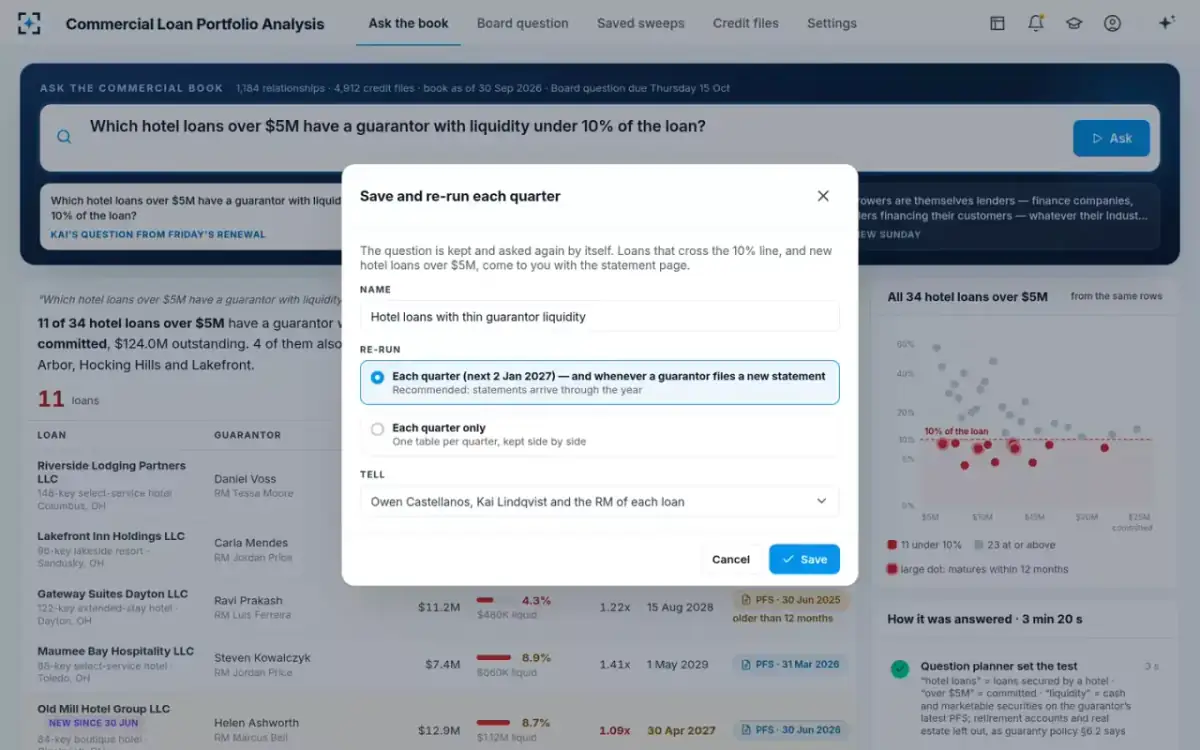
The files stay where the bank keeps them, and the solution reads them there. New documents are read as they arrive. At the sample bank, 14 files added in one week were read within minutes, and saved questions re-ran on them. That is what turns a one-off answer into monitoring. A question saved on Monday asks itself again when a guarantor files a new statement or an RM files a call memo.
The credit files: what each answer can draw on, and what it cannot stand on yet
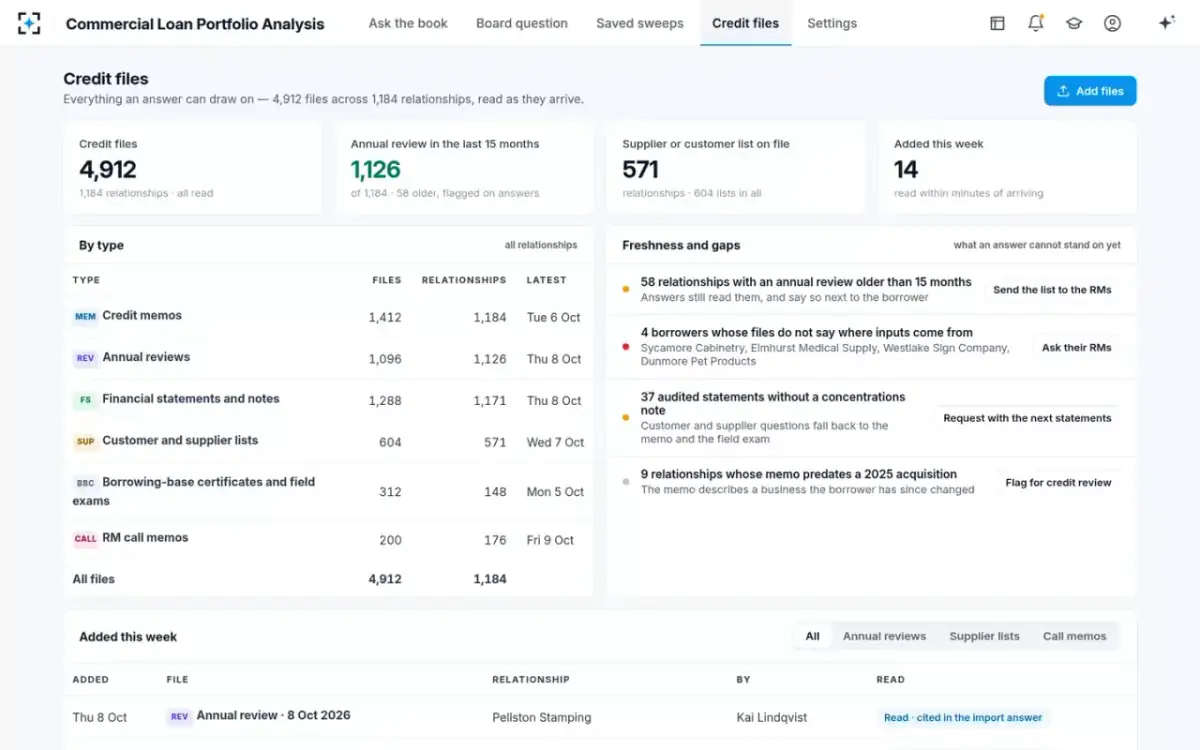
The same screen doubles as a documentation check. The OCC's 2026 booklet asks examiners whether the bank has “a system to monitor the timely submission of commercial borrower and guarantor financial statements” (OCC, 2026). The sample bank's list of 58 relationships with annual reviews older than 15 months is that system's output, and answers still read those reviews and flag them next to the borrower.
Tying every answer to the book
Every answer has one as-of date, and its totals tie to the loan system or the answer does not go out. On the sample bank's import question, the screener pulled the 30 September book, $6.42B committed across 1,184 relationships. The exposure calculator's $611.4M committed and $438.7M outstanding tied to it. A board number that does not reconcile to the general ledger's loan balances is the first thing an auditor or examiner will question, so the reconciliation is part of the answer rather than a separate step.
One answer, one date, one book
30 Sep
the single as-of date for every figure in the sample bank’s board answer
$6.42B
committed in the commercial book, from the loan system extract
$611.4M
committed to the 63 borrowers in the answer, tied to that book
1,184
relationships in the book, every one read for the question
Large banks already file borrower-level data with supervisors. The Federal Reserve's FR Y-14Q corporate schedule includes an “Obligor Financial Data Section.” In May 2026 the Board adopted revisions extending that reporting to borrowers that are nondepository financial institutions, effective 31 December 2026 (Federal Register, May 2026); they had been proposed in June 2024 (89 FR 52042). For those banks, an answer that reconciles to the same book as the regulatory filing avoids a second version of the truth.
Loan portfolio analysis software: what a buyer should compare
Compare products on what they read, what they write, how they reconcile and how a bank leaves them, before comparing dashboards. Those four decide the integration effort, the third-party review and the examiner's view of the output. A short list of questions, asked of every product the same way, separates reporting layers over the core from tools that can answer a question the core has no field for.
Loan portfolio analysis software: questions to ask every product, and the answer to look for
| Ask | Look for | Why it matters |
|---|---|---|
| What does it read? | The loan system extract and the credit files, named by document type | A tool that reads only the core cannot answer questions about suppliers, customers or guarantors |
| What does it write back? | Nothing to the core; ratings untouched | The core stays the single system of record |
| How do totals reconcile? | One as-of date per answer, tied to the book, stopping if they do not tie | A board number that does not reconcile is the first thing an examiner questions |
| What does each figure cite? | Document, page and date for every borrower-level claim | An answer that cannot be traced cannot be approved |
| What happens when a file is silent? | A named “not in file” list, outside the totals | Silent files otherwise look like cleared borrowers |
| Who sees what? | The bank’s entitlements applied to every answer | RMs should see their own book only |
| How do we leave? | Answers export with their sources; nothing to unwind in the core | Exit planning is part of third-party due diligence |
Who sees what
Answers respect the bank's existing entitlements. At the sample bank, relationship managers see their own book, while portfolio management and credit see all of it. A question typed by an RM returns only that RM's relationships. Every question, answer, re-run and approval is on the audit trail, and changes to settings are versioned.
Third-party oversight applies to all of this. The 2023 interagency guidance says “the use of third parties does not diminish or remove banking organizations' responsibilities” (88 FR 37920), and the replacement proposed in September 2026 keeps that principle while encouraging oversight tailored to risk (proposed guidance). A bank's review should cover where files are processed, who can see them, how long passages are kept and how answers are exported. The model risk questions are in the second line's questions about an AI that reads loan files.
What data does loan portfolio analysis software need? What you bring
Three things: the credit policy, a loan system extract, and a sample of credit files. The policy sets what counts. At the sample bank that included an imported share of 20% of cost of goods sold, a 1.20x coverage line and a 15-month limit on annual review age, each a setting. The extract sets the book. The files show the reader what the bank's documents look like. Botminds runs the solution on that sample first, against a question the bank's board has actually asked, so the bank judges it on its own files rather than on a demonstration.
What to bring to a first run of Commercial Loan Portfolio Analysis
- The credit policy sections that define what counts
Coverage lines, guarantor liquidity rules, review-age limits, concentration definitions: the settings the answers will use.
- A loan system extract for the commercial book
Relationship and facility identifiers, codes, committed, outstanding, rating, maturity, RM, at one as-of date.
- A sample of credit files across document types
Memos, reviews, statements, supplier lists, field exams, call memos and guarantor statements, enough to cover the variety.
- A question the board or an examiner has asked
Ideally one answered by hand before, so the two answers can be compared borrower by borrower.
- The entitlement model
Who may see which relationships, so answers are filtered from the first run.
- The approver
Who signs what leaves the credit team: the chief credit officer, or the CCO and the CRO.
The comparison with a past answer is the most useful test. If the bank answered a tariff or concentration question by hand last year, the first run should find the same borrowers, plus any the old method missed. It should name the ones whose files cannot say and show the passage for each. Where it disagrees, the passages show who is right. Why the not-in-file list matters in that comparison is in the borrowers it says it cannot answer for, and how to price the old method is in what a new portfolio question costs.
After the first answer: save it and let it re-run
Questions people ask
Does loan portfolio analysis software need to replace the core banking system?
No. Portfolio analysis needs the core's balances and codes, but it can read them from an extract. Commercial Loan Portfolio Analysis reads the extract and the credit files where they are, and the core remains the system of record.
What is a loan portfolio management system, and is it the same thing?
Usually not. A loan portfolio management system typically tracks loans after closing from structured data: statements due, covenant tests, reviews, ratings and exceptions. Portfolio analysis answers questions across the book, and the new ones often need the text of the credit files, which tracking systems do not read.
How are answers kept consistent with the call report and the general ledger?
By using one as-of date per answer and tying totals to the loan system's book at that date. If they do not tie, the answer stops rather than presenting a number that would not reconcile.
How long does it take to implement loan portfolio analysis software?
It depends mostly on whether data must be migrated. Reading in place, the first run needs an extract the bank's reporting can usually already produce, a sample of files and one past question, so the work is gathering those rather than mapping a new database. A migration to a new portfolio database adds mapping, loading and reconciliation for every source.
Is commercial lending software for banks the same as portfolio analysis software?
No. Commercial lending software usually means origination: applications, spreading, credit memos, approvals and closing. Portfolio analysis starts after closing and looks across the whole book, so a bank may run both, with the portfolio tool reading what the lending system produced.
Can we keep using our Excel templates?
Yes, for the work they suit. The OCC accepts a simple stressed loss-rate analysis on call report categories as a foundation for most community banks, and spreadsheet arithmetic is outside the 2026 definition of a model. Software earns its place on the questions that need the files.