Redaction services for clinical documents cover the preparation of a disclosure package for publication: marking what identifies patients, investigators and staff, proposing what is commercially confidential and drafting the justification for each claim, applying the recoding and generalisation the anonymisation plan calls for, producing both versions of every document in the form each authority specifies, and writing the anonymisation report. A sponsor can run that inside, buy it as a service, or split it — and the decision is hard because the volumes are lumpy and the deadlines are not. EMA's own advice is to start early and to settle the question before the opinion: prepare the package "in house or vendor chosen" (EMA, Policy 0070 relaunch webinar, 2023). Botminds' Clinical Trial Disclosure & Redaction changes the arithmetic rather than the choice: it does the reading and the proposing, in-house or alongside a vendor, and leaves the three judgements that cannot be bought with the people who have to defend them.
The sponsor, study, medicine and people in the examples below are invented sample data used to demonstrate the solution. The published volumes and deadlines are the authorities' own, linked where they appear.
What do redaction services actually cover?
The phrase covers a wide range of commitments, and the first job in any comparison is to pin down which of eight pieces of work a proposal includes. Preparing the redaction proposal version of each document, with everything marked and labelled but still legible. Identifying and marking personal data of patients, and separately of investigators, sponsor staff and the applicant's staff. Identifying candidate commercially confidential passages and drafting a justification for each. Applying the anonymisation techniques beyond black boxes — recoding, date offsetting, banding, pooling. Measuring re-identification risk. Writing the anonymisation report. Producing the final redacted files to the technical and colour requirements. And responding to the Agency's comments when they come back.
Expect the first, the second and the seventh to be the easiest to price, and the third, the fifth and the eighth the hardest — the last of them often quoted as time and materials. That is not evasion; those three depend on decisions the sponsor has not made yet. Which is the real shape of the problem.
The volumes a disclosure programme has to absorb
The scale is public, and it is larger than most teams assume before their first procedure. In its 2023 relaunch webinar EMA set out what it had published in 2022 for COVID-19 medicines alone: "46 PROCEDURES 742 DOCUMENTS 206,771 PAGES", with web traffic of 23,996 viewings and 57,428 downloads (EMA, Policy 0070 relaunch webinar, 16 May 2023). That is roughly 4,500 pages and sixteen documents in an average procedure — and an average hides the largest Phase 3 packages.
What one year of publication looked like, in EMA's own figures
46
procedures published in 2022 under Policy 0070 for COVID-19 medicines
742
documents across them — about sixteen in an average procedure
206,771
pages — roughly 4,500 a procedure, before any sponsor-side rework
57,428
downloads of the published clinical data in the same year
The downloads matter to the sourcing decision more than they look. Published clinical data is read: tens of thousands of downloads in one year, by researchers, competitors and journalists. Whatever a programme costs, it is producing a document that will be examined, which is an argument against treating redaction as a clerical overhead to be pushed to the cheapest available pair of hands.
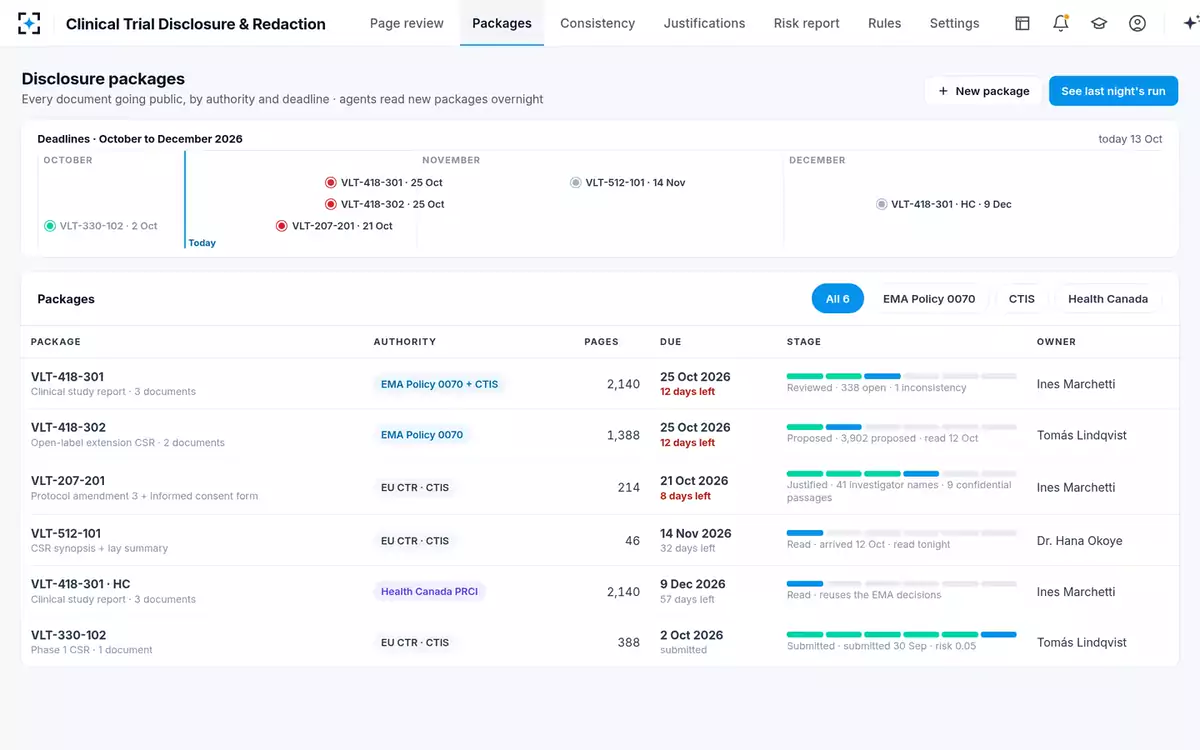
The shape of the load is the other half of the problem. Packages do not arrive evenly. On the board of one disclosure lead in the invented sample configuration there are six packages across three authorities with four deadlines inside eight weeks: two study reports due to EMA on the same day, a protocol amendment and an informed consent form due in CTIS four days earlier, a synopsis and lay summary due in CTIS three weeks after that, and the same study report due to Health Canada in December. A team sized for the average is idle for a quarter and underwater for a month.
Six packages, three authorities, four deadlines in eight weeks
The clocks: EMA's day 47, Health Canada's 60 calendar days
Capacity planning here is unusual because almost none of the dates are yours. The European submission window is defined by the procedure: "For initial marketing authorisation applications and line extension applications, applicants must submit their Redaction Proposal between D181 and ≤30 days post-opinion", with different windows for extensions of indication and for withdrawn applications (EMA, Clinical data publication: overview, process and timelines, 2024). The invitation email that starts it arrives at day 121 of the procedure, so a sponsor gets notice — if somebody is watching for it.
After submission the clock stops being generous. The redaction conclusion letter arrives on day 47 with the Agency's outcome on the confidential redactions, and then the final package is due fast: the Final Redacted Document package has to reach the Agency as a new sequence within seven calendar days of the conclusion letter, or of EMA's final response where comments were exchanged (EMA Policy 0070 external guidance, v1.5, §§2.3.3.1.15 and 2.4.8). Seven calendar days, to apply whatever was rejected or accepted across every document, re-cut the final files to the published form, and bring the anonymisation report into line.
Canada runs its own clock and it is shorter at the front: from the day Health Canada initiates the process, the manufacturer is asked for the de-identified documents and proposed redactions within 60 calendar days, and the authority aims to have the final package on its clinical information portal within 120 calendar days (Health Canada, Public Release of Clinical Information).
The two clocks, drawn on the same axis of calendar days
- Sponsor prepares and submits60 days
- Health Canada to publicationto day 120
- Before the window opensD121 → D181
- Submission windowD181 → opinion +30
Read the two lanes as a staffing question rather than a compliance one. The European front end is generous enough to plan: sixty days of notice, then a window. The back ends of both are not. A model that depends on sending files out and waiting has to survive a seven-day turnaround on a package that has just been partly rejected, in a month when two other packages are open.
Three judgements you cannot outsource
Three decisions in a disclosure package are the sponsor's whatever the operating model, because the sponsor is who the authority deals with and who will defend them. Vendors can prepare all three; nobody else can own them.
The three that stay inside, and what each one costs if it travels
| The judgement | Why it cannot be bought | What a vendor can legitimately do |
|---|---|---|
| What the company will claim as commercially confidential | It is a commercial position about your own pipeline, and a rejected claim is published anyway. Only the company knows what is already public and what is still unannounced. | Find candidate passages, draft each justification, and flag claims that look weak against the published rejection grounds. |
| Which re-identification risk method the company will defend | The metric, the adversary, the variable set and the threshold are a position you have to restate on every package and in front of a reviewer. | Propose a method, compute it, and show the result by site group — but the method is approved internally. |
| What the company is willing to publish | Beyond the rules there is a judgement about borderline material, and the published file carries the company’s name, not the vendor’s. | Prepare the package and highlight every borderline call rather than resolve it quietly. |
That is also the answer to the question procurement asks last and should ask first: who is responsible if a vendor misses an identifier. Contractually, whatever you negotiate. In front of the authority and the people in the listings, the sponsor — which is why the review step belongs inside even when the marking does not. What the three judgements have in common is that each has a document attached to it: the justification table, the anonymisation report, and the submission itself.
What does redaction cost, and what drives the number
There is no published rate for this work, and a guide that invented one would be worse than useless. What can be said is what drives it, and the drivers are unusually visible. Pages, obviously, and the page counts are public: roughly 4,500 in an average published procedure, and a large Phase 3 study report with its appendices can be a sizeable share of that on its own. The proportion of the package that is not text, because a scanned page has to be read as an image before anything else can be done with it. The number of authorities, since the same study report may go to Europe and to Canada. And rework: the seven-day turnaround after the conclusion letter, and any finding that sends a team back through the package.
Two floors are worth knowing. EMA will license a redaction tool to a micro, small or medium-sized enterprise for twelve months, with advice to contact the SME office five months before the opinion (§2.3.3.1.7) — so for a small sponsor the tooling cost of a first procedure can be close to nothing. And the internal effort is estimable even when the price is not: the solution's own estimate for one Phase 3 study report and its appendices splits eleven working days by hand across five activities, against a design target of two.
Where the working days go on one study report package, by activity
The two rows in the middle are the ones a sourcing decision should look at hardest, because they behave differently from the first. Marking pages scales with pages and is the easiest thing to buy by the hour. Checking one identifier against every other place it appears does not scale with pages at all — it scales with how many places each identifier turns up in, and it is the work a second vendor pass cannot replace, because two passes by the same method make the same mistake twice.
In-house, vendor, or vendor plus review: three operating models
Three ways to staff it, and how each behaves when two packages land together
| Model | What it is good at | Where it strains | Who carries the judgement |
|---|---|---|---|
| In-house | Knowledge of the pipeline, fast decisions on confidentiality, no handover loss, and the seven-day turnaround is survivable because the people are already in the room. | Peaks. A team sized for the average cannot absorb three packages in a month, and a team sized for the peak is idle most of the year. | Entirely inside, which is where it has to end up anyway. |
| Vendor-prepared | Elastic capacity, experience across many sponsors, and a predictable unit price for the marking. | Turnaround on rework, briefing cost on every new study, and a confidentiality list that has to be re-explained each time. | Formally inside, practically drifting outward unless the review is real. |
| Vendor-prepared, reviewed inside | The peak absorbed outside, the judgements kept inside, and a second pair of eyes by design rather than by budget. | Double handling if the review is a re-read rather than a check; it only works if the inside review looks at different things from the outside pass. | Inside, explicitly, with the vendor accountable for completeness rather than for decisions. |
Where software changes the comparison is in what the inside review can be. A review that is a second human read of 2,140 pages is unaffordable at any volume, so it becomes a sample, and a sample does not find the one identifier readable in a listing footnote. A review that starts from every identifier linked across the package, with the fourteen handled differently listed with the reason each was missed, is a few hours and finds exactly the class of error a page-by-page pass cannot. That is the same argument as the one for choosing redaction software by package rather than by page, arriving from the staffing side.
How do you compare redaction vendors on something other than price?
Ask every proposal the same twelve questions, and require the answers in writing rather than in a meeting. Most of these have a right answer, and the ones that do not at least make two proposals comparable.
Twelve questions to put to a redaction proposal
- Will you run a back-test on a package we have already published?
The single most informative thing in any evaluation: known answers, our documents, scored against what we actually published.
- What is your turnaround for the seven days after a redaction conclusion letter?
Not the standard turnaround. The one that applies when the Agency has rejected confidentiality claims across several documents.
- Who drafts the confidentiality justifications, and who signs them?
Drafting can be bought. Signing cannot. A proposal that is vague here has not understood the deliverable.
- How do you handle scanned pages and handwritten annotations?
Ask for the count of scanned pages in a sample package and what was done with each one.
- How do you guarantee one identifier is handled the same way in every document?
The answer "our reviewers are careful" is the answer that fails. Ask what is compared, and what the output of that comparison looks like.
- What happens to the un-redacted originals, where do they live, and when are they destroyed?
Get this in the contract, with a named jurisdiction and a deletion date rather than a policy reference.
- Who writes the anonymisation report, and on which template?
One report per package, on the mandatory joint template. A vendor that offers a report of its own design has not produced one before.
- Will the recoding scheme be reproducible across packages and years?
The same subject must carry the same code in a later publication of the same study. Ask how that is stored and by whom.
- Can you deliver both versions — read-through proposal with labels, final file in the required colours?
Ask for a sample of each from a real procedure, redacted of its content.
- What do you need from us, and when?
A proposal that needs nothing from the sponsor has not priced the confidentiality list or the risk method.
- How is the work staffed when three of our packages are open at once?
Named capacity, not a statement about the size of the firm.
- What does year two cost, and why is it different from year one?
If the answer is "the same", the vendor is not reusing anything — which is a finding about the service, not about the price.
What to hand over, and what to keep
A clean division is easier to run than a negotiated one, and it is mostly decided by who has to live with the consequence.
Line by line, with the reason
| The work | Where it belongs | Why |
|---|---|---|
| Reading every page and proposing redactions | Either — this is the elastic part. | It scales with pages and has a measurable output, so it can be contracted, automated or both. |
| The confidential-information list and what is already public | Inside. | It is a statement about your pipeline, and it changes between packages in ways nobody outside can track. |
| Drafting each confidentiality justification | Either, drafted; signed inside. | A drafted reason saves hours. A signed one is a commercial claim to a regulator. |
| The recoding scheme and the subject code list | Inside, always. | It has to be identical across documents, across authorities and across years. It is an asset, not a by-product. |
| Risk method and measurement | Method inside; computation either. | The method is a position you defend; the arithmetic is arithmetic. |
| Consistency checking across the package | Inside, or automated — but never a second manual pass. | Two manual passes by the same method find the same things. This check is a comparison, not a re-read. |
| Producing the two file versions | Either. | A technical deliverable with a written specification, which is exactly what a service should be bought for. |
| The anonymisation report | Drafted either way; approved and attested inside. | It is the document that describes what you did, and it is published with the package. |
| The un-redacted originals | Inside, in a locked store. | The strongest control in the whole programme is that the original never leaves and is never part of an output. |
Why the second year should cost less than the first
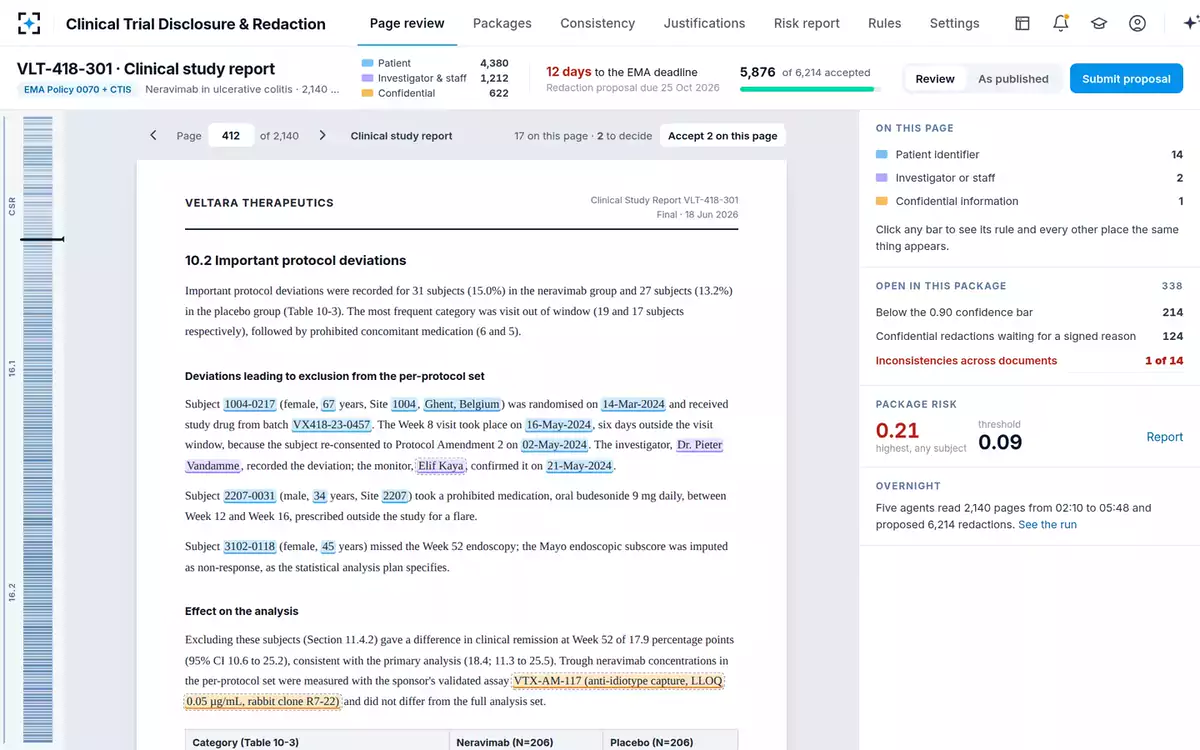
Almost everything expensive about a first package is reusable, and a programme that does not get cheaper is a programme that is throwing its own work away. The confidentiality list, once written and once tested against what the Agency accepted and rejected, is the starting point for every package after it. The recoding scheme for a study is permanent. The anonymisation methodology, once a reviewer has read it without comment, becomes the template for the next one. And the decisions on one study report are the starting proposals for the same report going to a second authority — in the sample configuration, 6,214 decisions made for the European package are copied to the Canadian one as proposals, with the confidential redactions sent back for a fresh look because the rules differ and nothing is applied until a person accepts it.
That is the question to put to any operating model, in-house or bought: what does it carry forward? A vendor priced per page carries forward nothing by design. A team that marks pages in a tool with no memory of the last package carries forward only what is in people's heads. The reason to ask about year two in a first conversation is that the answer describes the method, not the discount.
One page, with every decision tied to the rule that made it
Decide the three judgements first, then the clocks, then the model — in that order, because the first two constrain the third. To see what a package looks like when the reading is done overnight and the decisions stay with the people who sign them, start from Clinical Trial Disclosure & Redaction.
Questions people ask
Should you outsource clinical document redaction?
Outsource the part that scales with pages if your volumes are lumpy; keep the three judgements that the sponsor has to defend — what you claim as confidential, which risk method you will stand behind, and what you are willing to publish. EMA's own advice is simply to settle it early, before the opinion, and to prepare the package either in house or with a vendor chosen. The model that fails is the one where the inside review is a slower repetition of the outside pass.
How long does a redaction package take?
The windows are set by the authority, not by the work. In Europe the redaction proposal is submitted between day 181 of the procedure and thirty days after the CHMP opinion, with the final redacted package due within seven calendar days of the redaction conclusion letter. Health Canada asks for proposed redactions within 60 calendar days and aims to publish within 120 calendar days of initiating the process.
How many pages does a disclosure programme have to redact?
More than a first-time sponsor expects. EMA published 206,771 pages across 742 documents and 46 procedures of COVID-19 clinical data in 2022 — roughly 4,500 pages in an average procedure. A single Phase 3 study report with its appendices can run to thousands of pages on its own.
Who is responsible if a vendor misses an identifier?
The sponsor, in every sense that matters. The applicant or marketing authorisation holder is who submits the package, who answers the Agency's redaction conclusion, and whose attestation closes the anonymisation report; contractual recourse against a vendor does not change any of that. It is the reason the review step belongs inside even when the marking does not.
What should you never hand to a vendor?
The subject recoding scheme, the confidential-information list and the un-redacted originals. The first has to stay identical across documents, authorities and years; the second is a live statement about your own pipeline; and the third is the control that makes everything else recoverable. Everything from reading pages to producing the final files can reasonably be bought.
Why should the second package cost less than the first?
Because almost all of the expensive work is reusable: the confidentiality list tested against what was accepted and rejected, the recoding scheme, the methodology a reviewer has already read without comment, and the decisions themselves, which can be carried to a second authority as proposals. A proposal in which year two costs the same as year one is telling you that nothing is being carried forward.