The 16.2 patient data listings are the per-patient tables at the back of a clinical study report, and they are where redaction fails. ICH E3 puts them there on purpose: "individual patient data for specified groups of patients should be provided as listings in Appendix 16.2", one row per patient per event, each row carrying the patient identifier next to the demographic detail a reader needs to interpret it. That is also the exact combination of quasi-identifiers that makes a person findable. A study report body can be anonymised by a careful reader working page by page. Three thousand listing pages, in which the same participant appears in dozens of rows, footnotes and page headers, cannot — not because the work is hard on any one page, but because the thing being protected is a pattern across pages nobody reads together.
Botminds' Clinical Trial Disclosure & Redaction is built around that fact: every occurrence of every identifier in a package is linked, in whatever form it takes, so one decision covers all of them and any occurrence left readable is flagged with the reason it was missed. The worked example on this page is invented sample data — the sponsor Veltara Therapeutics, the medicine neravimab, study VLT-418-301 and subject 1004-0217 — while the guidance, the regulation and the research figures are the sources' own.
One sample study report package, by the numbers
2,140pages
in the package: the report body, Appendix 16.1 and the 16.2 listings
312
of those pages are scans, where an identifier is an image until something reads it
1,946
distinct identifiers linked to every place they appear across the three documents
38places
one subject number appears: 6 in the body, 3 in Appendix 16.1, 29 in the listings
What is in Appendix 16.2 of a clinical study report?
ICH E3 names eight sub-appendices, and each one is a different way of printing one patient per row: "16.2.1 Discontinued patients 16.2.2 Protocol deviations 16.2.3 Patients excluded from the efficacy analysis 16.2.4 Demographic data 16.2.5 Compliance and/or drug concentration data (if available) 16.2.6 Individual efficacy response data 16.2.7 Adverse event listings (each patient) 16.2.8 Listing of individual laboratory measurements by patient, when required by regulatory authorities".
The guideline sets out why they exist. Data should be presented "at different levels of detail": summary figures and tables for the important variables in the text, other summary tables and listings in section 14, and individual patient data as listings in Appendix 16.2. The three levels answer three different questions — what happened, what happened in each subgroup, and what happened to each person — and the last one is the one that cannot be aggregated away without losing the point.
Which listing pages actually get published
Here is a distinction worth getting right before a team spends two weeks on the wrong pages. Under EMA Policy 0070 in its current phase, the appendices under 16.2 are marked out of scope in the Agency's own scope table: "All appendices located under 16.2. PATIENT DATA LISTINGS — Out". What is in scope is the report body. And the guidance is emphatic that listings inside the body stay: "Individual patient data listings within the body of the report cannot be considered out of scope and should not be removed", including "listings extracted from 16.2. Patient Data listings (and labelled as such) that have been repurposed as part of CSR section 14". The one exception is the abnormal laboratory value listings typically found in section 14.3.4, which may be treated as out of scope where the report does not follow the ICH E3 format — while aggregated patient data listings within 14.3.4 "should NOT be removed".
So the published listing pages are usually extracts: the subset of 16.2 that the medical writer lifted into section 14 to make a point, printed in the body with the same identifiers, the same dates and the same site codes as the appendix they came from. That is why a disclosure team cannot treat 16.2 as somebody else's problem. The published extract has to be anonymised exactly as its source would be, and if the appendix is also released — to a researcher under a data-sharing agreement, or in a later phase of publication — the two versions have to agree. (Health Canada, for its part, says individual patient records, including patient listings and full case report forms, are not released with the rest of the clinical information.) Two differently redacted copies of the same listing are a re-identification method in themselves.
What fields does ICH E3 require in a patient data listing?
The adverse event listing is the clearest case, because E3 specifies its columns. All adverse events for each patient "should be listed in appendix 16.2.7, giving both preferred term and the original term used by the investigator", by investigator and by treatment group, and the listing "should include: Patient identifier; Age, race, sex, weight (height, if relevant); Location of CRFs, if provided; The adverse event (preferred term, reported term); Duration of the adverse event; Severity; Seriousness; Action taken; Outcome; Causality assessment; Date of onset or date of clinic visit at which the event was discovered; Timing of onset of the adverse event in relation to last dose of test drug/investigational product (when applicable)".
Every column ICH E3 asks for in an adverse event listing, and what it is in privacy terms
| The field E3 requires | What it is | What a disclosure team does with it |
|---|---|---|
| Patient identifier | Direct identifier | Redact, or recode to a study-wide pseudonym. The choice has consequences; see below. |
| Age | Indirect identifier, high risk at the tails | Band it. Ages at the top of the range carry most of the risk, which is why a 90-and-over category, as in the US Safe Harbor rule, is common practice. |
| Race and sex | Indirect identifiers | Usually retained, sometimes generalised. In a small site or a rare subgroup, the pair alone can single out a participant. |
| Weight, and height if relevant | Indirect identifier | Generalise to a range where the value is unusual. An exact weight to one decimal place is close to unique. |
| Location of case report forms | Indirect identifier, points at a site | Remove or generalise. It is an index into a filing system, not a finding. |
| Adverse event, preferred and reported term | High data utility; occasionally identifying | Keep. EMA expects every adverse event term to be retained, with a narrow exception for a term unique enough to identify someone. |
| Duration, severity, seriousness, action, outcome, causality | The clinical content | Keep. This is what the listing is published for. |
| Date of onset, or of the clinic visit | Indirect identifier, and the strongest one in a listing | Offset to a study day, or to a coarser interval. A calendar date plus a site is close to a direct identifier. |
| Timing of onset relative to the last dose | An interval, not an anchor | Keep. It is clinical content, and it carries no calendar date. |
Read the table as a whole and the problem is obvious: of twelve required fields, four or five are quasi-identifiers and they are required to appear together, on one row, for one person. The guideline is not careless — a reader judging a causality assessment needs the age, the sex and the timing. It simply means that a listing is, by design, the densest concentration of identifying information in the entire package.
Why does one readable subject number matter?
Because the identifier is the key that joins the rows. Hide the subject number in twenty-nine places and leave it readable in one, and every row that carries it anywhere in the package becomes attributable, including the rows where it was properly hidden: the reader now knows that the person at the readable occurrence is Subject 112, and Subject 112's recoded rows are no longer anonymous. The arithmetic of anonymisation is unforgiving that way — the package is as anonymous as its most exposed occurrence.
The quasi-identifiers do the rest of the work. Rocher, Hendrickx and de Montjoye, modelling re-identification in incomplete datasets, found that "99.98% of Americans would be correctly re-identified in any dataset using 15 demographic attributes", with the model predicting individual uniqueness at AUC scores from 0.84 to 0.97 across 210 populations, and concluded that "even heavily sampled anonymized datasets are unlikely to satisfy the modern standards for anonymization set forth by GDPR". A listing row with an age, a sex, a weight, a site and a sequence of event dates is well inside that territory.
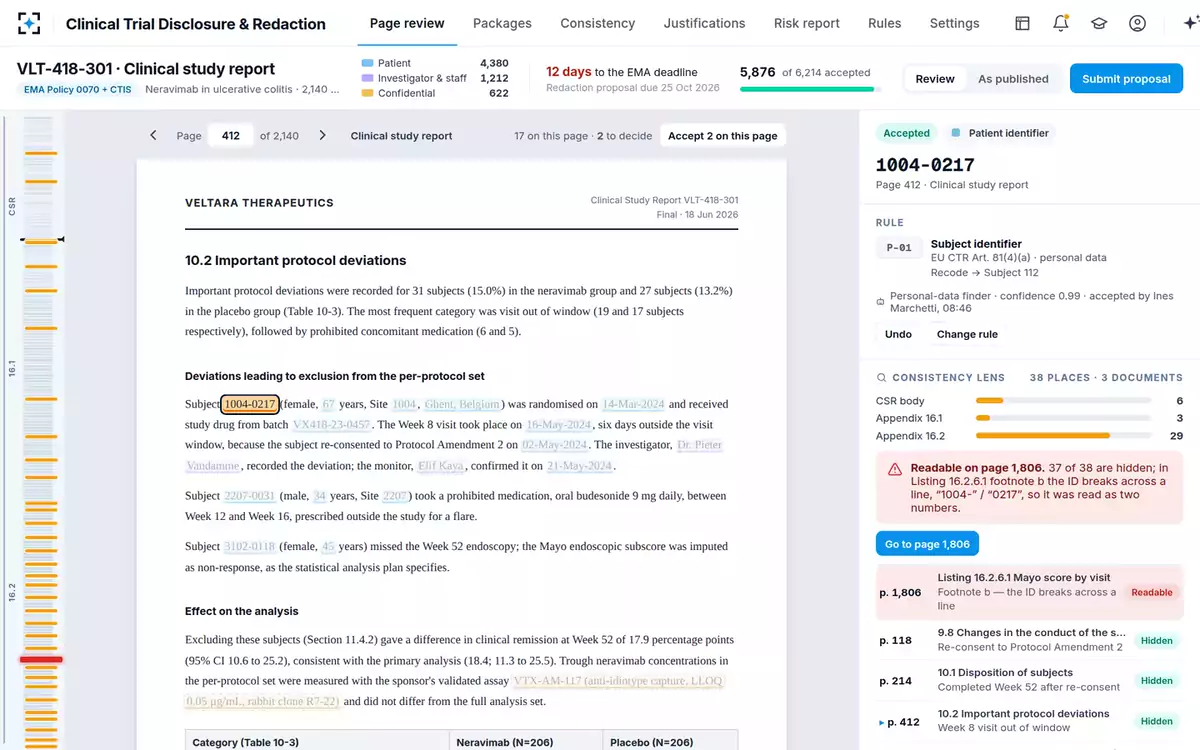
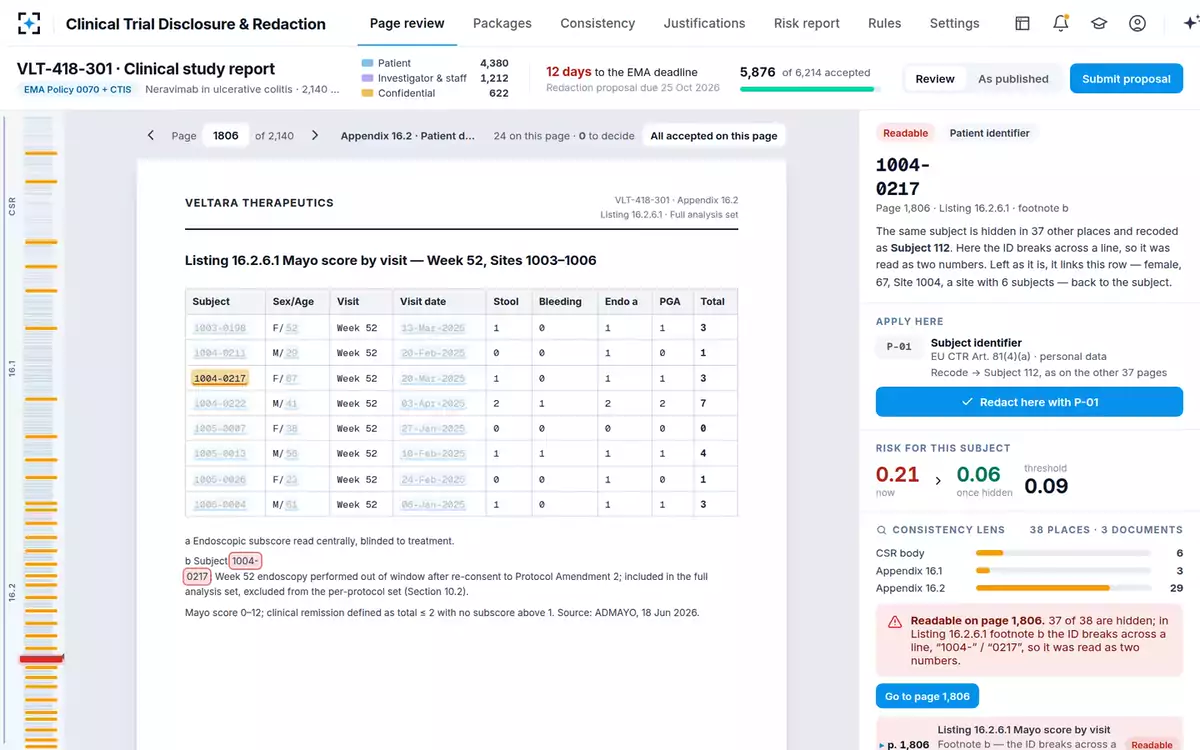
In the sample package, the whole of this is one page. Subject 1004-0217 is hidden in a listing row, and the footnote underneath that explains the row carries the identifier split across a line break. The subject is female, 67, at a site with six participants. Left as it is, that one footnote ties a row of real visit dates and Mayo scores back to a person, and the subject's risk reads 0.21 against a 0.09 threshold. Hidden, it reads 0.06 — and so does the rest of the study.
Where one subject appears in one sample package
How identifiers hide: line breaks, table cells, footnotes and scans
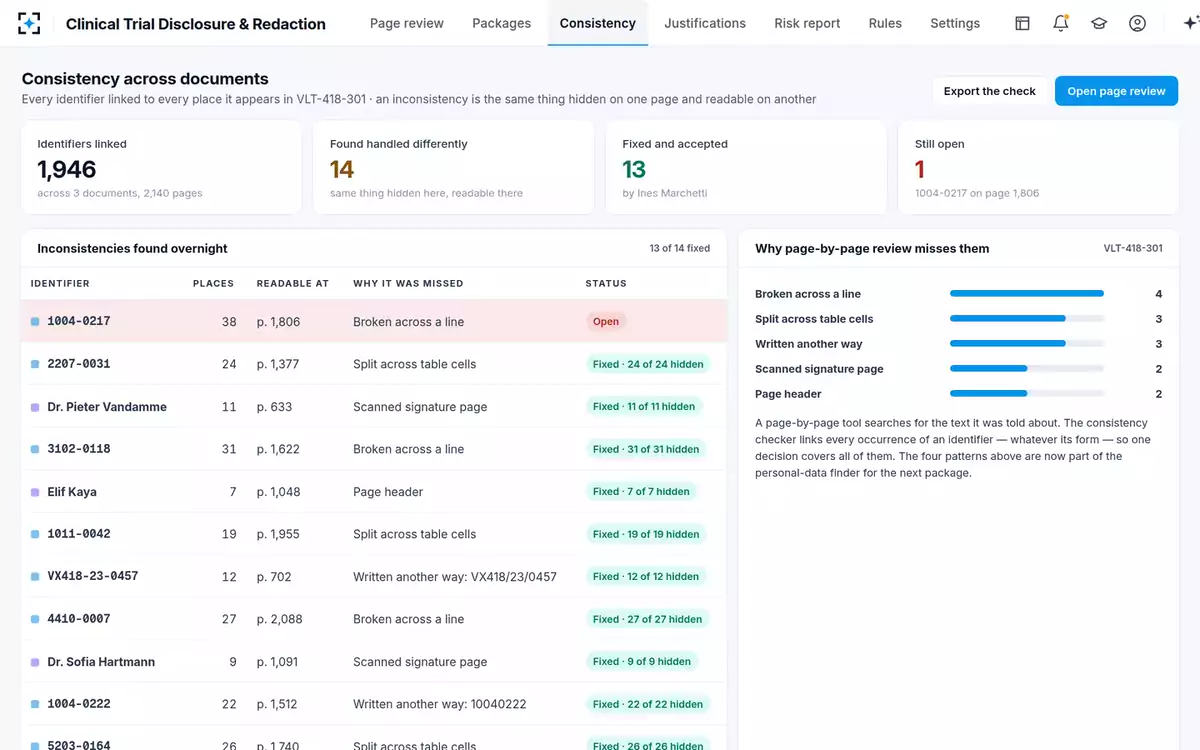
An identifier that a search cannot find is an identifier a page-by-page review will not find either, because both are looking for the same string. In the sample package, fourteen identifiers were handled differently in one place than in another, and the reasons divide into five recognisable kinds.
How fourteen identifiers survived a careful pass
The fourteen inconsistencies, by how each was missed
- Broken across a line · 29%
- Split across table cells · 21%
- Written another way · 21%
- On a scanned page · 14%
- In a page header · 14%
Each kind defeats a different assumption. A line break turns one number into two, so "1004-0217" is read as "1004-" and "0217" and matches nothing. A table cell boundary does the same thing horizontally, which is common where a listing prints a site and a sequence in adjacent columns. Another form is the oldest problem in record linkage: the same participant written as a batch code, a bare numeric string and a spaced variant, depending on which system produced the page. A scanned page holds text as pixels until something reads it. And a running header repeats an identifier on every page of a section, where a reviewer's eye has long since stopped registering it.
Automated tools meet the same obstacles rather than escaping them by default. A scanned page has to be read by optical character recognition before any detector can see an identifier on it, and a recognition error turns a subject number into a string nobody is looking for. A detector that finds a name in running text can still miss it when the layout splits it across cells or lines. And because one missed occurrence exposes every hidden one, the measure that matters is not how many identifiers a tool finds overall but whether any page is left with one readable. Buying software does not remove the need to test it, which is the subject of the guide on testing automated redaction.
Every identifier handled differently, with the page it is readable on
Redact or recode the subject number?
EMA allows both and sets out the trade in one passage. Patient identification numbers, including randomisation or treatment numbers and safety case identifiers, "can be either redacted or recoded. Recoding or pseudonymising direct identifiers have been demonstrated to reduce the risk of re-identification. However, having a pseudonym means that information for the same individual can be linked which is likely to increase the risk of re-identification." The guidance adds a consequence most teams meet later: "for any extension to the initial marketing authorisation application study, the same patients will be recoded differently from the initial marketing authorisation study".
Two ways to handle a subject identifier, and what each costs
Redact it: A black box. Rows cannot be connected to each other at all.
Recode it: A stable pseudonym, Subject 112, in every row and every document.
Redact it: Removes the key entirely. Risk comes only from the quasi-identifiers that remain.
Recode it: Removes the original key but creates a new one: everything about that person can be linked together, which raises risk.
Redact it: A reader cannot follow one participant through the adverse event listing, the efficacy listing and the narrative — the thing a listing is published for.
Recode it: The data stays interpretable, which is the reason for publishing individual patient data at all.
Redact it: Consistent by construction: a box is a box.
Recode it: Consistent only if the same code list is applied everywhere, every time.
Redact it: No issue.
Recode it: The same participant in an extension study will carry a different code, which EMA points out directly. A reader cannot join the two, and nor can you.
Redact it: Where linkage adds nothing a reader needs, or where the quasi-identifiers are already rich enough to make linkage dangerous.
Recode it: Where the value of the publication is in following individuals, and the quasi-identifiers have been generalised enough to carry it.
What a disclosure team should not do is choose by default. The useful question is whether a reader of this particular report needs to follow a participant across tables. For a safety-driven publication the answer is usually yes; for a listing that exists to document protocol deviations it is often no.
How do you de-identify dates, ages and sites in a listing?
Dates first, because they are the strongest indirect identifier on the row. A date of onset plus a site narrows a population to a handful of people and can often be checked against something a reader already knows. The usual treatment is to convert calendar dates to study days — day 1 is randomisation, everything else is an offset — which keeps every interval a clinician needs while removing the anchor. Where the publication does not need intervals at all, a coarser treatment works: the long-standing US Safe Harbor standard removes "All elements of dates (except year) for dates directly related to an individual, including birth date, admission date, discharge date, date of death; and all ages over 89 and all elements of dates (including year) indicative of such age", allowing those ages to be aggregated into a single category of 90 or older.
That last clause is the reason age bands stop at the top. Age is roughly uniform in the middle of a trial population and very thin at the ends, so the oldest participants are the ones a band protects most. Ten-year bands with a 90-and-over category are a common setting, and a package in a rare disease may need wider.
Sites are the third leg. A site is not personal data, but a site with six participants is close to one, because site plus sex plus age band can leave a cell of one. Pooling small sites to a country, or to a region, is the standard answer, and it is also where Europe and Canada differ in emphasis: Health Canada explicitly prefers generalising indirect identifiers to blacking them out, which is set out in the PRCI guide.
EMA's own instruction is to decide rather than to apply a rule everywhere: "To render the clinical reports anonymised it is not always necessary to redact or transform all indirect identifiers", and the decision depends on the number of indirect identifiers per participant, the group size sharing a set of values, the re-identification potential of specific identifiers, their data utility, and the size of the reference population. A listing with three indirect identifiers in a 2,000-patient trial is a different problem from a listing with eight in a 40-patient one.
Adverse event terms: the field you are expected to keep
There is one field in a listing that EMA tells sponsors not to touch, and it is the one teams reach for when a row looks risky. "It is expected that all adverse event terms are retained in both summary-level (i.e., tables, descriptive summaries) and participant-level data (i.e., narratives)." The exception is narrow and specified: "In exceptional cases where the (serious)/adverse event term poses a serious risk of re-identification or is unique, the term could be generalised to the HLT (high level term), HLGT (high level group term) or SOC (system organ class) as classified by MedDRA."
The logic is a data-utility judgement made for you. Adverse events are the variables with the highest value to a reader of a safety publication, so they are retained at the expense of other indirect identifiers: if a row is too identifying, the answer is to band the age or pool the site, not to delete the event. And the escape hatch is a generalisation, not a redaction — a rare event becomes its high level term, which keeps the row interpretable.
It is worth noticing what this implies about results generally. Keeping results readable is not the same as saying results are harmless. A sufficiently rare event, a sufficiently unusual laboratory value or a uniquely shaped response curve can identify a participant on its own, which is why a risk measurement over the published document, rather than a rule about field types, is the only honest way to sign one off.
Checking one subject across the body and the appendices
The review a listing needs is not a page review. It is a question asked about one identifier: where does this appear, in every document, in every form, and is it handled the same way in all of them? A person cannot ask that question across three thousand pages, and a page-by-page tool cannot answer it, because it searches for the text it was told about.
In the sample package the answer comes back as a list: 38 places across three documents, 37 hidden and recoded the same way, one readable on page 1,806. Fixing it is one decision — the same rule, the same code, applied in all 38 places — and the check turns green only when every occurrence agrees. That is also what makes the risk figure meaningful afterwards: it is computed from decisions a person accepted, over a document that is now internally consistent.
One identifier, every place it appears, one still readable
The occurrence that was missed, and why
What a reviewer should look at first
Given a finite number of hours and a package of several thousand listing pages, the order below spends them where the failures are. It is a working order, not a standard.
Eight checks for a listing package, in the order worth doing them
- Every occurrence of every identifier, in every form
Before reading a single page: list each identifier with all its occurrences and flag any handled differently. This is the check that finds line breaks, split cells and alternative forms, and it is the only one a person cannot do alone.
- The scanned pages
Signature pages, faxed deviation forms and anything imaged. Text that was never text is invisible to every search in the package.
- Running headers and footers
An identifier in a header repeats on every page of a section and stops being noticed after two.
- Footnotes beneath redacted rows
The sample package's failure. A row can be handled correctly while the note explaining it is not.
- The smallest sites and the rarest subgroups
Risk concentrates where the group sharing a set of values is small. Find the smallest cells first and ask whether a band or a pooling fixes them.
- Dates that stayed calendar dates
Any date not converted to a study day or an interval, particularly in deviation and discontinuation listings where free text often carries one.
- Ages at the top of the range
Participants over 89, and any age that is unique in its site. The band at the top of the scale is doing most of the work.
- Listings repurposed into the report body
The extracts in section 14 are the pages that get published under Policy 0070. They must match their source appendix exactly.
To see every occurrence of one identifier in one place, with the reason each exception was missed, start from Clinical Trial Disclosure & Redaction. How the resulting figure is written up for a regulator is covered in the anonymisation report guide, and the procedure the package is submitted into in the Policy 0070 guide.
Questions people ask
Are patient data listings published under Policy 0070?
The appendices under 16.2 are marked out of scope in EMA's own scope table for the current phase of Policy 0070. Individual patient data listings inside the report body are a different matter: they "cannot be considered out of scope and should not be removed", including listings extracted from 16.2 and repurposed into section 14, and they must be anonymised rather than deleted. The narrow exception is abnormal laboratory value listings typically found in section 14.3.4.
What is the difference between Appendix 16.2 and section 14 of a study report?
Level of detail. ICH E3 asks for summary figures and tables in the text, further summary tables and listings in section 14, and individual patient data as listings in Appendix 16.2. Section 14 is where a medical writer puts the tables a reader needs to follow the argument, sometimes including extracts lifted from 16.2 and labelled as such; the appendix is the complete per-patient record behind them.
Does recoding a subject number count as anonymisation?
It is one technique within it, not a substitute for the measurement. EMA notes that recoding reduces re-identification risk compared with leaving an identifier in place, but that a pseudonym allows information about the same individual to be linked, which is likely to increase risk. Whether the result is anonymised depends on the quasi-identifiers that remain beside it, measured over the whole document.
Should dates in a listing become study days or be removed?
Study days usually, because they keep every interval a clinician needs — time to onset, duration, time since the previous dose — while removing the calendar anchor that makes a date identifying. Removal is the right answer only where the intervals add nothing. The stricter alternative, used in the US Safe Harbor standard, is to drop all elements of a date except the year and to aggregate ages over 89.
How many indirect identifiers are too many in one listing row?
There is no number, which is why EMA asks for a decision rather than a rule: it lists the number of indirect identifiers per participant, the group size sharing the same values, the re-identification potential of specific identifiers, their data utility and the size of the reference population as the factors to weigh. For scale, modelling published in Nature Communications found that 15 demographic attributes would correctly re-identify 99.98% of Americans in any dataset.
Do adverse event terms have to stay in a published listing?
Yes, in almost every case. EMA expects all adverse event terms to be retained in summary-level and participant-level data alike, because they carry the highest value to a reader of a safety publication. Where a term is unique or poses a serious re-identification risk, the remedy is to generalise it to the MedDRA high level term, high level group term or system organ class — not to redact it.