A re-identification risk assessment is the calculation that decides whether an anonymised clinical study report can be published. For each trial participant it asks how many other participants look the same in the document once the redactions are applied, turns that group size into a probability, and compares the highest probability in the package with a threshold the sponsor has chosen and must justify. It is hard not because the arithmetic is difficult — the core of it is one divided by a group size — but because the number depends entirely on four judgements made before any arithmetic happens: which metric, which adversary, which variables count as identifiers, and which threshold. Botminds' Clinical Trial Disclosure & Redaction computes the score only from redaction decisions a person has accepted, reports the highest value for any subject against the 0.09 threshold by site group, and names the page that causes any subject to exceed it.
The study, the sponsor, the medicine, the sites and the people in the examples below are invented sample data used to demonstrate the solution; the regulatory figures and the published measurements come from the authorities and studies linked where they appear.
The four things that decide the number, before any arithmetic
Max
the metric EMA advises for public release: the highest risk across all records, not the average
0.09
the threshold EMA calls advisable — and explicitly allows a sponsor to replace with a justified alternative
11patients
the target cell size Health Canada says a 9% threshold equates to
3tests
replicability, distinguishability, knowability: what makes a variable an identifier at all
How is re-identification risk calculated?
Re-identification risk is calculated by counting look-alikes. Take the indirect identifiers still readable about one participant — age band, sex, country, site, study day of an event, a laboratory value if it is distinctive enough — and count how many participants in the published data share that same combination of values. That count is the group size, and the probability of picking the right person out of the group is one divided by it. EMA states the rule in those words: "the probability of re-identification of a record in a data set is 1 divided by the frequency of trial participants with same category/value of a set of the indirect identifiers (group size)" (EMA Policy 0070 external guidance, v1.5, §3.5.4).
One subject's risk, written out
Pick the subject
one trial participant in the published document
Every participant is scored, not a sample. A package is judged on its worst one.
Statistician or data protection officer
List what is still readable
the set of indirect identifiers left in the text
Age band 60–69, female, Belgium, Site 1004, Week 52 visit as a study day.
Follows from the redaction decisions
Count the look-alikes
how many participants share that whole set
Six subjects at the site, 34 in the country group, 412 in the study: three different group sizes for the same person, depending on what the document reveals.
Computed over the published form
Divide
risk = 1 ÷ group size
A group of 6 gives 0.17. A group of 11 gives 0.0909 — the figure the 0.09 threshold rounds, and Health Canada’s target cell size.
Compared with the threshold
Two things follow from that formula, and both matter more than they look. The first is that the group size is a property of what the document says, not of the trial. A participant at a six-patient site is in a group of six only if the document names the site; if small sites are pooled to a country, the same person sits in a group of 34, and the risk falls from 0.17 to 0.03 without one word of the results changing. The second is that every readable identifier can only ever shrink a group. Add sex to age band and the group splits. Add the site and it splits again. That is why a single occurrence left readable on one page out of two thousand can move a package's score: it adds an identifier to one subject's set that the assessment assumed was gone.
Maximum risk, and why public release uses it
Having a probability per participant, you still have to summarise 412 of them into one number, and the choice of summary is the second judgement. EMA is direct about which to use for publication: "The most appropriate way to measure the risk of re-identification for an entire dataset, in the context of public disclosure, is through the maximum risk, which corresponds to the maximum probability of re-identification across all records," and for public release "it is advisable to use the maximum risk" (§3.5.4, step 4). An average would let 411 comfortable subjects carry one exposed one. Maximum risk refuses that trade.
The reason is the absence of controls. EMA's guidance separates the context of release from the arithmetic: "The risk of re-identification can vary depending on the context of disclosure. In the case of public data release (publication to the world at large) the risk of re-identification needs to be very low since there are no controls that can be put in place" (§3.3.1). A data-sharing agreement can forbid linkage attempts, audit the recipient and withdraw access. A published PDF can do none of those things, so everything has to be carried by the document itself.
The literature usually calls the same assumption prosecutor risk: an adversary who already knows that a particular person took part and wants to find their row. It is worth knowing both names, because a method document written in the literature's vocabulary and a regulator's comment written in the guidance's vocabulary are describing one metric. In the sample package the solution reports it the regulator's way — the highest value for any subject, broken out by site group, with the page responsible — and the data protection officer approves that method before a package is scored against it.
What is the 0.09 re-identification risk threshold, and where did it come from?
0.09 is the threshold EMA recommends for public release, and it is a recommendation, not a rule. The guidance says so in one sentence that disclosure teams should be able to quote from memory: "Based on the recommendations made in the IOM report and the available precedents for public release of health data, EMA believes that it is advisable to set the threshold to a conservative level of 0.09. However, it is up to the applicants/MAHs to decide on the most appropriate threshold for public disclosure of the clinical reports at stake, and if a different threshold is selected a justification must be provided" (§3.5.4, step 4).
Three parts of that are worth separating. The number comes from precedent, not derivation: an Institute of Medicine report and earlier public health-data releases, not a formula that yields 0.09 from first principles. The status is advisory. And the escape clause is conditional on writing the justification down, which means a sponsor who wants 0.05 or 0.10 has to defend it in the one document the Agency reads alongside the redactions — the anonymisation report. Health Canada's guidance lands on the same figure, encouraging sponsors to adopt a 9% re-identification risk threshold (Health Canada, Public Release of Clinical Information), which is one reason a package prepared for Europe can usually be scored once and reused for Canada; what differs is how Health Canada expects the report to be assembled.
In the solution the threshold is a setting, and it travels with its qualifier. Wherever a package shows 0.09, the number is the sponsor's chosen threshold or a justified alternative, not a figure the software asserts.
0.09, k=11 and cell size: three ways of saying one thing
Three vocabularies describe the same arithmetic, and teams waste meetings translating between them. A risk of 0.09 is a group size of about 11, because one divided by 11 is 0.0909. Health Canada says it as a cell size — cell size being the number of patients sharing the same indirectly-identifying values — and states that adopting a 9% threshold equates to a target cell size of 11 patients (Health Canada PRCI guidance). The privacy literature says it as k-anonymity: every combination of quasi-identifiers must occur at least k times, and k=11 is the same requirement again.
One divided by the group: the whole table a disclosure team needs
Group size2
Risk0.500
What that level is forHalf a chance for each of the two. No regulator anywhere treats this as published-safe.
Group size5
Risk0.200
What that level is forThe level a controlled, contractual data share might accept. Public release does not.
Group size10
Risk0.100
What that level is forJust above the line. A single subject in a group of ten fails a 0.09 threshold.
Group size11
Risk0.0909
What that level is forHealth Canada’s target cell size: 0.09 is this figure rounded, which is why the two are treated as one standard.
Group size20
Risk0.050
What that level is forComfortably inside, and usually bought by pooling sites or widening a band.
Knowing the table is not the same as knowing which k applies. The group a subject belongs to is whichever is smallest among the sets the document actually discloses, and in a study report that is often the site. A multicentre trial of a few hundred participants spread over many centres will usually have sites with fewer than eleven patients, which is why pooling small sites to a country is a common first move in an anonymisation plan. In the invented sample package the rule is written as sites under 11 subjects pooled to country — the threshold and the cell size chosen to agree with each other, so the setting and the score cannot drift apart.
Choosing the quasi-identifier set is the whole assessment
The most consequential choice in a risk assessment is the one least often written down: which variables are treated as identifiers in the first place. Leave one out and the groups get bigger, the arithmetic gets friendlier, and the score falls — not because the document is safer but because the model stopped looking. The Article 29 Data Protection Working Party, whose opinion EMA's guidance builds on, names this as the characteristic failure: "A common mistake is to artificially augment the value k by reducing the considered set of quasi-identifiers," and "Not considering all the quasi-identifiers when selecting the attribute to generalize is a critical mistake; if some attributes can be used to single out an individual in a cluster of k, then the generalization fails to protect some individuals" (Opinion 05/2014 on anonymisation techniques, §3.2.1.2).
EMA gives a three-part test for admitting a variable to the set, and it is a good test precisely because it can exclude things as well as include them.
Three conditions that make a variable an identifier
- Replicability — the value is stable enough to recur
EMA: the values "must be sufficiently stable over time so that the values will occur consistently in relation to the data subject". Date of birth qualifies. A single haemoglobin reading on day 14 generally does not.
- Distinguishability — the value varies enough to separate people
A variable every participant shares distinguishes nobody. Sex splits a cohort in two; a rare concomitant medication can split it into ones.
- Knowability — an adversary could know it about the person
EMA: "an adversary must know the identifiers about the data subject in order to re-identify them. If a variable is not knowable by an adversary, it cannot be used to launch a re-identification attack on the data."
Knowability is where honest assessments argue with themselves. A neighbour knows a person's approximate age, their town and that they were in a trial; they do not know the day the person's Mayo score was taken. A family member might know both. The guidance resolves it by asking you to name the adversary first, which is the next choice, and the reason the two cannot be made separately.
The four choices behind one number, and what each authority says about each
| The choice | What EMA says | What Health Canada says | What it changes |
|---|---|---|---|
| The metric | Maximum risk for public release — the highest probability across all records. | Framed as a cell size: the number of patients sharing the same indirectly-identifying values. | Whether one exposed subject fails the package or is averaged away. |
| The adversary | Identify possible adversaries and plausible attacks; for public release the likely motive is a demonstration attack. | Public release, so no recipient controls can be assumed. | Which variables pass the knowability test, and so which enter the set. |
| The quasi-identifier set | Three conditions: replicability, distinguishability, knowability. Both direct and indirect identifiers must be addressed. | Direct identifiers such as names, initials, signatures and job titles are redacted; indirect ones are assessed. | The group sizes, and therefore every number downstream. |
| The threshold | 0.09 is advisable; a different threshold is allowed if a justification is provided. | Encourages a 9% threshold, which it equates to a target cell size of 11 patients. | Whether the package can be submitted as it stands. |
Who is the adversary? The four scenarios EMA asks you to consider
EMA asks sponsors to write down who they are defending against, and for publication its answer is blunt: "For public data release, adversaries are most likely to be interested in showing that an attack is possible (demonstration attack)" (§3.5.4, step 2). The guidance then sketches four scenarios: an organisation with a financial interest in identifying a fair number of participants; one participant of particular public interest pursued by the press or another body; a group or individual who wants to identify just one participant, without caring which, in order to embarrass the data controller or undermine support for releasing data at all; and the random case of a reader who happens to know a participant well enough to recognise them. "Each of the scenarios described above reflect possible adversaries and plausible attacks, having different risk implications," the guidance says, and sponsors "should identify possible adversaries and plausible attacks on the data and evaluate the impact on the risk of re-identification."
The third scenario is the one that justifies maximum risk. An adversary who does not care which participant they identify will go straight to the smallest group in the document — the six-patient site, the one participant of 90 and over, the single case of a rare adverse event. Against that adversary an average risk is meaningless, because the attack is aimed precisely at the tail. The fourth scenario is the one that justifies taking a published PDF seriously at all: it needs no skill, no linkage dataset and no motive beyond reading the report.
Is an anonymised study report still personal data?
If the anonymisation holds, no: data that is genuinely anonymised falls outside data protection law, which is the whole point of doing the work. If it does not hold, the report is personal data that has been published, and nothing about the redaction changes that. The dividing line is irreversibility, and the most common way to land on the wrong side of it is to confuse anonymisation with pseudonymisation. EMA's guidance is explicit: "The irreversibility of the anonymisation methodologies or techniques is also an important element as it can be used in order to differentiate from 'pseudonymisation'. ... When pseudonymisation is used alone, the natural person is still likely to be identified indirectly. Pseudonymisation reduces the linkability of a dataset with the original identity of a data subject but when used alone will not result in an anonymous dataset, therefore data protection rules still apply" (§3.3.2). The Working Party says it more shortly still: "pseudonymisation is not a method of anonymisation. It merely reduces the linkability of a dataset with the original identity of a data subject, and is accordingly a useful security measure" (Opinion 05/2014, executive summary).
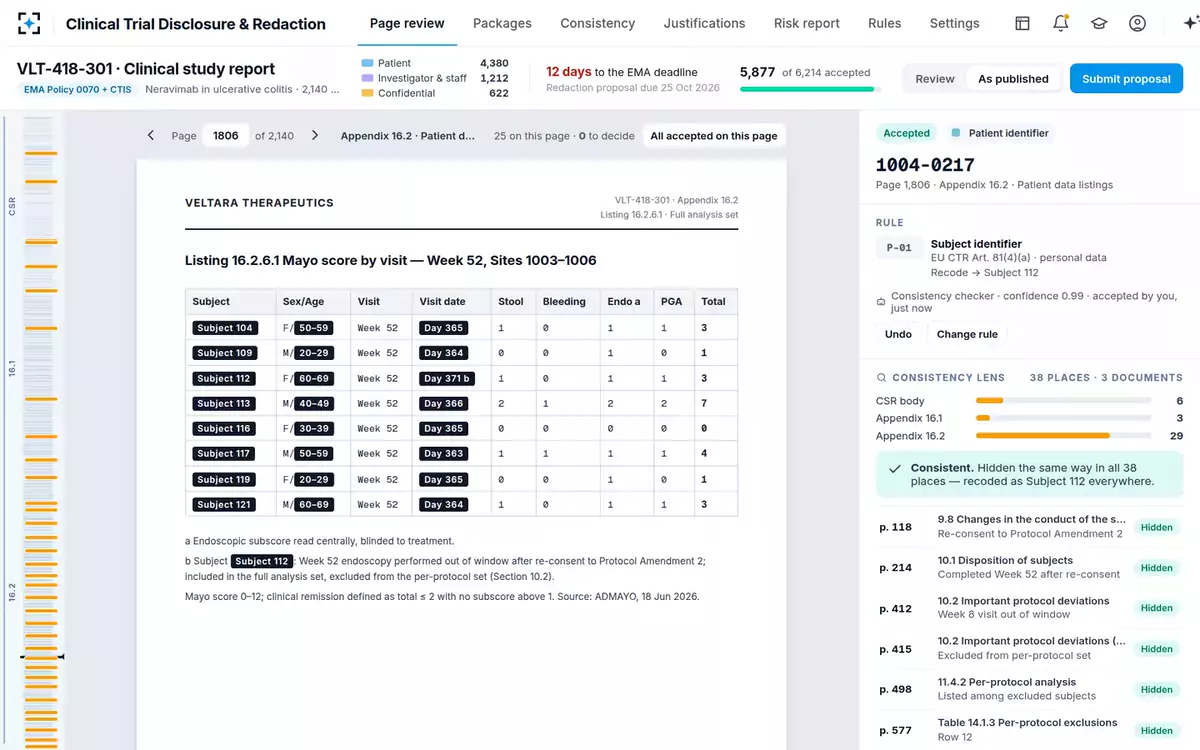
That matters for a study report because recoding subject numbers — 1004-0217 becomes Subject 112 — is pseudonymisation. It is necessary, because a listing has to stay readable as a listing, and it is nowhere near sufficient on its own. What makes the report anonymised is everything done to the indirect identifiers around the code: dates offset to study days, ages banded, small sites pooled. The code is just the thread that keeps the tables coherent.
Two routes to showing a report is anonymised
Demonstrate the three criteria: That it is not possible to single out an individual, not possible to link records relating to an individual, and not possible to infer information concerning an individual.
Measure the risk: That the highest probability of re-identification across all participants is at or below the threshold you set.
Demonstrate the three criteria: EMA: the demonstration route is available where all three criteria are met.
Measure the risk: EMA: "whenever a proposal does not meet one of these criteria, through an evaluation of the identification risks."
Demonstrate the three criteria: The reasoning for each criterion, against the techniques used — and an acknowledgement that no technique is free of shortcomings.
Measure the risk: The metric, the adversary model, the quasi-identifier set, the threshold with its justification, and the measured result.
Demonstrate the three criteria: A study report keeps results, design and methods readable, so singling out can rarely be excluded absolutely.
Measure the risk: It produces a number a reviewer can check against the decisions actually applied in the documents.
What a risk number cannot tell you
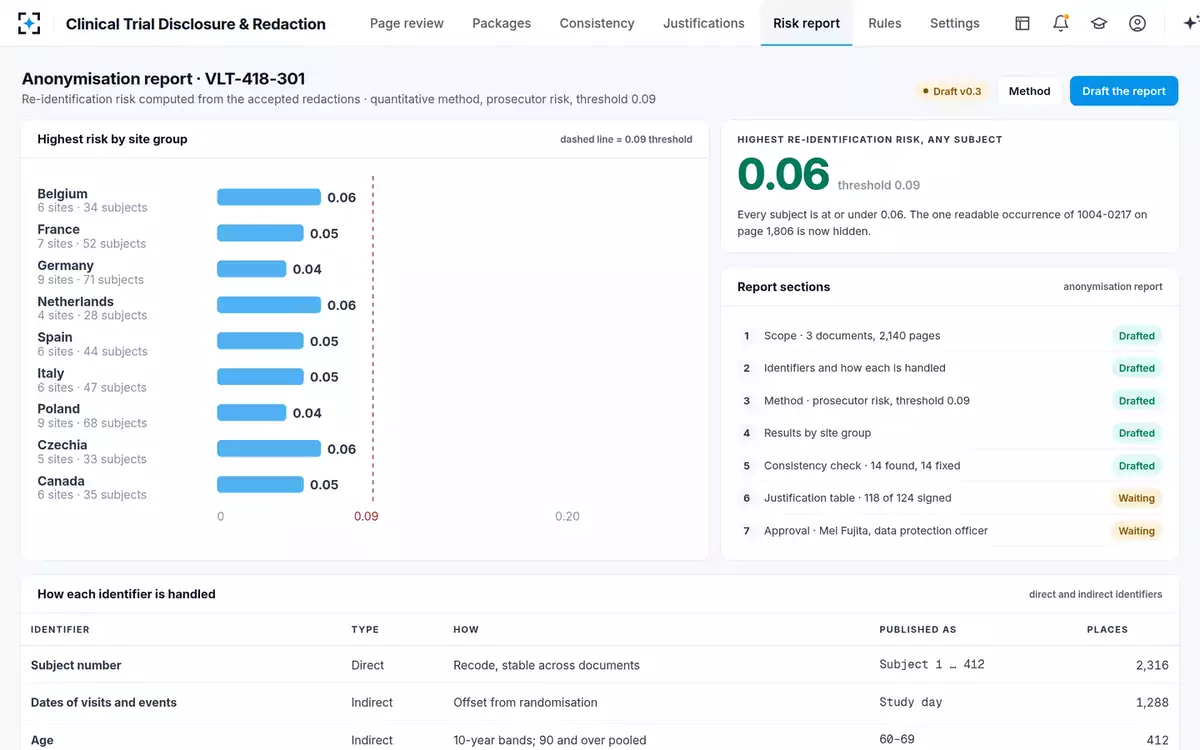
A risk score is computed over the document as the method believes it to be. If an identifier is still readable somewhere the method did not look, it is not in the arithmetic at all — the score is not wrong, it is answering a different question. This is the gap that makes consistency across a package a risk control rather than a tidiness exercise, and it is why a score should always be read next to a count of unresolved occurrences. In the invented sample package the two readings differed by more than a factor of three: one subject number hidden in 37 of the 38 places it appeared, and readable in the thirty-eighth, in a footnote on page 1,806 of the Appendix 16.2 patient data listings, where it had broken across a line as "1004-" / "0217" and been read as two numbers.
One subject, one footnote: the package's highest risk before and after
The direction of those two bars follows from the formula at the top of this page. With the ID readable, the subject's group is bounded by their own six-patient site — and is smaller still once sex, age band and visit days are combined within it — so the risk sits above 1 ÷ 6. With it hidden, the subject sits in the pooled country group of 34, where the sample's smallest matching cell is large enough to bring the figure to 0.06. Nothing else in the document changed; one footnote did.
Two design rules in the solution follow from that, and both are the kind of rule worth copying into a procedure whether or not you use software for it. The score is computed only from decisions a person has accepted, so it can never be flattered by a proposal that nobody approved. And no agent may change a decision to lower the score — the arithmetic reports on the redactions, never the other way round. The same discipline appears in HIPAA's expert determination route, which requires the expert not only to judge that the risk is very small but to document "the methods and results of the analysis that justify such determination" (45 CFR 164.514(b)(1)).
The score, by site group, against the threshold
Data utility is the other half of the decision
A risk assessment that only minimises risk has an obvious optimum: publish nothing. EMA treats utility as a requirement of the method rather than a nice-to-have, and says what the test is: "If anonymisation of the data results in clinical reports that are no longer useful for their intended secondary purposes, data utility is compromised. ... Ensuring that the analysis results produced after anonymisation are similar to the results that would be obtained from the original clinical reports is critical. Therefore, the amount of distortion should be minimised. Ultimately, a balance must be reached in order to obtain an acceptably low probability of re-identification and a high utility data" (§3.5.4, step 3).
In practice that balance is struck variable by variable, and each move trades a known amount of utility for a known amount of group size. Offsetting dates to study day keeps every interval in the report — time to response, days on treatment, the gap between a dose and an event — while destroying the calendar an adversary would need. Ten-year age bands keep the age distribution of the cohort and lose the exact age. Pooling small sites keeps the country-level picture and loses the centre. Redacting a laboratory value, by contrast, costs a reader something no other column replaces, which is why generalising is usually preferred to removing.
One detail on age is worth stating precisely, because it is widely copied without its source. Pooling everybody of 90 and over into a single band is a HIPAA Safe Harbor rule: the United States regulation requires ages over 89, and any element of a date that would reveal such an age, to be removed — while allowing them to be grouped into a single category of 90 or older (45 CFR 164.514(b)(2)). EMA's guidance does not set an age ceiling of its own. A European package that pools 90 and over is applying the sponsor's own setting, with a well-established precedent behind it — which is exactly how it should be described in the anonymisation report, rather than as a requirement nobody imposed.
What the balance looks like on the page the public sees
The last thing a risk assessment owes its reader is the record of how it was done — which metric, which adversary, which variables, which threshold, and which decisions departed from the plan. That is not a covering note; it is the document the Agency reviews beside the redactions, and what EMA and Health Canada expect in the anonymisation report is a standard of its own. To see a score computed from accepted decisions, site group by site group, start from Clinical Trial Disclosure & Redaction.
Questions people ask
What is a quasi-identifier?
A variable that does not name a person but narrows the field — age, sex, country, site, the date of a visit, an unusual concomitant medication. EMA calls them indirect identifiers and lists dates of birth, death or clinic visit, residence postal code, sex and ethnicity among them, noting that in recent re-identification cases "attackers used indirect identifiers to successfully determine the identity of individuals". A variable earns the label only if it is replicable, distinguishing and knowable by the adversary you have named.
What is k-anonymity, and is k=11 enough?
k-anonymity requires every combination of quasi-identifier values in the data to occur at least k times, so the best an adversary can do is one chance in k. At k=11 that is 0.0909, which is the arithmetic behind Health Canada's target cell size of 11 patients for a 9% threshold. Whether it is enough depends entirely on the set of quasi-identifiers you counted: the Article 29 Working Party warns that raising k by quietly shrinking that set is a critical mistake, and that no technique is free of shortcomings.
What is the difference between anonymisation and pseudonymisation?
Pseudonymisation replaces an identifier with a code, so records about one person stay linkable to each other but not directly to their name; anonymisation aims at irreversibility. EMA's guidance states that pseudonymisation used alone "will not result in an anonymous dataset, therefore data protection rules still apply". Recoding subject numbers in a study report is pseudonymisation; what makes the report anonymised is the treatment of the indirect identifiers around the code.
Who approves a re-identification risk method?
The sponsor does, and the authorities review it rather than certify it in advance: EMA reviews the anonymisation report to check that the guidance was followed and the chosen approach applied consistently across the documents. Inside a company the method is normally owned by the data protection officer or a statistician, with the disclosure lead responsible for the package. In the sample configuration the data protection officer approves the method before a package is scored against it and approves the report before anything is submitted.
Can you use a different risk threshold than 0.09?
Yes, with a justification. EMA's guidance leaves the decision to the applicant and requires that "if a different threshold is selected a justification must be provided". The practical constraint is that the justification has to survive the Agency's review of the anonymisation report, so a threshold chosen for convenience and defended thinly is worse than the recommended one.
Does the assessment cover the patient data listings as well as the report body?
It has to cover every listing that will be published. Under Policy 0070's current scope the Appendix 16.2 appendices themselves are out, but individual patient data listings inside the report body — including extracts lifted from 16.2 into section 14 — are in, and they are where one row usually holds a subject's whole profile, so they tend to produce the smallest groups and set the maximum risk. EMA's review looks for the chosen approach to have been applied consistently in all the clinical reports in the package, so a listing anonymised to a different standard than the rest of the body is a finding in its own right.