EMA Policy 0070 guidance is the Agency's external guidance on how a sponsor prepares the clinical reports behind a centrally authorised medicine for publication, and the practical answer it gives is that the work is two submissions, not one. First a Redaction Proposal Document package, in which every page is still readable and every proposed redaction is marked and labelled, accompanied by a mandatory anonymisation report and a justification table for each claim of commercial confidentiality. Then, after EMA has reviewed both, a Final Redacted Document package in which the redactions are applied and the pages are published as they stand. The two are judged against different standards: personal data has to be anonymised to a defensible risk, and confidential information has to be argued for, claim by claim, against a presumption that clinical data is not confidential at all.
Botminds' Clinical Trial Disclosure & Redaction is built around that split. Five agents read a study report package overnight, propose each redaction with the authority's rule beside it, keep the same identifier hidden the same way in every document, draft a justification for every confidential passage and score re-identification risk from the decisions a person has actually accepted. The examples here come from its sample data: the sponsor Veltara Therapeutics, the medicine neravimab and the people who sign the package are invented, as are the studies VLT-418-301 and VLT-418-302. The rules, days and figures attributed to EMA are the Agency's own, linked where they appear.
What one year of this work looked like at EMA
46
publication procedures completed in 2022 under the COVID-19 transparency programme
742
clinical documents published across those procedures
206,771
pages published, every one of them read and marked by a sponsor first
What does EMA Policy 0070 actually publish?
Policy 0070 publishes the clinical reports a sponsor submitted for scientific assessment, not a summary of them. In practice that means the clinical overview, the clinical summaries in sections 2.7.1 to 2.7.4, the body of each clinical study report, and three of its appendices: 16.1.1, the protocol and its amendments; 16.1.2, the sample case report form; and 16.1.9, the documentation of statistical methods. Those are the items the external guidance's content table for the Final Redacted Document package marks as published, together with the anonymisation report form itself; the cover letter, the list of expected documents, the tracking table and the justification tables travel with the packages but are never published.
Two scope rules catch sponsors out. A study whose main period has completed is in scope even if its extension is still running, and EMA evaluates that status at the publication date, not the submission date: a justification that says "on-going study" for a study that has since completed "will be disregarded". And case narratives cannot be dropped or blacked out wholesale — the guidance requires them to be anonymised instead, because a narrative is clinical content about a patient rather than an identifier that can be lifted out. Where a main period is genuinely still blinded at publication, the guidance allows additional blinding redactions, which stay in place until the study is unblinded, and asks the sponsor to raise them with its contact in the publication team as early as possible.
Documents published under Policy 0070 go onto EMA's clinical data website with a watermark the Agency applies itself, which is why the final package may not be password protected. What the public sees is the sponsor's own pages, in the sponsor's own layout, with black rectangles where a decision was made.
The two packages: redaction proposal, then final redacted
The redaction proposal is a read-through document. Every piece of text proposed for removal stays legible and is marked and labelled "CCI" for commercially confidential information or "PPD" for protected personal data, so a reviewer at the Agency can read what is underneath and decide. The final version is the opposite: the redactions are applied, the un-redacted text alone must be text-searchable, and the blackened box over a redaction "should neither be searchable nor subject to further editing". A sponsor who hands EMA a proposal with the text already removed has sent the wrong package.
The two Policy 0070 packages, and what each is judged on
| Redaction Proposal Document package | Final Redacted Document package | |
|---|---|---|
| What the pages look like | Every proposed redaction marked and legible, labelled CCI or PPD, in PDF within the eCTD sequence. | Redactions applied as clearly visible black rectangles; labels visible and irremovable; colour retained where the original had colour. |
| What travels with it | Cover letter with the declaration, the agreed list of expected documents, eCTD tracking table, submission checklist, the anonymisation report form, and one justification table per report that proposes confidentiality. | The final redacted reports, the cover letter, list of expected documents, tracking table and checklist, and the anonymisation report form updated for EMA’s comments — which, unlike the proposal-stage copy, is itself published. |
| Who reads it, and for what | The clinical data publication team: first that the package is complete and correctly labelled, then the content of each confidentiality justification and the anonymisation method. | A final package check that the comments raised on the proposal have been addressed in the documents themselves. |
| What a rejection means | An incomplete package is rejected whole — "individual parts cannot be submitted separately to correct submission deficiencies" — and the clock is recalculated. | An invalid final package restarts a 7-calendar-day submission window and the publication date moves. |
| Searchable text | The proposed redactions are readable by design. | Only the text that survives is searchable. |
The asymmetry matters for how a team works. The proposal is where the argument happens, and it is the only package EMA will discuss: by the time the final version is due, the decisions are settled and the job is mechanical. Teams that treat the proposal as a draft and the final as the real submission have the effort the wrong way round.
When is the Policy 0070 redaction proposal due?
For an initial marketing authorisation application or a line extension, the Redaction Proposal Document package is due between day 181 of the regulatory procedure and no later than 30 days after the CHMP opinion. For an extension of indication it is due between 30 days before the opinion and 30 days after it. For a withdrawn application the window is 60 days from EMA's receipt of the withdrawal letter, and for an application under Article 58 it is 60 days after the opinion. Those are the restart timelines EMA set out in its Step 2 webinar and wrote into version 1.5 of the external guidance in May 2025. Earlier versions of the guidance were tighter at the back end — 10 days after the opinion for initial applications — so a team working from an internal procedure written before the relaunch may be using a deadline the Agency has since relaxed.
When the Policy 0070 redaction proposal is due, by application type
| Application | Window for the Redaction Proposal Document package | When EMA publishes |
|---|---|---|
| Initial marketing authorisation application | Between day 181 of the procedure and 30 days after the CHMP opinion. | Within 120 days of the opinion. |
| Line extension | Between day 181 and 30 days after the opinion, as for an initial application. | Within 120 days of the opinion. |
| Extension of indication | Between 30 days before the opinion and 30 days after it. | Within 120 days of the opinion. |
| Withdrawn application | Within 60 days of EMA receiving the withdrawal letter. | Within 150 days of the withdrawal letter. |
| Article 58 application | Within 60 days of the opinion. | Within 150 days of the opinion. |
The deadline is therefore pinned to the opinion, which moves. That is the practical reason EMA's own key message is to prepare the package early, "prior to CHMP Opinion", and the practical reason a disclosure team cannot plan backwards from a publication date: the publication date is an output of the procedure, not an input to it. A team that holds the package until the opinion is confirmed has traded a few weeks of certainty for the whole of its preparation time.
From invitation email to published page, day by day
The procedure starts with an invitation email, not with a submission. EMA sends it to applicants whose procedures are selected, attaching an updated question-and-answer document, a draft list of expected documents "for agreement within 2 weeks after receipt of the invitation email", a submission checklist and the anonymisation report template. The list of expected documents is the one early decision a sponsor should argue about: it fixes what will be published, and two weeks is not long to disagree with it.
The publication procedure, from the proposal deadline to the published page
- ValidationDay 10
- Review of justifications and the anonymisation reportDay 11 to 47
- You agreeDay 54
- ResponsesDay 61 · 68
- Final package inDay 74
- Final check, then publicationDay 81 · 84
Read the back half of that axis carefully, because it holds the deadline most teams miss. The redaction conclusion letter arrives on Day 47 by Eudralink, carrying EMA's outcome on each confidentiality claim and its comments on the anonymisation report. The sponsor must state agreement or disagreement with the outcome on confidentiality by Day 54, may be asked for an updated anonymisation report or written responses by Day 61, and receives the Agency's final response on Day 68. The Final Redacted Document package is then due "within 7 calendar days following the redaction conclusion letter or following the final EMA response". Seven calendar days, over a weekend, to apply several thousand redactions and prove they landed — which is the week that decides whether a disclosure team is calm or not.
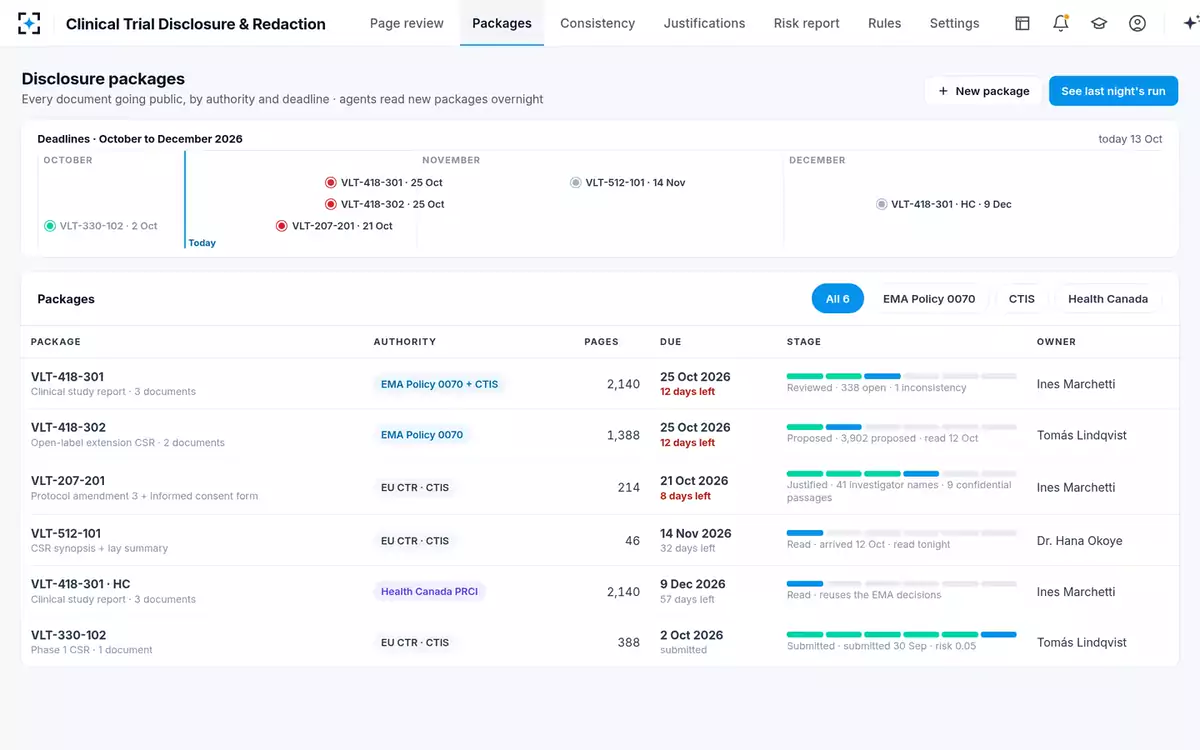
On the sample package, the board shows the same shape from the sponsor's side: six packages in flight, the VLT-418-301 study report and the VLT-418-302 extension due to EMA, a protocol amendment and an informed consent form due in CTIS, and the same VLT-418-301 report due later to Health Canada. The stages on that board — read, proposed, reviewed, justified, risk scored, submitted — are the sponsor's own workflow, not EMA's steps; EMA's steps are the six in the guidance, and a team should be able to name both.
Every document going public, by authority and deadline
Personal data and confidential information are judged differently
A single page can carry both kinds of redaction, and nothing about them is alike except the black rectangle. Personal data is removed because the regulation requires it and the test is statistical: has the sponsor reduced the risk that a reader can single out a trial participant? Confidential information is removed only if EMA agrees with an argument the sponsor makes in writing, against a policy that states the Agency "acknowledges that there are limited circumstances where information could constitute CCI" — a sentence written to be narrow.
The two standards in one Policy 0070 package
Protected personal data: Either all three anonymisation criteria from the Article 29 Working Party opinion are met — no singling out, no linking, no inference — or the risk of re-identification is measured and managed.
Commercially confidential information: Information not in the public domain whose disclosure "may undermine the legitimate economic interest" of the applicant, judged claim by claim.
Protected personal data: A method described in the anonymisation report, applied consistently across every document in the package.
Commercially confidential information: A justification table entry for each piece of text, naming the words, the innovative feature and the development programme at stake.
Protected personal data: The sponsor chooses the method and the threshold, justifying any threshold other than 0.09; EMA reviews whether it followed the guidance and applied it consistently.
Commercially confidential information: EMA decides, and communicates rejection, acceptance or partial acceptance in the justification table columns.
Protected personal data: A risk figure the report cannot support, and comments to answer by Day 61.
Commercially confidential information: A rejection, and text published that you had marked as confidential.
Protected personal data: A trial participant identifiable in a published document.
Commercially confidential information: Nothing EMA will tell you about.
The asymmetry in the last two rows is the one to carry into a review. An over-claimed confidentiality redaction costs a rejection and some credibility. An under-redacted identifier costs a person their privacy and cannot be undone once the page is on a public website — which is why the individual patient data listings in the report body, often lifted from Appendix 16.2, deserve more of a reviewer's time than the confidentiality claims do, and why what EMA actually accepts as commercially confidential is worth knowing before anyone marks a page.
The anonymisation report is the document EMA reads first
Since the relaunch, the anonymisation report form has been mandatory, on a template "developed jointly with Health Canada", and it is not a covering note. EMA reviews it "to check whether the applicant/MAH has followed the anonymisation guidance and applied it consistently throughout the documents", and the guidance states that the report "must describe the methodology of the anonymisation applied in each of the clinical reports" in the package, along with how the risk of re-identification was measured and managed, or how the three anonymisation criteria were met instead.
Three words in that sentence set the standard. Each: a single description of a house method is not enough if the body, the appendices and the summaries were handled differently. Consistently: the report is what EMA compares the documents against, so a report that says subject identifiers are recoded and a listing that redacts them is a finding against the report, not only against the page. And measured: the guidance calls a conservative threshold of 0.09 advisable but leaves the choice with the sponsor, who must justify any other figure, and for a public release it points to the maximum risk — the highest probability of re-identification for any participant — rather than an average across the study. The re-identification risk guide works through that arithmetic.
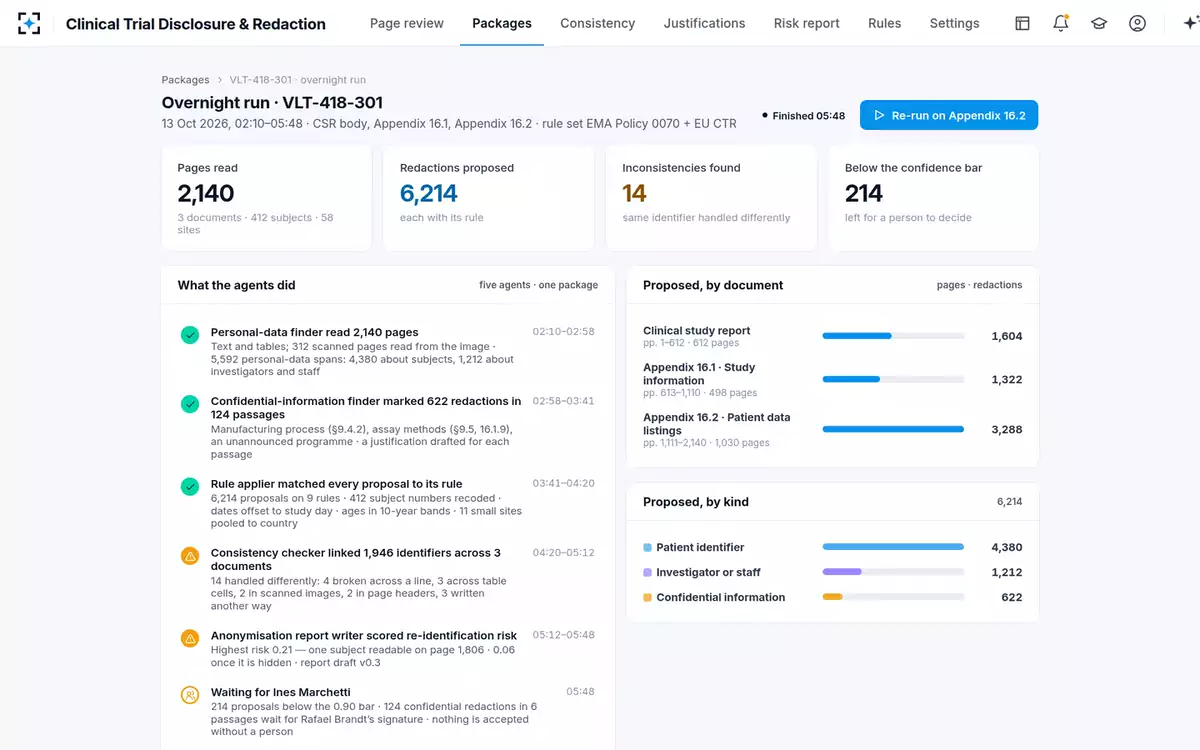
That is why risk in the solution is computed only from decisions a person has accepted, and why no agent may change a decision in order to lower the number. A score produced by a system that can edit the decisions behind it is not a measurement. On the sample package the highest subject risk reads 0.21 while one identifier is still readable in a listing footnote, and 0.06 once it is hidden — the same arithmetic the report has to show, site group by site group. How a figure like that is built, and what belongs in the report around it, is the subject of the anonymisation report guide.
What five agents did overnight, and what is left for a person
What a redaction has to look like on the page
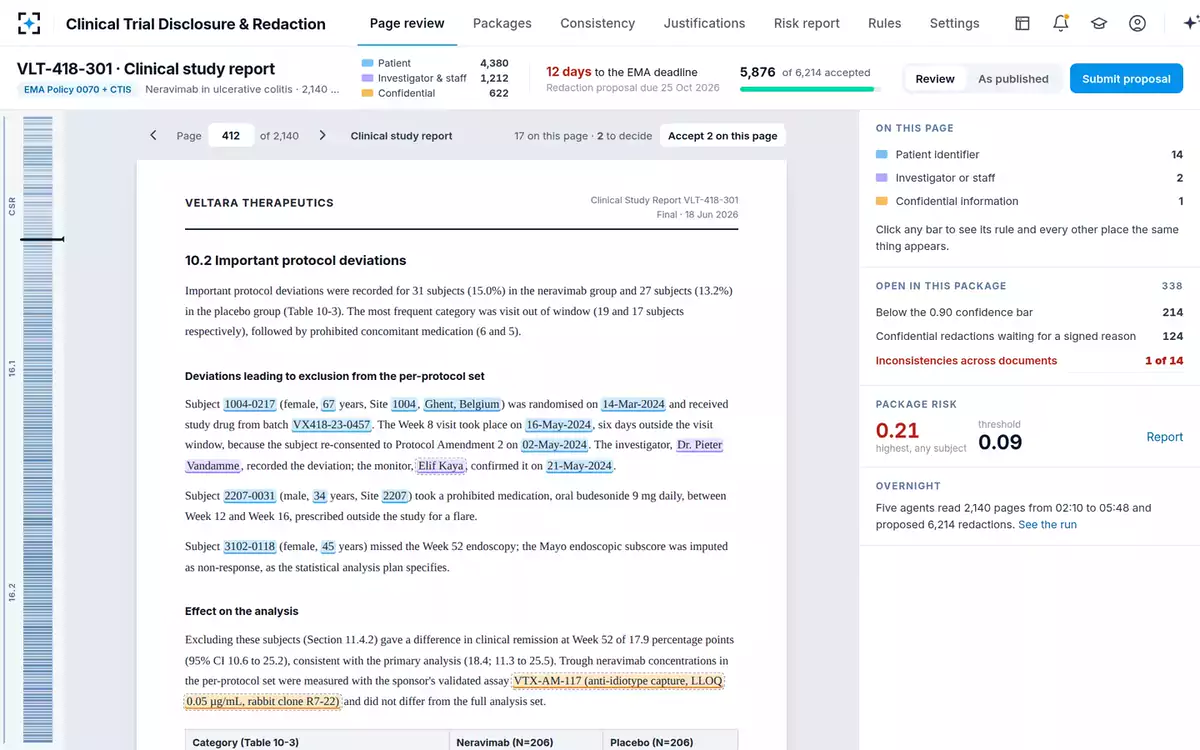
The guidance is unusually concrete here, because EMA has to watermark and publish whatever arrives. In the proposal version, text proposed for removal is marked but legible and labelled CCI or PPD; where redactions are masked, the expected colour coding is a black background with red overlay text for commercially confidential information and a blue background with black overlay text for personal data, so the two kinds can be told apart on sight. In the final version, redactions "must be clearly visible (typically using a black rectangle)", labels must be "visible and irremovable together with the final redacted text", files must not be password protected, documents that were in colour stay in colour, and 200 Mbyte per PDF is the stated best-practice ceiling.
The requirement with teeth is the searchability one. If the redacted text remains in the file's text layer under a drawn rectangle, the page looks redacted and is not; the guidance's wording — only un-redacted text searchable, the box neither searchable nor editable — is the test a tool either passes or fails. Any team choosing software should check that on a real file, and the guide to testing automated redaction sets out how.
What a complete Redaction Proposal Document package contains
- Cover letter with the declaration
Confirming that the reports submitted for scientific evaluation are the same as those submitted for publication, except for the proposed redactions. Templates are annexed to the guidance.
- The agreed list of expected documents
Annexed to the cover letter in PDF. Agreed with EMA within two weeks of the invitation email.
- eCTD tracking table and submission checklist
Both in module 1.0. The checklist was added at the relaunch specifically to make validation succeed first time.
- The anonymisation report form
Module 1.9, on the mandatory joint EMA and Health Canada template, describing the method for each report in the package.
- The clinical reports in their proposal version
Clinical overview, clinical summaries 2.7.1 to 2.7.4, each study report body, and appendices 16.1.1, 16.1.2 and 16.1.9 — including reports with no proposed redactions at all.
- One justification table per report that claims confidentiality
Every highlighted passage listed; a passage highlighted but missing from the table makes the proposal invalid, and it is sent back for clarification.
Why the policy stopped in 2018, and what restarted in 2023
Policy 0070 took effect on 1 January 2015 for new marketing authorisation applications and on 1 July 2015 for extensions of indication, and the first clinical data was published in October 2016. It was suspended in December 2018 as part of EMA's business continuity plans, and the EMA Management Board agreed in December 2022 to reinitiate it gradually. Through the suspension, publication continued for COVID-19 and other public health emergency data, which is where the 2022 figures at the top of this page come from.
The relaunch ran in two steps. Step 1 applied to new active substances from the September 2023 CHMP onwards, including negative and withdrawn products. Step 2, from the second quarter of 2025, extends publication to all new marketing authorisation applications — negative opinions and withdrawals included — together with line extensions and extensions of indication, while excluding biosimilars, hybrids and generics (EMA, Step 2 webinar on the revised scope, 14 November 2024). A sponsor whose application fails is still a sponsor with a publication package to prepare. The procedural changes are small and they all point the same way: emphasis on preparing the package before the opinion, product-specific pre-submission meetings, a cover letter checklist to make validation pass, the joint anonymisation report template, and EMA drafting the list of documents in scope and sending it to the sponsor for agreement rather than waiting to be told. There is also no plan to request clinical data for products authorised during the suspension — a gap in the public record that is worth knowing if you are searching for a comparator's reports and cannot find them.
Where a Policy 0070 package goes wrong
Validation failures are procedural, and the guidance names them. The team checks that the content of the package is all there, that the naming convention is followed, that redaction labels and colour coding are correctly applied, that out-of-scope sections are correctly identified, and that one justification table per relevant report is present when confidentiality is claimed. Clarification is then required in cases such as these: text highlighted for redaction in the report but missing from the justification table; all redactions present in the table but some rows or columns incomplete; and "the same unspecific copy/paste justification … used throughout the entire justification table".
That last one is the most instructive failure in the whole guidance, because it is what a hurried team produces. Validation only checks that the table is complete; the content of each justification is judged in the review that follows, and a table of identical sentences fails twice — once on completeness and once on substance. An unsuccessful validation rejects the package, asks for a revised one within 7 calendar days, and recalculates the timelines, which means a packaging mistake can cost more days than the argument it was hiding.
The substantive failures are different in kind: an identifier hidden in the body and left readable in a listing, a confidentiality claim over something already in the European public assessment report, a report that describes a method the documents do not follow. None of those are caught by a page-by-page pass, because none of them are visible on a single page.
Where a study report package’s days go, by hand and in Clinical Trial Disclosure & Redaction
Set that against the seven calendar days between the redaction conclusion letter and the final package, and the case for preparing early stops being a slogan. A package whose decisions are already made, consistent and explained can be re-issued in a day. One whose decisions are still being discovered cannot.
The page at reading size, with every proposed redaction and its rule
To see the proposal, the justification table and the anonymisation report built from one study report package, start from Clinical Trial Disclosure & Redaction.
Questions people ask
Who gets the invitation email for Policy 0070?
EMA sends it to applicants with selected ongoing procedures — at the Step 2 webinar, those with a planned CHMP opinion date from the second quarter of 2025 onwards. Step 2 of the relaunch covers all new marketing authorisation applications, including negative opinions and withdrawals, plus line extensions and extensions of indication; biosimilars, hybrids and generics are excluded. The email carries the updated question-and-answer document, the draft list of expected documents for agreement within two weeks, the submission checklist and the anonymisation report template.
How long does EMA take to publish clinical data?
For initial applications, line extensions and extensions of indication, EMA publishes the redacted reports within 120 days of the CHMP opinion; for withdrawn applications and Article 58 applications, within 150 days of the withdrawal letter or the opinion. Within the publication procedure itself, publication follows within 10 calendar days of the Agency receiving a valid Final Redacted Document package.
Does EMA review the anonymisation report?
Yes, and it is reviewed against the documents. The Agency checks whether the sponsor followed the anonymisation guidance and applied it consistently throughout the package, and sends its comments with the redaction conclusion letter on Day 47. If comments are raised, an updated report or written responses may be due on Day 61, with the Agency's final response on Day 68.
Was EMA Policy 0070 suspended?
Yes. The policy took effect in 2015, the first data was published in October 2016, and publication was suspended in December 2018 as part of EMA's business continuity plans. The Management Board agreed in December 2022 to reinitiate it gradually, and the relaunch applies from the September 2023 CHMP. Publication of COVID-19 and other public health emergency data continued throughout.
What is the redaction conclusion letter?
It is the letter EMA sends by Eudralink on Day 47 of the publication procedure, stating the outcome on each proposed confidentiality redaction — rejected, accepted or partly accepted, documented in the justification table columns — and its comments on the anonymisation report. It starts the seven-calendar-day window for the Final Redacted Document package, unless the Agency has asked for responses first, in which case the window runs from its final response.
Can the clinical study report appendices be left out of the package?
No. Appendices 16.1.1, 16.1.2 and 16.1.9 are listed for publication alongside the report body, and reports with no proposed redactions at all still have to be submitted in both packages so that the proposal and the final version contain the same number of reports. Where the body and the appendices are submitted as separate files, EMA expects a separate justification table for each file that claims confidentiality.