Health Canada's PRCI guidance — the guidance document on Public Release of Clinical Information — tells a manufacturer how to prepare the clinical information behind an approved drug or device for publication on Health Canada's clinical information portal. Its core is a three-step risk-based anonymization: identify and classify the variables, measure the re-identification risk, then anonymize the data. The number it measures against is the same one Europe uses, a risk of 0.09, but Health Canada expresses it the way a statistician would check it on a page — "adopting a risk threshold of risk=0.09 equates to a target cell size of 11 patients". The clock is short: 60 calendar days from initiation to submit the de-identified documents with the proposed redactions, with publication aimed at 120 calendar days from initiation.
For a sponsor publishing the same study report twice, in Europe and in Canada, the question is how much of the work transfers. The answer is more than most teams expect, provided the documents are the same: Health Canada lets a manufacturer certify that what it submits is identical to what EMA published, and under the EMA–Health Canada work-share such documents are re-published as EMA published them, without the anonymisation or the confidentiality redactions being assessed again. What needs fresh work is whatever differs. Botminds' Clinical Trial Disclosure & Redaction is built to that shape: the decisions taken for a Policy 0070 package can be copied to the Canadian one as proposals, with the same recoding so the two publications match, and in the sample configuration the confidentiality claims also go back to legal counsel for a fresh look, because anything Canada-specific is judged under Canadian law. The examples use invented sample data — Veltara Therapeutics, neravimab, study VLT-418-301 and the people who sign off — and the rules and figures are the regulators' own.
What does Health Canada's PRCI guidance require?
It requires three things in sequence, and they are not interchangeable. First an anonymization of the clinical information to a defensible standard, described in an anonymization report. Second, where the manufacturer wants to hold something back as confidential business information, a proposed redaction that meets a statutory test. Third, a submission within the time Health Canada allows, with a certification that the package is what it claims to be.
The anonymization itself "should broadly follow the following three steps: Step 1: Identify and classify the variables Step 2: Measure the re-identification risk Step 3: Anonymize the data". The order is the method. A team that starts by blacking out everything that looks like an identifier has skipped the measurement and will not be able to say, at the end, what risk the package carries — which is the one question the report has to answer.
The three steps of a risk-based anonymization
Step 1 separates direct identifiers, which name a person, from indirectly-identifying variables, which narrow a person down. Health Canada's own list of the second group is broad: "city, state/province, zip/postal code, demographic data (race, gender, etc.), medical history, serious adverse events, dates, height, weight, and BMI". Classification is where most of the judgement sits, because it decides what the measurement will be made on.
Step 2 measures. The measure is the probability that a reader can match a row to a person, and Health Canada is explicit about what a public release does to it: "in a public release environment, the context risk is unreducible", so the overall risk is the risk inherent in the data itself. There is no contract or trusted recipient to discount it, which is why EMA's guidance, working from the same logic, measures the highest risk in the dataset rather than the average. Step 3 then changes the data until the measurement comes back under the threshold — and here Canada differs from a page-by-page redaction habit: "Health Canada encourages the generalization of indirectly-identifying variables." A birth date becomes a year, an age becomes a band, a city becomes a province, a rare weight becomes a range. The information survives in a coarser form, which is the point: a document nobody can learn anything from has been protected at the cost of the reason it was published.
Why a 0.09 risk threshold means a cell size of 11
The arithmetic is one line. If a person shares a combination of indirect-identifier values with ten other people, the group holding that combination has eleven members, and a reader who knows the combination has a one-in-eleven chance of picking the right person: 1 ÷ 11 = 0.0909. Health Canada defines the group as a cell — "Cell size is defined as the number of patients with the same indirectly-identifying variable values" — and states the equivalence directly: a threshold of 0.09 "equates to a target cell size of 11 patients".
From a risk figure to something you can count on a page
The threshold
risk = 0.09
Health Canada encourages a 9% re-identification risk threshold.
Health Canada, PRCI guidance
The risk of one cell
risk = 1 ÷ cell size
The chance of picking the right patient out of the group that shares a combination of values.
The definition of a cell
The target
cell size ≥ 11
1 ÷ 11 = 0.0909: the 0.09 threshold is this figure rounded, which is why Health Canada equates the two. Ten patients gives 0.10, outside.
Health Canada, PRCI guidance
Two mistakes follow from reading the number without the definition. The first is to treat the cell as a site: a site with eleven subjects is not a cell of eleven unless those eleven share the same values for every indirect identifier a reader can see, and they almost never do, because age, sex and event dates differ. The second is to treat the cell as a target for the whole dataset rather than its smallest group. The one that fails is the smallest cell in the package, so a single unusual combination — one participant who is the only woman over 70 at a two-patient site — carries the measurement for everything.
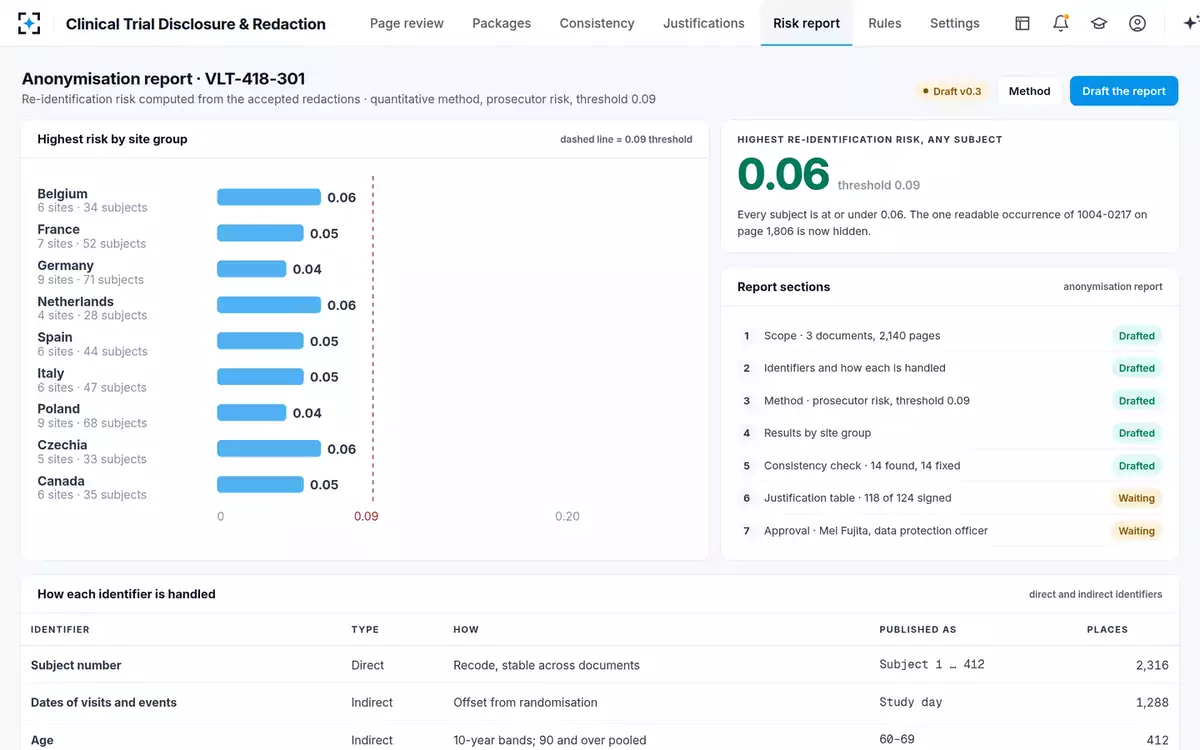
In the sample package, this is why the highest subject risk is the number on the screen. One subject at a site with six participants reads 0.21 while an identifier is still readable, and 0.06 once it is hidden, with every other subject at or below 0.06. Nothing about the other 411 subjects changes that figure; the package is as anonymous as its worst row.
It is worth being precise about one setting that shares the number 11. In the solution, "small sites: under 11 subjects, pooled to country" is a rule about how many participants a site enrolled, and it exists to stop a small site acting as a near-identifier. Health Canada's target cell size of 11 is about how many patients share the same combination of indirect-identifier values. They are different quantities that happen to share a figure, and a report that confuses them will describe a method it did not use.
Why the smallest group decides the package: risk by cell size
How long does a PRCI package take, and who starts the clock
Health Canada starts it. The process is initiated by the department when the qualifying regulatory decision is issued, with an email to the manufacturer — for a negative decision, 31 calendar days after the notice unless a letter of intent to seek reconsideration arrives — and from initiation "Health Canada requests that within 60 calendar days the manufacturer submit the de-identified documents with proposed redaction(s)". Publication is aimed at 120 calendar days from the same starting point: Health Canada "aims to upload a final redacted and anonymized clinical information package onto Health Canada's clinical information portal within 120 calendar days from initiation of the process".
The Canadian clock, from initiation to the portal
- Anonymize, propose redactions, write the report60 days
- Health Canada reviews each justification, with at most one further round, then the final package goes to the portalby day 120
Sixty calendar days is roughly eight and a half weeks, which sounds generous until you notice what is in them: a full anonymization of a study report package, a proposed redaction set with justifications, a measured risk figure and a written report. For a sponsor that has already published the same study report in Europe, almost all of that work exists. For one that has not, sixty days is the whole of the job, and much of the first fortnight can go on deciding which variables are indirect identifiers.
What counts as confidential business information in Canada
Unlike Europe, Canada has a statutory definition, and it is a three-part test. Confidential business information, in the words of the Food and Drugs Act as the guidance quotes it, means business information "(1) that is not publicly available, (2) in respect of which the person has taken measures that are reasonable in the circumstances to ensure that it remains not publicly available, and (3) that has actual or potential economic value to the person or their competitors because it is not publicly available and its disclosure would result in a material financial loss to the person or a material financial gain to their competitors".
The three-part test, and what each part asks of a manufacturer
| The statutory element | What it asks | Where a claim usually fails |
|---|---|---|
| Not publicly available | Has this information been disclosed anywhere — a publication, a conference abstract, a label, a filing in another jurisdiction, a published clinical report? | A passage already published in Europe under Policy 0070, or in a product monograph. Publication anywhere ends the claim everywhere. |
| Reasonable measures to keep it so | Can the company show it treated the information as confidential: access controls, confidentiality agreements, a confidential-information list? | Information that circulates freely inside the company and with partners, with nothing to show it was ever protected. |
| Actual or potential economic value from secrecy | Would disclosure cause material financial loss, or a material financial gain to a competitor — and can that be stated, not asserted? | A claim that names a section rather than the words, or asserts harm without saying what a competitor would do with the information. |
On top of the test, Health Canada narrows the field to two categories of clinical information that are eligible for redaction at all: information "that was not used by the manufacturer in the drug submission or supplement, or medical device application to support the proposed conditions of use or the purpose for which the drug or medical device is recommended", and information "that describes tests, methods or assays used exclusively by the manufacturer". Information that supported the approval is, by definition, outside the first category — which is a short way of saying that the evidence for the decision is public, and only what sits beside it can be held back. The parallel reasoning in Europe, and the handful of claims that survive it, is set out in the guide to commercially confidential information.
Generalise, randomise, offset — then redact: Health Canada's preference
A page prepared for Canada should not look like a page prepared by someone whose only tool is a black rectangle. The guidance says data transformation "should favour methods that retain analytical value, e.g. generalization, randomization and offsetting, as opposed to redaction", which means the preferred answer to a risky value is a coarser or shifted value rather than no value. A date of birth becomes a year. An exact weight becomes a range. A city becomes a province. A rare adverse event term may be reported at a higher level.
Redaction remains the usual answer for direct identifiers — a name, a participant number, a telephone number, a signature — which the guidance says may be redacted where removing them is not detrimental to the data's usefulness, and for confidential business information, where the point is to remove the words. For indirect identifiers it is best kept as a last resort, because each one removed costs a reader the ability to interpret the data, and the reason the information is being published is that somebody wants to interpret it.
Risk computed from accepted decisions, site group by site group
Reusing Policy 0070 decisions, and the certification that allows it
Health Canada anticipates that a manufacturer will have published the same information in Europe, and provides for it: a manufacturer may certify, on the template form in Appendix G of the guidance, that the clinical information submitted to Health Canada is identical to the information published under EMA Policy 0070. That certification is the formal route by which one anonymisation serves two publications.
The two agencies have since gone further. EMA's question-and-answer document on its work-share with Health Canada, dated April 2026, describes a voluntary joint review for initial marketing authorisation applications common to both: it is open where the planned outcomes fall within six months of each other and the lists of expected documents overlap by about 70%, one lead agency reviews the confidentiality proposals and the anonymisation report for the shared documents, and the other agency does not reassess them. On certification the document is plain: Health Canada "will not conduct re-assessment of the anonymisation strategy or of applied CCI (if any)" and re-publishes the documents in the exact form EMA published them (EMA, Policy 0070 work-share Q&A, 2026). Two exceptions run the other way: EMA requires all handwritten text to be redacted and principal investigators' names to be retained, and Health Canada accepts both for work-share packages.
The thing that genuinely transfers is the report itself. EMA's external guidance records that the anonymisation report form template and its instructions were written jointly by EMA and Health Canada's PRCI programme, that using the template is mandatory, and that each data package submitted for publication needs its own report. EMA's relaunch deck says the same thing from the other side: a "new anonymisation report template developed jointly with Health Canada". One template, two authorities.
Confidentiality has to be argued afresh wherever the Canadian package differs from the European one. Europe's test is a policy test — information not in the public domain whose disclosure may undermine a legitimate economic interest — and Canada's is statutory, with a reasonable-measures element Europe does not have and an eligibility filter Europe does not use. A document only Canada receives, or a passage proposed as confidential only there, is judged under that test; and a passage EMA declined to protect is, once published, publicly available and fails the first element automatically.
Two authorities, one study report: what matches and what does not
EMA Policy 0070: Advisable at 0.09; the sponsor may choose another with a justification.
Health Canada PRCI: Encouraged at 0.09, expressed as a target cell size of 11 patients.
EMA Policy 0070: The maximum risk, the highest probability of re-identification across all records.
Health Canada PRCI: The re-identification risk measured in step 2, against the cell sizes the data produces.
EMA Policy 0070: Not in the public domain and disclosure may undermine a legitimate economic interest, argued per passage.
Health Canada PRCI: The Food and Drugs Act three-part test, applied only to two eligible categories of clinical information.
EMA Policy 0070: Mandatory, on the template EMA says it developed jointly with Health Canada, reviewed by the Agency against the documents.
Health Canada PRCI: The Appendix F template: six sections ending in an attestation.
EMA Policy 0070: Proposal due between day 181 and opinion plus 30 days; publication within 120 days of the opinion.
Health Canada PRCI: 60 calendar days from initiation to submit; publication aimed at 120 calendar days from initiation.
EMA Policy 0070: The anonymisation decisions and the recoding, so both publications read the same.
Health Canada PRCI: Identical documents, certified under Appendix G, re-published as EMA published them; anything Canada-specific judged under Canadian law.
The anonymization report and the attestation at the end of it
The template's six sections, in Appendix F of the guidance, are a reasonable outline for any disclosure team, whichever authority it is writing for: "1. Anonymization methodology 2. Identification of data variables (direct and indirect identifiers) 3. Measurement of disclosure risk 4. Data utility considerations 5. Deviations 6. Attestation".
The six sections, and the one question each has to answer
- Anonymization methodology
What technique was applied to what, and why this technique for this package. Not a description of the software.
- Identification of data variables
Which variables were treated as direct identifiers and which as indirect, variable by variable. This is the list the measurement rests on, so an omission here is an error everywhere downstream.
- Measurement of disclosure risk
What was measured, against what threshold, and what the highest value is. A number without a method is an assertion.
- Data utility considerations
What was kept readable and why — the counterweight to over-redaction, and the place to say that adverse event terms, results and methods were retained.
- Deviations
Where the package departs from the method or the threshold, and the justification for each. A deviation declared is a decision; a deviation found is a finding.
- Attestation
A named person signing that the above is what was done. In the sample package that is the data protection officer, after approving the risk method.
The attestation is the reason the rest matters. A report describing a method nobody followed is worse than no report, because it is signed. That is why, in the solution, the risk figure is recomputed only from decisions a person has accepted and no agent may alter a decision to move the score — and why the data protection officer approves the method before approving the report. What belongs in each section in more detail is the subject of the anonymisation report guide.
Where PRCI and Policy 0070 pull in different directions
Three differences are big enough to change what a page looks like. Canada prefers generalisation; a team that redacts indirect identifiers in Europe out of habit will submit a less useful document in Canada than the guidance asks for. Canada's confidentiality test has a reasonable-measures element, which is an evidentiary burden about the company's own conduct rather than about the information — something legal counsel can prepare for in advance, and no redaction tool can supply. And the two clocks hang off different events: Europe's off a CHMP opinion, Canada's off Health Canada's email when its own regulatory decision issues — usually months apart for the same study report, so the two packages rarely land in the same week, and the second one can arrive while the team is busy with something else.
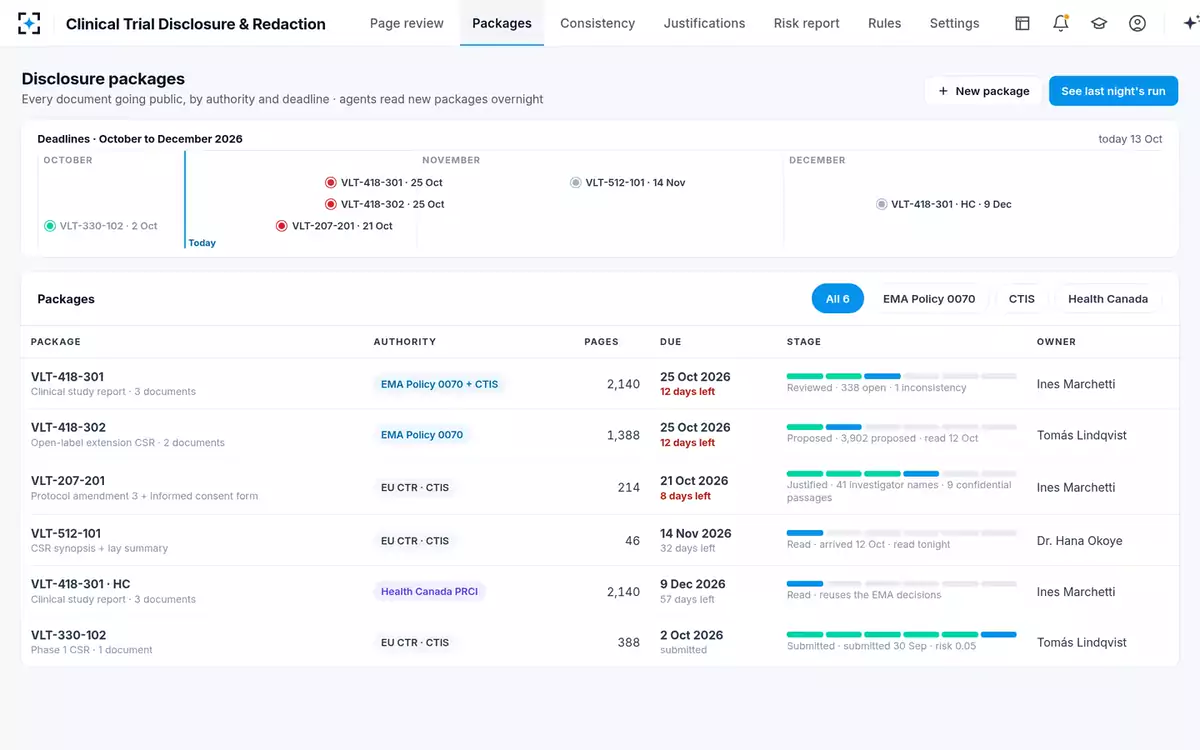
The practical answer is to treat the second publication as a copy — certified where it is identical, reviewed where it is not — rather than as a new project or a re-run. In the sample package, the Canadian row on the board reuses the EMA decisions as proposals with the same recoding, so a participant who is Subject 112 in Europe is Subject 112 in Canada, while the confidentiality claims return to legal counsel for a fresh look and nothing is applied until a person accepts it. Consistency between the two publications is not a nicety: two differently redacted versions of one study report, side by side on two public portals, are a re-identification method in themselves.
One study report, two authorities, on one board
To see one anonymisation serve two publications, with the risk recomputed from accepted decisions each time, start from Clinical Trial Disclosure & Redaction.
Questions people ask
How is re-identification risk measured for PRCI?
By Health Canada's three steps: classify the variables as direct or indirect identifiers, measure the risk that a reader can match a row to a person, then anonymize until the measurement passes. The threshold encouraged is 0.09, which Health Canada expresses as a target cell size of 11 patients sharing the same indirect-identifier values. Because a public release cannot reduce the risk through its context, the cell that decides the result is the smallest one, not the average.
Can you reuse EMA Policy 0070 redactions for Health Canada?
Largely, where the documents are identical. Appendix G lets a manufacturer certify that what it submits matches what was published under Policy 0070, and EMA's 2026 Q&A on its work-share with Health Canada says certified documents are re-published in the exact form EMA published them, without Health Canada re-assessing the anonymisation or the confidentiality redactions. Documents or claims specific to Canada are judged under Canada's statutory test, and anything EMA declined to protect is already public.
What goes in the Health Canada anonymization report?
Six sections, on the template in Appendix F: anonymization methodology, identification of direct and indirect data variables, measurement of disclosure risk, data utility considerations, deviations, and an attestation. EMA says its current anonymisation report template was developed jointly with Health Canada, so a sponsor publishing in both places can write one kind of report rather than two.
Does Health Canada prefer generalization to redaction?
For indirectly-identifying variables, yes: the guidance encourages generalising them, and lists city, province, postal code, demographic data, medical history, serious adverse events, dates, height, weight and BMI as examples. Redaction remains the method for direct identifiers and for confidential business information. Generalising preserves the usefulness of a document that is being published precisely so somebody can read it.
Which documents does Health Canada publish?
For a drug submission, the clinical overview (module 2.5), the clinical summaries (2.7) and the clinical study reports (5.3) with appendices 16.1.1, 16.1.2 and 16.1.9 — anonymized, with any accepted redactions of confidential business information applied — once the qualifying regulatory decision has issued. Individual patient records, including patient listings and full case report forms, are not released; for medical device applications the scope is set case by case.
What is confidential business information in Canada?
Business information that meets all three elements in the Food and Drugs Act: it is not publicly available, the person has taken reasonable measures to keep it that way, and its secrecy has actual or potential economic value because disclosure would cause material financial loss or a material competitor gain. On top of that, only two categories of clinical information are eligible for redaction: information not used to support the proposed conditions of use, and information describing tests, methods or assays used exclusively by the manufacturer.