The revised CTIS transparency rules, adopted by EMA's Management Board on 5 October 2023, changed what Europe's clinical trials database publishes and when. Two changes matter to anyone preparing documents for it. The deferral mechanism — by which a sponsor could ask for publication of a protocol to be held back, in some categories for up to seven years after the end of the trial — is gone for every trial category. In exchange, the list of documents that are published at all is much shorter, and focused on the ones patients and researchers use. The protection that used to be a delay is now an edit: for the documents that remain in scope, redaction is the only instrument left, and it has to be right the first time, because publication now follows the authorisation decision rather than a deferral period.
Botminds' Clinical Trial Disclosure & Redaction keeps a separate rule set for each authority for exactly this reason, changed by people and never by an agent. The sample package used for the examples here is invented — the sponsor Veltara Therapeutics, the medicine neravimab, study VLT-207-201 and the people named on the board — while the rules, dates and quotations are EMA's and the Regulation's own.
Removing the deferral mechanism for every trial category, in combination with reducing the publication of documents to only those essential to patients and researchers, will deliver much earlier publication of key documents (including protocols), as well as significant system simplification.
Revised CTIS Transparency Rules, section 5
What changed in the revised CTIS transparency rules?
Four things changed, and one thing did not. Deferral was removed for every trial category. The set of documents published was cut to those EMA describes as essential to patients and researchers. The structured data fields published were rationalised so that the public interface is searchable rather than exhaustive. And the trials submitted before 18 June 2024 were separated out as a group with their own rules. What did not change is the earliest moment anything may appear: the decision on the clinical trial application, as Article 81(5) of the Clinical Trials Regulation requires, unless there is an overriding public interest.
The categorisation of trials survives the revision, but only as a way of describing them. Category 1 is pharmaceutical development — Phase I and Phase 0, bioequivalence, biosimilar similarity and equivalence trials. Category 2 is therapeutic exploratory and confirmatory work: integrated Phase I/II, Phase II and Phase III. Category 3 is therapeutic use: integrated Phase III/IV, Phase IV and low-interventional trials. Under the old rules those categories decided how long a sponsor could defer. Under the revised rules they decide what is published and when, and nothing at all about delay.
The consultation that produced the revision
204
stakeholders responded to the 2023 public consultation — sponsors, contract research organisations, academia, national competent authorities, ethics committees, health professionals and patient organisations
3
trial categories retained, but no longer connected to deferral
0
categories that keep a deferral option
Deferral is gone: what a sponsor lost and what it gained
Under the rules in force at the launch of the system, categorisation "has been the basis for defining the applicable deferral timelines allowing sponsors to request to publish the relevant clinical trial information not at the time of the application decision, but rather at the end of the deferral period", and for some trials that allowed deferral of key documents, the protocol among them, "for up to 7-years from the end of the trial in the EU/EEA". A commercially sensitive Phase I protocol could, in practice, stay out of public view for most of a development programme.
What replaced it is narrower publication, earlier. For a Category 2 or 3 trial, the protocol and synopsis including patient-facing documents, the summary of product characteristics if available, the informed consent form and patient information sheet, and the recruitment arrangements including advertising material are all published at the time of the decision by the Member States concerned, with the first decision triggering publication. For a Category 1 trial in adults only, the protocol and patient-facing documents are published 30 months after the end of the trial in the EU/EEA; where the trial is in a paediatric population or part of a paediatric investigation plan, they are published together with the final summary of results, as soon as those results are submitted.
The trade is worth stating plainly, because it changes where a disclosure team spends its effort. A sponsor used to be able to buy time with a form. Now it can only buy protection with an edit, and an edit on a document a patient is meant to read.
The longest a protocol can wait for publication, before and after the revision
What CTIS publishes, and when, under the revised rules
| Trial category | Documents published | Timing |
|---|---|---|
| Category 1 · paediatric population or part of a paediatric investigation plan | Protocol, synopsis including patient-facing documents, if available. Final summary of results with a layperson summary. | The documents go out together with the final summary of results, as soon as the results are submitted in CTIS. |
| Category 1 · adults only | Protocol, synopsis including patient-facing documents, if available. Final summary of results with a layperson summary. | 30 months after the end of the trial in the EU/EEA. Results are expected in the secure domain within 12 months of the end of trial and published at 30 months. |
| Category 2 and 3 | Protocol and synopsis including patient-facing documents; summary of product characteristics if available; informed consent form and patient information sheet; recruitment arrangements including advertising material. | At the time of the decision on the application issued by the Member States concerned. The first such decision triggers publication. |
| Category 2 and 3 · results | Final summary of results with a layperson summary. | When submitted in CTIS. |
| All categories | The clinical study report, if available, where trial results are used in a marketing authorisation procedure. | When submitted in CTIS. |
Which documents CTIS publishes, by trial category
The table above is the whole published set, and the omissions are as instructive as the entries. The investigator's brochure is not listed. Nor is the investigational medicinal product dossier: EMA's CTIS guidance names both among the information that is never made public. A document that is not on the list is not published, which means a disclosure team's first question about any file going into CTIS is not "how do I redact this" but "is this published at all" — and for most of the application dossier the answer is no.
A short list of items is published never, and the rules say so explicitly rather than leaving it to inference.
Never published in CTIS, whatever the trial category
- Requests for information, and the sponsor responses to them
Raised by the Member States concerned at validation and during assessment of Part I and Part II. The superseded document versions that went with them are not published either.
- Assessment reports, draft and final, for Part I and Part II
Protected under Article 81(4)(c), which covers confidential communication between Member States in preparing the assessment report.
- Decision letters for the clinical trial application
The decision itself and its date appear as structured data; the letter does not.
- GCP inspection reports
Along with planning information for supervision activities, under the derogation in Article 81(4)(d) for effective supervision.
- The sponsor legal representative's details
Name, surname, telephone number and email address: personal data of a named individual, never published.
- Documents provided with corrective measures, ad hoc assessments and Union control plans
Including the sponsor's own opinion submitted with a corrective measure. The corrective measure itself is published when applied.
Two versions of one document: 'for publication' and 'not for publication'
CTIS does not redact anything. The sponsor uploads the redacted file itself, and the system's only contribution is a pair of labels. The rules put it this way: documents to be published "should be redacted to protect CCI and personal data, if this is needed depending on the document content", and for those documents "CTIS offers the possibility to use a document version 'for publication' for redacted documents and a document version 'not for publication' that may contain personal data and CCI, as needed for the scientific and regulatory review carried out by the Member States".
Three practical consequences follow. First, the assessors read the unredacted file and the public reads the redacted one, so a redaction never costs the assessment anything — a team that redacts defensively because it fears the reviewer has misunderstood the mechanism. Second, the two versions must be the same document apart from the redactions, which is a configuration-control problem as much as a privacy one: one version revised and the other not is how a sponsor publishes a document that was never assessed. Third, documents that will not be published at all are uploaded in the secure domain only, with a 'not for publication' version, so the label is also how a sponsor states its intent.
The version pair is the point at which a redaction tool earns its place. The published version has to be derived from the assessed one, every identifier handled the same way in both, and the difference between them explainable. In the sample package, that is what the consistency check is for: one decision about one identifier, applied in every place it appears, with the places listed. How that works across thousands of pages is the subject of the guide to patient data listings.
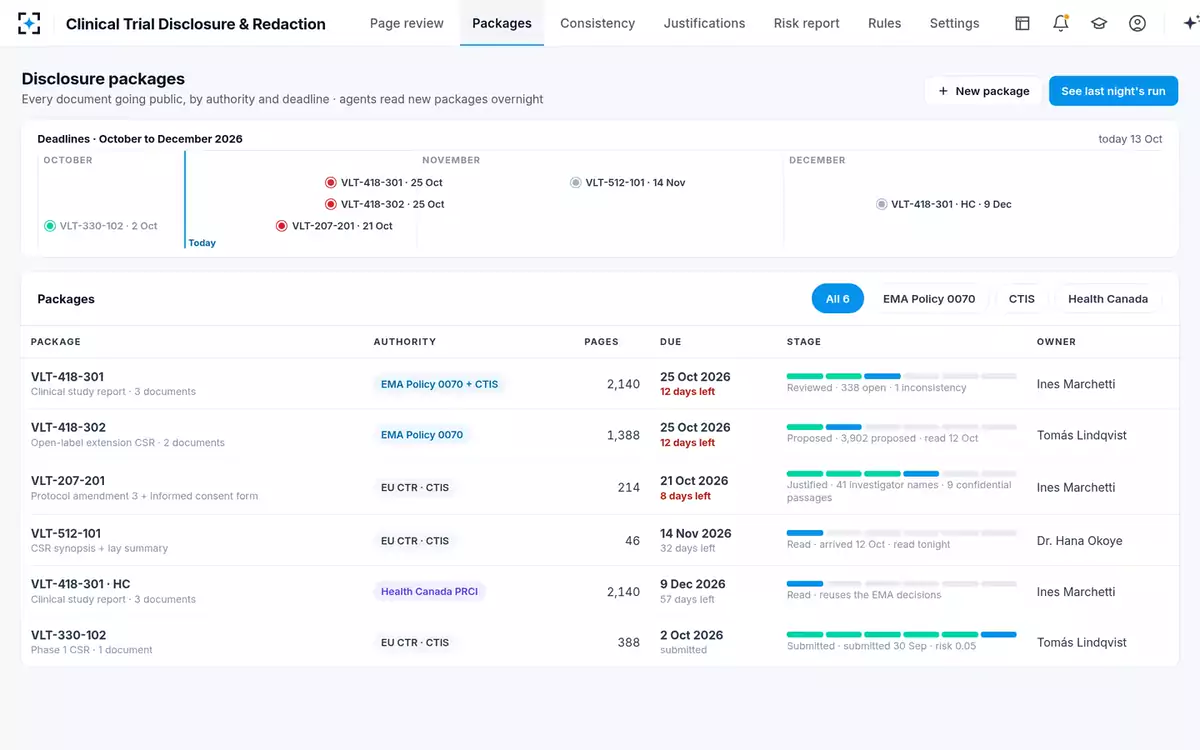
A CTIS package on the same board as the EMA and Health Canada ones
Why structured data fields can never be redacted
This is the rule most often discovered too late, and it is one sentence long: "structured data fields cannot be redacted, so CTIS users should not include any personal data or CCI in such fields". There is no 'for publication' version of a field. What a sponsor types into the trial title, the design, the inclusion and exclusion criteria, the primary and secondary endpoints, the product details, the site details or the sponsor contact details is the published value or it is not entered at all.
Two kinds of harm follow from forgetting it. A free-text field that carries a private mobile number, a patient's initials or a coordinator's personal email address publishes personal data with no way to take it back except a correction. (Principal investigators' names and professional contact details are a different matter: CTIS publishes them on purpose.) And a field that carries genuinely confidential detail — a formulation parameter typed into a product field because the form asked for it — is published at the decision, after which it is in the public domain and can never be claimed as confidential anywhere else. EMA's own guidance tells sponsors to check whether information is "already published, for example via the structured data fields in CTIS" before proposing it as confidential elsewhere.
One more protection is available and worth knowing: EMA retains the ability to edit public information on justified grounds, "for example in case of unintended disclosure of clinical trials information containing CCI". That is a remedy, not a plan. It depends on someone noticing.
Trials submitted before 18 June 2024 follow different rules
Trials submitted to CTIS before 18 June 2024 are 'historical trials', and EMA's CTIS guidance states the starting position for them plainly: their structured data is published under the revised rules, while "all documents contained in applications submitted to CTIS before 18 June 2024 are not published. This applies to all historical trials in the system, and regardless of the previous use of deferrals or publication status."
The catch is the next application. A substantial modification, a non-substantial modification or — for Part II documents only — the addition of a Member State, submitted on a historical trial, triggers publication of the documents in scope of that application under the revised rules, and the guidance notes that CTIS treats every document in scope as published "regardless of the fact that their update was in scope of the modification or not". A modification filed to update the investigator's brochure therefore publishes the protocol, the synopsis and the product characteristics, and the sponsor is expected to make sure their 'for publication' versions are properly redacted first. So the exposure for a historical trial is in two places: the structured fields, where redaction was never available, and every document that the next modification will carry into the public domain.
Does CTIS want an anonymisation report?
No, not by default. EMA's CTIS guidance is explicit: "An anonymisation report describing the anonymisation techniques used is not expected to be provided in CTIS, unless specifically requested." That is a real difference from the Policy 0070 procedure, where the anonymisation report is a mandatory part of the package and is reviewed against the documents.
It is not a licence to skip the work. The absence of a report means nobody at the Agency is checking the method before publication, which puts the whole burden of consistency on the sponsor. A team that has a method and writes it down anyway — because it also publishes under Policy 0070, or because its data protection officer requires it — will be able to answer a question about a CTIS document in a year's time. A team that does not will be reconstructing a decision from the published file.
CTIS and Policy 0070: one sponsor, two regimes
CTIS, under the revised rules: Structured data fields, plus a short list of documents: protocol and synopsis with patient-facing documents, product characteristics, consent form and patient information sheet, recruitment arrangements, results summary, and the study report where results support a marketing authorisation.
EMA Policy 0070: The clinical reports behind the authorisation: clinical overview, clinical summaries, study report bodies and appendices 16.1.1, 16.1.2 and 16.1.9.
CTIS, under the revised rules: At the decision on the application, for Category 2 and 3 documents; 30 months after end of trial for Category 1 in adults.
EMA Policy 0070: Within 120 days of the CHMP opinion for an initial application, line extension or extension of indication.
CTIS, under the revised rules: The sponsor uploads a redacted 'for publication' version. No Agency review of the redactions before publication.
EMA Policy 0070: The sponsor proposes; EMA validates the package, reviews every confidentiality justification and the anonymisation method, and answers on Day 47.
CTIS, under the revised rules: Not expected, unless specifically requested.
EMA Policy 0070: Mandatory, on the template built jointly with Health Canada, and reviewed.
CTIS, under the revised rules: Cannot be redacted at all. Protection is not entering the information.
EMA Policy 0070: Not applicable: the unit of publication is a document.
CTIS, under the revised rules: Patients and researchers reading a protocol and a consent form.
EMA Policy 0070: Researchers and assessors reading a study report.
What has to come out of a CTIS document, and what stays in
The legal frame is short. Article 81(4) of the Clinical Trials Regulation makes the database publicly accessible unless confidentiality is justified on one of four grounds: protecting personal data, protecting commercially confidential information "in particular through taking into account the status of the marketing authorisation for the medicinal product, unless there is an overriding public interest in disclosure", protecting confidential communication between Member States about the assessment report, and ensuring effective supervision by Member States. Article 81(7) is shorter still, and absolute: "No personal data of subjects shall be publicly accessible."
That pair is the whole of the drafting instruction for a redaction rule set. Trial participants' personal data is not a balance to be struck; it is a prohibition. Everything else — a staff member's private phone number, a sponsor's confidential detail — is a justified exception to a presumption of publicity, which means someone has to make the justification. Recital 67 adds the purpose: information in the database should be public, unless publishing a piece of it would breach the rights to private life and to the protection of personal data under Articles 7 and 8 of the Charter.
And the rules carry a warning about overdoing it that is easy to skip: "It should be noted that extensively redacted documents, in their published version, are of limited utility to stakeholders, including patients." A consent form blacked out to the point of unreadability satisfies nobody. It also stands out: the published set is now dominated by documents written for patients, so heavy-handed redaction is visible to exactly the audience the transparency rules exist to serve.
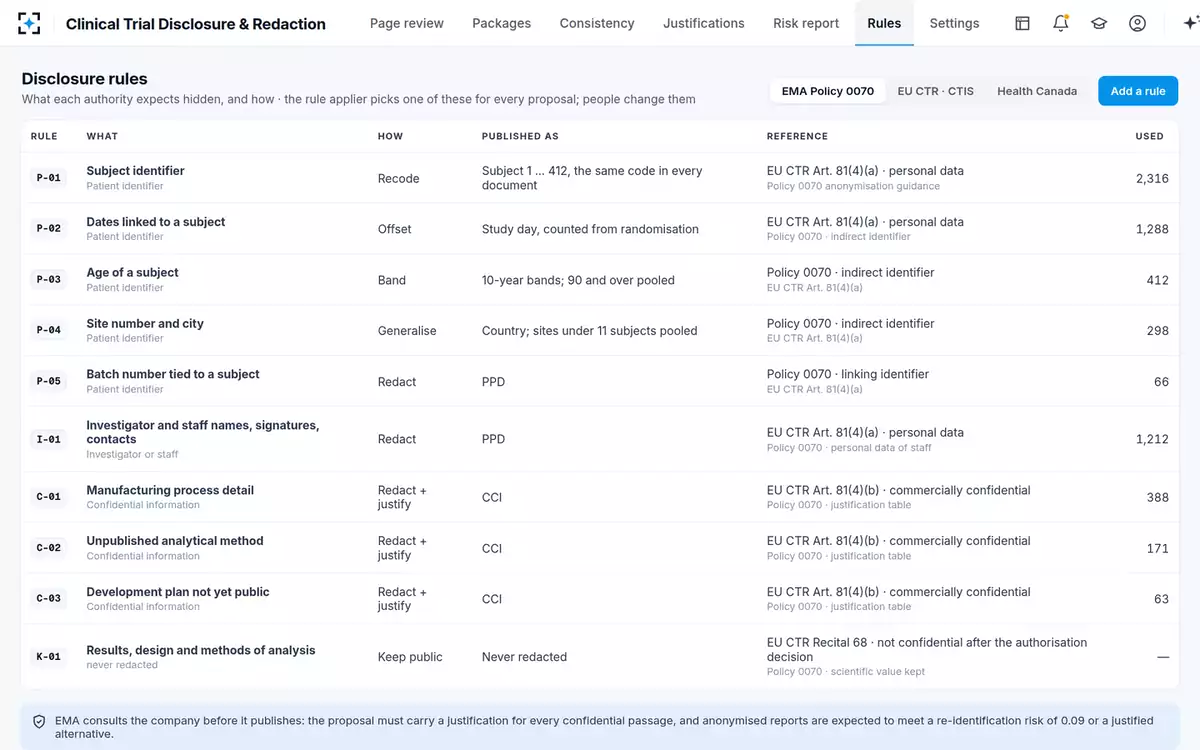
One rule set per authority, changed by people and never by an agent
Where CTIS redaction and Policy 0070 redaction part company
A sponsor running both will be tempted to run one process. The documents argue against it. A Policy 0070 package is thousands of pages of study report and listings, where the risk is a trial participant identified from a row of quasi-identifiers and the work is systematic anonymisation across files. A CTIS submission is a protocol, a consent form and a recruitment advertisement, where the risk is an investigator's mobile number in a footer or a site coordinator named in an appendix, and the work is close reading of a handful of documents.
The techniques diverge accordingly. Recoding subject identifiers and offsetting dates to study days are study report moves; they have little to do with a consent form. Generalising a site to a country protects a listing; on a recruitment arrangement, the site is the point. Even decisions about people do not simply transfer: EMA's CTIS guidance says the names of principal investigators and the professional contact details published through the structured fields should not be redacted in CTIS documents, while their signatures should be. What does transfer is a shared view of what counts as commercially confidential, which EMA defines in nearly the same words for both.
One instruction in the CTIS guidance pulls the other way, and is worth obeying: "Consistency should be maintained, and the extent of the redactions should be similar across published documents." A sponsor who blacks out a paragraph in a protocol and publishes the same paragraph in a study report has not protected it; it has only drawn attention to it. To see one rule set per authority, with the decisions from one package offered to the next, start from Clinical Trial Disclosure & Redaction.
Questions people ask
When did the revised CTIS transparency rules apply?
The Management Board adopted them on 5 October 2023, and the document said the Agency would endeavour to finish implementation by the second quarter of 2024, with the effective date communicated to users beforehand. The dividing line in practice is 18 June 2024: applications submitted from that date follow the revised rules, and applications submitted before it are treated as historical trials. The old deferral functionality stayed in place until the revised public website was available.
Was the CTIS deferral mechanism removed?
Yes, for every trial category. The revised rules remove deferral entirely and pair that with publishing fewer documents. Categorisation of trials is retained, "but no longer in connection with the use of deferrals" — it now determines what is published and when. During the consultation some stakeholders asked for deferral to be kept where a large number of documents would otherwise need redaction; it was removed anyway.
Does CTIS publish the protocol?
Yes, for every category, but at different times. For Category 2 and 3 trials the protocol and synopsis, including patient-facing documents, are published at the time of the decision on the application. For a Category 1 trial in adults only they are published 30 months after the end of the trial in the EU/EEA. For a Category 1 trial in a paediatric population or forming part of a paediatric investigation plan, they go out with the final summary of results.
Can structured data fields be redacted in CTIS?
No. The rules state that structured data fields cannot be redacted and that users should not put personal data or commercially confidential information into them. There is no published and unpublished version of a field as there is of a document. The only control is what is entered, which makes the data-entry step, not the redaction step, the place to protect a free-text field.
What is a document version 'for publication' in CTIS?
It is the redacted copy a sponsor uploads for the public interface, alongside a 'not for publication' version that may still contain personal data and commercially confidential information for the Member States' scientific and regulatory review. Documents that will not be published at all are uploaded to the secure domain with a 'not for publication' version only.
Are historical trials published in CTIS?
Their structured data is, under the revised rules; the documents in applications submitted before 18 June 2024 are not, regardless of whether deferrals were used. But a substantial or non-substantial modification submitted on a historical trial triggers publication of the documents in scope of that application, and an added Member State triggers publication of its Part II documents, so those documents must be redacted before the modification goes in.