Commercially confidential information, as EMA defines it for clinical data publication, is "any information contained in the clinical reports submitted to EMA by the applicant/MAH which is not in the public domain or publicly available, and where disclosure may undermine the legitimate economic interest of the applicant/MAH". That definition sounds broad and behaves narrowly, because the Agency starts from the opposite presumption about clinical reports. In the COVID-era programme it published 46 procedures; in seven of them a confidential redaction was proposed at all, in three any was accepted, and across the whole programme only 21 pages carried a confidential redaction. If you are preparing a package and expect to black out a chapter, EMA's own experience says you will not.
This guide sets out what EMA accepts, what it refuses and the five coded reasons it gives, then how to write the justification for the handful of claims that are worth making. Botminds' Clinical Trial Disclosure & Redaction drafts a justification for every passage its agents propose as confidential, and legal counsel signs or rejects each one — in the invented sample package used here, 124 passages went to a person and 17 proposed as confidential were kept public. The sponsor, the medicine, the study and the people in those examples are sample data; the rules and figures are EMA's own.
The Agency respects and will not divulge CCI. In general, however, clinical data cannot be considered CCI.
EMA Policy 0070, section 4, Policy statement
What counts as commercially confidential information?
Two conditions, both of them necessary. The information is not in the public domain or publicly available, and its disclosure may undermine the sponsor's legitimate economic interest. Neither condition does any work on its own. Information nobody has published is not confidential merely because nobody has published it; EMA says so directly — "the fact that certain pieces of information are not in the public domain as such, (word for word) does not necessarily mean that they should be considered by default as CCI". And information whose disclosure would plainly help a competitor is not protected if the competitor can already read it elsewhere.
The first condition is also wider than most teams assume, because EMA reads "publicly available" across every channel. Its guidance recommends a sponsor keep its own list of where information about its products appears, and names as a minimum the company's own websites, the EMA website including the European public assessment report and scientific guidelines, clinical trial registries such as the EU Clinical Trials Register and ClinicalTrials.gov, the websites of other regulators including the FDA, PMDA, TGA and Health Canada, and the scientific literature. A passage published by a regulator on another continent is in the public domain for this purpose.
Where to check whether information is already public, before claiming it
- Your own websites
Corporate and product sites, investor material, scientific communications. EMA puts this first because it is the source a sponsor controls and forgets.
- The EMA website
The product's European public assessment report and the scientific guidelines. A passage reproduced in the assessment report is public, and the Agency knows it is.
- Clinical trial registries
The EU Clinical Trials Register and ClinicalTrials.gov. Registry entries carry design, endpoints and eligibility criteria in structured form.
- Other regulators, inside and outside the EU
EMA names the FDA, PMDA, TGA and Health Canada, "especially when the product (or another product containing the same active substance) is approved in those specific jurisdictions".
- The scientific literature
Textbooks, PubMed and Medline — including your own authors' papers and congress abstracts.
- And keep the list
EMA recommends compiling and maintaining a company-specific list of where information about each product is available. It is also the evidence that a claim was checked rather than asserted.
That list is a practical instruction, not a flourish. A sponsor that maintains it can answer the first condition in minutes; one that does not will argue about a paragraph that its own medical affairs team presented at a congress two years ago.
EMA's own numbers: how little is ever accepted
Confidentiality claims in EMA's COVID-era publication programme
7of 46
procedures in which the sponsor proposed any confidential redaction
3of 46
procedures in which any confidential redaction was accepted
21pages
carried an accepted confidential redaction across the whole programme — EMA puts it at 0.01% of pages
Read those three figures as a sequence and they describe a funnel almost nobody gets through. Most sponsors claimed nothing. Of those who claimed, most were refused. Of what was accepted, the volume was trivial — and EMA's own summary of what survived is as narrow as the numbers: accepted claims sat in the clinical overview, the biopharmaceutic summary (section 2.7.1) and the protocol, and covered detailed manufacturing and assay information and candidate products not taken further.
There is a tactical reading of this and a strategic one. The tactical reading is that over-claiming wastes the few weeks between the proposal and the redaction conclusion letter on arguments you will lose. The strategic reading is more useful: if two or three pages of a study report are genuinely worth protecting, they deserve the whole of legal counsel's attention, and the way to get it is to stop asking counsel to sign forty passages of boilerplate.
The five rejection codes, and what each one is telling you
EMA rejects a proposed confidential redaction with one of five coded reasons, and each code is a sentence the Agency will write into the justification table beside your claim. They are worth reading before marking a page, because they are a checklist of the five ways a claim dies.
The five rejection codes, in EMA's own words
| Code | What EMA says | What it is telling you |
|---|---|---|
| 01 · Already in the public domain | "The information proposed to be redacted is already available in the public domain." EMA adds that it has not been shown how disclosing publicly available information would undermine an economic interest. | Check the sources first: your own site, the assessment report and product information, trial registries, other regulators, the literature. Publication anywhere ends the claim. |
| 02 · Common knowledge | "The information proposed to be redacted reflects approaches or decisions that were/are based on widely known practices/regulatory and scientific information." | Describing how you followed a guideline is not an innovation. Text that could be inferred from textbooks or scientific guidance is refused even if the exact wording is yours. |
| 03 · Disclosure due to public interest | The information is "relevant for the understanding of" the conduct of the studies, the reliability and validity of the data, the safety and efficacy profile, or the reasoning behind the company claims and the CHMP opinion. | Anything a reader needs in order to judge the evidence is published. This is the code that makes endpoints, methods and results unavailable as claims. |
| 04 · Insufficient justification | "EMA has concluded that the justification is not satisfactory as it does not clearly demonstrate how the disclosure of this particular information would undermine the economic interest or competitive position of your company." | The information might qualify; the sentence you wrote does not establish it. This is the code a better justification would have avoided. |
| 05 · Irrelevant justification | "EMA considers that the justification provided is not related to the information proposed to be redacted." The Agency concludes it is "unable to recognise how the disclosure of this particular information would undermine your economic interest". | The justification and the highlighted text are about different things — the signature of a table filled in by pattern rather than by reading. |
Codes 04 and 05 are the ones a disclosure team can do something about this week, because they are about writing rather than about the underlying information. Codes 01 to 03 are decided before anyone opens the document.
What EMA will not let you redact
The guidance carries an explicit, non-exhaustive list of elements that are not confidential, grouped into general or administrative, quality-related, non-clinical and clinical information. It is built from the claims EMA sees most often and rejects.
Refused as a matter of course, and arguable in the right circumstances
EMA names these as not confidential: Study identification numbers, including the sponsor's own internal number; names and addresses of investigator sites and principal investigators; the countries and the number of sites; the names of the sponsor, the contract research organisations and vendors.
These can be confidential, if argued: Nothing here. Site and investigator details may still come out as personal data, which is a different rule with a different reason.
EMA names these as not confidential: Primary, secondary, biomarker and exploratory endpoints; the justification of planned sample size; the protocol and its amendments, including treatment arms, inclusion and exclusion criteria and reasons for amendments; statistical methods including imputation of missing data.
These can be confidential, if argued: The intellectual work behind a sample size calculation — estimates of endpoint variability, measurement precision, screening and retention rates — which Policy 0070 names as a possible exception while stating that the sample size itself is not confidential.
EMA names these as not confidential: The name of a method or combination of methods and its general description; bioanalytical method names and general descriptions together with their validation parameters; generally used immunohistochemistry methods; quantification ranges of pharmacokinetic tests.
These can be confidential, if argued: Specifications and details of assays developed by the company — which part of which assay, not the fact that an assay exists. Novel features of a radio-labelling method developed by the company.
EMA names these as not confidential: The name of a purification process; high-level safety-related process information such as virus inactivation or ultrafiltration; the name of a cell line or strain in commercial use or already published; excipient names, their function and batch numbers; standard storage and shipping conditions.
These can be confidential, if argued: Detailed manufacturing information — the parameters rather than the names. EMA's own account of the claims it accepted in the COVID programme names detailed manufacturing and assay information.
EMA names these as not confidential: Information on scientific advice received from any regulator during development of the approved indication, including the design of completed studies, the timing of the advice and which agencies gave it.
These can be confidential, if argued: Advice relating to a development programme that is not the one under assessment, where the redaction can be tied to that ongoing programme.
EMA names these as not confidential: Adverse reactions in any form, aggregated or in case narratives, whether or not they appear in the product information; narratives relating to off-label use or to indications not yet applied for.
These can be confidential, if argued: Nothing as confidentiality. An adverse event term may still be generalised where it is unique enough to identify a participant — a personal data decision, not a commercial one.
One row deserves a flat statement, because it is the mistake that reaches legal counsel most often: the name of a cell line or strain with genetic recombination, when it is in commercial use or already published, is not confidential. Neither is the name of a purification process. If a sample package proposes those, the right outcome is that a person keeps them public — which is what happened to 17 of the proposed passages in the sample package here. What is arguable is a step further in: a specific parameter, a specific yield, the particular part of an assay a competitor could not derive.
What may be confidential: reading the Annex 3 list properly
Policy 0070's Annex 3 does list information that may be confidential, section by section of the common technical document, and it is written in a style worth copying. For the biopharmaceutic and clinical pharmacology summaries it says the section "may contain CCI in the form of details and specifications on assays developed by the company" and that the information "may bring significant advantages to competitors if published". For sample size it says the figure itself is not confidential, but "there may be occasions when the intellectual consideration that goes into the analysis of the information that drives the sample size calculation (e.g. estimates of endpoint variability, measurement precision, screening and retention rates) is considered CCI".
Both entries do the same thing: they name a level of detail rather than a topic. "Assays" is not a claim. "The validated range and acceptance criteria of our anti-idiotype capture assay" might be. The annex is a map of where to look, not a list of things to black out, and a team that treats it as the latter will produce exactly the proposal EMA describes as discouraged.
How do you justify a CCI redaction so it survives review?
EMA states the ingredients plainly. The justification "has to refer clearly to the information proposed to be redacted". It "has to highlight the innovative features of the information in the context of the common knowledge within the specific scientific area". It "has to indicate explicitly to which on-going development programme the proposed redaction relates". And it "has to explain how the disclosure of the information concerned would undermine the applicant's/MAH's legitimate economic interest".
The four things a justification has to say, in the order they are read
- Which words
Name the exact text, not the section. EMA's worked example is blunt: for a redaction on bioassays and analytical methods, saying the section contains information about company assays is not sufficient — "details of which assay(s), and more importantly which part of the assay(s), the company considers CCI must be specified".
- Which innovative feature
Say what is novel about it against what is common knowledge in that scientific area. A reader who knows the field has to be able to see the gap between your work and the textbook.
- Which development programme
Name the ongoing programme the redaction protects. A claim with no live programme behind it is a claim with no economic interest behind it.
- Which economic harm
Say what a competitor would be able to do, and what it would cost you. "Commercially sensitive" is not a harm; "a competitor could reproduce the assay without the two years of validation work behind it" is.
A fifth, unwritten requirement is brevity with specificity. The Agency is reading a table, one row per passage, and a row that argues in general terms about a category of information is the row that attracts the complaint about copy-paste justifications. The useful discipline is to write the justification first, for yourself, and mark the page only if the sentence comes out convincing.
The justification table is the claim, not the highlight
A proposal is two artefacts that must agree: the marked-up report, and the table. EMA's rule is mechanical and unforgiving. The tables "should contain justifications for all pieces of text considered CCI and proposed to be redacted", every proposed redaction in the table "should correspond to the text highlighted for redaction" in the report, and where a sponsor highlights text "but fails to explain its redaction in the justification table, the proposal will be considered invalid and will be sent back for clarification".
That is a validation failure rather than a substantive one, and it is expensive in a way that surprises teams: it happens before anyone at the Agency has looked at the merits, and it restarts the clock. Where the study report body and its appendices are submitted as separate files, a separate table is expected for each file — the guidance's own example names the body, 16.1.1, 16.1.2 and 16.1.9 — so a package of four files with claims in three of them owes three tables that each match their own document.
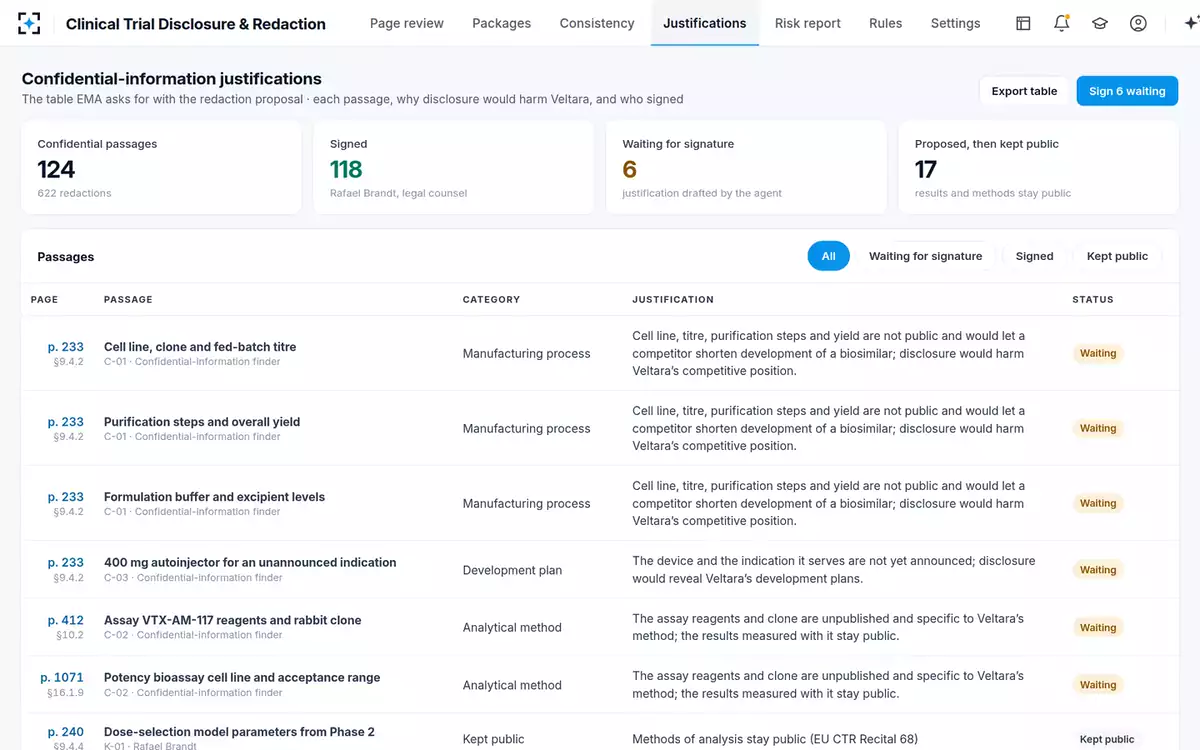
Keeping the two in step by hand across a few thousand pages is the work. In the sample package the justification list is the table: each passage carries its page, its category, the drafted reason and its status — signed, waiting or kept public — and the proposal is only submittable when every passage has been decided. The sequence that produces it is described in the Policy 0070 guide.
One row per passage: page, category, reason, status
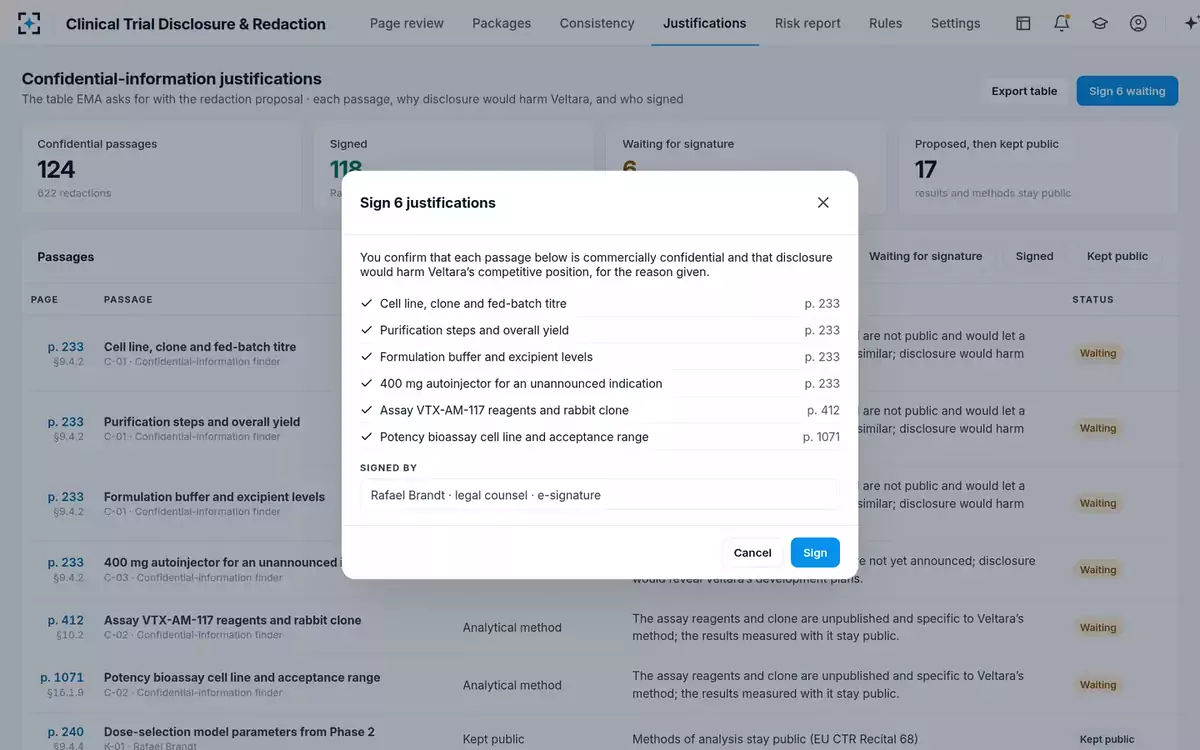
Legal counsel signs each claim, or refuses it
Why results, endpoints and statistical methods stay public
The reasoning is in the legislation before it is in the guidance. Recital 68 of the Clinical Trials Regulation states that "in general the data included in a clinical study report should not be considered commercially confidential once a marketing authorisation has been granted, the procedure for granting the marketing authorisation has been completed, the application for marketing authorisation has been withdrawn", and adds that the main characteristics of a trial, the conclusion on Part I of the assessment report, the authorisation decision, substantial modifications and "the clinical trial results including reasons for temporary halt and early termination, in general, should not be considered confidential".
Two cautions about how that is often restated. First, the recital speaks about commercial confidentiality, not about everything on the page: a participant identifier inside a results table is personal data and still comes out, which is why a results listing is published in full and unreadable as to who the rows belong to. Second, the recital says results; statistical methods and endpoints are kept public by the external guidance's own list, and protocol amendments with them. They are separate rules from separate instruments, and a team that keeps them separate can explain each one.
The practical consequence is a bright line that makes review much faster. Results, study design and methods of analysis are not available as confidentiality claims, so the only question those pages raise is whether a person can be identified in them. That is a different kind of reading, and it belongs to the appendix 16.2 listings, where the identifiers live.
Confidentiality in CTIS is a different question
The definition travels almost word for word. EMA's CTIS guidance defines commercially confidential information as "any information which is not in the public domain or publicly available and when its disclosure may undermine the legitimate economic interest or competitive position of the concerned entities" — the same two conditions, extended to sponsors, applicants, holders and service providers. What differs is everything around it.
No Agency review of a CTIS redaction is foreseen before publication: the sponsor uploads a redacted version and a complete one, EMA's CTIS guidance makes the quality of the redaction the user's sole responsibility and notes that CTIS does not check it, and no justification table is submitted for either. There is no rejection code, because there is no decision. And the structured data fields cannot be redacted at all, so information typed into them is published and is thereafter publicly available — which is how a sponsor can destroy its own Policy 0070 claim without touching a study report. EMA's CTIS guidance asks sponsors to check whether information is already published through CTIS before claiming it as confidential elsewhere, and that instruction runs in both directions. What CTIS publishes and when is set out separately.
One habit carries across both regimes and is worth adopting for its own sake: redact the same thing the same way everywhere. A passage blacked out in one publication and printed in another has not been protected, and the difference between the two versions tells a reader exactly where to look. To see the claims, the drafted reasons and the signatures on one package, start from Clinical Trial Disclosure & Redaction.
Questions people ask
Does EMA accept CCI redactions?
Rarely. In the COVID-era programme, EMA published 46 procedures: a confidential redaction was proposed in seven, accepted in three, and 21 pages in total carried one, which the Agency puts at 0.01% of pages. Its stated expectation for the relaunch is that it does not expect to see commercially confidential information in clinical documents under Policy 0070 at all. Claims do succeed, but they are few, specific and well argued.
Are clinical trial results commercially confidential?
No. Policy 0070 states that in general clinical data cannot be considered confidential, and Recital 68 of the Clinical Trials Regulation says the data in a clinical study report should in general not be considered commercially confidential once the authorisation procedure has concluded, including the trial results and the reasons for a temporary halt or early termination. Personal data inside a results table is a separate matter and is still removed.
Can you redact statistical methods?
No. Statistical methods, including the imputation methods used for missing data, are on EMA's list of elements that are not confidential, as are the endpoints, the justification of the planned sample size, and the protocol and its amendments. What Policy 0070's Annex 3 leaves open is the intellectual analysis behind a sample size calculation — estimates of endpoint variability, measurement precision, screening and retention rates — not the methods section itself.
Are protocol amendments confidential?
No. The guidance names the protocol and protocol amendments explicitly, including treatment arms, inclusion and exclusion criteria, allowed concomitant medications, reasons for withdrawal and the reasons for the amendments themselves. In CTIS the protocol is published outright for Category 2 and 3 trials at the time of the decision, so the question rarely survives contact with the second publication.
What is a CCI justification table?
It is the working document submitted with the redaction proposal, one per clinical report that claims confidentiality, listing every passage proposed for redaction with the reason for it. EMA checks at validation that every highlighted passage appears in the table and that the rows are complete; highlighted text missing from the table makes the proposal invalid. The Agency then writes its outcome — acceptance, partial acceptance or a rejection code — into the table's own columns.
Can you redact the name of a cell line?
Not when it is in commercial use or already published: EMA names that case explicitly, with CHO cells and E. coli K-12 as its examples. The name of a purification process is likewise not confidential, nor is the name and general description of a bioanalytical method with its validation parameters. Detailed manufacturing parameters and the specific part of a company-developed assay are the level at which a claim becomes arguable.