An anonymisation report is the document in which a sponsor explains how it anonymised the clinical reports it is about to publish — the methodology, the variables treated as identifiers, how the risk of re-identification was measured and managed, how data utility was preserved, where the work departed from the plan, and an attestation. EMA requires one for each data package, on a template it developed jointly with Health Canada's Public Release of Clinical Information programme, and the Agency reads it next to the redactions themselves. It is hard to write honestly after the fact, because its central claim is about consistency across thousands of pages that one person cannot re-read. Botminds' Clinical Trial Disclosure & Redaction drafts the report's sections from the redaction decisions that were actually accepted, with the identifier-by-identifier table and the risk figures computed from those decisions rather than typed in beside them.
The sponsor, study, medicine and people in the examples below are invented sample data used to demonstrate the solution. The regulatory requirements are the authorities' own and are linked where they appear.
What is an anonymisation report?
It is a required submission document, not a courtesy. EMA's guidance states that "An anonymisation report detailing the methodology used for anonymising the clinical reports must be included in the submission. The report should also describe how the risk of re-identification has been measured and managed" (EMA Policy 0070 external guidance, v1.5, §2.3.3.1.4). It sits in module 1.9 of the eCTD sequence, under a prescribed file name of the form clinicaltrials-anonymisation-report-TradeName.pdf, and the template itself arrives with the Agency's invitation email, alongside the draft list of expected documents and the submission checklist (EMA, Clinical data publication: overview, process and timelines, 2024).
One detail about it is easy to miss, and it changes how the report should be written. At the redaction proposal stage the anonymisation report form is listed as not published. In the final redacted package, the same document is listed as published. The report you write to persuade a reviewer is also a document the public will read alongside the clinical reports it describes — which is an argument for writing it as a methods section rather than as correspondence.
What the report is, in four numbers
1
report per package: a specific anonymisation report for each individual data package submitted for publication
1.9
the eCTD module the report form is filed in, under a prescribed file name
6
sections in the template Health Canada publishes: methodology, variables, risk, utility, deviations, attestation
D47
the day the Agency’s comments on the report come back, in the redaction conclusion letter
One template, two authorities
The template is not a sponsor's own format. EMA's guidance explains that the Anonymisation Report Form Template and its completion instructions "have been developed jointly by EMA and the Health Canada Public Release of Clinical Information (PRCI)", that the template "is mandatory to be used", and that a sponsor must "produce a specific Anonymisation Report for each individual data package submitted for publication" (§3.5.5). That joint authorship is the practical gift in this area: a sponsor publishing the same study report in Europe and in Canada writes the methodology once.
The two programmes stay distinct where it matters. Health Canada additionally asks manufacturers to certify, on its own form in Appendix G of its guidance, that the clinical information being released is identical to what was published under EMA Policy 0070 where that applies (Health Canada, Public Release of Clinical Information). That certification is a different document with a different claim: the anonymisation report says how the work was done, the certification says the two publications match. A sponsor that anonymises the Canadian package independently will find the second claim hard to make, which is the real argument for carrying one set of decisions across both — the subject codes, the date offsets and the age bands have to be the same, not merely equivalent. Health Canada's own guidance on anonymising a report for release covers the rest of that route.
What goes in an anonymisation report, section by section
Health Canada's guidance sets out the template's six headings, and they map onto the six questions a reviewer is actually asking.
The six sections, and the question each one answers
- Anonymisation methodology — what did you do, and could someone repeat it?
EMA asks that the methodology "include a way of demonstrating adequate anonymisation of the clinical reports and have a replicable process to follow". Name the techniques by variable: redaction, recoding, date offsetting, banding, pooling.
- Identification of data variables — which variables did you treat as identifiers?
Direct and indirect, listed, with the test you applied to admit each one. A reviewer who disagrees with the list disagrees with every number that follows from it.
- Measurement of disclosure risk — how was the risk measured and managed?
The metric, the adversary assumed, the threshold with its justification if it is not the recommended one, and the measured result. Or, if you took the other route, the case that the three criteria are met.
- Data utility considerations — what did the anonymisation cost the reader?
EMA treats utility as a requirement of the method, not a courtesy: the results after anonymisation should still support the secondary purposes the publication exists for.
- Deviations — where did the work depart from the methodology?
The section that makes the rest credible. A package with no deviations in 2,000 pages is a package whose deviations were not recorded.
- Attestation — who is standing behind it?
A sponsor-level statement, not a named individual’s opinion. Decide internally who may sign, and keep that consistent across packages.
Two of those sections carry almost all of the risk of a comment coming back, and they are not the ones teams spend their time on. The identification of data variables is where a reviewer can disagree on principle rather than on detail. And deviations is where an honest report earns the benefit of the doubt on everything else.
Measured or demonstrated: the two ways to show anonymisation
The risk section can be written two ways, and the report has to say which one it is using. EMA's review expectation puts them side by side: beyond the methodology applied in each clinical report, the report has to say either how the risk of re-identification was measured and managed, or how the three criteria for anonymisation were fulfilled (§2.3.3.1.16). Either claim is acceptable; what is not acceptable is a report that gestures at both and commits to neither.
What each route obliges the report to contain
| In the report | If you measured the risk | If you demonstrate the criteria |
|---|---|---|
| Methodology section | The technique applied to each variable, and a process another team could repeat on the next package. | The same, plus the reasoning that links each technique to the criterion it defeats. |
| Variables section | The full quasi-identifier set, because the group sizes depend on it. | The full set again — the argument that nobody can be singled out is only as wide as the list. |
| Risk section | Metric, adversary, threshold, justification if it is not the recommended figure, and the measured result. | The case that an individual cannot be singled out, that records about one individual cannot be linked, and that information about an individual cannot be inferred. |
| What a reviewer checks it against | The redactions in the documents: the figure has to be the one the applied decisions produce. | The documents again, on all three counts — a single readable identifier defeats the first criterion outright. |
| Where it usually fails | A score computed on a narrower variable set than the one the report lists. | A study report keeps results, design and methods readable, so absolute claims are hard to sustain across 2,000 pages. |
A study-report package that takes the measured route then lives or dies on whether the number it quotes is the number the documents produce. How a re-identification risk assessment is built — metric, adversary, variable set, threshold — is the other half of this section.
The consistency test a reviewer actually applies
There is one sentence in EMA's guidance that disclosure teams should treat as the grading criterion for the whole document: "EMA will review the anonymisation report form to ensure that the applicant/MAH has followed the guidance and applied the chosen approach for anonymisation consistently in all clinical reports" (§2.3.3.1.7). Note what is being tested. Not whether the approach is a good one, in the abstract. Whether the approach the report describes is the approach the documents show — in all of them.
"EMA will review the anonymisation report form to ensure that the applicant/MAH has followed the guidance and applied the chosen approach for anonymisation consistently in all clinical reports."
EMA, External guidance on the implementation of Policy 0070, version 1.5, §2.3.3.1.7
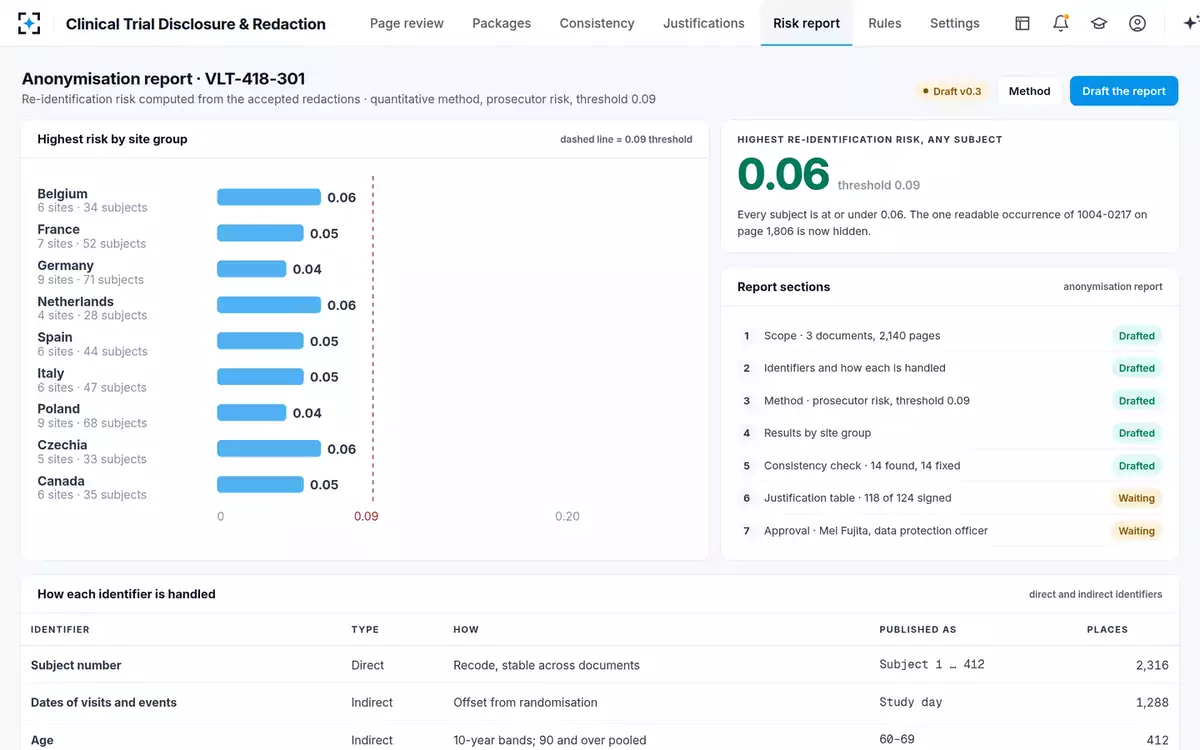
That is a hard claim to make about a study report whose body carries narratives and patient data listings, many of them lifted from Appendix 16.2, because consistency fails in the places nobody re-reads. In the invented sample package, prepared with its full Appendix 16.2 listings, the same subject number appeared in 38 places across three documents; 37 were hidden and recoded identically and one, in a listing footnote where the identifier had broken across a line, was not. A report claiming a consistently applied approach would have been wrong, in a way a reviewer opening that listing could see. The practical answer is to make the claim checkable before you make it: link every occurrence of every identifier across the package and resolve the ones handled differently, which is what the Appendix 16.2 listings demand anyway.
A report drafted from the decisions, section by section
Deviations: the section nobody wants to fill in
The deviations section is where a report stops being a policy document and becomes a record. Two kinds of entry belong in it. The first is the ordinary kind: a variable handled differently in one appendix because of how the data was tabulated, a site that had to be pooled further than the rule required, a case narrative that could not be anonymised without redacting it entirely — EMA requires that last case to be "clearly justified in the anonymisation report" (§2.2.2).
The second kind is specific and easy to miss. Where publishing a document could unblind a study still running, EMA allows a sponsor to propose additional temporary redactions, subject to the Agency's agreement, and is prescriptive about both the record and the marking: "The implementation of additional redactions to protect from study from unmasking/unblinding should be explained in the deviation section of the Anonymisation Report. The redaction boxes should display as white overlay text the acronym BLD on a black background to easily differentiate them from the redactions intended to protect personal data and commercially confidential information" (§3.7). Three categories of redaction, three visual treatments, and one of them exists only because of something written in this section of the report.
A report with an empty deviations section on a 2,000-page package is not a clean report; it is an unverified one. A report drafted from the list of accepted decisions, rather than from the methodology document, surfaces its deviations while they are still sentences to write rather than findings to answer later.
Does CTIS require an anonymisation report?
No — not routinely. EMA's guidance for the Clinical Trials Information System says plainly that a report describing the anonymisation techniques is not expected in CTIS unless one is specifically requested (EMA, Protection of personal data and CCI while using CTIS, v2.2, §3.2). Sponsors read that as a lighter regime and are half right: the document is not owed, but the work behind it still is, and the rules on what must be protected in CTIS do not soften because no report is filed. What the revised CTIS transparency rules publish, and what you redact sets out that side.
Where a report is owed, who reads it, and what they read it for
| Route | Report required? | Who reviews it | What the review is looking for |
|---|---|---|---|
| EMA Policy 0070 | Yes — one per data package, on the mandatory joint template, filed in eCTD module 1.9. | The Agency, during the review phase that opens after validation. | That the guidance was followed and the chosen approach applied consistently in all clinical reports. |
| Health Canada PRCI | Yes — the same joint template, plus a separate certification form where the package matches an EMA publication. | Health Canada, during its own review. | The methodology and the risk work, and that the Canadian release matches what was published in Europe where it applies. |
| EU CTR via CTIS | Not expected, unless specifically requested. | No standing review of a report; the published documents themselves are what is seen. | Nothing is filed — so the discipline has to be internal. |
Who signs it, and what the attestation commits them to
The template ends with an attestation, and the commitment it makes is corporate: the authorities deal with the applicant or marketing authorisation holder, not with a named statistician. Inside a company, though, somebody has to be able to say that the methodology is sound and that it was applied. One workable arrangement splits that into three signatures, and it is worth writing down which is which, because they answer different questions and cannot substitute for each other.
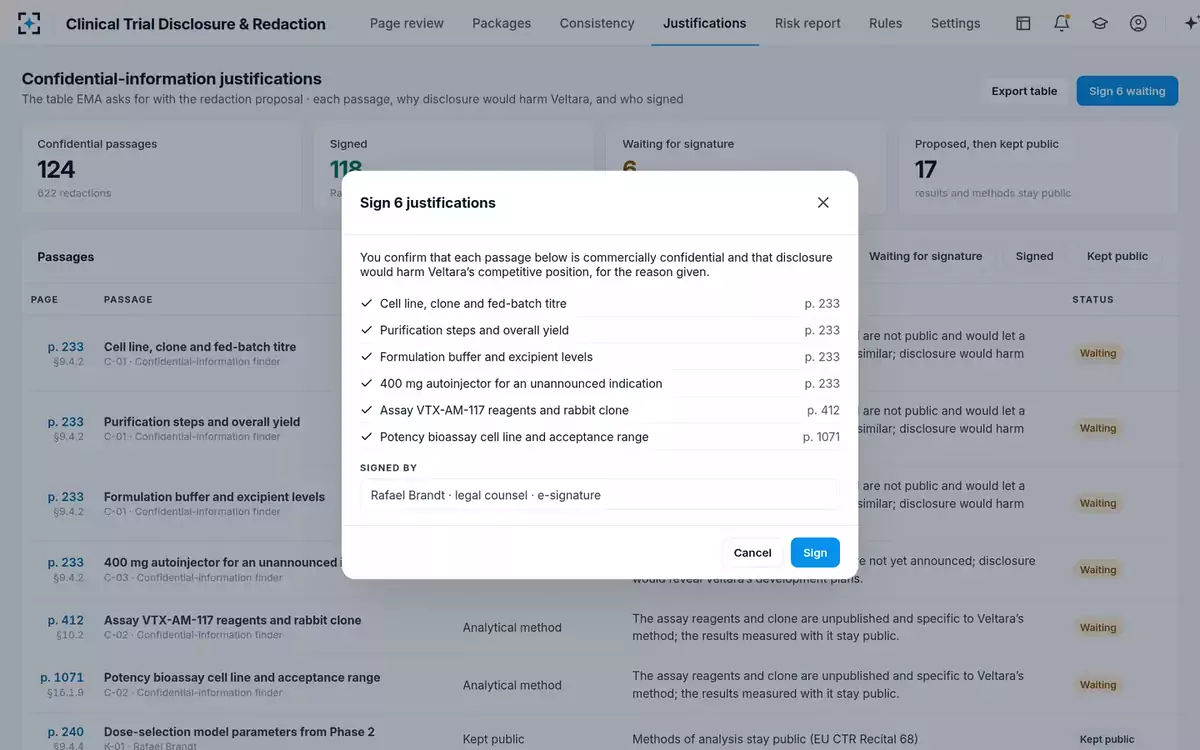
The sample configuration in the solution uses exactly that split: legal counsel signs each commercially confidential justification, the data protection officer approves the risk method and the anonymisation report, and the disclosure lead accepts every redaction and submits the package. Nothing about those roles is imposed by a regulator — they are the sponsor's own arrangement, and a smaller sponsor may collapse two of them into one person. What should not be collapsed is the separation between the person who decided what to hide and the person who attests that the method was followed.
Three signatures, three different claims
| Who | What they are actually asserting | What they need in front of them |
|---|---|---|
| Legal counsel, on each confidential justification | That this passage is commercially confidential and not already in the public domain — one claim per passage, not one per package. | The passage, its page, the category claimed and the drafted reason. |
| Data protection officer, on the method and the report | That the risk method is appropriate for a public release and that the report describes what was done. | The metric, the variable set, the threshold with its justification, and the measured result from the applied decisions. |
| Disclosure lead, on the package | That every proposed redaction has been decided by a person, and the package is complete. | The count of undecided proposals, unresolved inconsistencies and unsigned justifications — all of which should be zero. |
One of the three: the justifications signed before the report is approved
Writing the report from the decisions, not the decisions from the report
A common pattern is to write the report twice. The first version is written early, from the anonymisation plan, because the template arrives with the invitation and somebody has time. The second is written at the end, when the redactions are finished, and the two are reconciled by hand. That order is backwards, and it is the reason deviations sections end up empty: the document describes the intention, and the intention is what gets re-read.
The alternative is to generate the factual sections from the decisions that were accepted — the identifier table, the technique per variable, the counts, the risk figures by site group, the list of places where the applied treatment differs from the rule — and to write by hand only the parts that are genuinely argument: why this adversary, why this threshold, why this utility trade. In the solution the report writer does the first half and is bound by two limits that matter for exactly this reason: it computes the risk only from accepted decisions, and it may not change a decision to lower a score. A person approves and signs.
When the report is read, and when it has to change
- Validation · D10to D10
- Report reviewed · D11 to D4737 days
- Comments and responsesD47 → D68
- Package due7 days
- Then published10 days
Read that second lane carefully if you are planning resource. The report is not finished when it is submitted: comments arrive on day 47, a revised version may be asked for, and the final form has to describe the methodology as applied in the final redacted version — the one that incorporates whatever the Agency rejected or accepted on confidentiality. A report assembled by hand gets rewritten at exactly the moment the team has seven calendar days to produce the whole final package.
Where the facts in the report come from
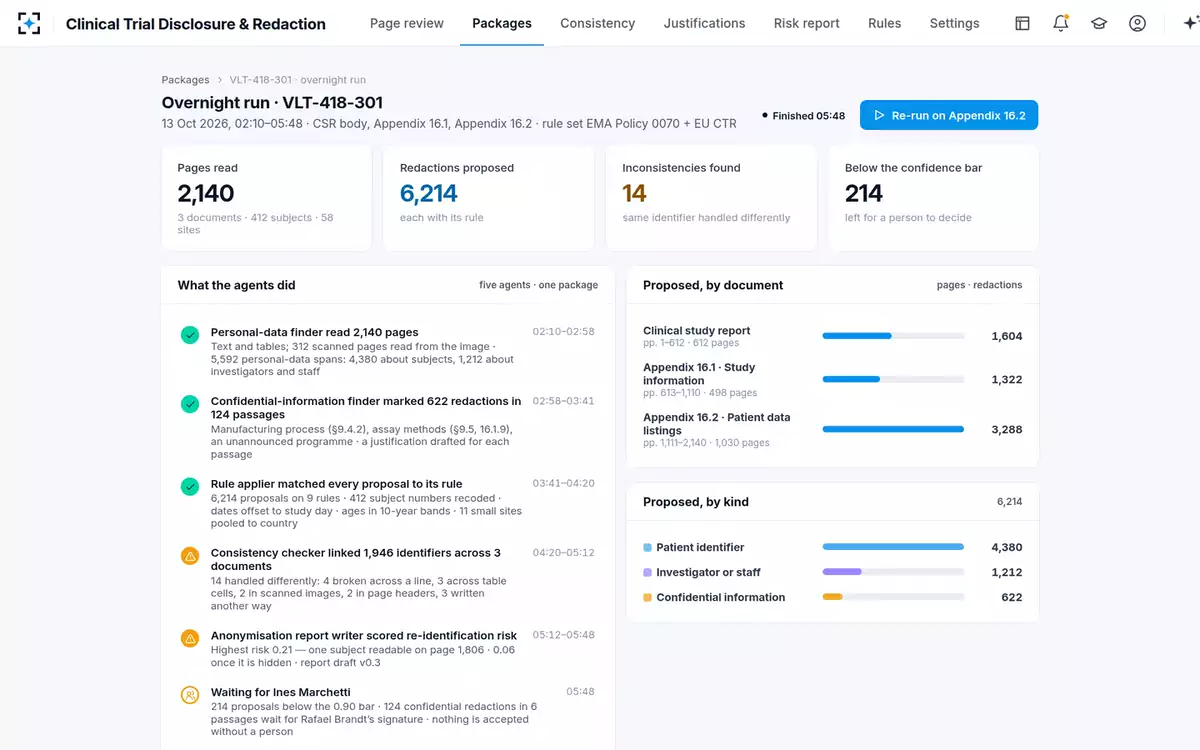
Written that way, the report stops being a deliverable at the end of the work and becomes the readable form of the work itself. That is also the version that survives being published, which, in the final package, is what happens to it. To see a report drafted from accepted decisions, start from Clinical Trial Disclosure & Redaction.
Questions people ask
Is the EMA anonymisation report template mandatory?
Yes. EMA's guidance states that the Anonymisation Report Form Template and instructions were developed jointly by EMA and Health Canada's Public Release of Clinical Information programme, that the template "is mandatory to be used", and that a specific report must be produced for each data package submitted for publication. The template and instructions are published on EMA's clinical data publication pages, and the template is also attached to the invitation email that opens the procedure.
How many anonymisation reports does one package need?
One. The requirement is a specific report for each individual data package, and that single report has to describe the methodology applied in each of the clinical reports the package contains — the study report body, the appendices and anything else in scope. A separate report per document is not what is asked for, and splitting the methodology that way makes the consistency claim harder, not easier.
Do EMA and Health Canada use the same anonymisation report template?
EMA says its mandatory template was developed jointly with Health Canada's programme, so a sponsor publishing in both can write the methodology once. Health Canada's own guidance sets out the template's six sections in Appendix F — anonymization methodology, identification of data variables, measurement of disclosure risk, data utility considerations, deviations and attestation. Health Canada also asks for a separate certification form where the clinical information being released is identical to what was published under EMA Policy 0070.
What belongs in the deviations section?
Anything the package did that the methodology section does not describe: a variable treated differently in one appendix, a site pooled further than the rule required, a case narrative redacted in full because it could not otherwise be anonymised, and any temporary redactions applied to avoid unblinding an ongoing study — EMA requires those to be explained there and marked with BLD in white on a black background so they are distinguishable from personal-data and confidentiality redactions.
Does anyone outside the regulator read the anonymisation report?
Yes, eventually. In the redaction proposal package the report form is listed as not published; in the final redacted package it is listed as published. It goes out with the clinical reports it describes, which is a good reason to write it as a methods section a researcher could use, rather than as a letter to a reviewer.
When do comments on the report come back?
In the redaction conclusion letter on day 47, which carries both the Agency's outcome on commercially confidential redactions and its comments on the anonymisation report. If a revision is asked for, an updated report may be due around day 61, with the Agency's final response around day 68, and the final redacted package is due within seven calendar days of the conclusion letter or the final response.