A contract playbook is the document that tells a negotiator what to do with a change the other side has made: the position you prefer, the positions you will accept instead, the line you will not cross, and who to ask when a change falls outside all of them. It is hard to write well because the useful content is not the preferred wording — everyone has that, it is the template — but the ladder of retreat underneath it. In clinical contracting the stakes are visible: an unsigned site agreement is a selected site that cannot enrol, and a sponsor whose contracts managers must ask a lawyer about a concession the lawyer already approved last year will sign slowly, whatever its template says. Botminds' Clinical Trial Agreement Negotiation reads a playbook written this way and places every change a site makes onto its ladder, which only works if the ladder exists.
The examples come from a fictional sample study used throughout the solution — Northwind Bio's VLT-302, its site Marlowe University Hospital, and a round 2 redline of 19 tracked changes. The sponsor, site, study and people are invented; the rules and research quoted around them are real and linked where they appear.
What is a contract playbook?
A contract playbook is a clause-by-clause statement of a company's negotiating positions, with the authority to use them. The minimum unit is not a clause but a clause family — subject injury, indemnity, publication, intellectual property, payment, confidentiality, governing law, insurance, records, termination — and each family carries the same five things: the position to open with, two ranked fallbacks, the point at which the answer is no, and the name of the person who decides anything past it.
What it is not is a style guide. A document listing preferred wording with no fallbacks tells a contracts manager nothing she did not already know from the template, and it sends every site change to the same place: a lawyer's queue. The test of a playbook is simple and uncomfortable — pick the last ten redlines you closed and ask how many of the changes had a written answer before anyone read them. If the answer is most of them, the playbook is working. If it is none, what you have is a template with opinions attached.
A playbook of preferences against a playbook with rungs and authority
Preferred wording only: The clause as the template has it, and a note that it is preferred.
Four rungs and an authority line: The clause, two acceptable alternatives in order, and the line past which the answer is no.
Preferred wording only: It goes to a lawyer, because nobody is allowed to say yes.
Four rungs and an authority line: It is settled where it arrives, with the rule quoted beside it.
Preferred wording only: Whole agreements, most of them already inside policy.
Four rungs and an authority line: The clause, the site’s ask and the line it crossed — nothing else.
Preferred wording only: Whatever each negotiator remembered, with no way to see it.
Four rungs and an authority line: The same rung for the same ask, visible as a settlement pattern per family.
Preferred wording only: Draft, then wait.
Four rungs and an authority line: Settle most of a round in the first week, inside a stated authority.
Preferred wording only: An edit to a shared file.
Four rungs and an authority line: A version, an owner, a date and an approval.
The four rungs: preferred, fallback 1, fallback 2, walk-away
Four rungs is the number we recommend, and the reason is arithmetic rather than taste. One rung gives a negotiator no room. Two give room but no ranking, so two negotiators concede differently. Five or more stop being positions and become a discussion. Four — a preferred position, two ranked fallbacks and a walk-away — is the smallest ladder that can answer most real redlines without a meeting.
Each rung needs the same three parts: the wording, the condition under which it may be used, and what it costs the sponsor. The cost line is the one teams skip and the one that makes the ladder usable. A fallback whose cost nobody has written down will be refused by a cautious negotiator and over-used by a confident one.
One clause family written out across all four rungs
| Rung | The position, in the subject-injury family | Who may take it |
|---|---|---|
| Preferred | The sponsor pays the reasonable medical expenses of an injury caused by the study drug or by a procedure the protocol requires, where the site followed the protocol, after the subject’s own insurance has been applied. | Anyone; it is the template |
| Fallback 1 | The sponsor pays without first billing the subject’s insurance. The institution’s ethics committee usually asks for this, and the sample site had already signed the same wording in 2024. | Contracts manager, alone |
| Fallback 2 | The sponsor also covers injury arising from the two study-only punch biopsies — procedures nobody would have had in ordinary care. | Contracts manager, alone, where authority is set that far |
| Walk-away | No payment for injury caused by the site’s own negligence, misconduct or a deviation from the protocol that was not made to protect a subject’s safety. | Nobody. Past this line it is the legal owner’s decision |
| Precedent | What this institution has already signed, clause by clause, where the agreement is fully executed and recent. | Applies automatically where the setting is on |
Notice what the walk-away does to the rest of the ladder. It is the only rung expressed as a prohibition, and it is what lets everything above it be delegated: a contracts manager can accept a fallback precisely because the thing she must not accept is written down. Note too that the subject-injury rungs cannot be written from the sponsor's risk appetite alone: each has to survive a comparison with the site's ethics-approved consent form, which is a separate check before any of them is offered.
Why the walk-away is the most useful line in the document
Teams often write the preferred position first and the walk-away last, if at all. Reverse it. The walk-away is the only line that changes what other people may do, and it is the only one a lawyer genuinely has to own.
A good walk-away is specific enough to be recognised in somebody else's drafting. In the sample playbook the indemnity family's walk-away reads: the sponsor never indemnifies the institution for its own negligence or misconduct, and never accepts uncapped consequential damages. That line is what catches the edit two rounds later where a site inserts the words “solely” and “gross” into an indemnity, because the test is not whether the wording looks aggressive but whether the sponsor would end up paying for the site's ordinary negligence. The five moves sites make on indemnification are all answered from that one line.
A bad walk-away is a mood: “we do not accept unreasonable liability”. Nobody can apply it, so everything is escalated, and the playbook has achieved nothing except a document to maintain.
The authority line: what a contracts manager may settle alone
The authority line is the sentence that turns a playbook into throughput. It says which rung a negotiator may take without asking anyone, and it is a setting rather than a principle, because different sponsors are comfortable at different heights and the same sponsor may move the line as its data improves.
In the sample study authority is set to accept automatically anything that sits up to Fallback 2, with two narrower values available — up to Fallback 1, or nothing automatic. A sponsor starting out should set it at nothing automatic for a few rounds, watch where its changes land, then raise it one rung at a time. The reason to write the line as a setting rather than a rule in the text is that it has to be auditable: the question “what was a contracts manager allowed to do on 7 October?” must have an answer.
A site change, from arrival to settled or escalated
Agent
Read the changeMap every tracked change and margin comment to a clause of the template, keeping the site’s own words with it.
Never: Never alters the site’s text
Agent
Place it on the ladderDecide which rung of which family the site’s wording sits on, and quote the rule.
Never: Never proposes anything past the walk-away
Agent
Check precedentLook for the same clause in a fully executed agreement with the same institution, and show the signature date.
Never: Only signed agreements count
Agent
Settle or draftAccept inside the authority with the rule cited, or draft a counter at the highest approved rung that answers the ask.
Never: Never sends anything to the site
A person decides
Contracts manager confirmsReviews the accepted changes and every counter, edits what she wants, and sends the response.
A person decides
Legal owner decides the restTakes the clauses past the walk-away or with no approved position, with the line quoted and a recommendation.
Clause families: how many, and how to split them
Ten to fifteen families covers a site agreement. Fewer than ten and a family contains positions that are not alternatives for each other; more than twenty and the same site change matches two families, which is worse than having no playbook because the ladder gives two answers.
The split that works is by who decides, not by where the clause sits in the agreement. Subject injury and indemnity look adjacent in the document and belong to different owners — one is argued against the consent form and the medical monitor, the other against the sponsor's liability position. Payment terms and fees look like one subject and split the same way: the mechanics can be delegated, the money cannot. The budget exhibit's own rules are the reason.
Name the families with identifiers and use them in writing. In the sample playbook the rules are PAY-04 for payment, CON-02 for confidentiality, INJ-01 for subject injury, IP-01 for inventions and IND-02 for indemnity. An identifier on every accepted change and every counter is what makes a playbook measurable later: you can count how a family settled, which you cannot do if the answer was “as discussed”.
Precedent as a fifth rung: what this institution already signed
The strongest argument in a site negotiation is not a position; it is a signature. If an institution accepted a 45-day publication review with a 60-day patent delay in a fully executed agreement two years ago, the useful counter is that wording, not the template's. It is hard to refuse what you have already signed, and the conversation ends sooner.
Precedent needs two guards or it becomes folklore. Only fully executed agreements count — a position someone offered in a draft is not precedent, and a redline the site sent is certainly not. And it needs a horizon: in the sample settings the precedent rule accepts changes matching an agreement signed with the same institution in the last 24 months. Beyond that, templates and regulations have moved, and the April 2026 suite of UK model agreements is a good illustration of how fast a two-year-old precedent can go stale.
What a laddered playbook is for, in the sample study's own numbers
84%
of site changes settled inside the playbook — a design target, not a measurement
13 of 19
changes accepted inside the contracts manager’s authority on the sample redline, each with its rule quoted
5
of those 19 matched a clause the same institution had already signed in 2024
2
changes with no approved position, which is what the legal owner actually saw
Who approves a change to a contract playbook?
One named person, and the change has a version. In the sample study the playbook is version 4.2, approved on 12 August 2026 and owned by the head of clinical contracting, Dana Okafor; a new fallback, or a clause family being added to automatic acceptance, needs her approval. The agents read the playbook. People change it — that separation is the whole governance story, and it is worth stating out loud in the document itself.
Standard-setters work the same way, which is a useful precedent to point at when someone asks why a change cannot just be made. The UK's model agreements are maintained centrally with a published cadence: “The Four Nations Contracting Leads group reviews feedback every 6 months and decides if any further changes need to be made to the contracts.” A sponsor's playbook deserves no less ceremony than the documents it negotiates against.
“The sponsor or investigator should maintain appropriate oversight of the aforementioned activities.”
ICH E6(R3) Guideline for Good Clinical Practice, principle 10.3 (2025)
Good clinical practice says the same thing in its own vocabulary: activities may be transferred, but oversight stays. A playbook is how a sponsor exercises that oversight over contracting work that other people, and increasingly software, carry out on its behalf. Which is also why a playbook with no owner is a governance finding waiting to be written.
Country rules sit above clause positions, not inside them
A common structural mistake is to fold national requirements into clause positions. A sponsor that writes “in the UK, use Fallback 1 for publication” has created a rule that will be wrong the moment the model agreement changes, and that cannot be applied to the next country.
Put country rules in a layer above the ladder and apply them first. For the UK model agreements the rule is not a position at all: check that only the yellow-highlighted fields have been completed, deleted or retained, and send any edit to the model text itself to legal. For France, only the annexes of the convention unique are negotiated. German liability caps and Japanese controlling-language requests go to legal regardless of where they would otherwise sit. Then, and only then, place what is left on the clause ladder. The country templates and what each one allows is the detail behind that layer.
The playbook as Clinical Trial Agreement Negotiation reads it
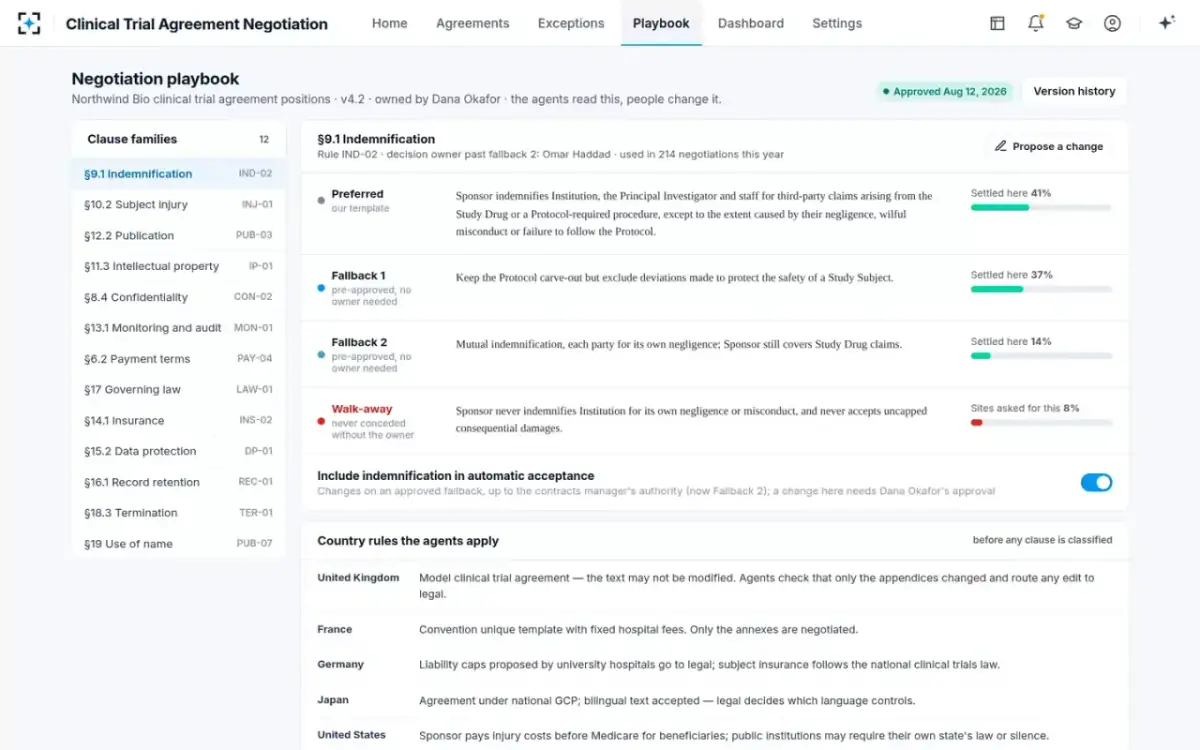
Keeping the playbook honest: what the settlement pattern tells you
A playbook written once and never revisited drifts away from what the market will sign. The cure is to count. For each family, how often did a site accept the preferred position, how often did the negotiation end at Fallback 1 or 2, and how often did it go past the walk-away?
Three patterns are worth acting on. A family that never settles above Fallback 2 has a preferred position no site accepts, and the template should change. A family that always settles at the preferred position may be leaving something on the table — or may simply be uncontroversial, which the clause text will tell you. And a family where the same clause is refused twice in one negotiation is a signal rather than a statistic: in the sample settings, a clause the site rejects in two rounds is sent to legal automatically, because the third round is where a negotiation turns into a dispute.
Standardisation work in academic networks shows how long this takes when it is done properly. The Trial Innovation Network's account of its first year describes how its accelerated agreement was built: “Leaders from the institutions' contracts and legal offices volunteered for consensus building work over 2 years.” The lesson for a sponsor's own playbook is that the first version is not the deliverable; the revision cycle is.
The authority line and the precedent rule, as settings in Clinical Trial Agreement Negotiation
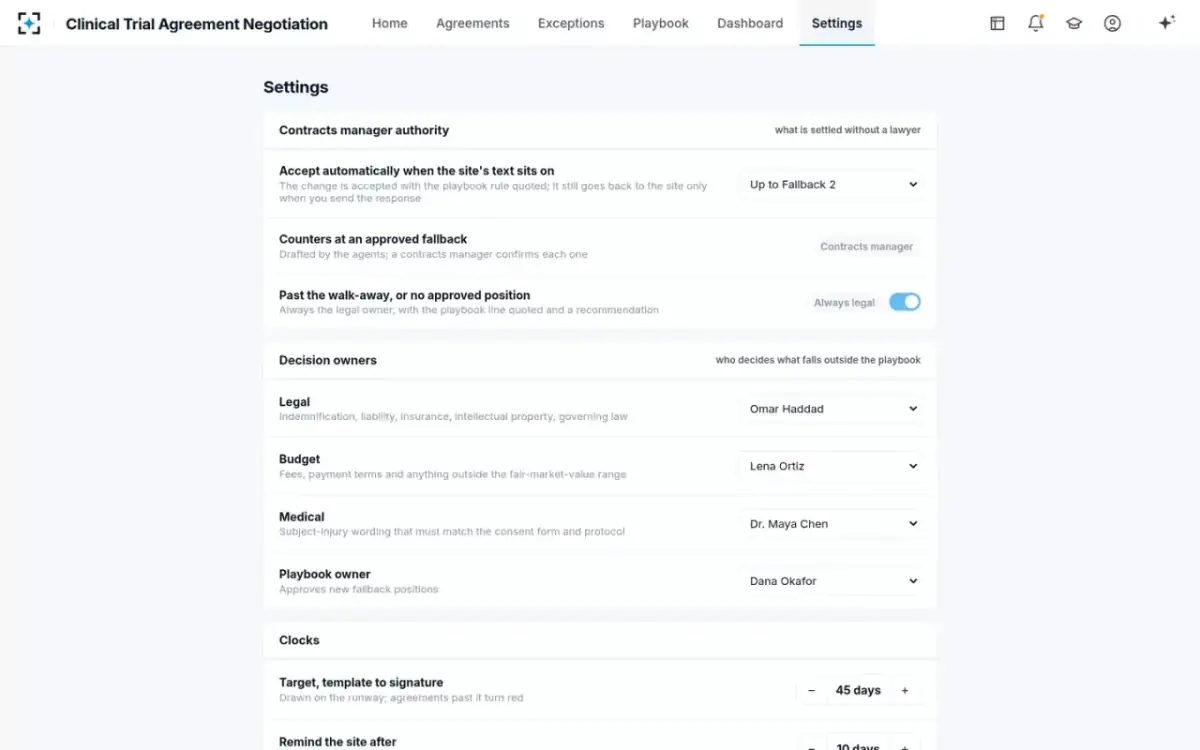
A worked family, from preferred position to walk-away
Take publication, a family academic sites argue about often, and write it the way this guide recommends. Preferred: the site may publish its own results after the multicentre publication, with 60 days for sponsor review before submission and a further 60-day delay if a patent application is needed. Fallback 1: 45 days' review, patent delay retained. Fallback 2: 30 days' review, patent delay retained, where the site is in a network whose policy sets the shorter period. Walk-away: no clause that lets a site publish before the multicentre analysis, and none that removes the sponsor's review altogether.
Now run the sample redline against it. The site cut review from 60 to 30 days and deleted the patent delay. Deleting the patent delay goes past both fallbacks, though not past the walk-away, so the change cannot simply be accepted; but it can be answered with an approved rung — Fallback 1, 45 days with the patent delay retained — which is exactly what the same institution signed in 2024. The counter writes itself, and it is stronger than the template, because it is their own signature. That is what a complete family buys: a specific answer in minutes, from a document rather than from whoever is free.
What every clause family needs before it can be applied without a person
- An identifier, and one subject
A family that answers two questions gives two answers to one change.
- Four rungs, in order, with the wording for each
Not a direction of travel: the actual text a negotiator may paste.
- The condition for each fallback
When it may be used, and on what kind of site or country.
- The cost of each fallback, written down
Otherwise the ladder is applied by temperament rather than by policy.
- A walk-away stated as a prohibition
Recognisable in someone else’s drafting, not a sentiment about reasonableness.
- A named escalation owner
A role is not enough; a name is who answers on the day it matters.
- A version, a date and an approver
So the position in force when a clause was settled can be reconstructed.
- Somewhere the settlement pattern is visible
A family nobody measures cannot be revised on evidence, only on anecdote.
One last argument for doing this work before buying anything. Standard agreements have measurably shortened negotiations in academic networks — the CTSA programme describes how, in August 2016, “representatives from the CTSA Hubs and Federal Demonstration Partnership (FDP) Member Institutions approved a subaward standard agreement template created by a CTSA-supported working group to reduce the need for tedious contracting negotiations”. A playbook is the sponsor-side equivalent, and it is the input every tool in this category depends on: what may safely be settled automatically is a question about your playbook before it is a question about software.
Questions people ask
What goes in a contract playbook?
For each clause family: the preferred wording, two ranked fallbacks with the condition and cost of each, a walk-away stated as a prohibition, the named owner of anything past it, and a version with an approval date. Above the families sit the country rules, which are applied before any clause is classified. Below them sits precedent — what this institution has already signed, which often answers an ask faster than the ladder does.
What is a fallback position in a negotiation?
A fallback is a position the organisation has approved in advance as an acceptable alternative to the one it prefers, ranked so two negotiators concede in the same order. The point of writing them down is delegation: a change that lands on an approved fallback can be settled by the person who received it, with the rule quoted, instead of joining a lawyer's queue. On the sample redline, 13 of 19 changes were settled that way.
How many clause families should a playbook have?
Ten to fifteen for a site agreement. Split them by who decides rather than by the agreement's own order, so subject injury and indemnity are separate families even though they sit side by side in the document. If two families can both claim the same site change, merge them — an ambiguous match is worse than a gap, because it produces two different answers to one redline.
How do you stop one site getting what another was refused?
Make the position, not the negotiator, the unit of decision: every acceptance and every counter cites the rule and the rung it came from, so the pattern per clause family is visible and an exception has to be approved rather than remembered. Drift is usually invisible rather than deliberate — a concession granted under time pressure, by someone who could not see what the last negotiator did.
How do you keep a playbook up to date?
Give it an owner, a version and a review cadence, and feed it the settlement pattern per family so revisions rest on evidence. Country rules need their own watch: the UK's model agreements were reissued in April 2026, and the group that maintains them reviews feedback every six months, so any playbook that quotes a national template has a dependency with a clock on it.
Can a playbook be applied automatically?
The parts of it that are complete, inside an authority a person sets. A family with four rungs, a stated walk-away and a named owner can be applied to an arriving change; a family with a preferred position and nothing else cannot, and should stay on the manual path. The limit is not the software's confidence but whether the organisation has actually decided what it will accept.