A clinical trial agreement is the contract between the sponsor of a trial and the institution that will run it — usually with the principal investigator named as a party or an acknowledging signatory — and it settles four things: what the site will do, what the sponsor will pay for it, who owns what the work produces, and who carries the loss if a participant is injured. It is not one negotiation. In practice it is about ten clause families, each with a different owner inside the sponsor, and the families that hold a signature up for weeks are rarely the two that genuinely need a lawyer. Botminds' Clinical Trial Agreement Negotiation reads each site redline against the sponsor's own template and negotiation playbook, places every change on the position ladder the contracting team approved in advance, and sends only what falls outside it to a named legal owner.
The worked examples on this page are fictional sample data from inside the solution: Northwind Bio's Phase 3 psoriasis study VLT-302, the site Marlowe University Hospital in Columbus, Ohio, and its contracts manager Priya Raman. The research figures come from regulators, a harmonised guideline and peer-reviewed studies, linked where they appear.
How long a site agreement takes, and what the sponsor is aiming at
41–46days
median contract negotiation on six studies run under an already accepted standard agreement
100days
the historical average the same study compares that median against
55→22days
average term negotiation under a one-off agreement, against the same work under a master agreement
45days
template to signature, the target set in the sample solution
A design target, not a measured outcome
What is a clinical trial agreement?
A clinical trial agreement — a CTA, and in the United Kingdom a clinical trial agreement or mCTA, in France a convention unique — is the binding contract that allows a selected site to begin a trial. The sponsor brings a template. The institution reads it, marks it up, and sends it back. The document that eventually gets signed carries the protocol by reference, a budget as an exhibit, and a set of clauses that allocate money, ownership and risk between two organisations that will be bound to each other for years after the last participant leaves.
Three things make it different from a commercial services contract. The first is that a third party who is not at the table — the trial participant — is affected by what the parties agree about injury and about data, and some of what the agreement says has to be repeated to that person in the informed consent form. The second is that a regulator will later inspect the arrangement: the agreement is itself a trial document. The third is that the institution is usually not negotiating for profit. A university's technology transfer office and its research administration are defending publication rights, the ownership of background inventions and the limits of what the institution's insurer will stand behind, and none of those are priced in dollars.
It is also often the slowest step of starting a site. Reporting on a national academic trials programme, one study recorded "median contract negotiations of 41–46 days, compared to 100-day historical averages" (JAMA Network Open, 2023). That median came from six studies run under a standard agreement the participating institutions had already accepted — it is what good looks like, not a baseline. The historical average is the figure most start-up plans are still built on.
Why good clinical practice makes the agreement a precondition, not paperwork
Good clinical practice does not treat the agreement as administration that can follow the first participant. The ICH E6(R3) guideline, which reached Step 4 in January 2025, puts documentation of the agreement before the work starts.
Agreements made by the sponsor with the investigator/institution, service providers and any other parties (e.g., independent data monitoring committee (IDMC), adjudication committee) involved with the clinical trial should be documented prior to initiating the activities.
ICH E6(R3), Guideline for Good Clinical Practice, section 3.6.1
Two more lines in the same guideline decide the shape of the document. Section 3.5 says that "the financial aspects of the trial should be documented in an agreement between the sponsor and the investigator/institution", which is why the budget travels with the agreement rather than beside it. Principle 10.2 says agreements "should clearly define the roles, activities and responsibilities for the clinical trial and be documented appropriately" — the reason the scope and delegation clauses are long even when nobody negotiates them.
Principle 10.1 explains why a sponsor cannot simply push an obligation onto the site and stop thinking about it: the sponsor "may transfer or the investigator may delegate their tasks, duties or functions", but "they retain overall responsibility for their respective activities". An agreement can move who performs an activity. It cannot move who answers for it.
Obligations also outlive the trial by years. Under United States investigational new drug rules, an investigator "shall retain records required to be maintained under this part for a period of 2 years following the date a marketing application is approved for the drug", or two years after the investigation is discontinued if no application is approved (21 CFR 312.62(c)). A site that negotiates a five-year retention period into the agreement has written a term that can expire before the obligation does.
The ten clause families, and who actually owns each one
The useful way to read a CTA is not clause by clause but family by family, because the owner changes between families and almost never changes inside one. The table below is the shape most sponsor templates take, with the ask the site usually makes and the question of whether the family really belongs in a lawyer's queue.
The clause families in a site agreement, and where each one is decided
| Clause family | What the site usually asks for | Who should decide it | Reaches a lawyer? |
|---|---|---|---|
| Scope, protocol and personnel | Name the protocol version, bind the site to it, let the investigator delegate | Clinical operations, with the medical owner on anything protocol-touching | Rarely |
| Budget and payment terms | Faster payment, a smaller holdback, invoiceables for screen failures | The budget owner, against the fair-market-value range | Rarely |
| Confidentiality | A term that ends, and a carve-out for what the institution already knew | Contracts, from the playbook | Rarely |
| Subject injury and compensation | Pay without billing the participant’s insurer first; cover study-only procedures | Contracts, checked against the approved consent form; medical owner on wording | Sometimes |
| Indemnity and insurance | Mutual indemnity, a liability cap, additional-insured status | Legal | Almost always |
| Intellectual property and inventions | Keep inventions made independently of the study drug and protocol | Contracts, with technology transfer on the other side | Sometimes |
| Publication | A shorter sponsor review, no patent delay, the right to publish single-site results | Contracts, from the playbook; legal on a multi-site carve-out | Sometimes |
| Data protection and participant data | Reference the institution’s own authorisation and privacy notice | Contracts, with the privacy owner | Sometimes |
| Records, audit and inspection | Shorten retention, limit access to study-specific files | Contracts, against the retention rule that applies | Rarely |
| Term, termination and governing law | The institution’s own state or country law, a wind-down fee, notice periods | Contracts, from the playbook | Rarely |
The right-hand column is the one worth arguing about inside a contracting team. Eight of the ten families produce changes a sponsor has seen hundreds of times, and for which an answer already exists somewhere — in a style guide, in a previous agreement with the same institution, or in the head of contracting's memory. Only two produce a genuine question of appetite for risk every time.
Indemnity and subject injury: the two families that belong to a lawyer
Indemnity decides who pays when a third party sues. Subject injury decides who pays for the care a participant needs when the trial harms them, whether or not anyone is at fault. They are adjacent, and sites often edit them together, but they are not the same clause and they fail in different ways.
An indemnity edit is dangerous when it changes which party's own negligence is covered. Two words will do it: adding "solely" so the sponsor's duty survives only if the harm was caused solely by the study drug, and adding "gross" so the sponsor's carve-out shrinks to gross negligence alone. Both quietly move the institution's ordinary negligence onto the sponsor's balance sheet. The five moves a site makes on the indemnity clause works each one through, with the answer a contracting team can approve in advance.
A subject-injury edit is dangerous when it promises the participant something the approved consent form does not. The agreement and the consent form are read by different people at different times, and a wording change that looks generous in the contract can put the site's own ethics committee out of step with the document it approved. Who pays for a trial injury, and what the consent form has to say sets out the three places the two documents drift apart.
Publication, inventions and confidentiality: where a university and a sponsor genuinely differ
These three families are where an academic institution is negotiating something it cannot trade away, and a sponsor who treats them as haggling will spend rounds getting nowhere. A university exists to publish; its faculty are promoted on publication. A sponsor needs time to read a manuscript for an unintended disclosure and, where a patent application is in prospect, time to file before the work becomes public.
The settlement is nearly always the same two numbers: a review window before submission, and a further delay if the sponsor needs to file a patent application. In the sample study, the site cut the review window from 60 days to 30 and deleted the patent delay. The counter drafted inside the solution is 45 days with the 60-day patent delay kept — not a split of the difference, but the exact terms the same institution signed with the same sponsor in a 2024 agreement.
Confidentiality usually settles on a term. A perpetual obligation is hard for a university to administer across a department of changing postdoctoral staff, so a definite term with the usual carve-outs — already known, independently developed, publicly available, required to be disclosed by law — is a position most sponsors can approve in advance. Inventions settle on a boundary rather than a number: the sponsor owns what arises from the study drug and the protocol, the institution keeps what its people invent independently of both.
The budget exhibit is a second negotiation with a different owner
Attached to almost every CTA is an exhibit of per-patient costs, invoiceable items, start-up and close-out fees, and payment terms. It is signed with the agreement and it is negotiated separately, by different people, against a different standard: a fair-market-value range rather than a legal position. A contracts manager who treats the budget as a clause family will get the holdback wrong; a budget analyst who treats the payment-terms clause as arithmetic will concede a term the sponsor's finance function cannot honour.
Keeping the two apart is also what stops the whole document waiting on one line. In the sample redline no per-patient fee changed at all; only the payment term moved, to 30 days with a 5% holdback, which is an approved fallback position. Where a fee does change, what a site really asks for in a budget negotiation follows it to the budget owner.
Who signs a clinical trial agreement, and in what order?
Three signatures are common and only two are universal. The institution signs through an authorised official — a director of research administration, a contracts officer, a vice-president for research — not through the principal investigator, who in most institutions has no authority to bind their employer. The sponsor signs through whoever holds delegated contracting authority. The principal investigator very often signs a short acknowledgement that they have read the agreement and will conduct the trial in accordance with it; that signature creates a personal obligation to the protocol, and it is one reason investigators ask whether the sponsor's indemnity covers them by name.
Order matters more than it looks. A sponsor who signs first has made an offer the institution can accept weeks later, after facts have changed; an institution that signs first has given the sponsor a document it can hold. Most sponsors therefore set a house rule — in the sample solution it is a setting, with the institution signing first — and apply it to every site rather than deciding each time.
Four documents a site negotiation uses, and what each one actually binds
What it binds: Protection for the protocol synopsis and feasibility information exchanged before anyone commits to anything. No obligation to run the trial, pay for it or publish.
Who signs it, and when: Signed before site selection, often by the institution’s contracts office alone. Its term usually outlives the CTA.
What it binds: The work, the money, the ownership of results, the handling of participant data and the allocation of injury and third-party risk for one protocol at one institution.
Who signs it, and when: Signed by an authorised institutional official and the sponsor, usually with the investigator acknowledging it. Required before the first participant.
What it binds: The clause families once, for every future study between the same two organisations. A new trial then needs only a work order or study-specific appendix naming the protocol and the budget.
Who signs it, and when: Signed once by both organisations, often after a longer first negotiation; each study adds a short signed order.
What it binds: A change to an executed CTA — a new protocol version, an added procedure, a revised budget, an extended term. It leaves the rest of the agreement standing.
Who signs it, and when: Signed by the same authorities as the original. A protocol amendment that adds cost almost always needs one.
CTA, CDA, master agreement and amendment: which document does what
The distinction that confuses newcomers most is the CDA against the CTA, because both are signed by the same two organisations about the same study. The CDA governs a conversation; the CTA governs work. A CDA signed in March will still be in force when the CTA is signed in September, and its confidentiality term may well run longer than the trial. Nothing in a CDA obliges either party to proceed, which is exactly why a sponsor should not let feasibility information substitute for a negotiated position on publication or inventions.
The master agreement is the one with measurable value. A 2018 account of the first year of the US national Trial Innovation Network cites data showing that "an average negotiation of contract terms of 55 days (exclusive of budget and IRB approval) could be reduced to 22 days if a 'master agreement' was used" (Journal of Clinical and Translational Science, 2018). That is the same clause families, the same two organisations and two-fifths of the elapsed time, because the argument has already happened. The cost is a longer first negotiation and a discipline about never reopening settled clauses in a work order.
What one round of redlines actually looks like, change by change
Abstractions about clause families become concrete the moment a Word file arrives. In the sample study, round two of the Marlowe agreement is 22 pages with 19 tracked changes and 12 margin comments, and it reaches the contracts manager on day 19 of a 45-day target. Read by hand, that is most of a morning before a single reply is drafted: each change found, matched to a template clause, placed against the sponsor's approved positions, checked against what this institution signed last time, and — for anything touching injury or money — read against the consent form or the fair-market-value range.
A site redline as Clinical Trial Agreement Negotiation shows it, change by change
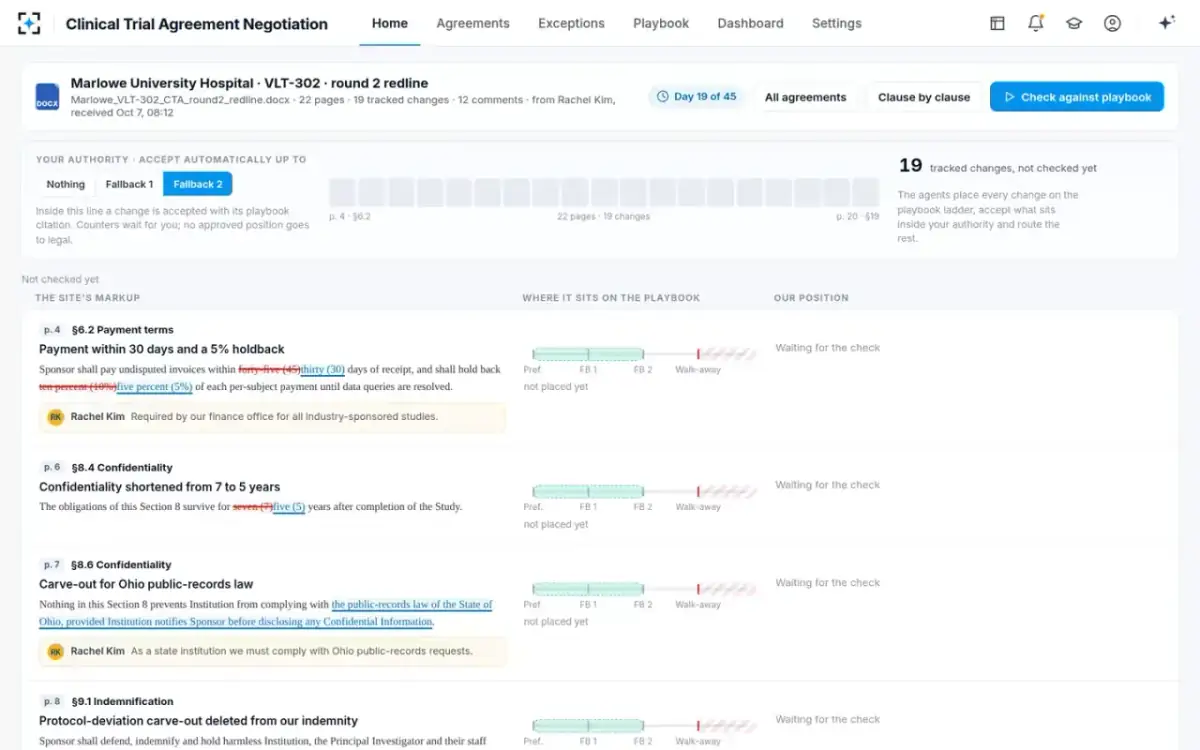
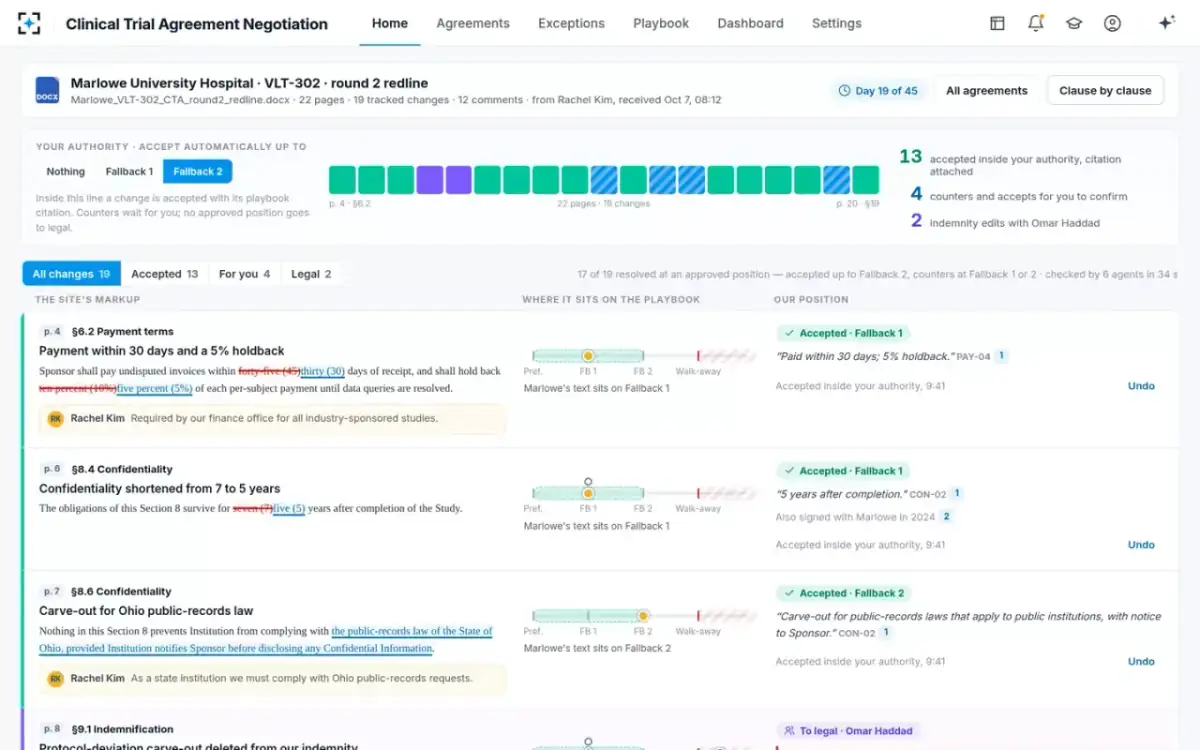
Checked against the playbook, the 19 changes split three ways: 13 sit on a position the sponsor has already approved and are accepted with the playbook line quoted, 4 sit past an approved position but can be answered with one and are drafted as counters for the contracts manager to confirm, and 2 have no approved position at all and go to the named legal owner. Both of the two are indemnity edits. That ratio is the point of the exercise: the families that produce most of the volume produce almost none of the decisions.
The same round after the playbook is applied: 13 accepted, 4 counters, 2 for legal
How long a clinical trial agreement takes, and what shortens it
Elapsed time on a site agreement is almost all waiting, not working. A round takes an afternoon to answer and a week or two to come back. The lever that matters is therefore the number of rounds and the length of the pause inside each one, not how fast anyone reads.
Where a 45-day target goes in Clinical Trial Agreement Negotiation, round by round
- Template out, site review14 d
- Round 1 answered4 d
- Site prepares round 29 d
- Round 2 at the sponsor3 d
- Legal exception4 d
- Site accepts, signature11 d
Three things genuinely shorten the chain. A master agreement removes the clause negotiation entirely and leaves a budget and a work order, which is the 55-to-22-day finding above. A position ladder written in advance removes the internal wait: a change that sits on an approved fallback can be answered the day it arrives instead of queueing behind the two that need a lawyer. And a precedent search removes the argument: a site rarely refuses wording it signed itself eighteen months ago, and in the sample round five of the 19 changes match the institution's own 2024 agreement.
What does not shorten it is pressure. A site that is asked to drop a publication right or accept liability for the sponsor's product will escalate internally, and an escalation inside a university costs more days than a counter would have. The sponsor's own escalations are the same: the two indemnity edits in the sample round cost four days with a named legal owner and a quoted walk-away position, and would have cost considerably more as a request to "please review the attached agreement".
What has to be in place before a selected site can enrol its first participant
- A final protocol and, where required, regulatory authorisation for the trial
The agreement names the protocol version; a later version usually needs an amendment.
- Ethics committee or institutional review board approval for this site
Including the site’s own consent form, which the injury clause has to match.
- An executed clinical trial agreement, signed by an authorised institutional official
Good clinical practice asks for agreements to be documented before the activities begin.
- A signed budget exhibit and the payment mechanics behind it
Per-patient costs, invoiceables, holdback and payment term, within the fair-market-value range.
- Insurance evidence in the form the agreement specifies
A certificate of insurance, or additional-insured status where that was conceded.
- Site staff trained and delegated, and the investigator’s own acknowledgement signed
The delegation of activities is itself part of what the agreement documents.
- Investigational product released to the site, and a site initiation visit completed
The last step that can be scheduled, and the one often rescheduled when the agreement slips.
Activation is where the cost of a slow agreement actually lands, because every other start-up step can be prepared in advance by one party alone and this one cannot. Where the 90 days of site activation actually go follows the whole chain. If the site is in a country that publishes a model agreement, the negotiation changes shape completely — what you may and may not change in the UK model agreement and four other countries explains why a country rule has to be applied before any clause is classified. To see a redline placed on the ladder with its citations, start from Clinical Trial Agreement Negotiation.
Questions people ask
What is a master clinical trial agreement?
A master agreement settles the clause families once between a sponsor and an institution, so each later study needs only a short work order naming the protocol and the budget. Data cited in a 2018 account of the US Trial Innovation Network's first year show that an average 55-day negotiation of contract terms could be reduced to 22 days where a master agreement was used. The trade is a longer first negotiation and a rule that settled clauses are not reopened.
Is a written agreement required by good clinical practice?
Yes, and before the work starts. ICH E6(R3) section 3.6.1 says agreements with the investigator and institution and with other parties involved in the trial "should be documented prior to initiating the activities", and section 3.5 says the financial aspects should be documented in an agreement between the sponsor and the investigator or institution. The guideline also expects agreements to be updated when the activities transferred change significantly.
What is the budget exhibit, and is it part of the agreement?
It is an attachment that lists per-patient costs, invoiceable items, start-up and close-out fees and the payment terms, and it is signed as part of the agreement. It is negotiated separately because it is judged against a fair-market-value range rather than a legal position, and because the people who answer it — budget and finance — are not the people who answer an indemnity clause.
What are the key terms in a clinical trial agreement?
Ten families cover almost every template: scope and personnel, budget and payment, confidentiality, subject injury, indemnity and insurance, intellectual property, publication, data protection, records and audit, and term, termination and governing law. Volume comes from confidentiality, payment, publication and governing law; risk comes almost entirely from indemnity and subject injury.
Does the principal investigator sign the agreement personally?
Usually as an acknowledging signatory rather than as a contracting party. The institution binds itself through an authorised official, because in most institutions the investigator has no authority to commit their employer. The investigator's own signature commits them to conduct the trial in accordance with the protocol and the agreement, which is why investigators ask whether the sponsor's indemnity names them.
What happens if the agreement is not signed before the first participant?
The site cannot enrol. Good clinical practice expects the agreement to be documented before activities begin, and an inspector reading the trial documents later will see the dates. A sponsor that is tempted to start on a letter of intent is creating a finding and, in practice, weakening its own negotiating position on the clauses still open.