Clinical trial compensation guidelines are the rules a sponsor follows when deciding what to pay a participant who is harmed by taking part in a trial, and they differ sharply by country. In the United Kingdom the Health Research Authority expects commercial sponsors to offer no-fault compensation under the industry schemes, which form part of the model site agreement and may not be modified; in the European Union every member state must have a compensation system in place; in the United States the federal rules require only that the consent form say whether compensation is available. The clause that carries any of this into a site agreement is unusual, because the same promise is repeated to the participant in the informed consent form, by a different author, approved by a different committee at a different time. Negotiating one without reading the other is how a sponsor ends up having promised two different things. Botminds' Clinical Trial Agreement Negotiation compares every injury, records, sample and data clause with the protocol and the site's approved consent form as part of reading the redline, and sends a wording conflict to the named medical owner rather than settling it.
The worked examples are fictional sample data from inside the solution: Northwind Bio's Phase 3 study VLT-302, the site Marlowe University Hospital, its negotiator Rachel Kim and the medical owner Dr. Maya Chen. The regulations, guideline and regulator guidance quoted are real and linked where they appear.
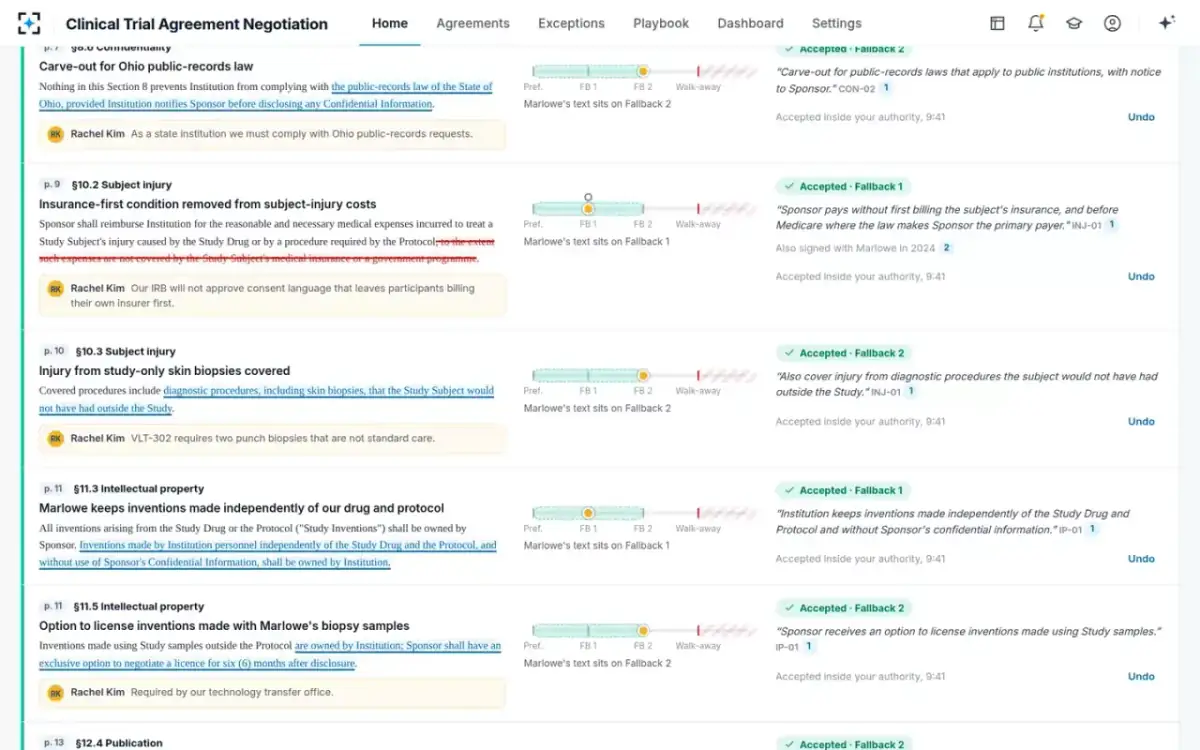
The injury edits in one site redline, and how each was answered
2
of the 19 changes in the round were edits to the subject-injury clause
F1
the rung for dropping the condition that the participant’s insurer be billed first
F2
the rung for covering injury from the two study-only punch biopsies
0
injury wording accepted without the approved consent form being checked against it
What are the clinical trial compensation guidelines?
They are the arrangements under which a participant harmed by a trial is paid without having to prove that anyone was negligent or that the product was defective. No single text applies everywhere. What exists is three layers: a harmonised guideline that tells sponsors to follow local law, regional or national law that sets the floor, and — in the United Kingdom — an industry undertaking that the regulator has written into the model agreement.
The harmonised layer is short. ICH E6(R3) says that "the sponsor’s policies and procedures should address the costs of treatment of trial participants in the event of trial-related injuries in accordance with the applicable regulatory requirement(s)", and that "the approach to compensating trial participants should comply with applicable regulatory requirement(s)" (ICH E6(R3), sections 3.14.2 and 3.14.3). It does not say what the amount should be or who must be covered. It sends the sponsor to the law of each country, which is why a global template cannot carry one injury clause unchanged.
The European Union sets the floor in the regulation itself. Article 76 of the Clinical Trials Regulation requires each member state to have a system in place that compensates a participant for any damage caused by taking part in a trial on its territory — by insurance, a guarantee or an equivalent arrangement suited to the nature and extent of the risk — and obliges the sponsor and the investigator to use that system in the form the member state requires (Regulation (EU) No 536/2014, Article 76). The form differs — national insurance schemes, mandatory policies, guarantees — but the existence of compensation is not negotiable at a European site.
The United Kingdom does it through the contract. For commercial studies the Health Research Authority's study-wide review criteria say that arrangements for no-fault compensation "should be provided in accordance with" the industry compensation schemes, and that those compensation guidelines "form part of the model agreement and may not be modified" (Health Research Authority, UK study-wide governance criteria). A sponsor that proposes to modify the model agreement, or not to provide no-fault compensation, is asked for a justification that is escalated through each nation's own process. For a commercial trial at an NHS site, in other words, the injury promise is fixed text before anyone opens the redline.
It is the role of RECs to decide whether or not a study can go ahead without a scheme of compensation for harm caused where there is no negligence.
Health Research Authority, UK study-wide governance criteria, risk to organisation
No fault, and what that actually obliges a sponsor to do
No fault means the participant does not have to establish negligence. It does not mean the sponsor pays for everything that goes wrong. What a no-fault promise replaces is the need to prove fault; what it keeps is the need to show that the injury came from taking part — from the investigational product, or from a procedure the protocol required. Causation, not fault, is therefore where the clause is argued, and a site's counsel will test every word of the trigger for whether it reaches protocol procedures as well as the drug.
The distinction matters because ordinary institutional cover answers a different question. The HRA notes that where research involves NHS patients under the care of NHS organisations, cover for harm "resulting from clinical negligence" is provided through NHS indemnity schemes, and that for non-commercial studies "arrangements for no fault compensation cannot be made in advance" by the NHS or other public bodies, which may at most consider an ex gratia payment. Negligence cover and no-fault cover are two different promises from two different payers. A commercial sponsor that offers no-fault cover is filling the gap the institution's own scheme leaves, which is why sites treat any narrowing of it as a point of principle rather than a drafting preference.
No fault is also not the same as indemnity, although the two clauses sit together. Indemnity is a promise between the sponsor and the institution about who bears a third-party claim; the injury clause is a promise about the participant's care and losses. The five moves a site makes on indemnity covers the other clause, and a site can be satisfied on one and still refuse to sign the other.
What the consent form must say about injury, by rule
In the United States the obligation runs to disclosure, not to payment, and it is written the same way in both rule sets a trial may fall under. For research involving more than minimal risk, the consent process must include "an explanation as to whether any compensation and an explanation as to whether any medical treatments are available if injury occurs and, if so, what they consist of, or where further information may be obtained" (21 CFR 50.25(a)(6); identical wording at 45 CFR 46.116(b)(6)).
Read it closely, because the drafting is deliberate. The rule requires an explanation of whether compensation is available. A consent form that says plainly "no compensation for injury is available under this study" satisfies it. A consent form that is silent does not. This is the reason a sponsor's subject-injury clause and a site's consent form have to be negotiated as one object: the clause decides what the sponsor will pay, and the consent form is where that answer is told to the person it concerns, in a document their ethics committee has approved.
Three rule sets, and what each one fixes before the negotiation starts
What the rules require: Each member state must have a compensation system in place — insurance, a guarantee or an equivalent arrangement — and the sponsor and investigator must use it in the form that state requires.
What it leaves to the site agreement: The form and the level, country by country. The existence of compensation is fixed; the clause records how the sponsor meets the national requirement.
What the rules require: No-fault compensation in accordance with the industry schemes, which form part of the model agreement and may not be modified. A study without no-fault cover needs the ethics committee’s agreement.
What it leaves to the site agreement: Very little. The injury and insurance terms are fixed text; a site edit to them is an escalation, not a fallback.
What the rules require: Disclosure: for research involving more than minimal risk, the consent form must explain whether compensation and medical treatment are available if injury occurs.
What it leaves to the site agreement: Almost everything — whether the sponsor pays, for what, before or after the participant’s insurer, and for which procedures. This is where injury redlines are fought.
What the rules require: No consent form may contain language through which the participant waives, or appears to waive, a legal right (the US wording); the harmonised guideline sends the sponsor to local law on treatment costs and compensation.
What it leaves to the site agreement: Making sure that whatever the clause says can be told to the participant honestly, in a form their ethics committee will approve.
Who pays first: the insurance-first condition, and why sites delete it
A sponsor's template often says the sponsor will pay the reasonable costs of treating a trial injury to the extent they are not covered by the participant's own health insurance or another source. It is a sensible-looking piece of drafting. It is also a sentence sites routinely strike, and they are right to.
The objection is not financial, it is about what the participant is told. A condition like that has to be repeated in the consent form, where it reads as an instruction to a person who has just been injured in a study to go and bill their own insurer before the company that ran the study will help. In the sample round the site's negotiator puts it bluntly: her ethics committee will not approve consent language that leaves participants billing their own insurer first. Whatever a sponsor thinks of the coordination-of-benefits point, the committee's view is the operative one, because the consent form cannot be used without its approval.
A common answer is to pay first and pursue recovery afterwards if a third party is liable. In the sample playbook that position already exists one rung down as Fallback 1 of the injury rule — the sponsor pays without first billing the participant's insurance — so the change is accepted the day it arrives, with the rule quoted and the institution's own 2024 agreement cited, instead of becoming a round of correspondence.
Injury changes accepted with the rule quoted, in Clinical Trial Agreement Negotiation
What does the sponsor not have to compensate?
A sponsor's injury clause usually excludes four things, and they are not equally contentious. The first three are statements that a trial is a trial: no payment because the investigational product failed to work, none for the failure of a placebo to produce a benefit, and none for harm from a licensed comparator given as ordinary treatment, which is the comparator's own manufacturer's and the treating clinician's territory. A site's counsel will rarely spend a round on any of them.
The fourth is a cluster: injury arising from the site's own failure to follow the protocol, from someone else's wrongful act — including the institution's own negligence — or from the participant's failure to follow instructions. The protocol-departure limb is where sites push, for the same reason they push on the indemnity carve-out: it reads, to a clinician, as a threat to withdraw cover from a participant because their doctor acted. The honest drafting is to exclude the injury only to the extent it arose from the departure, and to say in terms that a deviation made to protect the participant's safety is not what the exclusion is for. In the UK model agreement none of this is open; elsewhere it is one of the clauses a playbook should settle in advance.
One boundary is worth writing into the agreement itself: whether the clause covers treatment continued after the trial ends. A participant kept on an unlicensed product after close-out at the investigator's instigation is outside what a trial injury clause was written for, and a site that asks for open-ended cover for that period is raising a question for the medical owner rather than a fallback position.
Study-only procedures: the biopsy nobody would have had
The clause's reach is widest and least understood here. Compensation is not limited to harm from the drug. It extends to a clinical intervention or procedure provided for by the protocol that would not have occurred but for the participant's inclusion in the trial — the research biopsy, the extra scan, the additional line placement that no clinician would have ordered as care. The consent rules point the same way from the participant's side: the US elements of informed consent require the form to identify any procedures that are experimental (21 CFR 50.25(a)(1)), so the procedures the clause has to reach are already listed in the document the participant signs.
In the sample study the protocol requires two punch biopsies that exist only for the research. The site asks for injury arising from them to be covered explicitly, which is Fallback 2 in the sponsor's playbook and is what a no-fault promise is for. The reason to write it into the clause rather than rely on the general wording is the consent form: the participant is being asked to consent to two procedures they would not otherwise undergo, and the form should say what happens if one of them goes wrong.
What happens when the agreement and the consent form disagree?
They disagree more often than sponsors expect, because they are written by different people on different schedules: the agreement by contracts and legal, the consent form by the medical writer and then edited by the site's ethics committee, which can change it after the agreement is signed. Three drifts account for almost all of it.
The three ways an agreement and a consent form drift apart, and the question each raises
| The drift | How it happens | The question it actually raises |
|---|---|---|
| The form promises more than the clause | The site’s committee softens a conditional sentence — removing the insurance-first condition or the protocol-departure exclusion — so the form reads as an unconditional promise to pay. | Will the sponsor honour the form? In practice it must, because the form is what the participant relied on. The clause should be moved to match, not the form. |
| The clause promises more than the form | A fallback conceded at the table, such as cover for study-only procedures, never reaches the medical writer, so the form is silent about the procedures the participant is consenting to. | The sponsor has an obligation nobody has told the participant about. The form needs an amendment, which needs the committee, which takes weeks — so find it during the negotiation. |
| The two use different words for the same thing | The clause says “study-related injury”, the form says “injury caused by the study drug”; or the clause covers “reasonable medical expenses” and the form says “treatment at no cost to you”. | Which document governs? Agreements usually say the agreement does, and a participant will read the form. The drafting fix is one defined term used in both. |
A consent-form conflict in Clinical Trial Agreement Negotiation, from detection to decision
Agent
Protocol and consent checkerMatches each injury, records, sample and data clause to the protocol section and to the site’s approved consent form, and flags any promise the form does not make.
Never: decides a wording conflict
Agent
Playbook checkerPlaces the site’s edit on the injury rule’s ladder — preferred position, fallback 1, fallback 2, walk-away — and quotes the line it matched.
Agent
Precedent finderLooks for the same wording in an executed agreement with the same institution, and shows the signed text with its signature date.
Never: treats an unsigned draft as precedent
A person decides
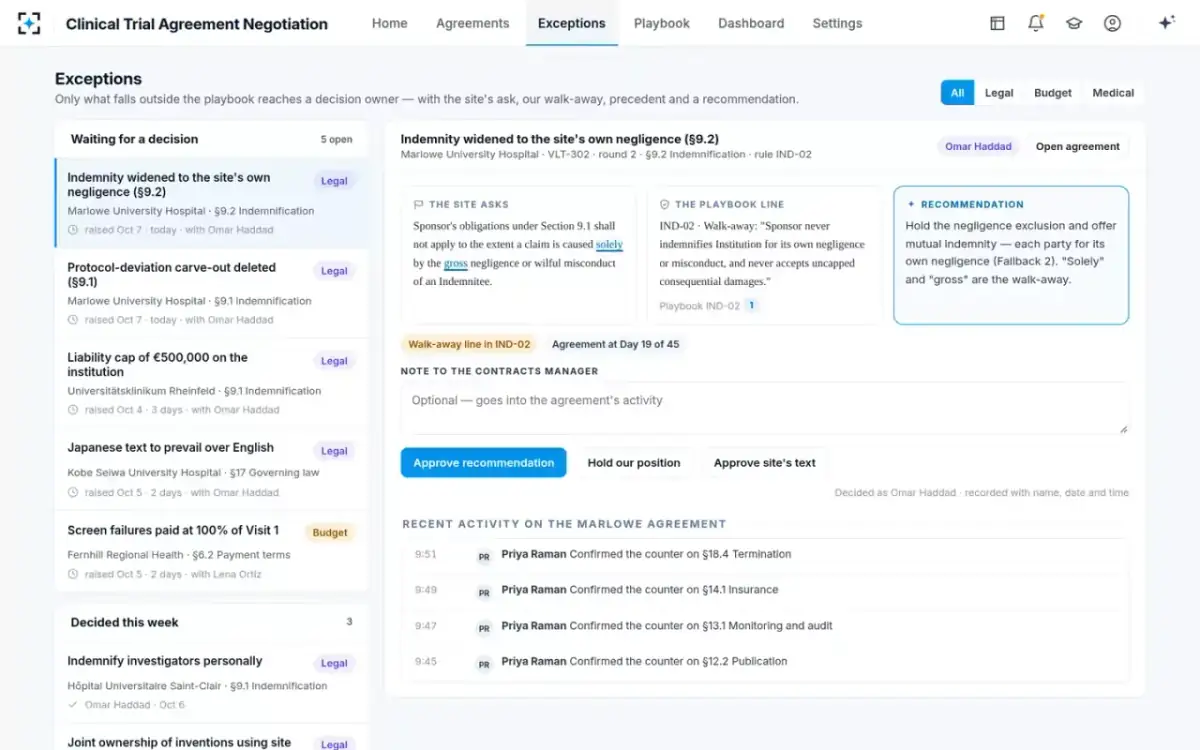
Medical ownerDecides which document moves — the clause, or the consent form through an amendment — and leaves the reason with the decision.
A person decides
Contracts managerConfirms the counter, then approves and sends the response redline and its cover email to the site.
Exculpatory language: the line a consent form may not cross
Whatever the agreement says about who pays, there is one thing the consent form may never do. Under United States regulation no informed consent "may include any exculpatory language through which the subject or the representative is made to waive or appear to waive any of the subject's legal rights" (21 CFR 50.20). The same sentence forbids language that releases or appears to release the investigator, the sponsor or the institution from liability for negligence.
The phrase that does the work is "or appear to". A form does not have to contain a formal waiver to fail; it fails if a reasonable participant would read it as giving something up. "By signing you agree that the sponsor is not responsible for any injury" is the obvious case. The harder cases are the ones that come out of a negotiation: a sentence added to mirror a liability cap agreed in the agreement, or a line saying the participant's sole remedy is the compensation described above. Both can be entirely accurate as between the two organisations and still be exculpatory in the document the participant signs.
This is why an injury concession should never be copied from the agreement into the consent form without someone reading it as a participant would. It is also why a sponsor's own template language, which has been through this test, is usually safer than a sentence drafted at speed in round three.
The insurance behind the promise, and who checks it
A compensation promise is only as good as the cover that pays it, and the cover is reviewed by different people in different places. In the European Union each member state assesses compliance with the compensation article as part of its own review of the application, before the trial is authorised (Regulation (EU) No 536/2014, Article 7(1)(g)). In the United Kingdom the HRA's criteria ask a clinical trial sponsor "not providing £5M of insurance cover" to justify that figure, pass the justification to participating organisations for their local review, and treat any relevant change to the insurance arrangements as a substantial modification to be notified to the ethics committee. They also expect NHS organisations not to request renewals of insurance certificates, since maintaining the insurance is the sponsor's responsibility as set out to the committee.
That last point is a useful corrective in a negotiation. A site that asks to be sent each year's certificate, or to be named on the sponsor's policy, is asking for administration the regulator's own process already covers. The limit is a fair question; the mechanism usually is not. Certificate of insurance or additional insured works through why the two are not equivalent.
The HRA adds one requirement that bears directly on consent drafting: a description of the study insurance, indemnity and compensation should always be provided in the participant information sheet for clinical trials, proportionate to the study type, and where the industry compensation arrangements are described "it should not be limited to provision of costs for medical treatment". A consent paragraph that talks only about paying for treatment understates what a UK commercial participant is entitled to.
Checking an injury redline against the approved consent form
The comparison is mechanical enough to be done the same way every time, which is the only reason it gets done at all when a 22-page redline lands on day 19 of a 45-day target. Four documents, one list of questions.
What a reviewer compares across the agreement, the consent form and the protocol
- Does the clause cover protocol procedures as well as the product?
A no-fault promise should reach the research procedures as well as the product. Name the study-only procedures the protocol actually requires.
- Is payment conditional on anything the form will have to repeat?
An insurance-first condition, a notification deadline or a requirement to use a named provider all have to be told to the participant.
- Does the consent form promise anything the clause does not fund?
Read the form’s injury paragraph as a participant would, then find the sentence in the agreement that pays for it.
- Do the exclusions in the clause appear in the form in plain words?
The protocol-departure exclusion is the hardest to state honestly, and the easiest to leave out.
- Is there any sentence a participant could read as giving up a right?
The consent rule bars exculpatory language and language that appears exculpatory, including a sole-remedy line copied from the agreement.
- Does the form say where the participant claims, and from whom?
Claims run to the sponsor, usually through the investigator. A form that names no route leaves the site’s staff to invent one.
- Do the agreement and the form use one defined term for injury?
Two phrases for the same idea is the drift that surfaces only when a claim is made.
A consent-form conflict waiting for its named owner
Injury is one clause family of about ten, and it is unusual only because of the second document behind it. What a clinical trial agreement is, family by family sets out the rest, and where the 90 days of site activation go shows what a round of correspondence about injury wording costs a start-up plan. To see an injury redline checked against a consent form, start from Clinical Trial Agreement Negotiation.
Questions people ask
Who pays for an injury caused by a clinical trial?
It depends on the country. In the European Union every member state must have a compensation system — insurance, a guarantee or an equivalent — that the sponsor and investigator use. In the United Kingdom commercial sponsors are expected to provide no-fault compensation under the industry schemes written into the model agreement. In the United States the federal rules require only that the consent form say whether compensation is available, so what the sponsor pays is whatever the agreement and the consent form say.
What is no-fault compensation in a clinical trial?
Payment that does not depend on anyone being at fault. The participant still has to show that the injury came from taking part — from the product or a protocol procedure — but not that the sponsor was negligent or the product defective. It fills a gap ordinary cover leaves: NHS indemnity schemes, for example, cover harm resulting from clinical negligence, and the HRA notes that no-fault arrangements cannot be made in advance by the NHS for non-commercial studies.
Can a consent form say the participant should bill their own insurer first?
It can be written that way, and an ethics committee may refuse it. A condition in the agreement has to be repeated in the form, where it reads to an injured participant as an instruction to claim from their own insurer before the sponsor helps. Many sponsors keep a position one rung down that pays first and pursues recovery afterwards, which settles the point without a round of correspondence.
What does the sponsor not have to compensate?
Sponsor injury clauses usually exclude the product's failure to work, the failure of a placebo to provide a benefit, and harm from a licensed comparator given as ordinary treatment. They also commonly exclude or reduce payment where the injury arose from a departure from the protocol, from someone else's wrongful act or from the participant's own failure to follow instructions. In a UK commercial trial these terms are part of the fixed model text rather than a negotiation.
Does a protocol deviation remove a participant's right to compensation?
It should do so only to the extent the injury arose from the deviation, and a well-drafted clause says so. That matters at the negotiating table, because sites read the exclusion as aimed at their clinicians. Saying in terms that a deviation made to protect a participant's safety is not what the exclusion is for usually settles the clause in one round.
Are the compensation guidelines law?
Not in the United Kingdom as such: they are an industry undertaking, but the HRA has made them part of the model agreement for commercial studies, and that text may not be modified, so at an NHS site they bind by contract. In the European Union the duty to have a compensation system is in the Clinical Trials Regulation itself. The United States has no general federal duty to compensate, only a duty to tell the participant whether compensation is available.