Contract negotiation software is bought to solve one problem — site agreements take too long to sign — and four quite different things get bought under that heading: a contract lifecycle system, a study start-up module inside a trial management platform, outside counsel on the redlines, and software that applies the sponsor's own negotiation playbook to each change. They look similar in a demonstration because they all store agreements and show a status. They differ in the only thing that moves a signature date: who answers the next redline, and how much of it they can answer without asking anyone. Botminds' Clinical Trial Agreement Negotiation is the fourth kind, and this guide is as specific about where it does not fit as about where it does.
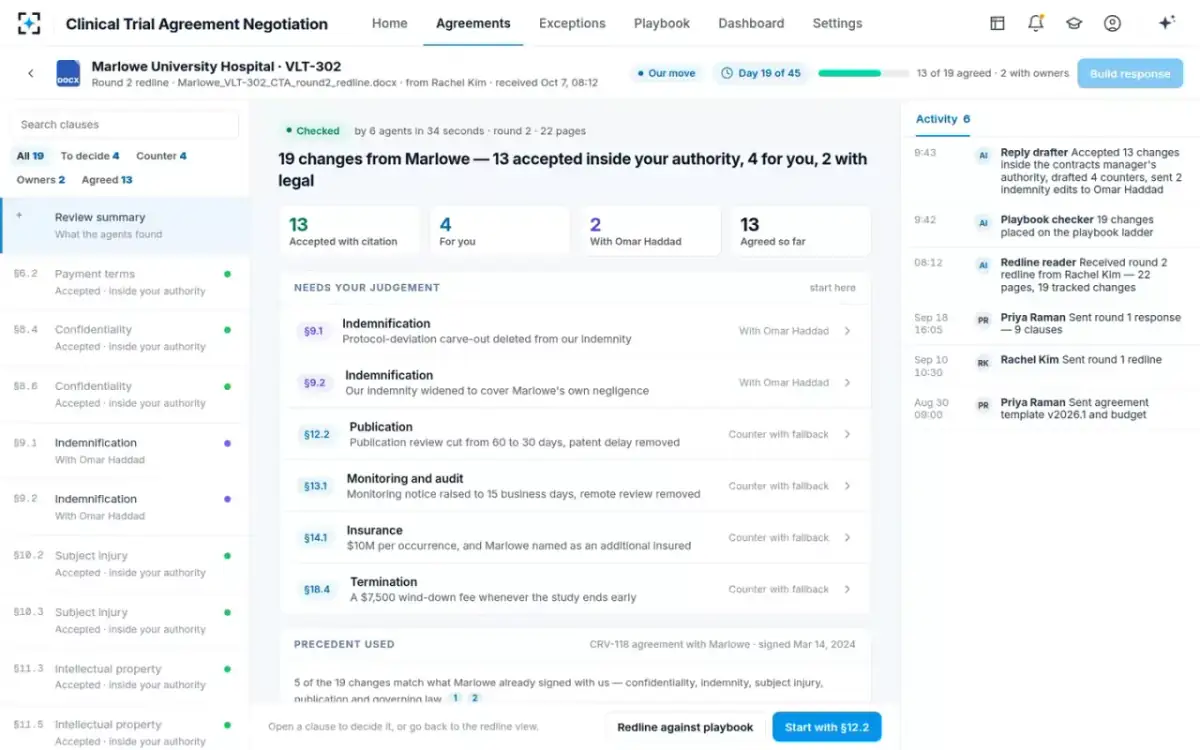
The comparison runs over one fictional sample round used throughout the solution: 19 tracked changes and 12 margin comments in a 22-page round 2 redline from Marlowe University Hospital on study VLT-302, with a 45-day target from template to signature. No vendor or product is named here; the four options are categories, and the hour figures attributed to each are our estimates, labelled as such.
What is contract negotiation software, and what is it not?
Contract negotiation software is the part of contracting that handles an incoming change: reading it, placing it against positions the organisation has approved, drafting the response, and routing what nobody has approved to the person who decides. That is a narrower definition than the category usually claims, and deliberately so — it separates negotiation from the two things it is most often confused with.
It is not a repository. Storing executed agreements, extracting their key terms and reminding someone before an expiry is valuable work, and it is what contract lifecycle management does well; it just happens after the negotiation that caused the delay. And it is not a template library. A template library is where a negotiation starts, not how it is answered: the Trial Innovation Network lists “nonstandard contracting language” among the hurdles that slow trials down, but the sponsor with an excellent template still has to answer the 19 changes a site made to it.
The distinction matters at purchase time because the three categories are sold by the same words. Ask what the product does with an incoming redline, and the answer places it immediately.
Four ways to answer a site redline, on the dimensions that decide a signature date
| Option | Who answers the next redline | Where the playbook lives | What is left behind |
|---|---|---|---|
| A contract lifecycle system | A contracts manager, by hand, in the same hours as before — the system stores the result. | In a document library, if anywhere; the system does not apply it. | A clean repository of executed agreements and extracted terms. |
| A study start-up module | A contracts manager, by hand, with the status visible to the study team. | Outside the tool. The module tracks the milestone, not the clause. | Dates, owners and a start-up timeline per site. |
| Outside counsel | A lawyer, at an hourly rate, round after round. | In the firm’s own experience, not in your organisation. | Advice, and whatever the invoice narrative records. |
| Software that applies a playbook | Agents place every change on your ladder and settle what is inside authority; people decide the rest and send everything. | In the product, versioned and owned by the head of contracting. | Each change with the rule and precedent it was settled on, the decisions by name, and the response as sent. |
Option one: a contract lifecycle system as the system of record
A contract lifecycle system is the right answer to a real problem — nobody can find the executed agreement, nobody knows which sites have which terms, and renewal and expiry dates live in a spreadsheet. It gives a clause library, version control, approval routing, electronic signature and reporting across a portfolio, and its reporting is usually better than anything a contracting team could build.
What it does not do is answer the redline. The tracked changes still arrive as a Word file, a person still reads them against the template and the playbook, and the system records what that person decided. If the bottleneck is reading and placing changes — which, in clinical contracting, it often is — a lifecycle system moves the paperwork around the bottleneck rather than through it.
The honest version of this option is to buy it for what it is good at and not expect the negotiation to speed up. A team that buys it to shorten cycle time is likely to find itself re-running the evaluation later.
Option two: a study start-up module inside the trial system
Most clinical trial management systems have a start-up or site-activation module, and it has one genuine advantage over anything bought separately: the study team already lives there. The contract's status sits beside ethics submission, site initiation and first-patient-in, which is exactly where a start-up lead wants it.
Its limitation is that it tracks milestones, not clauses. It will tell you that the Marlowe agreement is on day 19 of 45 and that contracts hold the pen. It will not tell you that the two indemnity edits are the only changes without an approved answer, which is the fact that decides whether day 19 becomes day 26 or day 52. A module that shows a red status with no clause-level reason produces chasing rather than progress.
Used well, it is the layer above: the place the study team watches, fed by whatever actually answers the redlines. Where the start-up weeks really go is the wider picture that module is drawing.
Option three: outside counsel on the redlines
Sending site redlines to a law firm is the fastest option to set up and the most expensive to run, and its real cost is not the hourly rate. It is that the knowledge accumulates in the firm. After forty agreements the firm knows which concessions this sponsor makes and which institutions ask for what; the sponsor knows what it was invoiced.
There is a narrow version that works well: counsel writes the playbook and owns the walk-aways, then sees only what falls outside them. That is the arrangement the fourth option is designed to produce, and it is how legal time gets spent on the two indemnity edits rather than on the thirteen changes a lawyer approved in the abstract a year ago.
Good clinical practice is also comfortable with the delegation, as long as the responsibility is not delegated with it: activities may be transferred, but the sponsor keeps oversight of them, and the signed agreement itself is an essential record of the trial.
Option four: a playbook the software can actually apply
The fourth option starts from the playbook rather than the repository: every clause family carries four rungs, an authority line says which rung a contracts manager may take alone, and software places each arriving change on that ladder. In the solution used as the example here, six agents read the redline, place all 19 changes, look for what the same institution signed before, check subject-injury wording against the approved consent form and fees against the fair-market-value benchmark, then draft the response — and a named person confirms the counters and sends everything.
Its weakness is the mirror of its strength. It is worth nothing without a playbook, and a sponsor whose positions exist only in a senior negotiator's head will get a tool that escalates everything. Writing the ladder is weeks of work by the people who are already busiest, and it cannot be bought. How to write one, family by family is the prerequisite, not an optional extra.
The clause board in Clinical Trial Agreement Negotiation, agreement by agreement
The same 19-change round, run four ways
The comparison that settles an argument is not a feature grid; it is one real round costed under each option. Take the sample round — 19 changes, 12 comments, five of them matching clauses the same institution signed in 2024, two with no approved position — and walk it through all four.
One 19-change round under each option: hours, handoffs and what still has to happen
| Option | Contracting hours in the round | Handoffs before a response goes out | What still has to happen |
|---|---|---|---|
| A contract lifecycle system | About 12.5, our estimate: the reading and placing are unchanged. | Two or three, plus a legal review of the whole agreement. | Someone reads 22 pages and decides every change from memory or from the playbook document. |
| A study start-up module | About 12.5, our estimate, with better visibility of the delay. | The same, plus status updates to the study team. | The same reading, and a chase on whoever holds the pen. |
| Outside counsel | About 2 internal, plus the firm’s own time on all 19 changes. | Three: to the firm, back, then to the site. | A bill for thirteen changes that were already approved positions, and a wait for the firm’s queue. |
| A playbook applied by software | About 1.6, our estimate: thirteen acceptances reviewed with their citations, four counters confirmed. | One, for the two clauses with no approved position. | A contracts manager confirms the counters and sends the response; the legal owner answers two clauses, not an agreement. |
Where the hours go in one redline round, by hand
Read the two figures together and the argument becomes clear. The hours do not move because a repository is better organised; they move because the reading and the placing are done differently. Any option that leaves those two rows untouched will leave the cycle time where it was, however good its reporting is.
What each option costs over three years
Three years is the right horizon, because it is long enough for the implementation to be paid off and short enough that the templates have not changed twice. Write the cost as a sum rather than a licence figure, and the four options rank differently from how they rank on price per seat.
The three-year cost of answering site redlines, term by term
Licence or fees
annual licence × 3, or the firm’s hourly rate × hours
The only term most comparisons contain, and the one that varies least between options in the same category.
Procurement
Contracting hours
hours per round × rounds per agreement × agreements per year × 3 × loaded rate
Often the dominant term. Three rounds per agreement is a reasonable planning assumption; count your own.
Head of contracting
Legal hours
clauses escalated per round × rounds × hours each × rate
The term a playbook moves most: escalating two clauses rather than an agreement changes both the hours and the queue.
Legal
Implementation and playbook work
set-up + the weeks of senior time to write the ladders
Pay it once. It is the term teams leave out and then discover, and it is also the term that keeps its value if the software is replaced.
Head of contracting
The cost of delay
days saved per agreement × what a day of delayed enrolment is worth to you
Price it yourself from your own study plan rather than from a published figure; this is where the business case usually lives.
Study start-up
The three numbers a sponsor should fix before comparing anything
19changes
in the sample round — use your own median, counted from your last ten redlines
45days
the target from template to signature in the sample study; set yours before you shop
3rounds
a reasonable planning assumption per agreement, and the multiplier that dominates the cost model
Is contract lifecycle management enough for clinical trial agreements?
It is enough for the half of the problem it addresses. If your difficulty is that executed agreements are scattered, that nobody can answer which sites have which terms, or that approvals are untracked, a lifecycle system solves it and the clinical specifics do not get in the way.
It is not enough for three things that are specific to this work. Site agreements are negotiated against documents outside the contract — the protocol and the ethics-approved consent form — and a system with no view of those cannot tell you that a subject-injury edit promises something the consent form does not. Fees have an outside rule attached, so a payment change is a compliance question rather than a commercial one. And national model agreements impose rules that sit above clause positions, with their own version clocks.
“Any new contracts with participating NHS and HSC organisations entered into on or after 28 April 2026 must use the April 2026 version of the relevant agreement.”
UK Health Research Authority, updated suite of UK model agreements now in use (28 April 2026)
That is the kind of dependency to test in any evaluation: when a national template is reissued, what has to change in the system, who notices, and how long it takes. A product whose answer is “we would update the template library” has not understood that the rule is about which document may be used at all, and that previous versions stop being acceptable on a date.
What to insist on whichever you choose
Some requirements are category-independent, and they are the ones worth putting in writing before any demonstration. Standard agreements have measurable traction when they are genuinely shared — the CTSA programme reports that “63/65 CTSA Hubs and 10 affiliates have registered to use the agreement as a starting point for contract negotiations in TIN studies”, and 73 institutions have signed on to the federal standard subaward agreement — which tells you that the asset worth owning is the agreed position, not the tool that stores it.
What to require of any option, before signature
- Your playbook lives in your organisation, exportable
Positions, rungs and walk-aways you can take with you. This is the asset; the software is the reader.
- Every settled change names the rule it was settled on
A status with no reason cannot be reviewed, audited or improved.
- Only a named person sends a response
Of all the failure modes in this work, an unreviewed concession reaching a site is the one with no undo.
- Escalation goes to a person, not a queue
With the clause, the ask and the line it crossed — not the whole agreement.
- The protocol and the consent form are in scope
Subject-injury and records wording is checked against the documents the ethics committee approved.
- Country rules are applied before clause positions
And reissues of a national model agreement are handled as a dated requirement, not a template refresh.
- Decisions are stored with a name, a date and a time
Reconstructable years later by someone who was not there, which is who usually asks.
- A measured pilot on your own closed redlines
Not a demonstration on the vendor’s sample document.
The questions that separate a demonstration from a deployment
Six questions, asked in this order, will place any product in this category inside ten minutes. What happens when a 22-page redline with tracked changes arrives — walk me through it on my document. Where do my positions live, and who may change them? Which changes would this settle without a person, and who set that limit? What reaches a named owner, and what does that person see? Reconstruct for me how a clause was settled on an agreement you closed last year. And what does the system do with a clause I have no position for?
The sixth is the most revealing. A product that treats an unmatched clause as a low-confidence classification will quietly place it somewhere; a product built for this work routes it to a person with the gap stated. How to measure the answers rather than take them on trust is the test to run next, and where the line between reading and settling should sit is the design question underneath all four options.
The response Clinical Trial Agreement Negotiation builds from the decisions
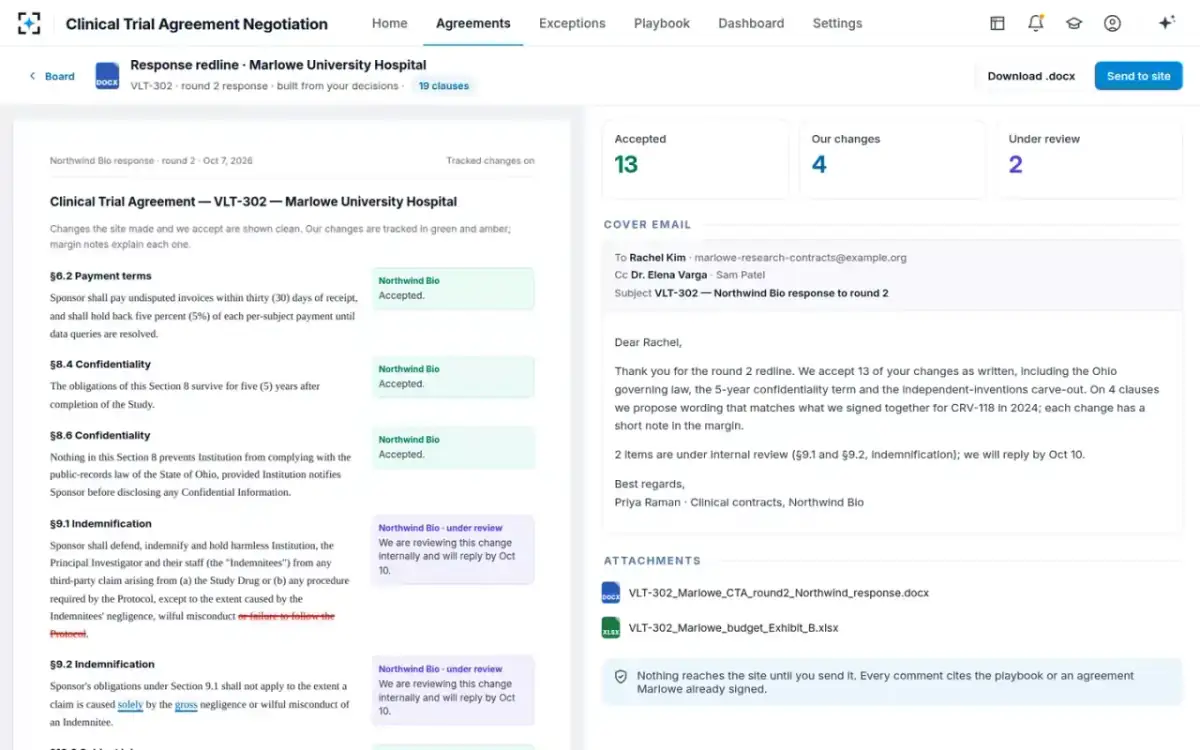
One closing caution about this whole comparison. The four options are not mutually exclusive, and the sensible end state for many sponsors is two of them: a repository for executed agreements and portfolio reporting, and something that answers the redlines against a playbook. What does not work is buying the first and expecting the second.
Questions people ask
Can a clinical trial management system handle site contracts?
It can track them. A start-up module shows each agreement's status, owner and days against a target, which is exactly what a study start-up lead needs and is why the module should stay. What it does not do is place an incoming change against your approved positions, so the hours spent reading and deciding do not move — and those are the hours that decide the signature date.
Should site contracts go to outside counsel?
The walk-aways should; the redlines mostly should not. Counsel is the right owner of the positions past which the answer is no, and the right reviewer of anything that crosses them. Sending whole agreements round after round pays a firm to re-decide concessions it already approved, and leaves the accumulated knowledge of your negotiations in the firm rather than in your organisation.
What does contract negotiation software cost?
Ask instead what answering your redlines costs over three years: licence plus contracting hours per round, times rounds per agreement, times agreements per year, plus legal hours on escalations, plus the one-off work of writing the playbook, plus whatever a day of delayed enrolment is worth to you. For many sponsors the hours term is larger than the licence term, which is why a comparison built on price per seat can pick the wrong option.
How do you compare contract software options fairly?
Run one real round through each. Take a redline you have already closed, with its real margin comments, and ask each option the same four questions: how many hours, how many handoffs, what reaches a lawyer, and what is left behind afterwards. Fix your own median change count and round count first, so the comparison is against your work rather than against a sample document.
What should contract software do that a template library cannot?
Answer a change. A template library gives you the words to start with; the delay comes from the 19 changes the site made to them, each of which needs a position, a precedent check and either a settlement or an escalation. The test is simple: hand the product a redline rather than a blank template, and see whether it produces an answer or a comparison.
How long does it take to implement?
The software is rarely the long part. Loading templates, executed agreements and a benchmark is days to weeks; writing the playbook ladders, if they do not exist, is weeks of senior contracting and legal time, and it is the dependency to plan around. The compensation is that the playbook keeps its value independently of the tool — it is yours, and it is what makes the next evaluation short.