Automated contract review is software reading an incoming contract or redline, identifying what has changed, and deciding what each change means against the rules the organisation has already approved. The part buyers argue about is reading accuracy. The part that decides whether a deployment survives its first audit is permission: how much of the answer the software is allowed to settle on its own, what it may never touch, and whether a person can undo any of it afterwards. In clinical contracting that line is unusually easy to draw, because the rules are written down — a negotiation playbook, a consent form, a fair-market-value benchmark — and Botminds' Clinical Trial Agreement Negotiation is built so the line is a setting a named person owns rather than a property of the software.
The examples below come from a fictional sample used throughout the solution: a round 2 redline of a site agreement with 19 tracked changes and 12 margin comments, on Northwind Bio's study VLT-302 with Marlowe University Hospital. One document is a demonstration, not a benchmark, and this guide is careful about the difference.
What is automated contract review?
In its honest form, automated contract review does four things to an incoming document: it finds the changes, it attaches each one to the clause of your own template that it changes, it classifies the change against your approved positions, and it proposes a response. Everything else a vendor demonstrates is a variation on those four.
What distinguishes products in this category is not whether they can do that but what happens at the end of it. Some stop at a report. Some draft a reply a person must assemble. Some will accept changes, write the response document and — if nobody stops them — send it. Those are different products with the same description, and they carry different risks, which is why the first question in an evaluation should be about permissions rather than about recall.
Five permissions inside one phrase, and who should hold each
| Permission | What it risks if it is wrong | Who should hold it |
|---|---|---|
| Read — find the tracked changes and comments and keep them intact | A change is missed, so nobody answers it. The quiet failure, and the one worth measuring hardest. | Software, checked by measurement: it reads page 22 with the same attention as page 1, which a tired reader does not. |
| Classify — place each change against an approved position | A change is placed one rung too low and looks acceptable when it is not. | Software, with the rule it used shown beside every classification. |
| Draft — write the counter or the margin note | Wasted review time, and wording that does not match what the institution signed before. | Software, reviewed by the negotiator who will send it. |
| Accept — settle a change so no person looks at it again | A position the organisation never approved becomes a signed term. | A person’s setting, bounded by the playbook and reversible. |
| Send — put the response in front of the other side | An unreviewed concession reaches a counterparty, where it cannot be recalled. | A named person, every time, with no setting that removes them. |
Reading, classifying, settling: three very different permissions
Reading is the permission to give away first, and the easiest to justify. A redline of 22 pages with 19 tracked changes and a dozen margin comments is exactly the work people do badly when tired and under a start-up deadline: the failure mode is not a wrong judgement but a change nobody noticed, which then goes unanswered into the next round and arrives as an agreed term.
Classification is harder, because it is where a system's confidence can exceed its competence. A classifier that says “this is a payment change” is doing taxonomy. One that says “this sits on Fallback 1 of your payment rule” is doing judgement against policy, and the only way to make that reviewable is to show the rule. If a classification cannot be displayed with the line of the playbook it rests on, it cannot be checked by the person who has to own it.
Settling is a different kind of act altogether. It is the point where no human will look at that change again, so it is the only permission whose errors are silent. Everything in the rest of this guide is about how to grant it narrowly.
What parts of a contract can be reviewed automatically, and which may be settled?
All of it can be read. The part that can be settled is the part where the organisation has already decided the answer and written it down, at a level of precision a stranger could apply. In practice that means three groups.
The first is mechanical terms: notice periods, payment days, invoicing cadence, holdback percentages, reporting addresses, counterpart signature mechanics. The worst case of a wrong answer is a cost the sponsor chose, and a cash-flow cost at that.
The second is positions the sponsor has pre-approved as fallbacks — a five-year confidentiality term instead of seven, the institution's own state law, a reference to its own privacy authorisation, the site keeping inventions made independently of the study drug and protocol. These are changes a lawyer has already approved in the abstract; sending them to a lawyer again is the waste a playbook exists to remove.
The third is anything this institution has already signed in a fully executed agreement, recently enough that the templates and the law have not moved underneath it. It is hard to argue against your own signature, and a counter that quotes it is both faster and stronger.
What may not be settled is the complement of those three, and it is worth naming rather than implying: anything past the walk-away, anything with no approved position at all, any fee outside the benchmark, and anything that touches what a participant is told. Writing the playbook that makes this list possible is the work that has to happen first.
Where 19 changes went on one sample redline
Round 2 redline, 19 tracked changes
- 13 accepted inside authority · 68.4%
- 4 countered at an approved rung · 21.1%
- 2 to the legal owner · 10.5%
The authority line, and why it should be a setting and not a feature
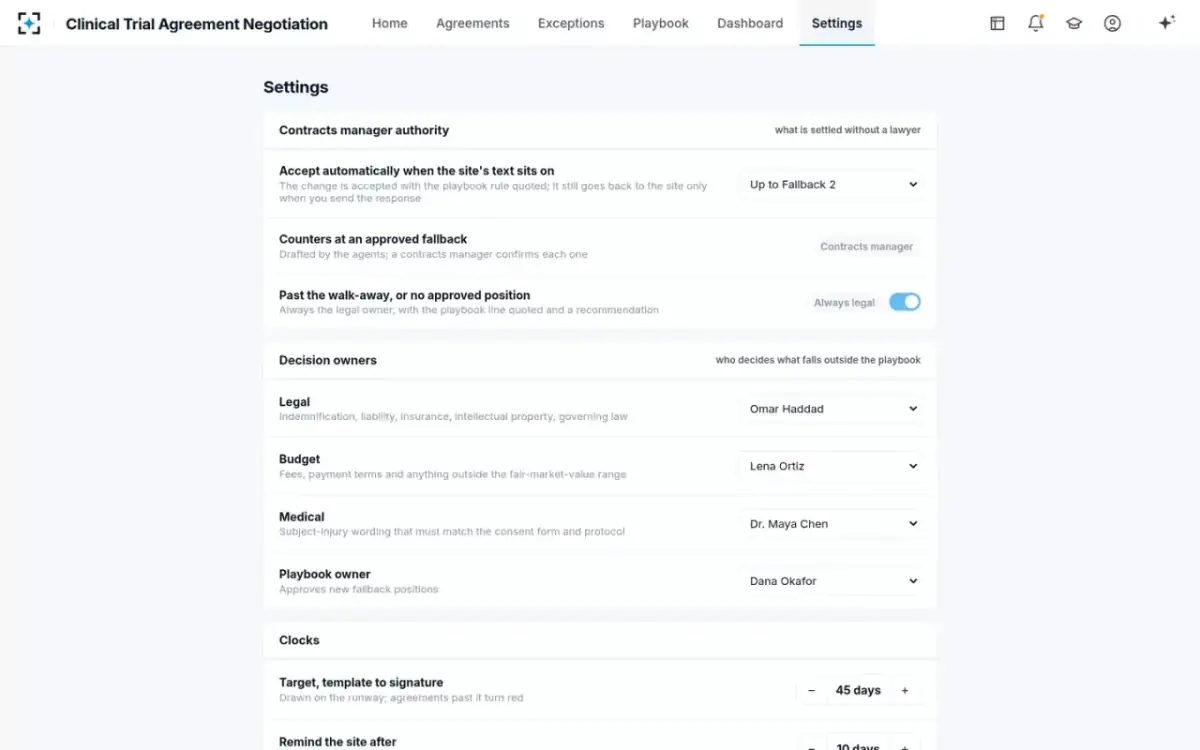
The authority line is the sentence that says how high the software may climb the playbook's ladder without asking. In the sample study it has three values — nothing automatic, up to Fallback 1, or up to Fallback 2 — and it is set by the contracting team, not by the product.
Making it a setting matters for three reasons. It is reversible, so a sponsor can start at nothing automatic and raise the line when it has seen enough rounds. It is auditable, because the question “what was this system allowed to settle on 7 October?” has a stored answer. And it is honest about where the risk appetite lives: a vendor cannot know how much a particular sponsor is prepared to concede without a lawyer, and a product that decides that on the sponsor's behalf has taken a decision it cannot be accountable for.
NIST's AI Risk Management Framework makes the same point in general terms: the human roles in deciding and overseeing an AI system need to be defined and kept distinct, and the configuration can sit anywhere from fully autonomous to fully manual (NIST AI 100-1, 2023).
“Mechanisms are in place and applied, and responsibilities are assigned and understood, to supersede, disengage, or deactivate AI systems that demonstrate performance or outcomes inconsistent with intended use.”
NIST, Artificial Intelligence Risk Management Framework (AI RMF 1.0), NIST AI 100-1 (2023), MANAGE 2.4
The framework's point is that the configuration is a design choice to be made deliberately, not a property the technology has. Alongside the override mechanism above, it asks organisations to define and document the processes for human oversight in accordance with organisational policy (MAP 3.5). An authority line, an undo and a named owner are those three requirements expressed in contracting vocabulary.
Up to Fallback 1 against up to Fallback 2: what changes
Authority up to Fallback 1: Changes landing on the first approved fallback only — the positions the organisation concedes most readily.
Authority up to Fallback 2: Changes landing on either approved fallback, including the ones that were argued before they were approved.
Authority up to Fallback 1: More counters, including several she would always have agreed to.
Authority up to Fallback 2: Fewer counters, each needing real judgement.
Authority up to Fallback 1: Identical. The walk-away does not move with the authority line.
Authority up to Fallback 2: Identical, for the same reason.
Authority up to Fallback 1: Time: approved concessions queue behind people.
Authority up to Fallback 2: Drift: a second-rung concession becomes the default because nobody saw it.
Authority up to Fallback 1: How many counters a negotiator accepted unchanged — those are candidates for the higher line.
Authority up to Fallback 2: Whether the undo is ever used, and on which clause families.
Every acceptance needs a citation and an undo
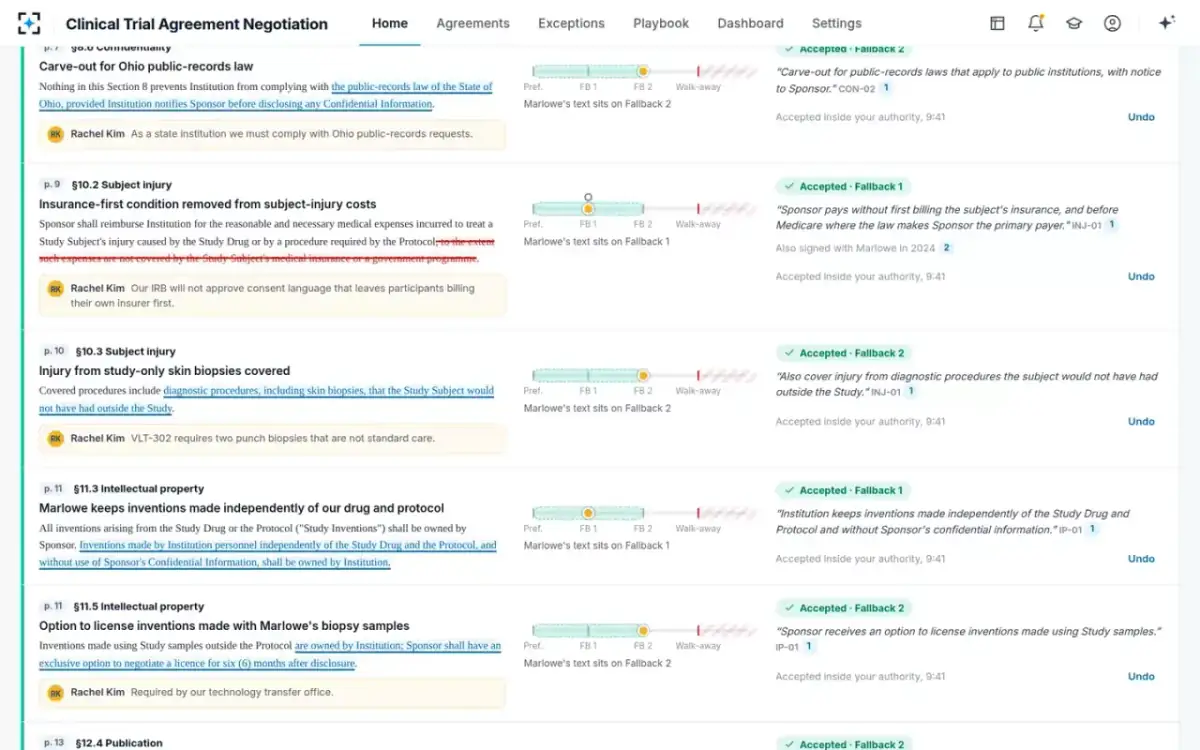
Two mechanisms make automatic acceptance defensible, and both are cheap. The first is the citation: every accepted change carries the rule and the rung it rests on, and the precedent if there is one. On the sample round the accepted payment change quotes the payment rule's first fallback — payment within 30 days and a 5% holdback — and the five-year confidentiality term quotes both the confidentiality rule's first fallback and the agreement the same institution signed in 2024. A citation turns a review of 13 acceptances into a few minutes of reading rather than a re-negotiation.
The second is the undo. Every automatic acceptance in the solution can be reversed by the contracts manager before the response goes out, which is what makes the authority line a risk a sponsor can price: the worst case of setting it one rung too high is a reversal, not a signed term. A product that cannot undo an acceptance is asking for a permission it has no way to return.
Accepted changes in Clinical Trial Agreement Negotiation, with the rule, the precedent and an undo
Should software ever be allowed to send a response?
No, and this is the one place where a hard answer is easier to defend than a nuanced one. Everything inside the building is reversible — an acceptance can be undone, a classification corrected, a draft rewritten. A response that has reached the other side is a negotiating position the counterparty has seen, and no undo exists for it.
In the sample study that is expressed as a setting which cannot be switched off: the agents never send anything to a site, and every response redline and cover email is approved and sent by a named contracts manager. It costs a few minutes per round and removes the only failure mode in this category that cannot be repaired.
It also keeps the responsibility where good clinical practice puts it. ICH E6(R3) is explicit that where activities have been transferred or delegated, “the responsibility for the conduct of the trial, including quality and integrity of the trial data, resides with the sponsor or investigator, respectively”. Delegating the reading is ordinary; delegating the sending would be delegating the position itself.
The clauses that must always reach a named person
Four categories should leave the automatic path regardless of how confident any system is, and all four can be written as rules rather than as instincts.
Anything past the walk-away, or with no approved position at all. On the sample redline that was two indemnity edits: one deleted the protocol-deviation carve-out, which no rung of the indemnity rule permits, and one inserted the words “solely” and “gross”, which would have made the sponsor pay for the site's own ordinary negligence. Both went to the legal owner with the walk-away quoted and a recommendation, which is the useful form of escalation — a clause, an ask and a line, not a 30-page agreement.
Anything that touches what a participant is told. A change to a subject-injury clause can contradict the ethics-approved consent form, and the limit is statutory: a consent form may not contain exculpatory language through which a subject waives their legal rights or appears to release the investigator, sponsor or institution from liability for negligence (21 CFR 50.20). No authority setting should be able to settle a change that puts the agreement and the consent form at odds; in the solution those conflicts go to the medical owner.
Any fee outside the fair-market-value range. Research payments are expected to be fair market value for legitimate, reasonable and necessary services, in the compliance guidance the Office of Inspector General issued for pharmaceutical manufacturers, and a payment that cannot be explained in a budget review is a payment that will be reported publicly without its explanation. The budget check in the solution routes anything above the range to the budget owner and never approves it.
And anything a site has now refused twice. A clause rejected in two consecutive rounds is not a classification problem; it is a negotiation that needs a different conversation, which is why that pattern is a setting rather than an exception in the sample study.
Seven conditions a change should meet before it is settled without a person
- It belongs to a clause family with four written rungs
A family with a preferred position and no fallbacks has nothing to accept against.
- It lands on a rung inside the authority a person set
And the authority is stored with a date, so the day’s permissions can be reconstructed.
- The rule it rests on is shown with it
An acceptance without a citation cannot be reviewed; it can only be trusted.
- It is not past the walk-away, and not unmatched
The two cases that must always reach a named owner, whatever the setting says.
- It does not contradict the consent form or the protocol
Subject-injury, records, samples and data wording is checked against the approved documents first.
- It carries no fee above the benchmark
Payment mechanics may be settled; prices may not.
- It can be undone before anything is sent
The undo is what makes the authority line a reversible decision rather than a bet.
What to write down so a decision can be reconstructed later
Contracting decisions are read years later, by people who were not there: an auditor, an inspector, a lawyer in a dispute, or the negotiator doing the next agreement with the same institution. What they need is not a log of software activity but the decision in its context.
Five things are enough. The change as the site made it, with its section and page. The position it was placed on, with the rule's identifier. The precedent, if one was used, with the signature date of the agreement it came from. The person who decided, with the date and time — in the sample study every decision is recorded that way, and the legal owner's choices are stamped with his name. And the response actually sent, as a document. Every executed agreement then carries a signature manifest naming the signer, the meaning of the signature, and when it was given.
What is deliberately not in that list is a transcript of the software's reasoning. A reason nobody can check is not evidence; the rule, the rung and the name are.
How to pilot automatic acceptance without betting the study
Run the system behind the people before you run it in front of them. For the first few rounds set authority to nothing automatic: the agents read, classify and draft, every proposal is reviewed, and the team counts how often it would have accepted the proposal unchanged. That count is the evidence for raising the line, and it costs nothing but the reading that was happening anyway.
Then raise it one rung, on a subset of clause families rather than all of them — the mechanical ones first, the ones with the clearest fallbacks second, subject injury and indemnity never. Watch two numbers: how often the undo is used, and whether anything reached a decision owner that should have been settled earlier. The first tells you the line is too high; the second tells you a family is incomplete.
NIST's framework is blunt about why the order matters: putting into service an AI system that is inaccurate, unreliable or generalises poorly beyond the data and settings it was trained on creates and increases negative risk, and makes the system less trustworthy. A pilot that measures on your own closed redlines, rather than on a vendor's sample, is how a sponsor finds out which it has — how to test one of these systems before buying it sets out the four measures to take.
The authority line in Clinical Trial Agreement Negotiation is a setting with an owner
Questions people ask
Should software be allowed to accept a clause?
Only inside a limit a person set, against a position the organisation approved in advance, with the rule shown and the acceptance reversible. Those four conditions make the worst case a reversal rather than a signed term. Without them the question is not whether software should accept a clause but whether anyone has decided what the organisation accepts at all.
What is a human-in-the-loop approval in contract review?
It means a named person decides a specific class of change before anything happens, rather than reviewing a batch afterwards. The classes worth defining that way are the ones with no approved answer: in the sample study, clauses past the walk-away go to the legal owner, fees outside the benchmark to the budget owner, and consent-form conflicts to the medical owner, each with the line quoted and a recommendation.
How do you undo an automatic acceptance?
In the sample study every automatically accepted change carries an undo that the contracts manager can use before the response is sent, which returns the change to the queue with its classification intact. Ask a vendor to demonstrate this on a real acceptance, not on a draft — a product that can only revise a draft response is not offering an undo, it is offering an edit.
What should never be automated in a contract review?
Sending, and deciding anything the organisation has not already decided. In clinical contracting that means indemnity edits past the walk-away, subject-injury wording that the ethics-approved consent form does not support, fees above the fair-market-value range, and any clause the site has already refused twice. All four are rules a sponsor can write down, which is what makes the boundary enforceable rather than aspirational.
How do you set the authority line for automatic acceptance?
Start at nothing automatic and measure. For several rounds let the system read, classify and draft while people decide, and count how often a proposal was accepted unchanged; that share is the evidence for raising the line one rung, on the clause families with the clearest fallbacks first. Raise it as a setting with a date, so the permission in force at any moment can be reconstructed.
Does automated review replace the contracts manager?
It replaces the reading, not the decision. On the sample round the contracts manager still confirmed four counters, reviewed thirteen acceptances with their citations and sent the response herself; what she did not do was re-read 22 pages to find the changes or brief a lawyer on concessions a lawyer had already approved. The job that remains is the judgement, which is the part that was being crowded out.