Clinical trial site activation is everything that has to happen between choosing a site and that site being allowed to screen its first participant: regulatory authorisation for the trial, ethics committee approval for this site, a signed agreement and budget, staff trained and delegated, investigational product released, and an initiation visit completed. It is hard because the steps have different owners who each report their own step as finished on time, and because the one step that cannot be prepared in advance by one party alone — the agreement — is usually the last one outstanding. Botminds' Clinical Trial Agreement Negotiation attacks that step directly: every site change is placed against positions the contracting team approved before the first template went out, so a round is answered the day it arrives rather than queued behind the two clauses that need a lawyer.
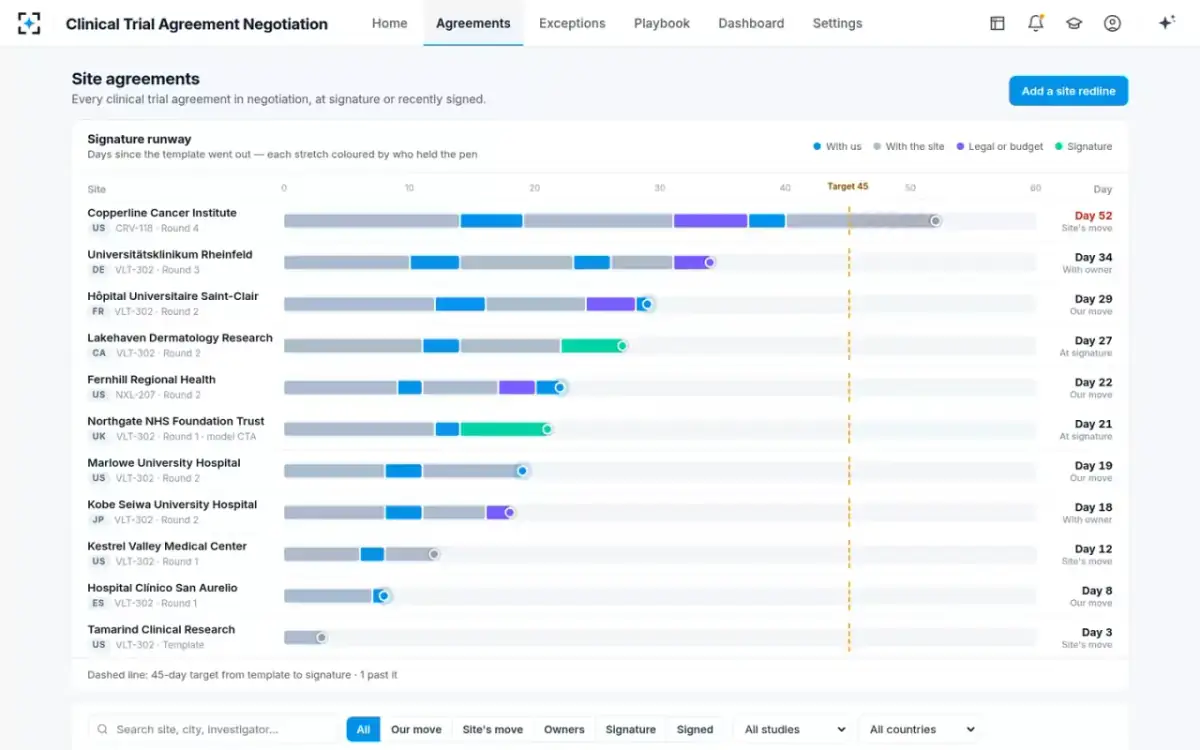
The research figures below come from peer-reviewed studies and a national code; the worked examples are fictional sample data from inside the solution — Northwind Bio's Phase 3 study VLT-302 and its sites, including Marlowe University Hospital on day 19 of a 45-day target and Copperline Cancer Institute on day 52.
What a site costs to start, and how long the start takes
90days
average site-related start-up under standardised multicentre trial activation methods
2–12months
the site administrative process per site, depending on the type of institution
$50k
estimated administrative cost of starting one site, with no guarantee of enrolment
20–30%
of study centres in cancer trials never enrol a patient on a given study
What is site activation in a clinical trial?
Site activation is the point at which a sponsor tells a selected site it may begin — in many sponsors by a formal activation letter or greenlight notice naming the date from which screening may start. Everything before it is study start-up. Everything after it is enrolment, and the site's performance is measured from it.
The distinction from site selection matters because the two are often reported as one number. Selection is a judgement about whether a site has the patients, the staff and the equipment, and it ends with the site saying yes. Activation is the administrative and legal work that makes that yes operative. A sponsor whose feasibility is excellent and whose activation is slow has not chosen badly; it has a queue problem.
What activation requires is not a matter of taste. Good clinical practice expects agreements with the institution to be documented before the activities begin, the ethics committee must have approved this site's documents including its consent form, and the trial itself must be authorised wherever authorisation is required. A sponsor can decide the order and the overlap. It cannot decide to skip one.
What are the steps in clinical trial site activation?
Eight steps cover almost every programme, and they fall into three lanes that run largely in parallel. Drawing them end to end instead, as most start-up plans do, is what makes the agreement look like a small box in the middle rather than the thing everything else is waiting for.
From selection to first participant: the steps, and the ones that overlap
- Trial authorisationcountry-level
- Ethics review for this sitesite-level
- Template and budget outsponsor
- Round 1site, then sponsor
- Round 2site, then sponsor
- Signatureboth
- Essential documents and trainingsite and sponsor
- Product release and suppliessponsor
- Initiation visitboth
The regulatory lane is the one everyone plans around, because its deadlines are published and its owner is outside the organisation. The readiness lane is the one sponsors manage best, because every item in it can be prepared before it is needed. The contracting lane is the awkward one: it has no external authority setting a deadline, it cannot be completed by either party alone, and its duration is decided almost entirely by how many times the document changes hands.
The two clocks: regulatory approval and the agreement
Treating these as one timeline is a common planning error in study start-up, because they behave differently in every respect that matters.
Two clocks, and why only one of them responds to effort
The regulatory clock: A competent authority and an ethics committee. The sponsor submits and waits.
The contracting clock: Two organisations, alternately. Neither can finish it alone, and neither is waiting on anyone else.
The regulatory clock: Usually yes, published, and often statutory. Planning around it is reliable.
The contracting clock: Usually none. France is the notable exception, where the single agreement must be concluded within forty-five days of the sponsor’s proposal.
The regulatory clock: A complete, correct first submission. Little else; resubmission costs a full cycle.
The contracting clock: Fewer rounds and shorter pauses. The reading is hours; the waiting is weeks.
The regulatory clock: A dated request for information, visible to everyone, with a known clock restart.
The contracting clock: Silence. An agreement sitting with a site’s counsel looks exactly like one that is nearly signed.
The regulatory clock: As a milestone with a date, because there is a date.
The contracting clock: As “in legal review”, which is why a start-up dashboard that does not say who holds the pen says almost nothing.
Country templates are the other reason the two clocks diverge, and they cut both ways: a published model agreement removes the clause negotiation almost completely, but it also removes the sponsor's freedom to concede anything, so a site's edit becomes an escalation rather than a fallback. What you may and may not change in the UK model agreement and four other countries sets out the rule each one imposes.
Why does site activation take so long?
Because almost all of the elapsed time is waiting, and almost none of it is work. A redline round takes a contracts manager a few hours to answer; it takes a week or two to come back from the site. The same is true at the other end — an institution's research administration is handling dozens of studies, and a sponsor's own legal team is a shared resource with a queue.
The arithmetic is unforgiving because the waits multiply rather than add. Each additional round adds the site's turnaround plus the sponsor's, and the sponsor's turnaround is itself the sum of the contracts manager's reading time and whatever internal queue the clauses are sent into. A sponsor that sends four pre-approved concessions to a lawyer along with the two edits that genuinely need one has not been careful; it has added the lawyer's queue to four clauses that never needed it.
Handoffs make it worse in a way that is easy to miss on a plan. Every time a document changes organisations it joins a queue it was not in before, and the length of that queue has nothing to do with this study. A redline that arrives at a university's research administration on the Friday before a holiday period is not being neglected; it is twelfth in a stack of twelve, behind eleven other sponsors' agreements that arrived first. The only variable a sponsor controls is how many times it creates that situation.
Days to activation, as the sum a start-up lead can actually influence
Approval path
the later of trial authorisation and this site’s ethics approval
Runs in parallel with everything else. Shortened only by a complete first submission.
Regulatory affairs
Rounds
rounds × (site turnaround + sponsor turnaround)
The term that dominates. Three rounds at a fortnight each is six weeks of calendar for perhaps nine hours of work.
Contracting
Internal escalations
+ queue days per clause with no approved position
Paid once per clause, not once per agreement — which is why pre-approved concessions must never travel with the ones that need a lawyer.
Legal, budget, medical
Signature and readiness
signature + essential documents + product release + initiation visit
Preparable in advance, and often the part already finished while the agreement is still open.
Clinical operations
What a standard agreement actually saves
The measured answer is large. Data cited in a 2018 account of the first year of the US national Trial Innovation Network put the average negotiation of contract terms — leaving aside the budget and ethics approval — at 55 days, and show it could fall to 22 days under a master agreement (Journal of Clinical and Translational Science, 2018). Thirty-three days of calendar, on the step that is usually last.
The mechanism is worth being precise about, because it is not that standard wording is better wording. It is that the argument has already happened. Under a master agreement or an accepted standard template the clause families are settled between the two organisations, so a new study needs only a work order naming the protocol and a budget. The saving is the rounds that do not occur.
That is also the reason a negotiation playbook delivers a share of the same benefit without needing the institution to sign anything in advance. A sponsor who has written out, for each clause family, the position it prefers and the two positions it will accept has pre-decided its side of the argument. The site still redlines, but most of what it sends can be answered the day it arrives.
Where a 90-day site start-up tends to go, step by step
What an activated site costs, and what it returns
Activation is not free, and the cost is paid whether or not the site enrols. A study of rare and selective cancer indications put it plainly: the administrative process "takes 2–12 months per site, depending on the type of institution, at an estimated cost of $50,000 each, with no guarantee that patients will ever be enrolled at a given site" (Drug Information Journal, 2012). The authors describe the figure as an estimate, and it is a decade old; the structure of the claim is what survives. Starting a site is a fixed investment made before any return is known.
That changes how a start-up budget should be read. Adding sites to rescue enrolment is a strategy with a known cost and an unknown yield, and it is most often chosen late, when the fixed cost is highest relative to the time left. Shortening the activation of the sites already selected is the cheaper lever, because the money is already committed.
The sites that activate and never enrol
The uncomfortable figure from the same study is that "in cancer clinical trials, it is common that 20–30% of study centers never enroll a patient on a given study". Between a fifth and nearly a third of the activation work on a trial, with its administrative cost, produces nothing.
Why a given site enrols nobody is a separate question with many answers — competing studies, a narrower eligible population than feasibility suggested, a departed investigator, a protocol amendment that changed who qualifies. It is worth resisting the temptation to attribute it to any single cause, including contracting. What can be said is narrower and still useful: the later a site activates, the smaller the window in which it can enrol before the study closes, and a site that activates after the enrolment curve has turned is being added to a race that is nearly over.
Every open agreement on one runway in Clinical Trial Agreement Negotiation, by who holds the pen
What can be done before the protocol is final
Most of the contracting lane is preparable, and almost none of it usually is. The work below can all be finished before a single site sees a template, and each item removes either a round or a queue.
The reason it goes undone is structural rather than lazy. Preparation is paid for by a programme that has not started, and it is consumed by programmes that have; a contracting function judged on open agreements has every incentive to answer today's redline and none to write down a position that would have answered it. The organisations that do prepare tend to be the ones that treat the playbook as an asset with an owner and a version rather than as a document someone will get round to.
What a sponsor can have ready before the first site redline arrives
- A position ladder for every clause family, approved by whoever owns the risk
Preferred position, the two fallbacks and the walk-away, written down. This is the item that decides how much of a redline is answerable on arrival.
- A named decision owner for each kind of exception
Legal, budget and medical, with a route and an expectation of turnaround. An unnamed owner is a queue.
- A fair-market-value range for every budget line
So a fee change is a comparison rather than an escalation, and only genuine outliers reach the budget owner.
- The country rule for every country in the study
Whether a model agreement applies, what may be altered in it, and what statutory deadline runs. Applied before any clause is classified.
- A searchable set of executed agreements with the institutions you expect to use
A site rarely refuses wording it signed itself. Only fully signed agreements count, and the signature date should travel with the quotation.
- The consent form template and the protocol sections the injury clause depends on
So an injury edit can be compared with what the participant will actually be told, in the same pass.
- A reminder rule for the days a site holds the pen
Ten days of silence is a nudge, not an escalation. A reminder is routine; without a rule it rarely gets sent.
Reading a start-up plan as a queue, not a Gantt chart
The last reason activation runs long is that nobody owns the whole of it. Regulatory affairs owns authorisation, the clinical operations manager owns readiness, contracting owns the agreement, and a start-up lead owns a plan that is the sum of three other people's reports. Each of those reports can be accurate while the total slips, because the slippage lives in the spaces between them — the week between an ethics approval and the contract going out, the three days between a legal decision and the counter being drafted, the fortnight between a site signing and its initiation visit being scheduled. Those gaps rarely appear as a line on anyone's plan, and together they are often longer than any single step.
A Gantt chart tells you how long each step is supposed to take. It does not tell you what every step is waiting for, and in start-up almost everything is waiting for the same two things: an external approval, and the other party's contracts office. Three habits make a plan honest.
The first is to track who holds the pen rather than how many days have elapsed. An agreement on day 30 with the site is a different fact from an agreement on day 30 with the sponsor's own legal queue, and only one of them is a problem the sponsor can fix today. The second is to count rounds, not weeks: a study whose agreements average four rounds will not be rescued by asking people to read faster. The third is to separate time waiting on a decision from time waiting on a person, because the fixes are different — the first is a missing approved position, the second is a reminder.
The metrics that tell you where the weeks went
Five numbers, read together, locate the delay. Days from template out to full execution, as a median rather than a mean, because one pathological agreement distorts a mean. Rounds per agreement. Days held by each party, which is the only measure that distinguishes a slow site from a slow sponsor. The share of site changes settled without an escalation, which is the direct measure of whether the playbook covers reality. And the share of selected sites that activate at all.
Each of those has a different fix, which is the point of measuring them separately. A long median with few rounds means the pauses are long and the answer is a reminder rule and a named contact at each institution. A short median with many rounds means the agreement is being answered quickly and wrongly, and the positions need revisiting. A high share of changes escalated means the playbook does not cover what sites actually ask for — and the clause families that recur in those escalations are a list of the positions that have never been decided.
Start-up read as a distribution in Clinical Trial Agreement Negotiation, not a status
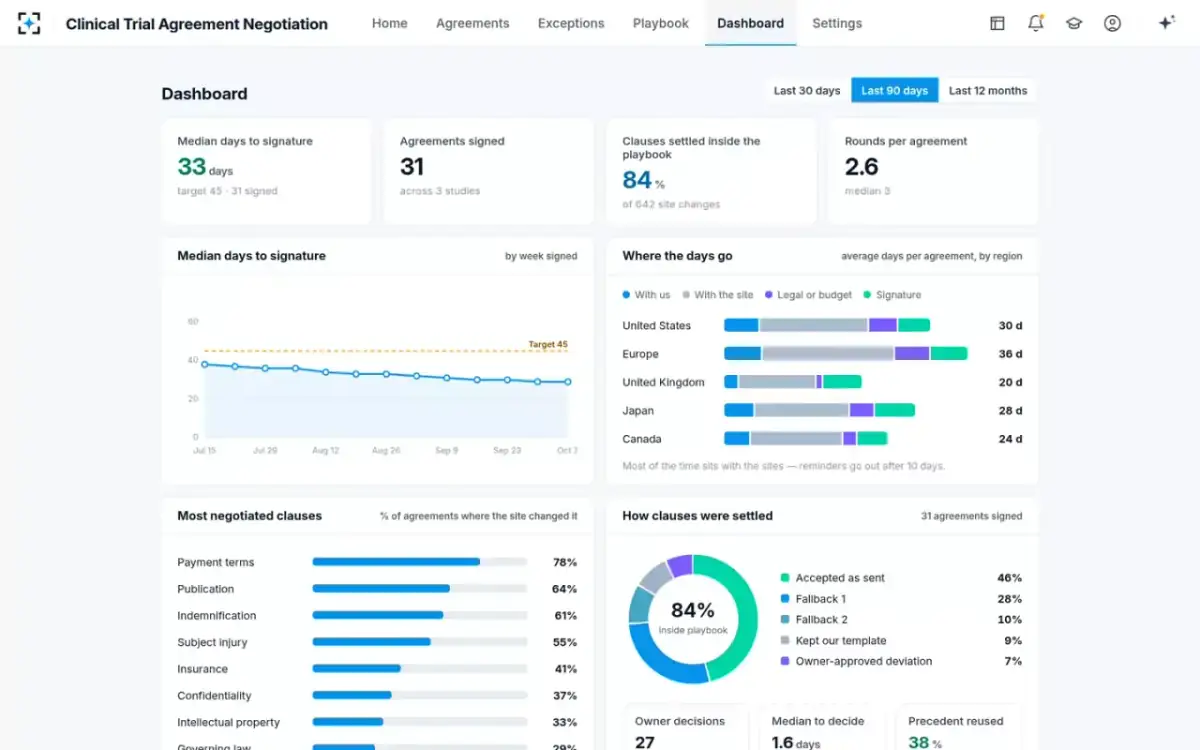
In the sample study the slowest agreement is in round four on day 52, past a 45-day target, with the site reviewing a counter on intellectual property. Nothing on that agreement is late in the sense of a missed deadline. It is late because the same clause family has now travelled four times, which is the signal that it needs a call rather than another redline. For the clause families those rounds are spent on, what a clinical trial agreement contains and who owns each part is the place to start; for the family that most often causes an escalation, the five site moves on indemnity gives the answer to four of them. To see every agreement on one runway, start from Clinical Trial Agreement Negotiation.
Questions people ask
What is a site activation letter?
A written notice from the sponsor to the site confirming that every condition has been met and naming the date from which the site may begin screening. Sponsors use different names — activation letter, greenlight notice, site activation notification — and the content is the same: the conditions, the date, and often the first shipment of investigational product. It is a sponsor instrument rather than a regulatory one.
How long does site activation take?
Under standardised activation methods for multicentre randomised trials, a national US network reported site-related start-up averaging 90 days from receipt of the approved protocol and consent. A study of rare and selective cancer indications put the site administrative process at 2 to 12 months, depending on the type of institution. The range is wide because institution type, country and whether a standard agreement is in place matter more than the sponsor's own speed.
What is the difference between site selection and site activation?
Selection decides whether a site can do the study — patients, staff, equipment, competing trials — and ends when the site agrees to take part. Activation is the regulatory, contractual and operational work that makes that agreement operative, and ends when the site may screen. A programme can select excellently and still activate slowly; the two are measured separately for that reason.
How much does it cost to activate a site?
One published estimate for rare and selective cancer indications puts the administrative process at about $50,000 per site, with no guarantee that any patient is ever enrolled there. The figure is an estimate from a 2012 study rather than a benchmark, and the composition varies, but the structural point holds: it is a fixed cost paid before any return is known.
How many activated sites never enrol a patient?
In cancer trials, the same study reports that 20 to 30 per cent of study centres never enrol a patient on a given study. The causes are mixed — competing studies, a narrower eligible population than feasibility suggested, investigator turnover, a protocol amendment — and it is worth resisting a single explanation. What follows reliably is that a late activation shortens the window in which a site could enrol at all.
Can a site be activated before the agreement is signed?
No, and the attempt creates a problem rather than solving one. Good clinical practice expects agreements with the institution to be documented before the activities begin, and the dates are visible to an inspector reading the trial documents afterwards. A sponsor tempted to start on a letter of intent is also weakening its position on whatever clauses remain open.