Clinical trial budget negotiations are the second negotiation inside a site agreement, and often the one handled least carefully. The clause redline argues about risk; the budget exhibit argues about money, and three separate rules decide what the answer may be — a coverage rule that says which costs the study has to pay for at all, a fraud-and-abuse rule that says what a payment may be worth, and a disclosure rule that says whose name the number will eventually appear under. That is why a fee a sponsor and a site agree outside the benchmark is not a concession; it is a compliance event with a paper trail. Botminds' Clinical Trial Agreement Negotiation reads the budget exhibit alongside the clause redline, compares every fee and payment term with the sponsor's fair-market-value benchmark, and routes anything outside the range to a named budget owner instead of settling it.
The negotiation on this page is a fictional sample used throughout the solution: Northwind Bio's Phase 3 psoriasis study VLT-302, its site Marlowe University Hospital, and a round 2 redline of 19 tracked changes that arrived on day 19 of a 45-day target. The people, the sponsor, the site and the study are invented. The rules quoted around them are not, and each is linked where it appears.
The budget is where a start-up timeline is usually lost
49%
of study delays, at the upper end, that one report attributes to budget negotiation and approval, as the Trial Innovation Network cites it
$600k–$8M
the loss per day of delayed launch a sponsor may carry, in studies cited in the same paper
3
requirements a trial must meet before Medicare will cover any of its routine costs
How is a clinical trial budget actually negotiated?
A clinical trial budget is negotiated in two layers that move at different speeds. The per-patient grid — every protocol visit, every procedure in it, priced per completed subject — is arithmetic plus judgement about who does the work. The non-patient fees — start-up, ethics submission, pharmacy set-up, storage, archiving, close-out — are flat amounts a site argues for on principle, because they cover work it does whether or not a single subject enrols.
The sequence is almost always the same. The sponsor sends a template budget with the agreement. The site's research finance office rebuilds the per-patient grid from the protocol's schedule of assessments, prices it at its own institutional rates, adds its indirect rate and returns a figure that is higher — sometimes much higher — along with a list of fees the template did not have. Then the two sides argue line by line, while the clause redline runs on a separate track with different people on it.
Three things decide how long that takes. The first is whether the sponsor's benchmark is written down and current, because a negotiator with no benchmark negotiates on instinct. The second is whether the site's grid can be compared with the protocol at all: a budget that does not name the visit each procedure belongs to cannot be checked without rebuilding it. The third is authority — who on the sponsor's side may say yes to a figure, and at what point the answer has to travel.
The budget lines a site changes most, the question each raises, and who owns the answer
| What the site changes | The question it actually raises | Who owns the answer |
|---|---|---|
| Per-patient total raised | Is the grid priced to the protocol, or to the institution’s standard chargemaster? | Budget owner, against the benchmark |
| A procedure moved from routine to study-only | Would this patient have had it in ordinary care? | Budget owner with the medical monitor |
| Screen-failure payment added or raised | How many screen failures does the protocol expect, and are they capped? | Budget owner |
| Indirect or overhead rate raised | Is the rate the institution’s published research rate, applied to the same base? | Budget owner |
| Start-up fee raised, or made non-refundable | What work does it pay for, and what happens if the study never opens here? | Budget owner |
| Payment term shortened, holdback cut | Does the term still leave a reconciliation at the end? | Contracts manager, inside authority |
| Invoiceable items added (couriers, imaging reads, unscheduled visits) | Are they capped, and do they need pre-approval? | Contracts manager, inside authority |
| Wind-down or early-termination fee added | Is it tied to the work actually done, or to an event? | Budget owner |
The split in that last column is the useful part. Payment mechanics — net days, holdback percentage, invoicing cadence — are terms a sponsor can pre-approve, because the worst case is a cash-flow cost it chose. A fee is different: it has an outside rule attached to it, and an answer given in the wrong place cannot be unsaid. A playbook that carries four rungs per clause family can hand the first group to a contracts manager and keep the second with the person who owns the benchmark.
What fair market value means in a clinical trial budget, and what it does not protect
Fair market value is not a budgeting convention in clinical research; it is the language the fraud-and-abuse regulators use about payments between a manufacturer and the people who buy, prescribe or study its products. The Office of Inspector General's 2003 compliance guidance for pharmaceutical manufacturers, which OIG keeps available as a resource while it issues newer industry guidance, is the plainest statement of it, and it is specifically about research money.
Its test for research money is a single sentence: research payments should be worth fair market value, and should pay for services that are legitimate, reasonable and necessary (HHS-OIG, 68 FR 23731, 2003). Read it carefully, because it carries four tests, not one. The amount must be fair market value; the services must be legitimate; they must be reasonable; and they must be necessary. A site can be paid a defensible hourly rate for work the protocol never asked for and still fail three of the four. The same guidance tells manufacturers these contracts “should be structured to fit in the personal services safe harbor whenever possible”.
“Postmarketing research activities should be especially scrutinized to ensure that they are legitimate and not simply a pretext to generate prescriptions of a drug.”
HHS Office of Inspector General, Compliance Program Guidance for Pharmaceutical Manufacturers, 68 FR 23731 (2003)
It also draws a line inside the sponsor's own building. Prudent manufacturers, the guidance says, keep the awarding of research contracts separate from marketing, and it singles out research contracts that start in the sales or marketing function, or are offered to purchasers alongside a sales contact, as ones that attract suspicion. In a budget negotiation that line usually shows up as a request routed informally, from someone whose job is the relationship with a high-enrolling site rather than the price of its work.
What fair market value does not do is protect a number simply because somebody called it fair market value. The protection comes from the method: a benchmark that is written down, sourced, dated and applied the same way to every site, with a documented reason wherever a figure sits outside it. A single approved exception with a one-line justification is defensible. Twenty undocumented exceptions, each agreed on a call, are a pattern — and a pattern is what an examiner looks for.
Routine costs: what the payer covers and what the study must
In the United States the first question about any procedure in the grid is not what it costs but who may be billed for it. Medicare's national coverage determination on routine costs settles that for a qualifying trial: “Medicare covers the routine costs of qualifying clinical trials, as such costs are defined below, as well as reasonable and necessary items and services used to diagnose and treat complications arising from participation in all clinical trials.”
Routine costs are defined by what they exclude. Three categories sit outside them: the investigational item or service itself, unless it would be covered anyway; items and services “customarily provided by the research sponsors free-of-charge for any enrollee in the trial”; and the one that produces most of the argument in a budget negotiation — anything done only to produce data.
Three kinds of cost in one protocol visit, and where each is meant to land
What the rule says: Items or services “that are typically provided absent a clinical trial (e.g., conventional care)”, the clinically appropriate monitoring of the investigational item, and care for complications arising from it.
What that means for Exhibit B: Billable to the payer for a qualifying trial. It does not belong in the per-patient grid, and a site that bills both is paid twice.
What the rule says: “Items and services provided solely to satisfy data collection and analysis needs and that are not used in the direct clinical management of the patient (e.g., monthly CT scans for a condition usually requiring only a single scan)”.
What that means for Exhibit B: The study pays. This is the heart of the per-patient grid, and the line a site is right to defend.
What the rule says: Items and services “customarily provided by the research sponsors free-of-charge for any enrollee in the trial”.
What that means for Exhibit B: Neither billed nor paid for again: drug, devices, central-lab kits, couriers the sponsor has already arranged.
Two threshold conditions matter before any of that applies. The trial's subject must be an item or service inside a Medicare benefit category and not statutorily excluded, and — the test most often forgotten — “the trial must not be designed exclusively to test toxicity or disease pathophysiology. It must have therapeutic intent.” A trial designed only to test toxicity does not qualify, which is why its budget has to carry procedures that a qualifying trial's participants might have billed to Medicare.
Study-only procedures and the line between care and data collection
The coverage analysis that places each procedure on one side of that line is the most useful document in a budget negotiation, and it is usually built by the site rather than the sponsor. It reads the protocol's schedule of assessments against the standard of care for the indication and marks every row: conventional care, study-only, or sponsor-supplied. The budget is then the sum of the study-only column plus the work around it.
Arguments cluster where a procedure is ordinary medicine performed at an extraordinary frequency. Monthly imaging for a condition that would normally be imaged once is the regulator's own example, and the principle generalises: the first scan is care, the eleven extra scans are data. The two punch biopsies in the sample protocol are the cleanest case of all — nobody with plaque psoriasis would have them in ordinary dermatology care, so the study pays for them, and the agreement also has to cover injury arising from them. That is why a budget change and a subject-injury change often arrive in the same round and have to be answered together; what the sponsor owes if a study-only procedure harms a subject is a separate negotiation with the same site.
What a per-patient figure is made of, term by term
Procedures, per visit
study-only procedures in each visit × institutional research rate
Priced from the schedule of assessments, visit by visit, with routine care excluded. The only term a sponsor can check against the protocol without asking the site anything.
Site research finance
Personnel time
coordinator and investigator hours per visit × loaded rate
Consent, source documentation, data entry, query resolution, drug accountability. The term that moves most between a simple and a complex protocol.
Site research finance
Overhead
direct costs × the institution’s published research indirect rate
Check the rate and the base. A rate applied to a base that already contains pass-through items inflates the total quietly.
Site research finance
Non-patient fees
start-up + ethics submission + pharmacy set-up + archiving + close-out
Paid whether or not anyone enrols, which is exactly why a sponsor wants them tied to work done rather than to the site opening.
Budget owner
Payment terms: net days, holdbacks and the final reconciliation
Payment terms are where a budget negotiation can be settled quickly, because the money is the same and only its timing changes. A site typically asks for shorter payment days, quarterly payments regardless of enrolment, and no holdback at all. Each of those has a sensible answer that does not touch the total.
On the sample round the site asked for payment within 30 days and a 5% holdback instead of the template's longer term. Both sit on the first fallback of the sponsor's payment rule, inside the contracts manager's authority, and both were accepted automatically with the rule quoted — which is the point of writing payment terms into a playbook rather than treating every one as a decision. The holdback is the part worth defending: a small percentage retained until the end funds the final reconciliation, where over-payments for screen failures, visits not performed and queries never resolved are netted off. Remove it and the reconciliation becomes an invoice to a site that has no reason left to answer it.
One more term belongs in the same paragraph, because it is often missed: what happens to data queries after the last payment. A budget that pays per completed visit, with no retention and no close-out fee, has no money left at the point where the data management team needs the site most.
Start-up, archiving and wind-down fees
Non-patient fees are easy to agree without reading closely, and they are the ones most worth shaping. A start-up fee pays for regulatory submission, contract and budget work, site initiation and system set-up — real work, done before a single subject is screened. The reasonable sponsor position is not to refuse it but to tie it to the work: payable on execution, not on selection, and credited against the first invoices if the site never opens.
Archiving fees follow the retention obligation. Good clinical practice treats the trial's financial arrangement as an essential record in its own right — the ICH E6(R3) essential records table lists “arrangement between parties on the financial aspects of the trial”, marked as a record that should generally be in place before the trial starts — and the site has to keep its records for years after the study closes. A per-year archiving fee is defensible; an open-ended one, with no end date and no cap, is a liability that outlives everyone who negotiated it.
Wind-down and early-termination fees are the hardest of the three, because they ask the sponsor to pay for a study that stopped. On the sample redline the site asked for a flat $7,500 wind-down fee. The counter drafted at the approved fallback did not argue the amount; it attached a condition — the fee applies only if the study ends within six months of the first subject's enrolment — which protects the site against being opened and abandoned without paying a windfall on a study that ran its course.
Are research payments to investigators made public?
Yes, for payments in the United States by an applicable manufacturer, and the rule has its own reporting path. Open Payments treats research money separately from everything else: “All payments or other transfers of value made in connection with an activity that meets the definition of research in this section and that are subject to a written agreement, a research protocol, or both, must be reported under these special rules.”
What gets reported is more than a total. The special rules require the name of the research institution or entity receiving the payment, the “total amount of the research payment, including all research-related costs for activities outlined in a written agreement, research protocol, or both”, the name of the research study, the related products, and information about each principal investigator who is a covered recipient; the ClinicalTrials.gov identifier and contextual information are optional. In other words, the figure two negotiators settle in an email becomes a line attributable to a named institution and a named investigator, in a public file, under a study name.
That changes how a negotiator should think about an unusual fee. A payment that is hard to explain in a budget review is a payment that will be published without the explanation attached. The discipline is to write the justification down at the moment of the decision, not when somebody asks about it two years later.
What a budget reviewer checks before approving a figure outside the range
- The benchmark itself, with its date and source
A range nobody can cite is not a benchmark. Record which version was used for this decision.
- The coverage analysis behind the line
Is the procedure study-only, or routine care the payer may already cover? A routine cost paid by the study is the error that is hardest to unwind.
- The protocol row the fee belongs to
Every per-patient figure should trace to a visit and a procedure in the schedule of assessments.
- What is actually different about this site
A region, a rate agreement, a device, a licence, a specialist unit. The reason has to be a fact about the site, not its enrolment forecast.
- Who asked, and through which channel
A fee request that arrives through a commercial relationship rather than the contracting route is the pattern regulators describe as suspect.
- The indirect rate and the base it applies to
Confirm the published research rate and that pass-through items are out of the base.
- The same decision for the next site
If the answer here would be refused to the next site, it is not a price; it is a precedent with no rule behind it.
- The written justification, signed and dated
One paragraph, by name, in the agreement’s own file. This is the document that answers an audit.
What happens when a site asks for a fee above the benchmark?
It goes to the person who owns the benchmark, with the request, the range and the gap. In the sample study that is the budget owner, Lena Ortiz, and the rule the agents follow is written as a limit rather than a preference: the budget checker never approves a fee above the fair-market-value range. It compares fees and payment terms against the benchmark, and anything outside it leaves the automatic path and arrives in her queue with the figure, the benchmark and the site's reason.
She has three honest answers. Approve the figure with a written justification, where something about the site genuinely explains it. Hold the benchmark and counter, which is the usual outcome. Or restructure — pay for the work rather than the fee, by converting a flat amount into an invoiceable item with a cap and a pre-approval. The one answer that should not exist is an automatic yes, which is why automatic acceptance on this solution stops at payment terms and never extends to a fee.
Counters drafted at an approved fallback, in Clinical Trial Agreement Negotiation
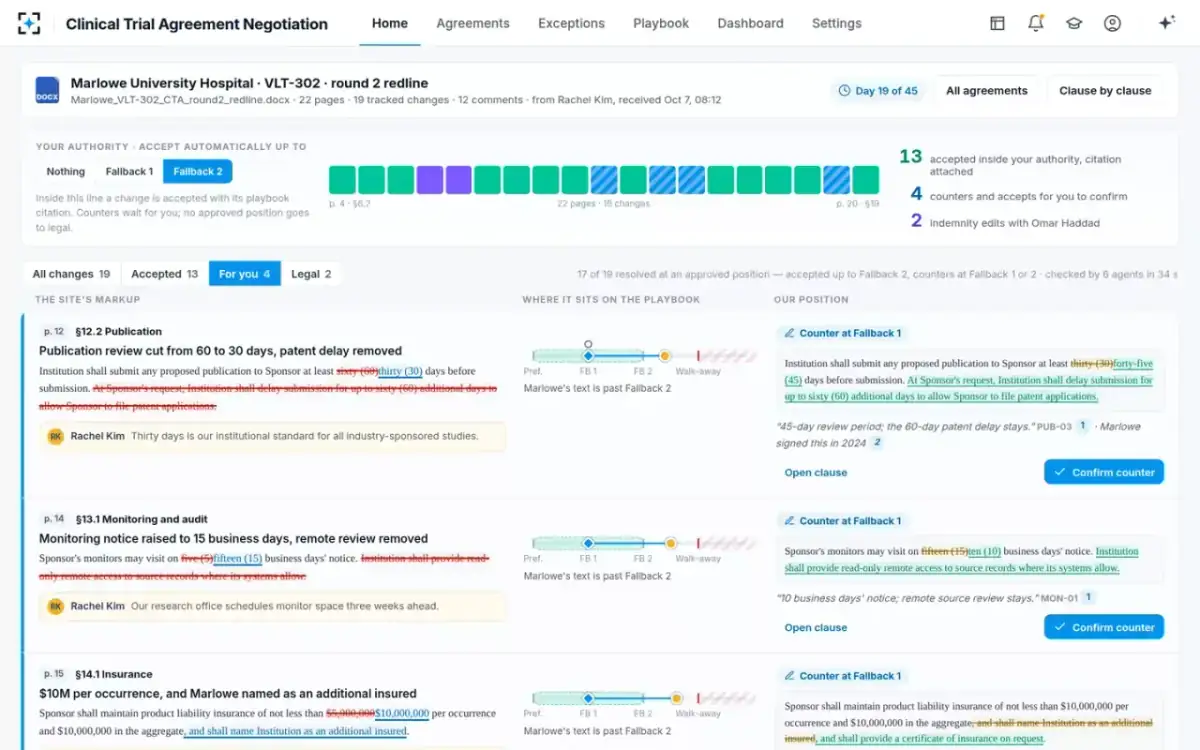
Reading a budget redline next to the clause redline
The sample round is a good illustration of why the two should be read together. Across 19 tracked changes, not one Exhibit B fee moved — the site accepted the per-patient grid as sent. What it changed was the payment term and the wind-down fee: the mechanics, not the price. A team that treats the budget as a separate workstream would have discovered that a week later, after the clause redline came back.
The opposite case is more dangerous. A change in the clause text can move money without touching a number: an indemnity edit that shifts the cost of treating an injury, a records clause that extends retention past the archiving fee, a publication clause that adds work nobody priced. Reading the two redlines in one pass is how those are caught, and it is the reason the budget check runs as one of six agents over the same document rather than as a separate review.
Where a fee outside the range goes in Clinical Trial Agreement Negotiation
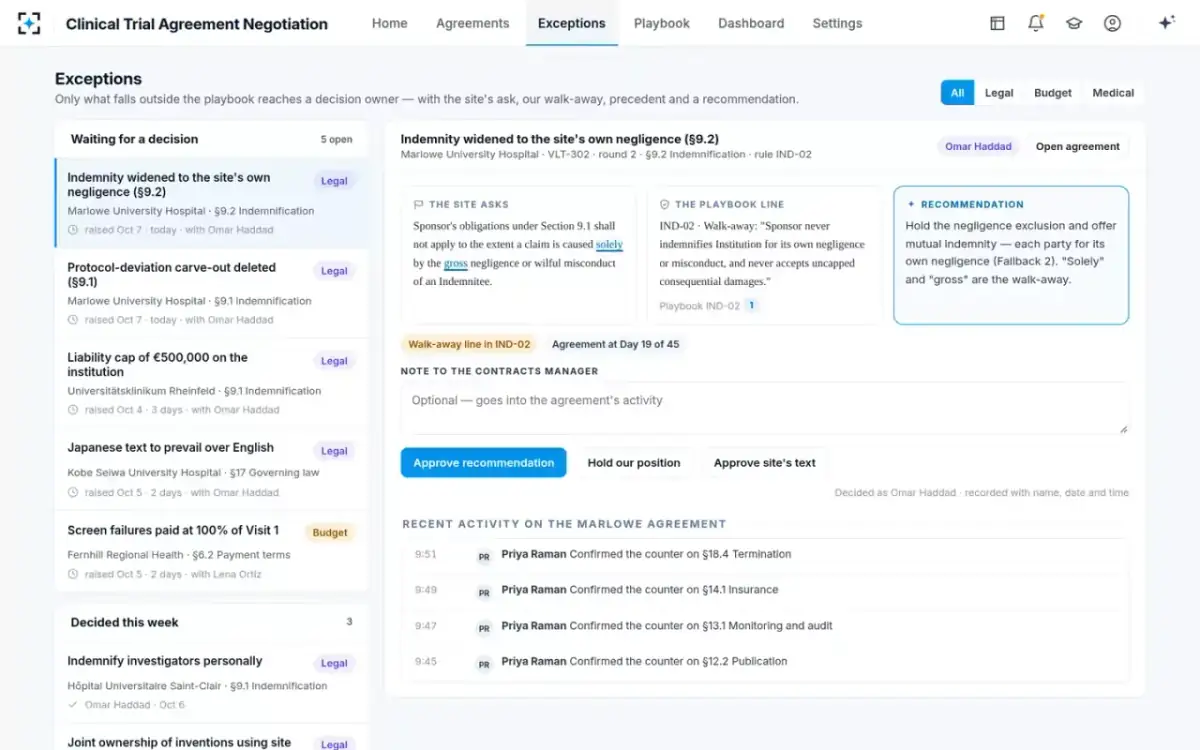
One practical habit closes the loop. When a fee is approved outside the range, write the justification into the agreement's file in the same sitting, and tag the clause family it came from, so the next negotiation with the same institution starts from a decision rather than a memory. That is the same discipline as clause precedent, applied to money — and it is what makes the second agreement with an institution faster than the first. Where the rest of the start-up weeks go is the wider version of the same question.
Questions people ask
What is a holdback in a clinical trial budget?
A holdback is a percentage of each payment the sponsor retains until the site's work is complete, released at the final reconciliation. The percentage is negotiated; on the sample agreement the first fallback allows 5% alongside payment within 30 days. Its purpose is not leverage but arithmetic: it funds the netting-off of screen-failure payments, visits not performed and unresolved data queries at the end of the study.
How often are sites paid in a clinical trial?
Quarterly payment is a common cadence, with payment due a set number of days after an approved invoice or the sponsor's own data reconciliation — 30 days in the sample agreement. Sites ask for monthly payment and for payment to run on a calendar rather than on enrolment, because a site that has screened nobody still has coordinator time to fund. A term that pays only on completed visits puts the whole cash-flow risk of slow enrolment on the site.
Is a start-up fee refundable?
Usually not, and that is the negotiation. The sponsor-side position worth holding is that a start-up fee pays for work rather than for selection: payable on execution of the agreement, and credited against the first invoices if the site never activates. A non-refundable fee payable on selection pays a site for being chosen, which is harder to justify under the fair-market-value test than paying it for the submission work it actually did.
Who owns the budget on the sponsor's side?
Not the contracts manager. In the fictional sample study the budget owner is a named person, Lena Ortiz, and every fee outside the benchmark reaches her with the figure and the range; the contracts manager keeps payment terms, invoicing cadence and holdbacks. Splitting it that way is deliberate — payment mechanics are a cash-flow choice a sponsor can pre-approve, while a fee has an outside rule attached to it.
Can a site bill Medicare for a study procedure?
Only for routine costs of a qualifying trial, and never for anything the study already paid for. The national coverage determination excludes the investigational item itself, items customarily provided free by the sponsor, and anything provided solely to satisfy data collection. The practical risk runs both ways: a procedure the study pays for and the site also bills is double payment, and a routine cost the study pays for is money the sponsor did not need to spend.
Does a change to the budget need a contract amendment?
If the budget is an exhibit to the agreement, changing it changes the agreement, so the mechanism matters: most agreements let the parties replace the budget exhibit by written agreement of named representatives rather than by a full amendment. Good clinical practice expects the financial arrangement to be documented between the sponsor and the institution and kept as an essential record, so whichever route is used, the signed version has to be the version everyone is working from.