There is a standard UK clinical trial agreement template — in fact a whole suite of them, published by the Health Research Authority for use with participating NHS and health and social care organisations — and the first thing to understand about it is that it is not a starting position. Its value comes from being used unaltered, and a sponsor who treats it as a draft to improve loses the benefit and gains a submission problem. That is the pattern wherever a country publishes a model document, and it is why a negotiation playbook written clause by clause will confidently propose a fallback the jurisdiction does not allow. Botminds' Clinical Trial Agreement Negotiation applies the country rule first, before any change is placed on a ladder, so a site's edit to an unalterable template is routed as an exception rather than answered as a concession.
The rules below come from the regulators and bodies that publish them, linked where they appear. The worked examples are fictional sample data from inside the solution: Northwind Bio's study VLT-302 and its sites, among them Rheinfeld in Germany with a liability cap at legal and Kobe Seiwa in Japan asking for Japanese text to prevail.
What a standard agreement looks like when a whole sector adopts one
300+
organisations with legal sign-on acceptance of the Accelerated Clinical Trial Agreement’s terms
25
academic hubs that developed it, with a university–industry partnership and input from pharmaceutical companies
2years
of consensus work by volunteers from those institutions’ contracts and legal offices
60+
institutions and affiliates registered to use the separate federal standard agreement for funded trials
Is there a standard UK clinical trial agreement template?
Yes, and it is a suite rather than a single document. The updated agreements published for use from 28 April 2026 include the model clinical trial agreements with their contract-research-organisation and advanced-therapy variants, the primary care versions in bi-partite and tri-partite form, model commercial chief investigator agreements, model clinical investigation agreements for devices, model non-interventional study agreements and a model commercial hub and spoke agreement, alongside the non-commercial model agreement and its own hub and spoke version. They were revised to reflect changes to the clinical trials regulations that came into force the same day.
Picking the right one is the first decision, and it is a decision about the trial, not about the site: an advanced-therapy study uses the advanced-therapy model, a device investigation uses the clinical investigation model, a study run through a contract research organisation uses the CRO variant. Getting it wrong is not a drafting error that can be fixed in round two; it means the agreement in front of the site is the wrong agreement.
What 'unaltered' means in the UK, and what the yellow highlights are for
The model agreements carry passages highlighted in yellow, which are the places the parties are expected to act: a name, a date, an option to keep or drop. Everything else is settled text. The administrative consequence of respecting that boundary is stated plainly.
There is no need to submit a modification to use an updated agreement as long as the agreement is used unaltered with only the yellow highlights completed, deleted or retained as appropriate.
UK Health Research Authority, 28 April 2026
Read the sentence as a conditional, because that is how it behaves. Unaltered, with only the highlights acted on, costs nothing. Alter a clause and you are outside the condition, which is why sponsors tend to treat any proposed edit to the body as a legal escalation rather than a negotiation. The published agreements also allow existing contracts to stand — agreements already in place with participating NHS and HSC organisations do not have to be updated or replaced — while any new contract entered into from 28 April 2026 uses the April 2026 version.
There is a feedback route, and it is worth knowing about rather than redlining into a contract: the Four Nations Contracting Leads group reviews feedback on the model agreements every six months and decides whether further changes are needed. A clause a sponsor genuinely cannot live with is a letter to that group, not an amendment to one site's copy.
Version dates: using the wrong edition stops the submission
The version rule is the sharpest edge in the whole UK arrangement, because it does not negotiate. New studies submitted in the Integrated Research Application System on or after 28 April 2026 "must use the April 2026 versions of the model agreements. Previous versions will not be accepted from this date" (UK Health Research Authority).
For a sponsor running several studies, that is an inventory problem rather than a legal one. The template sitting in a start-up folder, the one a contract research organisation attached to its own kit, and the one a site helpfully sent back from its last study are all plausible candidates for being last year's edition. A country rule that checks the edition before anything else is read is cheap; discovering it at submission is a cycle.
France: the convention unique and a statutory clock
France is the one country in this set where the contract itself has a deadline in law. Article R1121-3-1 of the public health code provides that the convention unique "est conclue au plus tard quarante-cinq jours après réception de la proposition du promoteur" — concluded at the latest forty-five days after the establishment receives the sponsor's proposal. Where the research runs at several sites, that deadline applies to the agreement with the coordinating establishment, and a further fifteen days runs for the agreements with associated establishments, counted from the day each receives the necessary documents from the sponsor (Légifrance, article R1121-3-1).
France’s statutory contracting clock, and what it means for sequencing
- From receipt of the sponsor’s proposal to conclusion45 days
- The coordinating agreement’s period45 days
- A further period from receipt of the documents15 days
Two practical consequences follow. The first is that the clock starts on receipt of the sponsor's proposal, so an incomplete proposal is not a way of buying time; it is a way of restarting the sequence badly. The second is that France rewards sequencing: if the coordinating agreement is concluded promptly, the associated sites run on their own short period from their own documents, which makes France an unusually predictable country to plan around.
Can you change a model clinical trial agreement at all?
Technically yes in most places, and the question is what it costs. In the United Kingdom an alteration takes the agreement outside the condition that avoids a modification submission. In France the model is national and the part a sponsor's own playbook treats as negotiable is the annexes, where the costs sit, rather than the body. In the United States an institution that has signed on to a standard agreement has done so for the agreed terms, so an edit asks that institution's legal office to reopen something it settled centrally.
The useful framing for a contracting team is that a model agreement converts a negotiation into a routing decision. There are no fallback positions, because there are no positions: there is the text, the highlighted fields, and an escalation. That is a simpler job than a free negotiation and a harder one to improvise, because the single most damaging thing a reviewer can do is answer a site's edit with a sensible concession.
An unaltered model agreement against a freely negotiated template
Model agreement, used unaltered: Highlighted fields completed, and occasionally a request to change settled text — which is an exception, not a redline.
Sponsor template, negotiated: Anything from two changes to forty, across every clause family in the document.
Model agreement, used unaltered: Contracting for the fields; the legal owner for any proposed alteration, every time.
Sponsor template, negotiated: Contracting from the ladder for most of it; legal, budget or medical for what falls outside it.
Model agreement, used unaltered: Usually one, because there is little to argue about and the cost of arguing is visible to both sides.
Sponsor template, negotiated: Two to four is common, and each round is a site turnaround plus a sponsor turnaround.
Model agreement, used unaltered: In picking the wrong model or the wrong edition, and in a reviewer conceding an edit without realising what it costs.
Sponsor template, negotiated: In inconsistency between sites, and in pre-approved concessions queueing behind the ones that need a lawyer.
Model agreement, used unaltered: A country rule: which model, which edition, what may be filled in, and who sees anything else.
Sponsor template, negotiated: A position ladder per clause family, with a named owner for each kind of exception.
Germany, Japan and the clauses that always escalate
In the countries without a published model, the pattern is different: the template is the sponsor's, the negotiation is a normal one, and the same one or two clause families come back from every site in the country. A sponsor that notices this can turn it into a routing rule rather than rediscovering it each time.
In the sample solution two such rules are written down, and both are the sponsor's own practice rather than any country's law. German sites' requests for a cap on the sponsor's liability go to the legal owner, because a cap on a bodily-injury obligation is a decision about appetite for risk rather than a wording question. Japanese sites' requests that the Japanese text prevail over the English go to the legal owner too, because a controlling-language clause decides which document a court will read, and the sponsor's contracting team is not in a position to verify that two language versions say the same thing.
Both rules are worth writing down even though an experienced reviewer would probably reach the same answer unaided, for the same reason a position ladder is written down: the value is not in the judgement, it is in the judgement being made once, by the person who owns the risk, and then applied the same way by whoever is at the desk on the day. A rule also makes its own exceptions visible. If the German liability cap is conceded three times in a year, that is a question for the head of contracting about whether the position is still the right one — a question nobody can ask if each concession was an individual act of good sense.
Writing these as country rules rather than as clause rules matters because they fire before classification. A liability cap in a German agreement is not a fallback the ladder can answer, even though the indemnity family has rungs on it — and the five site moves on indemnity shows what those rungs look like when the country rule does not intervene.
The United States: no model, but a widely accepted one
There is no national model agreement in the United States, and there are two standard agreements with enough adoption to behave like one. The Accelerated Clinical Trial Agreement was developed by 25 academic hubs with a university–industry partnership and input from several pharmaceutical companies, over two years of consensus work by volunteers from those institutions' contracts and legal offices; "over 300 unique organizations, including a variety of institution types as well as most CTSAs, have legal sign-on acceptance of the terms" (Journal of Clinical and Translational Science, 2018).
The second is a standard agreement for federally funded, fixed-price domestic trials, developed with the Federal Demonstration Partnership, which "over 60 CTSA institutions and their affiliates have registered to use" (JAMA Network Open, 2023). The distinction matters in practice: a sponsor asking an institution whether it accepts "the standard agreement" should say which one, because the two cover different kinds of trial.
Neither is a model agreement in the sense the United Kingdom and France mean. Nothing obliges an institution to use them, no regulator checks which edition is in front of a site, and a sponsor outside the academic networks that built them may find that the institution it is negotiating with has never signed on. What they are is evidence of what becomes possible when enough organisations settle the same clauses once: a trial contract that arrives already agreed, needing only the study-specific schedule.
The lesson a commercial sponsor can take from both is not that it should adopt someone else's text. It is that the saving comes from sign-on in advance rather than from the wording itself. An institution that has already accepted a set of terms does not negotiate them, and that is the whole of the effect. Where the 90 days of site activation go puts the saving in the context of the other start-up steps.
Sequencing countries by how long their contracting really takes
A global study's first-patient date is set by its slowest country, so the order in which countries are started is a lever worth using. Three questions decide the order, and none of them is about the size of the country's patient population.
Five countries, and what a contracting team has to know before it reads a clause
| Country | The model document | What may be changed | Who decides an edit | The clock to plan against |
|---|---|---|---|---|
| United Kingdom | The Health Research Authority’s suite of model agreements: the model clinical trial agreements and their contract-research and advanced-therapy variants, the primary care versions, the chief investigator, clinical investigation and non-interventional models, and the non-commercial model. | The yellow highlights — completed, deleted or retained. Anything beyond them and the unaltered route is gone. | The sponsor’s legal owner, on any edit at all | A version rule rather than a deadline: new studies submitted from 28 April 2026 must use the April 2026 editions |
| France | The convention unique, the single national agreement between the sponsor and the establishment. | In the sample sponsor’s own practice, the annexes only. | The budget owner on the cost annexe; the legal owner on anything in the body | Forty-five days from the establishment’s receipt of the sponsor’s proposal, and fifteen more for associated establishments |
| Germany | Institution and university-hospital templates rather than one national document. | Negotiated clause by clause, as a sponsor template would be. | The sponsor’s legal owner on a liability cap, by its own escalation rule | Plan against the sponsor’s own target |
| Japan | Institution templates, commonly carrying a clause on which language version prevails. | Negotiated clause by clause. | The sponsor’s legal owner on a controlling-language request, by its own escalation rule | Plan against the sponsor’s own target |
| United States | No national model. Two widely accepted standard agreements: the Accelerated Clinical Trial Agreement and the Federal Demonstration Partnership–CTSA standard agreement. | Accepted as a whole where the institution has signed on; otherwise negotiated clause by clause. | Contracting, from the position ladder; the legal owner on exceptions | Plan against the sponsor’s own target |
Read down the fourth column and the design of a country rule becomes obvious. In two of these five jurisdictions almost any edit is a legal escalation regardless of how small it looks, because the document is not the sponsor's to change. In the other three the ordinary ladder applies and the escalations are specific and predictable. A reviewer who has to hold that distinction in their head will get it right most of the time, which is the problem: the cases they get wrong are the ones nobody notices until a submission is rejected or a cap is conceded.
Is there a model agreement, and is it genuinely unaltered in practice? That country's contracting is short and predictable, and it should start when its regulatory path starts, not before. Is there a statutory deadline, as in France? Then the controllable variable is when the proposal is sent and how complete it is, and the sponsor should prepare the whole package before the clock starts. Is the country a free negotiation with a recurring escalation, as Germany and Japan are in the sample study? Then start it first, because the elapsed time is set by rounds and the rounds will happen whatever anyone intends.
Clause families with their country rules, in Clinical Trial Agreement Negotiation
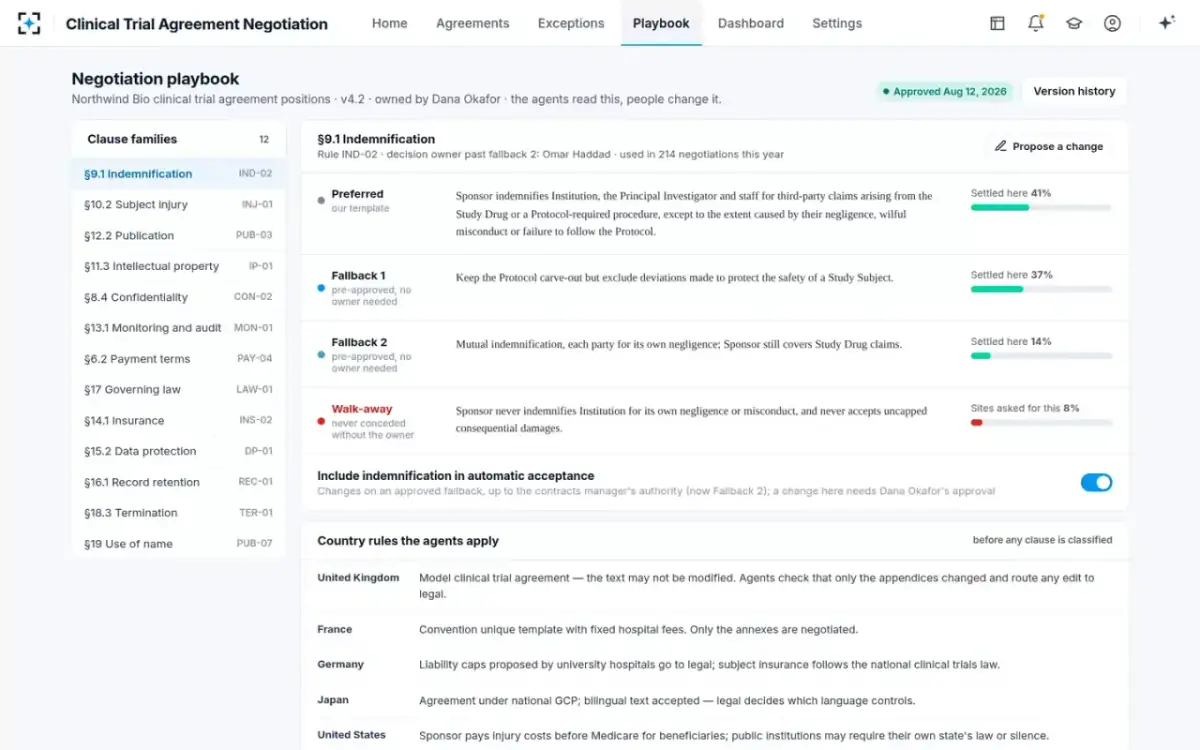
Writing a playbook that applies the country rule first
The ordering is the whole design. A playbook that classifies a change and then asks which country it came from will have proposed an answer before it knows whether an answer is allowed, and a reviewer reading that proposal will accept it, because it is a reasonable position and it is on the screen. The rule has to fire first.
The country rule Clinical Trial Agreement Negotiation settles before the first clause is classified
- Which model document applies to this trial, if any
Decided by what the trial is — investigational medicinal product, advanced therapy, device, non-interventional — and whether a contract research organisation is a party.
- Which edition is current, and from what date
A version rule can reject a submission outright. Check the edition before reading a single clause.
- What may be completed, and what counts as an alteration
In the UK suite that is the yellow highlights; elsewhere it is whatever the national practice treats as the negotiable part.
- What deadline runs, and from what event
France’s period runs from receipt of the sponsor’s proposal, and a second period runs for associated establishments from their own receipt of the documents.
- Which clause families always escalate in this country
A liability cap, a controlling-language clause, a data-transfer restriction. Write them as country rules so they fire before classification.
- Who the named owner is for an edit to unalterable text
There is no fallback to offer, so the only options are hold, escalate, or accept with a reason recorded.
- Whether the agreement needs updating later, and on what trigger
Good clinical practice expects agreements to be updated when the activities transferred change significantly, which a protocol amendment often does.
One agreement, clause by clause, with the rule that decided each
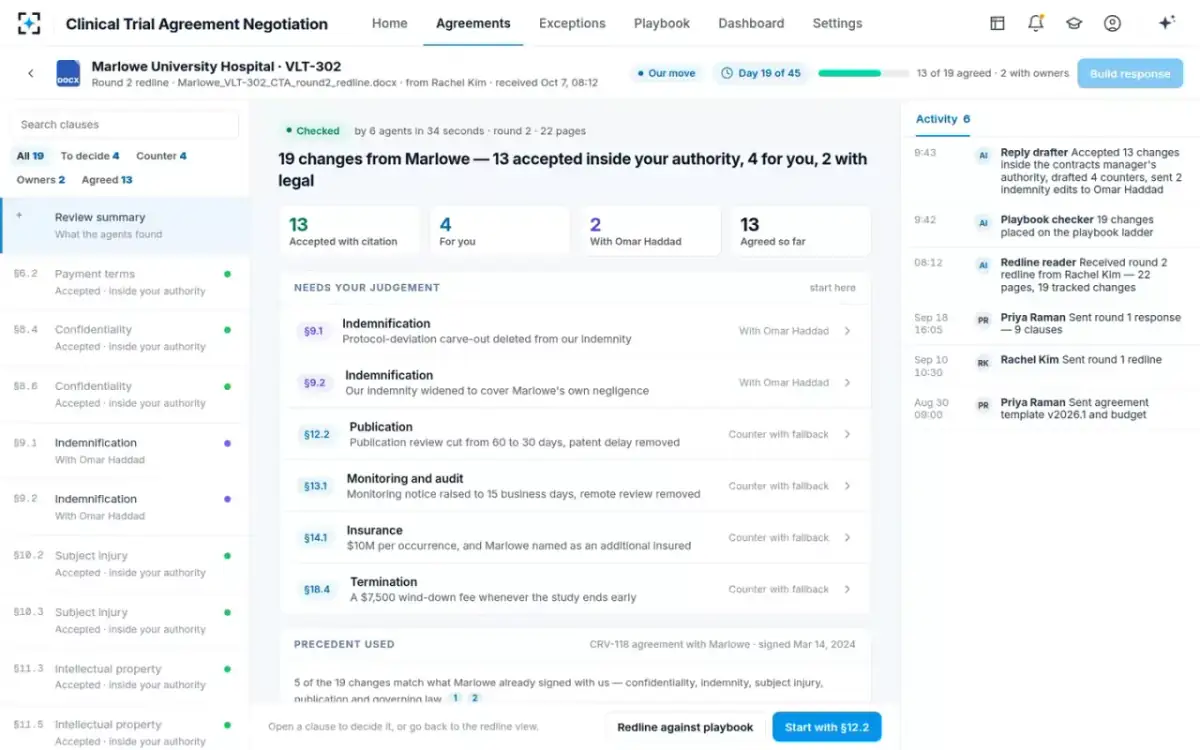
There is one more reason to keep the country rule separate from the clause ladder, and it shows up at maintenance time rather than at the negotiating table. Clause positions change when a sponsor's appetite for risk changes, which is rare and deliberate. Country rules change when a regulator publishes a new edition, which happened in the United Kingdom on 28 April 2026 and will happen again. If the two live in the same list, every regulatory update becomes a review of the whole playbook; kept apart, it is one line, changed by the person who watches that country.
Run this way, a multi-country study stops being five negotiations with one playbook and becomes one playbook with five entry rules. For the clause families the ladder answers once the country rule has let them through, what a clinical trial agreement contains and who owns each part is the place to start. To see the country rules alongside the clause ladders, start from Clinical Trial Agreement Negotiation.
Questions people ask
Which version of the UK model agreement do I have to use?
New studies submitted in the Integrated Research Application System on or after 28 April 2026 must use the April 2026 versions, and previous versions are not accepted from that date. Contracts already in place with participating NHS and HSC organisations do not have to be updated or replaced, but any new contract entered into from that date uses the April 2026 version of the relevant agreement.
How long does France allow for a site contract?
The public health code sets forty-five days from the establishment's receipt of the sponsor's proposal for the single agreement to be concluded. Where the research runs at several sites, that period applies to the coordinating establishment, and a further fifteen days applies to the agreements with associated establishments, running from the day each receives the necessary documents from the sponsor.
Do German sites negotiate liability caps?
In the fictional sample study they do, often enough that the sponsor's playbook carries it as a country rule: a cap requested by a German site goes straight to the named legal owner rather than being answered from the ladder. That is the sponsor's own escalation practice rather than a legal requirement, and a sponsor should write down what it actually sees in each country rather than adopt someone else's list.
What is the Accelerated Clinical Trial Agreement?
A standard agreement developed by 25 academic hubs together with a university–industry partnership and with input from several pharmaceutical companies, after two years of consensus work by volunteers from the institutions' contracts and legal offices. More than 300 organisations, including a variety of institution types and most of the academic hubs in the national network, have legal sign-on acceptance of its terms, which is what removes the negotiation rather than the wording itself.
Does a model agreement mean there is no negotiation?
It means there is no clause negotiation, which is not the same thing. The budget or cost annexe is still negotiated, the highlighted fields still have to be agreed, and a site can still ask for an alteration — which becomes an exception for a named owner rather than a counter. A sponsor that staffs a model-agreement country as though nothing will happen will still be surprised by the cost schedule.
How do you run one playbook across countries?
By making the country rule the first thing applied. Decide which model document and edition govern, what may be filled in rather than altered, what deadline runs and from what event, and which clause families always escalate there — then classify the change. A playbook that classifies first will offer a fallback in a country that does not allow one, and the reviewer reading the screen will accept it.